
Fact-checked by the CapitalLendingNews editorial team
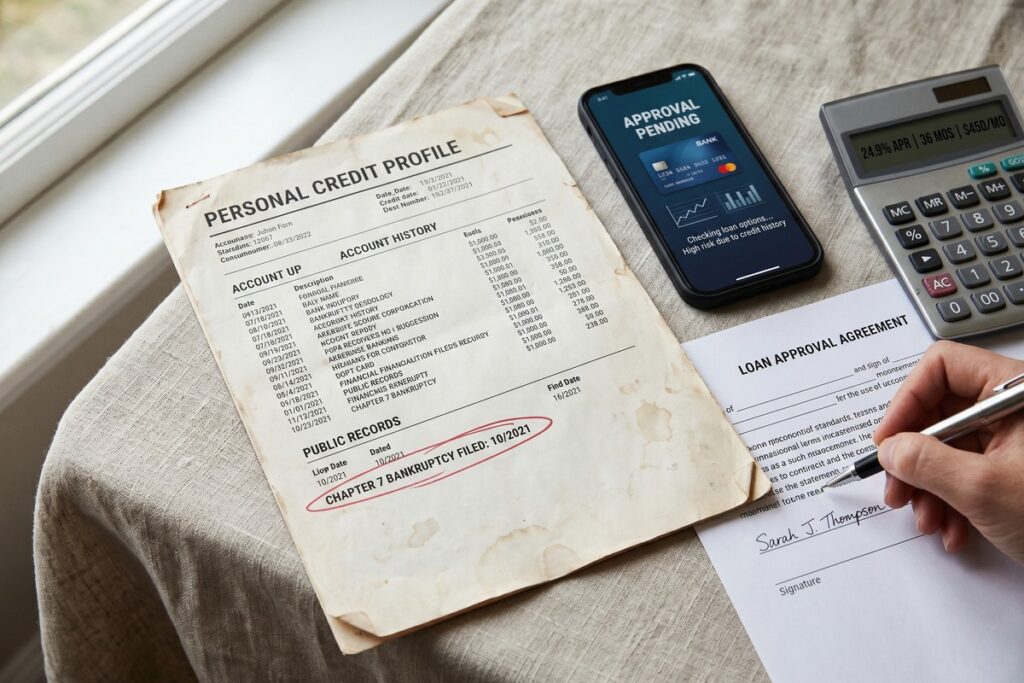
According to the Administrative Office of the U.S. Courts, individual bankruptcy filings hit 494,201 in the 12-month period ending December 31, 2024, a 13.9% jump over the prior year. For the people behind those numbers, the period after discharge brings a specific, urgent problem: most traditional lenders will not touch a borrower whose credit report still carries a bankruptcy flag, yet life does not pause while the record clears. Fintech loans after bankruptcy have emerged as a genuine, institutionally backed credit channel for this population, one that uses AI-driven underwriting and alternative data to evaluate applicants in ways that a bank’s automated decline system simply cannot.
The post-bankruptcy borrower population is not a niche. Epiq AACER data reported by the American Bankruptcy Institute shows 276,126 total filings in the first six months of 2025 alone, a 10% increase over the same period in 2024, with Chapter 7 filings up 15% year-over-year. Layered on top of that, aggregate U.S. household debt stood at $18.59 trillion as of Q3 2025, according to the Federal Reserve Bank of New York, reflecting the broad financial pressure that pushes households into insolvency in the first place. When you emerge from bankruptcy into that environment, rebuilding is not optional; it is a financial survival task.
This article maps the specific fintech platforms willing to work with post-bankruptcy borrowers, their actual eligibility thresholds, the true cost of borrowing in this risk tier, and the concrete steps that move approval odds from unlikely to realistic. By the end, you will know which lenders to approach, which to avoid, what the math actually looks like on these loans, and when waiting to apply will serve you better than applying today.
Key Takeaways
- Individual U.S. bankruptcy filings reached 494,201 in 2024, up 13.9% year-over-year, creating a large and growing pool of borrowers locked out of traditional credit channels.
- The CFPB confirms a Chapter 7 bankruptcy stays on a credit report for 10 years; Chapter 13 drops off after 7 years, making the bankruptcy type a key variable in your timeline for accessing better loan terms.
- Upstart evaluates roughly 1,500 underwriting variables and reports 43% higher approval rates versus score-only lenders, but it requires no bankruptcy within the prior 12 months and does not allow co-signers, a combination that most competing advice ignores.
- APRs for post-bankruptcy fintech personal loans typically range from the high teens to the low 30s; origination fees of 8–12% on a $5,000 loan mean you may receive as little as $4,400 while paying interest on the full $5,000.
- A fresh Chapter 7 discharge can sharply lower your debt-to-income ratio by eliminating balances, a factor that fintech cash-flow models may weight positively, even when your FICO score is still depressed.
- Fintech aggregator marketplaces that use a single soft-pull inquiry to surface multiple offers are strategically superior for post-bankruptcy applicants, since multiple hard inquiries compound damage to an already fragile credit file.
In This Guide
- What “Fintech Loans After Bankruptcy” Actually Means
- How Your Bankruptcy Type Changes Everything About Your Loan Options
- Why Fintech Lenders Are More Open to Post-Bankruptcy Borrowers Than Banks
- The Fintech Lenders Most Likely to Work With You, and Their Real Requirements
- What to Expect: APRs, Loan Amounts, and Fees in the Post-Bankruptcy Tier
- How to Maximize Your Approval Odds Before You Apply
- When a Fintech Loan After Bankruptcy Helps vs. Hurts Your Recovery
- Alternatives to a Fintech Personal Loan That Most Articles Overlook
What “Fintech Loans After Bankruptcy” Actually Means
A fintech personal loan is not simply an online loan. The defining structural feature is automated, AI-driven underwriting that pulls data from sources a traditional bank’s loan officer never sees: bank account transaction history, employment tenure, income trajectory, educational background, and in some cases, even the time of day an application is submitted. This is meaningfully different from a bank offering a loan application on its website while still running the same FICO-threshold rules behind the scenes.
For post-bankruptcy borrowers, that structural difference matters because a FICO score immediately after discharge is often in the low-to-mid 500s, a range where traditional lenders stop reading the file. Fintech underwriting models are built to extract signal from variables that FICO never captures, which is exactly why they produce different decisions for people whose credit scores look bad on paper but whose actual financial behavior has stabilized.
Two Very Different Situations: Discharged vs. Still in a Plan
Before going further, there is a distinction virtually every competing article skips, and it controls everything that follows. There are two separate situations a bankruptcy filer can be in. The first is a borrower whose bankruptcy has been fully discharged: the legal process is complete, debts were eliminated or reorganized, and they are now a private individual trying to rebuild. The second is a borrower currently in an active Chapter 13 repayment plan, which runs three to five years and is not yet complete.
Those two situations are governed by entirely different rules. A Chapter 13 debtor in an active plan is still under court supervision. Incurring new credit obligations, including a personal loan, typically requires prior court approval through a trustee. Applying to a fintech lender without that approval is not just a bad financial move; it can technically violate the terms of the repayment plan. If you are currently in Chapter 13, speak with your bankruptcy attorney before submitting any loan application. The rest of this article primarily addresses borrowers who are fully discharged.
The Consumer Financial Protection Bureau confirms that a Chapter 7 bankruptcy appears on a credit report for 10 years from the date of the order, while a Chapter 13 bankruptcy drops off after 7 years. That three-year difference in reporting duration is a real variable in long-term credit strategy.
For discharged borrowers, the relevant clock is the discharge date, not the filing date. Most fintech lenders run their eligibility cutoffs from discharge. A borrower who filed in January 2024 and received a Chapter 7 discharge in April 2024 is, more than 15 months past discharge, which clears the minimum threshold at several fintech platforms.
How Your Bankruptcy Type Changes Everything About Your Loan Options
Chapter 7 and Chapter 13 produce different outcomes in every dimension that matters to a lender. Chapter 7 is a liquidation bankruptcy: most unsecured debts are discharged within three to six months of filing, wiping them out entirely. It stays on the credit report for 10 years. Chapter 13 is a reorganization: the filer proposes a three-to-five-year repayment plan, repays some portion of debts, and upon completion receives a discharge. It stays on the report for seven years from the filing date.
From a lender’s perspective, a Chapter 7 discharge means the borrower has no discharged debt remaining. That can actually create a cleaner financial picture than most people expect. The FICO score will still reflect the bankruptcy notation, but the underlying debt load is gone. A borrower who had $35,000 in credit card and medical debt before filing may have a monthly payment obligation near zero after discharge, a dramatically lower debt-to-income ratio than someone still carrying delinquent balances.
The Counterintuitive DTI Benefit of a Fresh Discharge
This is a point almost no competing article makes, and it is one of the most practically important things a post-bankruptcy borrower can understand. Fintech lenders that use cash-flow and DTI modeling, rather than relying almost entirely on a credit score, may actually view a recent Chapter 7 discharge more favorably than a borrower who never filed but is currently managing $40,000 in delinquent accounts across five credit cards.
The math is simple. If your monthly take-home income is $4,000 and you had $1,200 in monthly debt payments before bankruptcy, your pre-filing DTI was 30%. After a Chapter 7 discharge eliminates most of that, your DTI might drop to 5–8%. A fintech platform running its AI model on income, bank balance behavior, and current obligations may see that low DTI as a strong signal, even when the credit score still shows the bankruptcy flag. This is not a guarantee of approval, but it is a real dynamic that works in a discharged borrower’s favor at cash-flow-sensitive lenders like Upstart.
Individual Chapter 7 bankruptcy filings reached 163,219 in the first half of 2025, a 15% increase over the 141,566 filed in the same period of 2024, according to Epiq AACER. Each of those filers eventually enters a post-discharge period where new credit access becomes a pressing need.
When Chapter 13 Complicates the Picture
Chapter 13 filers who have completed their plan and received a discharge are in a better position than commonly assumed. Because Chapter 13 falls off the credit report after seven years rather than ten, and because the repayment plan demonstrates a track record of consistent payments, some fintech lenders view completed Chapter 13 cases somewhat more favorably than a Chapter 7 discharge of equivalent age. The payment history built during the plan is real and verifiable.
The complication, again, is for those still in the plan. If your plan runs through 2027, you are not free to take on new credit without trustee approval. Any fintech loan application you submit without that approval puts your entire plan at risk. Get legal guidance first.
Why Fintech Lenders Are More Open to Post-Bankruptcy Borrowers Than Banks
Traditional banks use FICO score cutoffs as the primary filter for personal loan applications. Most set a floor in the 650–700 range for unsecured personal loans, and many apply an automatic decline for any applicant with a bankruptcy notation regardless of score. The decision is made by a rules engine, not a human, and a post-bankruptcy borrower rarely clears the first gate.
Fintech lenders are structurally built differently. Their business model depends on finding creditworthy borrowers whom traditional risk models misclassify as high-risk. They do that by training machine learning models on outcome data from thousands of loans, using variables that FICO never touches. The result is an underwriting system that can distinguish a borrower with a 540 FICO who is genuinely high-risk from one with a 540 FICO who filed bankruptcy due to a medical crisis, has been stably employed for three years, and has had zero missed payments since discharge.
How Alternative Data Changes the Calculus
The variables fintech AI models evaluate include bank account transaction patterns (income regularity, balance volatility, overdraft frequency), employment tenure and job title stability, whether income has been growing or shrinking, the time elapsed since the last negative event, and in some cases, educational credentials as a proxy for income trajectory. Upstart reportedly evaluates approximately 1,500 such variables, and its own published data indicates a 43% higher approval rate compared to lenders relying primarily on credit scores. That is a measurable, documented difference, not a marketing claim.
For post-bankruptcy borrowers whose non-credit signals are strong, that methodology is a direct benefit. If you have been at the same employer for four years, your income has grown 15% in the past two years, and your bank account shows consistent end-of-month positive balances, those facts matter to an Upstart model in a way they simply do not matter to a bank’s automated decisioning system.
To understand how payroll data specifically feeds these approval models, see our detailed breakdown of how fintech lenders use payroll data to approve borrowers banks would reject.
A Federal Reserve analysis found that fintech lenders held approximately $50 billion, or roughly 14% of all U.S. personal loans, as of end-2022, with fintech-bank partnerships dominating 35% of unsecured loan offer solicitations. The fintech personal loan market is not a fringe alternative; it is a mainstream and institutionally backed credit channel.
Honest About the Limits
Fintech flexibility does not mean easy approval. Every platform still imposes hard cutoffs. The flexibility operates within defined bounds, not as an open door for anyone who has ever filed bankruptcy. A borrower who filed bankruptcy six months ago, has not opened any new accounts since, and has a 490 FICO will not be approved at the fintech lenders described in this article. The platforms that claim “guaranteed approval” for that profile are, without exception, payday lenders or predatory installment lenders operating under a different risk model. Knowing that boundary in advance prevents expensive mistakes.
The Fintech Lenders Most Likely to Work With You, and Their Real Requirements
Generalities about “fintech lenders being more flexible” are useless unless they come with specific platform requirements. The table below covers the fintech lenders most frequently cited as viable options for post-bankruptcy borrowers, with their actual published thresholds as of mid-2025.
| Lender | Min. Credit Score | Bankruptcy Policy | APR Range | Origination Fee | Co-Signer/Co-Borrower |
|---|---|---|---|---|---|
| Upstart | No stated minimum | No bankruptcy in prior 12 months (some partners: 3 years) | ~7%–36% | Up to 12% | Not allowed |
| Avant | ~580 | Case-by-case; targets fair/poor credit | ~9.95%–35.99% | Up to 9.99% | Not available |
| Upgrade | 560 | Generally requires 2+ years post-discharge | ~9.99%–35.99% | 1.85%–9.99% | Joint applications allowed |
| LendingClub | 600–650 | Generally requires 2+ years post-discharge | ~9.57%–35.99% | 2%–8% | Joint applications allowed |
| OneMain Financial | No stated minimum | Considers post-bankruptcy on case-by-case basis | ~18%–35.99% | 1%–10% or flat fee | Co-borrower allowed |
There is an important nuance in the Upstart row. The platform does not publish a minimum FICO, which leads some sources to describe it as accessible to anyone. The real floor is the bankruptcy timing restriction and a minimum income requirement (typically $12,000 annually). Also, Upstart does not allow co-signers or joint applications at all. This is a critical detail for borrowers who planned to add a creditworthy family member to strengthen their application: that strategy works at LendingClub and Upgrade, but it is simply not an option at Upstart. For more on how a co-borrower’s credit profile affects approval and pricing, see our analysis of how co-borrowers with mismatched credit scores affect the interest rate on a joint loan.
Direct Lenders vs. Aggregator Marketplaces
The distinction between a direct fintech lender and a fintech aggregator marketplace matters enormously for post-bankruptcy borrowers, yet virtually every competing article collapses the two categories into one. Direct lenders (Upstart, Avant, Upgrade) make their own credit decisions; applying triggers a hard inquiry at one lender. Aggregator marketplaces (LendingTree, Acorn Finance, MoneyLion’s loan marketplace) run a single soft-pull inquiry and surface offers from multiple partner lenders simultaneously.
For someone emerging from bankruptcy with a fragile credit score, the aggregator approach is strategically superior. A post-bankruptcy borrower applying to six direct lenders in one week generates six hard inquiries, each dropping the score by a few points and each visible to every subsequent lender as a sign of desperate credit-seeking. Running the same search through an aggregator produces one soft-pull event, visible to no one, with multiple offers returned. The practical advice is to start with an aggregator to identify who will approve you and at what rate, then make a targeted application to the best-fit direct lender.

What to Expect: APRs, Loan Amounts, and Fees in the Post-Bankruptcy Tier
The advertising APRs posted on fintech lender websites are not the rates post-bankruptcy borrowers receive. Those low-end figures, sometimes as low as 7–9%, go to borrowers with strong credit histories, stable long-term employment, and no derogatory marks. A borrower 18 months out of a Chapter 7 discharge with a 560 FICO will land in a fundamentally different pricing tier.
Realistic APRs for this borrower profile at the lenders listed above run from the high teens (18–22%) for the most favorable cases to the high 20s and low 30s for higher-risk profiles. That is a workable rate compared to predatory alternatives, but it is expensive in absolute dollar terms, particularly over a two-to-three-year loan period.
The True Cost Calculation Most Borrowers Miss
The origination fee is the cost variable that most post-bankruptcy borrowers underestimate. Origination fees on higher-risk fintech loans often run 8–12%. On a $5,000 loan with a 10% origination fee, the lender deducts $500 at funding: you receive $4,500 in your bank account, but your loan balance and the interest calculated on it is based on the full $5,000.
Run the full math on that scenario. A $5,000 loan at 29% APR over 36 months carries a monthly payment of approximately $208. Total repaid over the life of the loan: roughly $7,488. Add the $500 origination fee already deducted, and your actual cost of borrowing $4,500 in net proceeds is $2,988, an effective cost rate considerably higher than the stated 29% APR. No top-ranking article on this topic walks through that calculation, but it is the number that should drive your decision.
Upstart charges origination fees of up to 12% on some loan offers. On a $5,000 loan, a 12% origination fee means the borrower receives $4,400 but pays interest on the full $5,000 balance for the entire loan term. For a 3-year loan at 32% APR, total repayment exceeds $7,900 on net proceeds of $4,400.
Where the Predatory Products Begin
There is a category of lenders that will approve post-bankruptcy borrowers with virtually any history, advertising “no credit check personal loans” or “guaranteed approval.” These are not fintech personal loans in any meaningful sense. They are high-cost installment loans or payday products with effective APRs that frequently exceed 100–300% once all fees are annualized. Conflating these with legitimate fintech lenders is a common and genuinely dangerous mistake made by borrowers who are understandably desperate for any approval.
The practical test: if a lender’s marketing materials prominently feature “no credit check,” “100% approval,” or “bad credit welcome” without disclosing APR and fees upfront, treat that as a warning sign. Legitimate fintech lenders always disclose APR ranges before you apply and run at least a soft-pull inquiry. The FTC’s guidance on the Fair Credit Reporting Act is clear that lenders using automated underwriting must maintain accurate data practices, a standard that applies equally to fintech platforms and traditional banks.
Lenders advertising “guaranteed approval” or “no credit check personal loans” to post-bankruptcy borrowers are operating in a different product category from legitimate fintech lenders. Effective APRs on these products routinely exceed 100%. Applying in desperation for a quick approval can create a debt cycle that makes the original bankruptcy look manageable by comparison.
How to Maximize Your Approval Odds Before You Apply
Applying to a fintech lender the day after discharge, with no preparatory steps, produces the worst possible outcome: either a denial that adds a hard inquiry to your damaged file, or an approval at the highest rate the lender offers. Either way, you have not optimized. A 6–12 month runway of deliberate credit rebuilding before applying to a fintech personal lender produces materially better results in approval odds and loan pricing.
The first step is pulling your credit reports from all three bureaus through AnnualCreditReport.com and checking every account that was included in the bankruptcy. Each of those accounts must show as discharged, closed, and carrying a zero balance. Errors on this specific point are common, and they can suppress your score by dozens of points. A credit card that was discharged but still shows a $4,200 balance on your Equifax report is generating a utilization hit you should not be taking. Dispute every error in writing, citing the discharge date.
Building the Payment History Signal
Fintech AI models weight recent payment behavior heavily. Six months of perfect on-time payments on any open account, even a secured credit card with a $300 limit, generates a positive signal that begins to offset the bankruptcy notation. The fastest practical path for most post-bankruptcy borrowers is opening one secured credit card immediately after discharge, using it for a single small recurring charge each month, and paying it in full.
A credit-builder loan from a credit union or community development financial institution (CDFI) works similarly. You make fixed monthly payments over 12–24 months, and the funds are held in escrow until the loan is repaid. The payment history is reported to all three bureaus. After 12 months of clean payments on both a secured card and a credit-builder loan, a borrower who started at a 520 FICO can realistically expect to be in the 580–640 range, which is the zone where meaningful fintech personal loan options begin to appear.
Keep your debt-to-income ratio as low as possible before applying to a fintech lender. Fintech AI models weight DTI heavily, and the period immediately after a Chapter 7 discharge is typically when your DTI is at its lowest. Taking on new monthly obligations before applying (such as a car loan or new credit card balances) erodes this advantage before you have used it.
The Co-Borrower Strategy (and Where It Does Not Work)
Adding a co-borrower with a strong credit profile to a joint application can shift approval odds and pricing significantly. LendingClub and Upgrade both support joint applications. If you have a spouse, domestic partner, or family member with a 700+ FICO and a clean history who is willing to apply jointly, those platforms will blend the underwriting evaluation in a way that can move you from denied to approved and from a 30% APR to a 20% APR.
The platform-specific caveat: Upstart does not allow co-signers or joint applications. This is consistently omitted from advice recommending “add a co-signer to improve your odds.” That advice is not wrong generally, but it does not apply to Upstart, which is one of the most commonly recommended platforms for post-bankruptcy borrowers. If the co-borrower strategy is important to your plan, target LendingClub or Upgrade specifically, and understand that Upstart is off the table for that approach.
Understanding how loan term length interacts with the total interest cost is also critical at this stage. Before you commit to any offer, review how loan term length quietly controls how much interest you actually pay. A 5-year term at 25% APR costs dramatically more in total interest than a 2-year term, even though the monthly payment is lower.
When a Fintech Loan After Bankruptcy Helps vs. Hurts Your Recovery
A fintech personal loan after bankruptcy is a tool. Like most financial tools, its value depends entirely on what you use it for. The honest case for borrowing post-bankruptcy exists, and so does the honest case for waiting. Neither is universally correct.
The scenarios where a post-bankruptcy fintech loan makes defensible financial sense are narrow but real. A genuine emergency, a medical expense or a car repair necessary to keep a job, where the alternative is not borrowing but losing income, is a legitimate use case. Using a small, manageable installment loan as a credit-building vehicle, taking a $2,000 loan at 25% APR specifically to generate 24 months of on-time payment history and then paying it off, is also a legitimate strategy with a defined and measurable goal.
When Borrowing Accelerates the Next Crisis
The scenarios where post-bankruptcy borrowing makes the situation worse are more common. Using a 29% APR loan to fund consumption spending, replacing the lifestyle that existed before bankruptcy, is a documented path back to insolvency. The interest cost on revolving high-rate debt compounds quickly, and a borrower who takes a $10,000 fintech loan at 31% APR to cover living expenses after discharge may find themselves in financial distress again within 18–24 months.
The CFPB’s empirical research using its Consumer Credit Panel found that “understanding how the bankruptcy system is being used… is important because of the role bankruptcy can play in helping consumers recover from financial shocks and the effect the system can have on the cost and availability of credit.” That framing is worth taking seriously. Bankruptcy is a financial reset. Taking on expensive debt immediately after that reset, without a specific and sober purpose, undermines the very benefit the process was designed to provide.
Re-bankruptcy is a real risk. Taking on high-rate debt before income and expenses are genuinely stable is a documented contributor to repeat filings. The courts do not treat second filings identically to first filings, and the automatic stay protections available in a second case within 12 months are limited. The stakes of getting this decision wrong are higher than most borrowers appreciate in the moment.
A second bankruptcy filed within one year of a prior case does not automatically trigger a full 180-day automatic stay. The protections are limited, and creditors can move to lift the stay more quickly. Using a post-bankruptcy fintech loan to fund consumption spending rather than genuine emergencies or deliberate credit-building is one of the cleaner paths back to insolvency.
The Metrics That Tell You When You Are Ready
A practical framework for deciding whether to apply now or wait: you are ready to apply for a fintech personal loan when your credit score is at or above 560, you have at least 12 months of on-time payment history on at least one open account, your DTI excluding the new loan payment would be below 40%, and you have a specific, defined purpose for the funds. If any of those conditions are not met, the waiting strategy is not just conservative advice; it is the option backed by evidence and likely to produce a better financial outcome.
Alternatives to a Fintech Personal Loan That Most Articles Overlook
Most articles on this topic treat fintech personal loans as the primary or only credit option for post-bankruptcy borrowers. That framing misses several alternatives that often carry better net terms, lower costs, or lower risk for recent filers. They deserve direct consideration before a fintech personal loan application.
Credit unions with second-chance loan programs are the most underused alternative. Many credit unions offer small personal loans of $500–$2,500 specifically designed for members rebuilding credit after financial setbacks, at rates of 12–18% APR with no origination fees. These are not widely advertised, but asking directly at a credit union where you hold a checking account is a reasonable starting point. The total cost on a $2,000 credit union loan at 15% APR over 24 months is dramatically lower than the same amount from a fintech lender at 28% APR with a 9% origination fee.
| Option | Typical APR | Origination Fee | Approval Speed | Best For |
|---|---|---|---|---|
| Fintech Personal Loan | 18%–35% | 5%–12% | 1–3 business days | Larger amounts ($3,000–$10,000), emergency needs |
| Credit Union Second-Chance Loan | 12%–18% | None to minimal | 3–7 business days | Smaller amounts, lower total cost |
| CDFI Credit-Builder Loan | 6%–15% | None | Funds held in escrow | Building payment history, not accessing cash |
| Secured Personal Loan | 8%–20% | Low or none | 3–7 business days | Borrowers with an asset to pledge |
| Cash Advance App | No interest (fee-based) | None to small fee | Same day | Sub-$500 short-term gap, no credit impact |
CDFIs and Cash Advance Apps as Transitional Tools
Community Development Financial Institutions (CDFIs) are a category that major comparison sites rarely surface. CDFIs are mission-driven lenders certified by the U.S. Treasury’s CDFI Fund to serve underbanked communities. Many offer credit-builder loans, small personal loans, and financial counseling with rates and fees well below market, specifically for borrowers recovering from financial hardship. Finding a CDFI in your area through the CDFI Fund’s locator is worth 20 minutes of research before applying to any fintech lender.
At the smaller-dollar end, cash advance apps (Earnin, Dave, Brigit, and similar platforms) offer advances of $100–$500 with no credit check and no interest, relying instead on small subscription fees or optional tips. They are not a solution to a large financial need, but they can bridge a short-term gap between discharge and first loan eligibility without adding a hard inquiry or interest costs to an already strained financial picture. As a transitional tool, that is a meaningful practical option that most long-form guides on this topic simply ignore.
For borrowers whose income is non-traditional or irregular, the approval landscape is further complicated. Our guide to digital lending for gig workers between contracts covers how income gaps affect underwriting decisions at the same fintech platforms discussed here.
The U.S. Treasury’s CDFI Fund certifies thousands of community development financial institutions nationwide. CDFIs are specifically chartered to serve borrowers with limited access to traditional credit, including recent bankruptcy filers, often at rates and terms unavailable through either banks or fintech platforms. Many also offer free financial counseling alongside their loan products.
Real-World Example: A Post-Chapter 7 Borrower Rebuilding Over 18 Months
Consider an illustrative example: a 38-year-old warehouse supervisor who filed Chapter 7 bankruptcy in January 2024 after a combination of medical debt and two months of unemployment reduced her to $22,000 in unmanageable unsecured balances. Her discharge was granted in April 2024, at which point her credit score had dropped to 518. Her income at her current job was $52,000 annually ($4,333 monthly take-home), and with her discharged debts gone, her only monthly obligations were rent, utilities, and a car insurance payment. Her DTI at discharge was approximately 6%.
She did not apply for a personal loan immediately. Instead, she opened a secured credit card with a $400 limit in May 2024, using it exclusively for her monthly streaming subscriptions and paying the balance in full each month. In July 2024, she took out a $1,500 credit-builder loan through a local credit union at 10% APR, with funds held in escrow for 18 months. By October 2024, 6 months of clean payment history had moved her score to 562. By April 2025, 12 months of consistent payments had pushed it to 604.
In June 2025, 14 months post-discharge, she ran a pre-qualification check through a fintech aggregator marketplace using a single soft inquiry. Two offers came back: Upgrade at 22.4% APR for $6,000 with a 7% origination fee (30-month term), and a second lender at 27.9% APR with a 5% origination fee. She selected the Upgrade offer. Net proceeds after the $420 origination fee: $5,580. Monthly payment: $261. Total repaid over 30 months: $7,830. Total interest and fee cost: $2,250 on $5,580 in actual proceeds, a meaningful cost, but within a budget she could manage.
She used the loan to replace a failing car transmission, a repair necessary to maintain employment. By the time the loan is paid off in late 2027, she will have 42 months of on-time installment payment history added to her credit file, alongside 38 months of credit card payment history. Credit modeling tools suggest her score at that point will be in the low-to-mid 700s, a range that opens conventional loan products at competitive rates. The fintech loan was not cheap, but used with a specific purpose and entered into at the right time in her rebuilding process, it served as a functional bridge rather than a financial setback.
Your Action Plan
-
Confirm your discharge status and date
Before taking any other step, locate your bankruptcy discharge order and note the exact discharge date. This is the clock most fintech lenders use for eligibility cutoffs, not the filing date. If you are still in an active Chapter 13 plan, speak with your bankruptcy attorney before applying to any lender; you may need court permission to incur new debt.
-
Pull and audit all three credit reports
Download your reports from AnnualCreditReport.com and check every account that was included in the bankruptcy. Each must show as discharged, closed, and carrying a zero balance. File written disputes for any errors, citing the bankruptcy discharge date and order number. Errors on discharged accounts are common and can suppress your score by 30–50 points unnecessarily.
-
Open a secured credit card and use it deliberately
Apply for a secured credit card with a $200–$500 deposit limit from a card issuer that reports to all three bureaus. Use it for one or two small, recurring charges each month and pay the full balance before the due date. Do not carry a balance; the goal is payment history, not revolving credit utilization. Six months of clean history will begin to move your score measurably.
-
Consider a credit-builder loan
A credit-builder loan from a credit union or CDFI runs 12–24 months, reports on-time payments to all three bureaus, and requires no credit check in most cases. You do not receive the funds until the loan term ends, but the payment history generated is real and valuable. Running this in parallel with a secured card is the fastest legitimate path to a score range where fintech personal loan approval becomes realistic.
-
Monitor your debt-to-income ratio and protect it
Your DTI is at its lowest point immediately after a Chapter 7 discharge. Avoid taking on new monthly obligations before applying for a personal loan. A car loan, a new credit card with a high monthly payment, or co-signing for someone else all increase your DTI and erode one of the few structural advantages the post-bankruptcy period offers. Keep your DTI below 35% before adding a new installment loan payment.
-
Pre-qualify through an aggregator before applying directly
When you are ready to apply (12+ months post-discharge, score above 560, 6+ months of payment history), use a fintech aggregator marketplace that runs a single soft-pull inquiry. This surfaces multiple offers without damaging your credit file. Compare the full-cost math on each offer: APR plus origination fee on the net proceeds you will actually receive, not the loan face amount.
-
Decide on the co-borrower question before targeting a lender
If you have a creditworthy co-borrower available and willing, that option exists at LendingClub and Upgrade, and it may meaningfully improve both approval odds and your offered rate. It does not exist at Upstart. Decide whether you will apply jointly or individually before choosing your target lender, since this choice determines which platform to prioritize.
-
Define a specific purpose for the funds before accepting any offer
Before accepting a fintech loan offer in the 20–35% APR range, write down the specific purpose the funds will serve and confirm that purpose justifies the total cost you calculated. A genuine emergency or a deliberate credit-building strategy with a measurable endpoint are defensible reasons. Covering general living expenses or discretionary spending at a 30% APR is not a strategy; it is a fast path back to the conditions that produced the original bankruptcy.
Frequently Asked Questions
How long after bankruptcy can I apply for a fintech personal loan?
The minimum waiting period depends on the lender. Upstart requires no bankruptcy in the prior 12 months, though some of its partner bank configurations extend that to 36 months. LendingClub and Upgrade generally look for at least 2 years since discharge. In practice, applying at the minimum threshold will produce offers at the highest available APR. Waiting 18–24 months and using that time to build payment history will produce materially better terms at most platforms.
Will applying for a fintech loan hurt my credit score?
Pre-qualification checks through aggregator marketplaces use soft inquiries and do not affect your score. A formal application to a direct lender triggers a hard inquiry, which typically reduces your score by 5–10 points temporarily. For post-bankruptcy borrowers with scores in the 550–620 range, that drop is significant enough to warrant caution. Apply to no more than one or two direct lenders within a 30-day window, and use an aggregator first to identify your best options before triggering any hard inquiries.
Does it matter whether I filed Chapter 7 or Chapter 13?
Yes, significantly. Chapter 7 discharges debts within 3–6 months of filing and stays on the credit report for 10 years. Chapter 13 requires 3–5 years of repayment before discharge and drops off the report after 7 years. Fintech lenders generally use the discharge date as their eligibility clock, not the filing date. A borrower who completed a Chapter 13 plan after 5 years and received a discharge has a meaningful payment history track record from the plan period, which some lenders view more favorably than a Chapter 7 discharge of equivalent age.
Can I get a fintech loan if I am still in a Chapter 13 repayment plan?
Possibly, but not without court involvement. Chapter 13 filers are under ongoing court supervision, and incurring new credit obligations during the plan typically requires trustee and court approval. Applying without that approval can jeopardize the repayment plan itself. If you are currently in Chapter 13 and need new credit, the process starts with your bankruptcy attorney, not a loan application.
What credit score do I need for a fintech personal loan after bankruptcy?
Upstart has no stated minimum FICO, but practical approval for post-bankruptcy borrowers generally requires a score in the 560+ range once income and employment factors are considered. Avant and Upgrade typically require 560–580; LendingClub generally looks for 600–650. These are not hard cutoffs in all cases, but they represent realistic floor expectations. Below 550, the options narrow sharply to secured loans, credit unions, and credit-builder products rather than unsecured fintech personal loans.
What APR should I expect as a post-bankruptcy borrower?
Realistically, APRs for post-bankruptcy borrowers through the major fintech platforms run from the high teens (18–22%) in the best cases to the high 20s and low 30s for borrowers closer to the minimum eligibility thresholds. The headline low-end rates advertised by these platforms go to borrowers with clean, long credit histories. Factor in origination fees of 5–12% on top of the APR when calculating the true cost of any offer.
What is an origination fee, and how does it affect my loan?
An origination fee is a one-time charge deducted from your loan proceeds at funding. On a $5,000 loan with a 10% origination fee, you receive $4,500 but owe and pay interest on the full $5,000 balance. For post-bankruptcy borrowers receiving offers at the higher end of the origination fee range (8–12%), this fee is a defining cost variable. Always calculate your cost of borrowing based on net proceeds received, not the face amount of the loan.
Does Upstart allow co-signers or joint applications?
No. Upstart does not allow co-signers or joint applications. This is a specific and practically important limitation that many advice sources fail to mention, since adding a co-borrower is often recommended as a general strategy for post-bankruptcy applicants. If the co-borrower approach is central to your plan, target LendingClub or Upgrade instead, both of which support joint applications.
Are there better options than a fintech personal loan for recent bankruptcy filers?
For many borrowers in the 0–18 month post-discharge window, yes. Credit unions with second-chance loan programs and CDFI credit-builder loans often offer lower total costs with no origination fees. Secured personal loans backed by a savings deposit eliminate default risk for the lender and typically price lower as a result. Cash advance apps (no-interest, sub-$500) can bridge short-term gaps without any credit impact. The fintech personal loan becomes the best available option for larger amounts, faster funding needs, or when credit union and CDFI options are not accessible in your area.
How long does a bankruptcy stay on my credit report?
As confirmed by the Consumer Financial Protection Bureau, a Chapter 7 bankruptcy remains on a credit report for 10 years from the date of the order. A Chapter 13 bankruptcy remains for 7 years from the filing date. The FTC enforces the Fair Credit Reporting Act, which governs these timelines, and they apply equally to traditional lenders and fintech platforms using automated underwriting. There is no legal mechanism to have an accurate bankruptcy notation removed early.
Sources
- Administrative Office of the U.S. Courts, Bankruptcy Filings Rise 14.2 Percent (2025)
- Epiq AACER (via American Bankruptcy Institute), Total Bankruptcy Filings Increased 10 Percent in the First Half of 2025
- Federal Reserve Bank of New York, Household Debt and Credit Report, Q3 2025
- Consumer Financial Protection Bureau, How Long Does a Bankruptcy Appear on Credit Reports?
- Consumer Financial Protection Bureau, Quarterly Consumer Credit Trends: Consumer Bankruptcy (2019)
- Federal Trade Commission, Consumer Reports: What Information Furnishers Need to Know
- Capital Lending News, How Fintech Lenders Are Using Payroll Data to Approve Borrowers Banks Would Reject
- Capital Lending News, Debt-to-Income Ratio on Digital Lending Platforms: The Number That Quietly Kills Your Application
- Capital Lending News, How Co-Borrowers With Mismatched Credit Scores Affect the Interest Rate on a Joint Loan
- Capital Lending News, How Loan Term Length Quietly Controls How Much Interest You Actually Pay
- Capital Lending News, Digital Lending for Gig Workers Between Contracts: How to Borrow During Income Gaps
- Capital Lending News, Fintech Loan Stacking: What It Is, Why Lenders Flag It, and How to Avoid the Trap
- Consumer Financial Protection Bureau, Consumer Credit Trends Data and Research