

Fact-checked by the CapitalLendingNews editorial team
In July 2024, Federal Reserve staff researchers analyzing credit bureau data found that fintech lenders hold $181 million in small-dollar loan balances, representing 13% of the total small-dollar lending market. More telling is who those borrowers are: the median credit score among fintech emergency loan applicants sits at just 584, well below what most traditional banks require for unsecured credit. These aren’t reckless borrowers. They are people with imperfect credit histories facing real, immediate financial gaps, and fintech emergency loans small amounts have become one of the few accessible options available to them.
The demand side of this equation is equally stark. According to the Federal Reserve Bank of St. Louis, 37% of U.S. adults said they would cover an unexpected $400 expense by borrowing, selling something, or could not pay at all. Bankrate’s 2025 Emergency Savings Survey, conducted in January of this year, found that 27% of adults have no emergency savings whatsoever. A broken transmission, an emergency dental procedure, or a utility shutoff notice doesn’t wait for a savings account to materialize. That financial pressure is exactly what the fintech lending industry has built its sub-$2,000 product category around.
This guide gives you the tools to make a clear-eyed borrowing decision. By the time you finish reading, you will know how to identify which product type fits your specific need, calculate the true cost of a loan beyond its advertised APR, spot the warning signs of a predatory lender (including some well-known brand names), and understand why gig workers face a different set of eligibility hurdles than W-2 employees. The goal is not to steer you toward or away from fintech borrowing. It’s to make sure you go in with accurate information rather than assumptions.
Key Takeaways
- 37% of U.S. adults cannot cover a $400 emergency expense using savings alone, per 2024 Federal Reserve survey data published in 2025.
- Fintech lenders held $181 million in small-dollar loan balances as of mid-2024, serving borrowers with a median credit score of 584, well below traditional bank thresholds.
- Cash advance apps typically cap advances at $250–$750 and are designed for gaps under $500; fintech installment loans cover $1,000–$2,000 with APRs ranging from roughly 20% to 36%.
- A $9.99/month subscription plus a $5 express fee on a $200 advance can translate to a triple-digit effective APR, a cost most lenders’ marketing does not make obvious.
- The FTC took action against Cleo AI in 2025 (resulting in a $17 million settlement) and referred a case against Dave Inc. for allegedly undisclosed fees, brand recognition is not a substitute for due diligence.
- Most popular cash advance apps require W-2-style direct deposits and will not qualify freelancers or 1099 contractors, creating an eligibility wall that most comparison articles fail to mention.
In This Guide
- Why So Many Americans Are Turning to Fintech for Small Emergency Loans
- The Three Distinct Product Types, and Which One Fits a Sub-$2,000 Emergency
- What Fintech Lenders Actually Look at When You Apply
- The Real Cost of Borrowing Small: APR, Fees, and the Subscription Trap
- Red Flags and Regulatory Reality: How to Spot a Predatory Fintech Lender
- Gig Workers and Non-W2 Earners: The Eligibility Wall Most Articles Don’t Mention
- Before You Apply: A Decision Checklist for Borrowers
- After the Loan: Avoiding the Repeat-Borrowing Trap
Why So Many Americans Are Turning to Fintech for Small Emergency Loans
The savings gap in the United States is not a new phenomenon, but the scale of it in 2025 is difficult to ignore. The Federal Reserve’s 2024 Report on the Economic Well-Being of U.S. Households found that 18% of adults could only handle an emergency expense under $100 using savings. For these borrowers, a $1,500 car repair or a $900 emergency room bill is not a minor inconvenience. It is a financial crisis that requires external credit, quickly.
Traditional banks have not filled this gap well. A $1,000 personal loan application at a major bank typically involves a branch visit or a multi-day online review process, minimum credit score requirements in the 660–680 range, and approval timelines measured in days rather than hours. For someone who needs to pay a mechanic by Friday to get to work on Monday, that timeline is functionally useless. The credit union alternative is more affordable (Payday Alternative Loans carry maximum APRs of 28%), but membership requirements and limited digital infrastructure put them out of reach for many borrowers who need funds same-day.
What Makes Fintech Structurally Different for Amounts Under $2,000
Fintech lenders have built their underwriting infrastructure specifically around speed and accessibility at small dollar amounts. Most use automated algorithms that can assess an application in seconds rather than days, drawing on bank account transaction data, payroll deposit patterns, and in some cases alternative data like utility payment history. Pre-qualification typically uses a soft credit pull, which means you can check your eligibility without any impact to your credit score.
The absence of branch infrastructure also matters. A fintech lender operating entirely online has a dramatically lower cost structure than a community bank, which allows it to profitably serve loan sizes ($500–$2,000) that most banks simply won’t touch. TransUnion data cited by Bankrate shows that fintech lenders originated 53% of all personal loans in Q2 2025, up from 43% in the prior year. That market share shift reflects genuine consumer demand, not just aggressive marketing.
Fintech lenders accounted for 53% of all personal loan originations in Q2 2025, according to TransUnion data, up from 43% just one year earlier, making them the dominant force in consumer lending at small dollar amounts.
The Three Distinct Product Types, and Which One Fits a Sub-$2,000 Emergency
Calling everything a “fintech emergency loan” obscures important structural differences. There are three meaningfully different products in this space, and choosing the wrong one for your situation can cost you significantly more than necessary, or leave you with a product that doesn’t cover what you need.
Cash Advance Apps
Cash advance apps like EarnIn, Dave, Brigit, and Empower provide advances typically capped between $250 and $750, repayable on or around your next payday. These are best suited for short-term gaps under $500: a utility bill, a grocery run when you’re between paychecks, or a modest car repair. The appeal is obvious: no credit check, approval within minutes, and funds available same-day with an instant transfer option.
The limitations are equally real. Most apps cap advances well below $1,000, and the repayment structure ties directly to your next paycheck, which means a single missed payday can trigger the entire balance coming due at once. If your emergency costs $1,400, a $500 advance solves only part of the problem while still creating a repayment obligation. For larger needs, a different product is the more honest fit.
Fintech Installment Loans
Fintech installment loans from lenders like Upstart, Avant, and Upgrade cover the $1,000–$2,000 range more effectively. These are structured products with fixed monthly payments spread over 12 to 36 months, not lump-sum repayments due on payday. APRs can range from roughly 20% at the lower end to 36% for borrowers with weaker credit, which is meaningfully lower than a credit card cash advance at 29%+ or a payday loan at 300%+.
The tradeoff with installment loans is time. Even with fintech speed, a fully underwritten installment loan from Avant or Upstart typically funds in one to three business days, not the same afternoon. If your emergency requires payment today, a cash advance app may be the only viable option even if an installment loan would cost less overall.
Earned Wage Access vs. True Debt
Earned Wage Access (EWA) is structurally different from borrowing, and that distinction is frequently overlooked. Products like EarnIn and DailyPay allow you to draw wages you have already earned but not yet received. You are not taking on debt. You are accessing income you have already generated. There is no interest charged because there is no loan principal. The costs, when they exist, come from optional tips or express transfer fees.
This matters because EWA does not create a debt obligation and typically does not appear on a credit report. For someone who needs $300 to bridge a four-day gap before payday and has already earned those wages, EWA is almost always the lower-cost choice compared to a cash advance loan product. The eligibility restriction, covered in detail later, is that EWA requires a W-2 employer relationship. Gig workers and freelancers are generally excluded.
Earned Wage Access products let you draw wages you have already earned, meaning you are accessing your own income rather than taking on debt. This distinction affects both your cost and your credit report, EWA typically does not appear as a liability.

| Product Type | Typical Amount | Repayment | APR Range | Funding Speed |
|---|---|---|---|---|
| Cash Advance App | $50–$750 | Next payday | Varies (fee-based) | Same day (with fee) |
| Fintech Installment Loan | $1,000–$2,000+ | 12–36 months | 20%–36% | 1–3 business days |
| Earned Wage Access | Up to earned wages | Next paycheck deduction | 0% (fees may apply) | Same day |
What Fintech Lenders Actually Look at When You Apply
The underwriting logic differs significantly between product types, and understanding it in advance helps you choose the lender most likely to approve you, and at the best terms available to your profile.
For Cash Advance Apps: Direct Deposit History Matters More Than Credit
Cash advance apps generally do not perform a credit check at all. Instead, they evaluate your bank account activity: how long you have held the account, how regularly income deposits arrive, whether your balance frequently drops near zero before payday, and whether you have existing overdrafts. An account with 60 days of consistent direct deposits from the same employer will qualify for larger advances than a newer account or one with erratic deposit patterns.
The practical implication is that your bank account health is your underwriting profile for these products. Overdraft fees, returned payments, or a pattern of negative balances within the past 60 days will reduce your advance limit or trigger a denial, regardless of your credit score. Understanding how fintech lenders use payroll data to make approval decisions gives useful context for how your deposit history translates into borrowing power.
For Installment Lenders: Credit Score Minimums and DTI
Fintech installment lenders use a more traditional underwriting framework, though with more flexibility than banks. Avant publicly accepts credit scores as low as 580. Upstart uses a machine-learning model that considers education and employment history alongside credit data, and has publicly stated it accepts scores as low as 300 for some applicants. Both use debt-to-income ratio (DTI) as a meaningful signal. If your existing monthly debt obligations consume 45% or more of your gross income, approval becomes difficult even with an adequate credit score. The relationship between DTI and digital lending approvals is worth understanding in depth before you apply; a high ratio can quietly kill an application that looks otherwise qualified.
Pre-qualification at most fintech installment lenders uses a soft credit pull, which does not affect your score. This allows genuine comparison shopping. The critical step that many borrowers miss: once you submit a formal application, the lender performs a hard credit inquiry, which does affect your score. Applying to four different installment lenders in one week generates four hard inquiries. Credit bureaus apply a rate-shopping window for mortgages and auto loans (multiple inquiries within 14–45 days count as one), but this logic does not reliably apply to personal loans. Apply selectively, not broadly.
Pre-qualification uses a soft pull and won’t affect your credit. But each formal application triggers a hard inquiry that stays on your report for two years. Submitting applications to multiple installment lenders in the same week can stack hard pulls and lower your score at exactly the moment you need it to be highest.
The Real Cost of Borrowing Small: APR, Fees, and the Subscription Trap
APR is a useful benchmark for comparing loans of similar size and duration. For short-term, small-dollar products, it is an almost meaningless number on its own. Some lenders know this and use it to obscure true cost.
Why APR Distorts the Picture for Short-Term Advances
Consider a $100 advance with a $5 flat fee, repaid in 14 days. That $5 fee equates to an APR of approximately 130% when annualized. The same math makes a payday loan at $15 per $100 look like a 390% APR product. These annualized figures are technically accurate, but they suggest an enormous cost that isn’t actually what the borrower pays. The borrower pays $5 on a $100 advance. The real question is whether $5 for two weeks of credit on $100 is worth it given the alternative, and that depends entirely on what the alternative is.
The honest way to evaluate short-term advances is total repayment cost in dollars: what do you borrow, and what do you pay back in total? A $500 advance that costs $8 in fees to receive in 30 minutes and repays as $508 from your next paycheck is a different calculation than a $500 installment loan at 36% APR repaid over 12 months, which costs roughly $96 in interest. Neither is automatically better. The installment loan stretches cost over time; the advance concentrates a smaller absolute cost into a single repayment.
The Subscription Fee Model: Hidden Costs That Compound Fast
Apps like Brigit and MoneyLion use a subscription fee model, typically $8.99 to $9.99 per month, in addition to any express transfer fees. If you take a $200 advance once per month through an app with a $9.99 monthly subscription and pay a $5 express fee for instant access, your effective borrowing cost for that single advance is $14.99 on $200, or roughly 7.5% per borrow cycle. Annualized, that is well above 90% APR.
This math is almost never presented in fintech app marketing. The subscription is framed as an “access fee” or a “membership benefit,” but if the primary reason you pay it is to access advances, it is a borrowing cost and should be evaluated as one. Borrowers who use these apps infrequently pay the monthly subscription whether they advance or not, which makes the effective cost per advance even higher if you’re a light user. The comparison in the table below makes this concrete.
| App | Advance Limit | Monthly Fee | Express Fee | Effective APR on $200 Advance |
|---|---|---|---|---|
| Brigit | Up to $250 | $9.99 | $3.99–$7.99 | ~90%–130% (estimated) |
| Dave | Up to $500 | $1/month | $3–$5 | ~25%–35% (estimated) |
| EarnIn | Up to $750 | $0 | $3.99 (Lightning Speed) | ~35%–60% on small draws (estimated) |
| Empower | Up to $300 | $8/month | $1–$8 | ~60%–100% (estimated) |
Before using any cash advance app, calculate your total repayment amount in dollars, not APR. Add the advance amount, the monthly subscription prorated to this borrow cycle, and any express fee. Then ask whether you have a cheaper option: a credit union PAL, a 0% APR credit card, or an employer emergency fund program.
Red Flags and Regulatory Reality: How to Spot a Predatory Fintech Lender
The word “fintech” does not confer legitimacy. The same technology that enables responsible, affordable small-dollar lending also enables predatory lenders to reach consumers at scale. Several well-known brands have faced federal enforcement actions in the past 18 months.
Recent FTC Enforcement: Why Brand Names Aren’t a Safe Harbor
In May 2025, the Federal Trade Commission took action against Cleo AI, resulting in a $17 million settlement. The FTC’s complaint alleged that Cleo misrepresented the cash advance amounts consumers would actually receive and charged fees it had not adequately disclosed. In November 2024, the FTC referred a case against Dave Inc., one of the most widely downloaded cash advance apps in the United States, alleging that it deceived customers through undisclosed fees and made it difficult for users to cancel subscriptions.
These are not obscure fringe lenders. Cleo and Dave are heavily advertised, frequently recommended in consumer finance articles, and have millions of downloads. The FTC actions are a concrete reminder that marketing prominence is not consumer protection.
One structural risk that the enforcement actions brought into focus is the rent-a-bank arrangement. Some fintech lenders partner with out-of-state banks to originate loans at interest rates that would be illegal under the consumer’s home state law, then immediately purchase those loans back. The arrangement lets the fintech charge rates it couldn’t legally charge directly. If a lender’s website says loans are “issued by [Bank Name] and serviced by [Fintech Name],” that is worth investigating before applying. The National Consumer Law Center has documented how these schemes allow triple-digit APR products to reach borrowers in states that explicitly prohibit them.
Warning Signs Specific to Small-Loan Fintechs
Specific red flags to watch for in the sub-$2,000 space include: “guaranteed approval” language (no responsible lender approves everyone regardless of financial situation); upfront fees required before disbursement (legitimate lenders deduct fees from the loan, not before it funds); no visible state licensing information (licensed lenders are required to display their license numbers); and the absence of a prominently displayed APR or total cost of credit. The CFPB’s final rule on small-dollar lending confirms that consumers retain protections under Dodd-Frank’s prohibition on unfair, deceptive, and abusive acts even in the small-dollar space. Knowing that framework exists empowers you to file a formal complaint if a lender behaves badly.
The CFPB received over 12,000 consumer complaints about small-dollar loans in 2024. Of those, 35% cited unclear repayment terms or unexpected fees, making fee transparency the single most common complaint category for this product type.
Gig Workers and Non-W2 Earners: The Eligibility Wall Most Articles Don’t Mention
Here is something most fintech emergency loan roundups don’t tell you: the majority of popular cash advance apps were designed for W-2 employees with predictable, regular payroll direct deposits. If you are a freelancer, a 1099 contractor, a rideshare driver, or anyone whose income arrives in irregular amounts from multiple sources, you will hit an eligibility wall with EarnIn, Dave, Brigit, and most of their direct competitors.
Why the Standard Model Fails for Variable-Income Earners
These apps verify income by detecting a consistent, recurring direct deposit pattern, typically two or three consecutive pay periods at roughly the same amount from the same employer. Freelance income that arrives in different amounts on different dates from multiple clients does not match that pattern. The app’s algorithm reads it as insufficient income evidence and either denies the application or offers a near-zero advance limit.
This is not a minor limitation. According to multiple estimates, roughly 15% of the U.S. workforce now does some form of gig or freelance work, and this population has below-average emergency savings because irregular income makes saving harder. The people most likely to need a small emergency loan are among the least likely to qualify for the most advertised emergency loan products. For gig workers facing income gaps between contracts, specialized lenders and lending strategies exist; the digital lending options for gig workers during income gaps deserve separate consideration before applying to mainstream apps. Workers with seasonal income patterns face compounded eligibility challenges that require a different approach entirely.
Gig-Specific Alternatives and What to Prepare
A small number of apps have built underwriting specifically for irregular earners. Fundo and Giggle Finance use bank-feed income analysis rather than payroll deposit detection, evaluating the total cash flow through your primary account over a 60–90 day window. This allows variable-income earners to demonstrate financial activity even without a conventional employer. Cleo, despite its FTC settlement, also uses bank transaction analysis and does not strictly require regular payroll deposits, though fee structures require careful review post-settlement.
The most important preparation step for gig borrowers is concentrating income through one primary bank account. Multiple accounts receiving fragments of freelance income make it nearly impossible for any algorithm to assess your total earnings. Routing all income through a single account for at least 90 days before you need to borrow creates a deposit trail that substitutes for a pay stub. Fintech lenders that specialize in seasonal and gig workers also offer specific loan structures worth exploring; how to qualify for fintech loans with a seasonal income gap covers those strategies in detail.
The median credit score among fintech small-dollar loan borrowers is 584, per Federal Reserve credit bureau research, placing them in a segment most traditional banks and credit unions treat as too risky, and making fintech lenders the primary accessible option for this population.
Before You Apply: A Decision Checklist for Borrowers
The most common mistake in emergency borrowing is speed without comparison. The urgency of the situation creates pressure to accept the first available offer, which is rarely the best available offer. A 20-minute pre-application review can save you hundreds of dollars.
Total-Cost Math Before APR Comparisons
Start with the dollar question: what is the total amount you will repay, and over what period? On a $1,500 installment loan at 36% APR over 24 months, total repayment is approximately $1,980. The same amount at 20% APR over 24 months costs roughly $1,735. That $245 difference is real money, and it shows up only when you do the math rather than comparing headline APRs without context. Understanding how loan term length controls total interest cost is a foundational concept; the relationship between term length and total interest paid explains why shorter terms almost always cost less even at the same APR.
Also consider cheaper alternatives before any fintech product. Federal credit unions offer Payday Alternative Loans (PALs) with APRs capped at 28% and loan amounts of $200–$1,000 with terms up to six months. Some employers now offer emergency loan programs through third-party fintech providers like HoneyBee or Brightside, with rates as low as 0% APR or even grant-based emergency funds. These are almost never mentioned in mainstream emergency loan comparisons, yet employer clients for these programs grew substantially in 2024 and 2025. If you have a credit card with available credit, a cash advance carries a high APR but no application process and no hard inquiry.
Timing: Cutoffs Matter in a Real Emergency
Same-day funding from fintech lenders is real, but conditional. Most platforms require applications to be submitted before a noon or 2:30 PM Eastern Time cutoff to fund the same business day. Missing that window by even an hour typically means next-business-day funding. If you need funds on a Friday afternoon, many platforms won’t deliver until Monday. Which platforms actually deliver on same-day versus next-day funding promises is worth reviewing if timing is the primary constraint in your situation.
Credit Bureau Reporting: The Invisible Difference
Most cash advance apps do not report on-time payment activity to the three major credit bureaus. This means that consistently repaying advances through EarnIn, Dave, or Brigit contributes nothing to your credit score, even if you use the product responsibly for years. If rebuilding credit is a goal alongside covering an emergency need, this matters. Fintech installment lenders like OppLoans and some others do report to credit bureaus, meaning on-time monthly payments generate positive credit history. That reporting difference has no bearing on the emergency itself, but it changes the long-term value proposition of the two product types significantly.
| Product | Credit Check Required | Reports to Bureaus | Min. Credit Score | Best For |
|---|---|---|---|---|
| EarnIn | No | No | None | W-2 employees, gaps under $500 |
| Dave | No | No | None | W-2 employees, $500 max |
| Avant | Yes (soft pre-qual) | Yes | ~580 | Credit-building, $1,000–$2,000 |
| Upstart | Yes (soft pre-qual) | Yes | ~300 | Thin credit files, $1,000–$2,000 |
| Credit Union PAL | Yes | Yes | Membership req. | Lowest cost, $200–$1,000 |
After the Loan: Avoiding the Repeat-Borrowing Trap
Cash advance apps are designed for reuse. The product model depends on repeat borrowing. Each pay cycle, many users advance again. LendEDU data tracking EarnIn usage found that the average advance from 2018 through mid-2025 was just $73, far below the app’s $750 maximum. That figure suggests most real-world emergency borrowers are dealing with very small cash flow gaps, not catastrophic one-time events. When a $73 advance becomes a routine feature of every pay cycle, the underlying problem is not an emergency. It is a structural shortfall between income and expenses.
Recognizing a Debt Cycle Before It Starts
A one-time advance to cover a broken windshield is a reasonable use of the product. A tenth consecutive advance to cover groceries is a signal that something more fundamental needs attention. The distinction is not always obvious in the moment because each individual advance feels manageable. The cumulative cost of 12 monthly advances at $9.99/month in subscription fees plus $5 express fees each time is roughly $178 per year. Not catastrophic, but not free either, and that money is not building any financial buffer for next year.
The FDIC’s interagency guidance on small-dollar lending specifically recognizes the role these products play in helping customers “meet credit needs due to unexpected expenses or income shortfalls,” with the key qualifier being responsible offer and sound risk management. The guidance was aimed at banks, but the principle applies equally to consumers evaluating their own habits.
Building a Micro Emergency Fund While Repaying
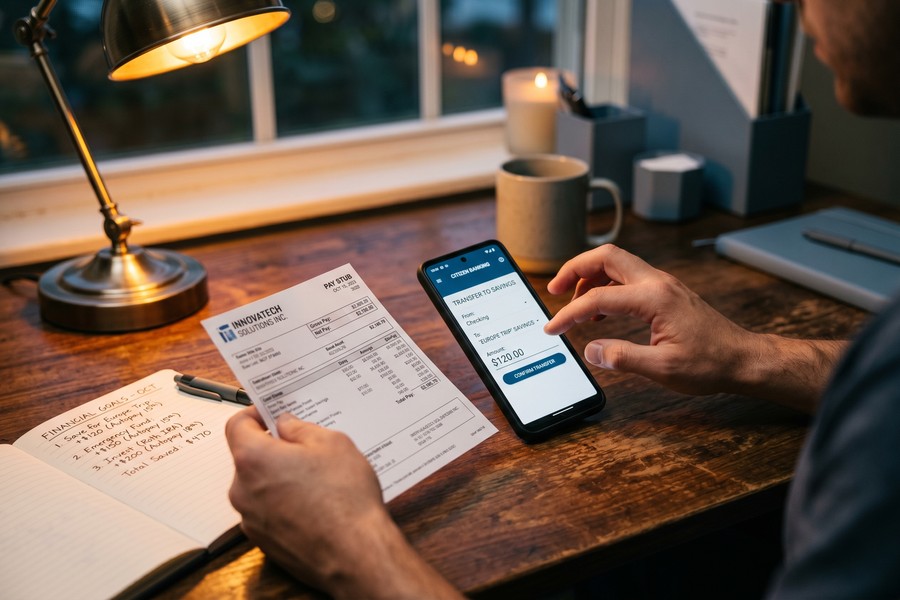
The counterintuitive advice for anyone currently using a cash advance app regularly: automate a small transfer to savings the same day your paycheck arrives, before you have a chance to spend it. Even $25 per paycheck builds a $600 buffer over a year. That amount covers the median fintech emergency borrowing need several times over, and it eliminates the fee cost entirely once the buffer exists.
The American Fintech Council has publicly supported a 36% APR cap as the benchmark for responsible small-dollar credit, noting that its members demonstrate “every day it is possible to offer affordable loans at 36% APR.” That figure is meaningful because it represents the dividing line many consumer advocates use between responsible small-dollar credit and exploitative pricing. Products priced below 36% can still be expensive relative to a bank loan, but they are in a structurally different category from triple-digit rate products. Using the 36% mark as a personal screening filter when evaluating fintech installment lenders is a reasonable and defensible approach.
According to LendEDU tracking data, the average EarnIn advance from 2018 through mid-2025 was just $73, far below the app’s $750 maximum. Most people using cash advance apps for emergencies need very small amounts, not hundreds of dollars.
| Borrower Behavior | 12-Month Cost | Credit Impact | Emergency Fund Built |
|---|---|---|---|
| Monthly $200 advance (app with $9.99 sub + $5 express fee) | ~$178 in fees | None (no reporting) | $0 |
| $1,500 installment loan at 36% APR, 24 months | ~$480 in interest | Positive (if on time) | $0 |
| $25/paycheck automated savings for 24 months | $0 in fees | Neutral | $600–$1,200 |
Real-World Example: A $1,200 Car Repair and Three Different Borrowing Paths
Consider an illustrative example: a 34-year-old administrative assistant earning $42,000 per year with a 601 credit score, $180 in savings, and a car repair bill of $1,200 due within 72 hours or she loses her transportation to work. She has a regular W-2 paycheck deposited every two weeks. She has three realistic options.
Option one: a cash advance app. Her best available app offer is $500 (the maximum her bank account history qualifies her for). She could take the $500 advance and put the remaining $700 on a credit card charging 28% APR. The advance fee is $5 (standard delivery) or $8.99 (instant). The credit card portion will cost approximately $98 in interest if repaid over 12 months. Total borrowing cost for the combined solution: roughly $104–$108. The complication: she now has two simultaneous repayment obligations, and the $500 advance comes due in 11 days from her next paycheck, leaving her with a thinner-than-usual check right when she needs to start paying down the credit card.
Option two: a fintech installment loan. She pre-qualifies at Avant for $1,500 at 34% APR over 18 months. Monthly payment: approximately $112. Total repayment: roughly $2,016. Total interest cost: about $516. The full $1,200 repair is covered with one product, one repayment schedule, and no cash advance debt coming due on her next payday. Avant reports to all three credit bureaus, so 18 months of on-time payments would incrementally improve her 601 score.
Option three: her credit union offers a PAL for $1,000 at 18% APR over six months. Monthly payment: approximately $180. Total repayment: roughly $1,080. Total interest cost: about $80. The remaining $200 she covers from the following paycheck. This is the lowest-cost solution available to her, but it requires credit union membership she established two years ago, and the application process takes one business day, meaning she cannot pay the mechanic today. In this scenario, she uses the fintech installment loan as the practical choice because it funds in one business day and the PAL does not. The key takeaway: cost-optimal and situation-optimal are not always the same answer, and planning for the next emergency with a credit union PAL as the primary option would save her roughly $436 compared to the fintech loan.
Your Action Plan
-
Calculate your actual dollar need, not a round number
Before you open any app or browser tab, write down the exact amount you need to borrow and the date by which funds must be available. Over-borrowing by $200–$300 “just in case” increases your repayment obligation and your interest cost without solving a real problem. Most emergency borrowers need less than they think; the average fintech emergency advance is under $100.
-
Check your employer’s benefits before any third-party lender
Ask your HR department whether your employer offers an emergency loan program through a provider like HoneyBee, Brightside, or a similar service. Employer-sponsored emergency programs often carry 0% APR or grant-based funds for qualifying employees, and they are almost never advertised prominently. A five-minute conversation with HR could save you the entire cost of a fintech loan.
-
Check your credit union eligibility
If you are a member of any federal credit union, call and ask about Payday Alternative Loans (PALs). Maximum APR is 28%, amounts run from $200–$1,000, and terms extend up to six months. If you are not yet a member, note that most federal credit unions have open membership requirements and joining takes 24 hours or less. This is worth doing before your next emergency even if you don’t need a loan today.
-
Pre-qualify with at least two installment lenders before accepting any offer
If you need $1,000 or more, use the soft-pull pre-qualification tool at a minimum of two fintech installment lenders (for example, Avant and Upstart) before accepting any offer. APR differences of 10–15 percentage points between lenders are common for borrowers in the 580–620 credit score range, and that difference on a $1,500 loan over 18 months is real money. Pre-qualification does not affect your credit score.
-
Calculate total repayment cost in dollars, not just APR
For any offer you receive, multiply the monthly payment by the number of months to get total repayment, then subtract the loan amount to get total interest cost. Do this for every offer you’re comparing. A 36% APR loan repaid over 12 months costs roughly the same total as a 20% APR loan repaid over 24 months. The APR headline does not tell you that without the math.
-
Verify the lender is licensed in your state
Legitimate fintech lenders display state license numbers on their website, typically in the footer or on a dedicated “Licenses” page. Cross-check the license number with your state’s financial regulator website. Lenders without visible licensing information in states that require it should be disqualified immediately, regardless of how professional the website looks.
-
Read the repayment terms before any funds hit your account
The CFPB received over 12,000 small-dollar loan complaints in 2024, with 35% citing unclear repayment terms or unexpected fees. Read the loan agreement for: exact repayment date, whether the lender will auto-debit your account, what happens if a payment fails (NSF fees can stack up quickly), and whether prepayment is allowed without penalty. If anything in the agreement is unclear, contact the lender’s customer service before accepting, not after.
-
Set up a micro savings transfer the day you repay in full
The day your final payment is made, automate a transfer of the same monthly payment amount into a dedicated savings account. If you were paying $112/month on an installment loan, redirect that $112 into savings. In 12 months you will have $1,344, enough to self-fund the same emergency without any borrowing cost. This is the most effective single habit for escaping the repeat-borrowing cycle.
Frequently Asked Questions
What credit score do I need to qualify for a fintech emergency loan under $2,000?
It depends on the product type. Cash advance apps like EarnIn and Dave do not check your credit score at all; they evaluate your bank account deposit history instead. For fintech installment loans, Avant publicly accepts scores as low as 580, and Upstart’s machine-learning model can approve applicants with scores as low as 300, though terms will be less favorable at the lower end of that range. In practice, borrowers with scores below 550 should expect either denial or very high APRs from installment lenders, and should prioritize cash advance apps or credit union PALs instead.
How quickly can I actually receive funds from a fintech emergency lender?
Cash advance apps with instant transfer options can deliver funds within minutes of approval, typically for a fee of $1–$8.99. Standard delivery is free but takes one to three business days. Fintech installment lenders like Avant and Upstart typically fund in one to three business days after full approval. If you need money the same day, be aware that most platforms have cutoff times (often noon to 2:30 PM Eastern) for same-day ACH deposits. Missing the cutoff on a Friday means waiting until Monday, which matters in a true emergency.
Will taking out a fintech emergency loan hurt my credit score?
Cash advance apps do not perform credit checks and do not report to credit bureaus, so using them has no direct credit score impact in either direction. Fintech installment lenders use a soft pull for pre-qualification (no score impact), but a formal application triggers a hard inquiry, which typically reduces your score by five to ten points temporarily. If the lender reports your on-time payments to credit bureaus (Avant, Upstart, and OppLoans do), consistent repayment will improve your score over time. Cash advance app repayments do not build credit regardless of how reliably you repay.
I’m a freelancer with irregular income. Can I qualify for a fintech emergency loan?
Not easily through the most popular apps. EarnIn, Dave, and Brigit require W-2-style regular direct deposits and won’t reliably qualify freelancers or 1099 workers with variable income. Your better options are fintech lenders that use bank-feed income analysis (looking at total account cash flow rather than payroll pattern) such as Fundo or Giggle Finance, or fintech installment lenders that accept self-employment income documentation. The most important step you can take in advance is consolidating all income into one primary bank account for at least 90 days before applying. That deposit history becomes your income proof.
Are fintech emergency loans safe? How do I know if a lender is legitimate?
Established fintech lenders operating within regulatory frameworks are generally safe, but the FTC’s 2025 actions against Cleo AI and Dave Inc. confirm that even well-known brands can engage in deceptive practices. Before applying, verify that the lender displays state license numbers and check them against your state regulator’s database. Avoid any lender that promises “guaranteed approval,” demands upfront fees before disbursement, or fails to display a clear APR and total repayment cost. The CFPB’s complaint database (consumerfinance.gov) allows you to search a lender’s name for prior complaints, which is a worthwhile two-minute check.
What is the difference between a cash advance app and a payday loan?
Structurally, they are similar: both provide small amounts of money repaid from the borrower’s next paycheck. The key differences are cost and regulatory status. Payday loans are formal debt products with explicit APRs that frequently exceed 300%, made by licensed lenders in states that permit them. Cash advance apps are generally marketed as not being loans, charge flat fees or subscription costs rather than interest, and often lack the same state-by-state licensing requirements. That regulatory ambiguity cuts both ways: it allows apps to operate with lighter oversight, but it also means consumer protections may be less clearly defined. If an app’s terms look structurally identical to a payday loan, treat it as one for cost-comparison purposes.
Can I take out more than one fintech emergency loan at the same time?
You can apply to multiple lenders, but doing so carries risks. For installment lenders, each formal application generates a hard credit inquiry, and multiple inquiries in a short window signal credit-seeking behavior that can lower your score. Some fintech lenders also use data-sharing tools that flag borrowers with multiple simultaneous applications, a practice sometimes called loan stacking. Understanding how fintech lenders identify and respond to loan stacking behavior is important before applying to multiple platforms at once, particularly if you need installment loans rather than advance apps.
Does repaying a fintech emergency loan help me build credit?
Only if the lender reports to the major credit bureaus. Most cash advance apps do not report payment history to Equifax, Experian, or TransUnion, meaning even years of on-time repayments through these platforms generate no credit benefit. Fintech installment lenders including Avant, Upstart, and OppLoans do report to credit bureaus. If building credit is a secondary goal alongside covering an emergency, explicitly ask any lender whether they report to all three bureaus before accepting the offer, and favor installment products over advance apps if the answer matters to you.
What if I can’t repay a fintech emergency loan on time?
Contact the lender before the payment date, not after. Most fintech installment lenders have hardship or deferral options that can be accessed by calling customer service. Missing a payment without notice typically triggers late fees ($15–$25 is common), a negative mark on your credit report if the lender reports, and potential ACH re-submission attempts that can cause bank overdraft fees. For cash advance apps, a failed repayment usually results in account suspension and may generate an overdraft fee from your bank. The worst outcome is ignoring the problem. Communication with the lender almost always produces a better result than silence.
Is a fintech emergency loan better than putting the expense on a credit card?
It depends on your credit card APR and your ability to pay it down quickly. If you have a credit card with a 24%–29% APR and can pay the balance over six months, the total interest cost will often be comparable to or lower than a fintech installment loan at 36% APR. If you have a 0% introductory APR credit card with available credit, using it is almost always cheaper than any fintech loan product: no fee, no hard inquiry, and no interest if repaid within the promotional window. The fintech loan earns its value when a borrower either has no available credit card capacity or needs funds faster than a new card application would allow.
Sources
- Federal Reserve Board, 2024 Report on the Economic Well-Being of U.S. Households: Banking and Credit
- Federal Reserve Board (FEDS Notes), Small-Dollar Loans in the U.S.: Evidence from Credit Bureau Data (July 2024)
- Federal Reserve Bank of St. Louis, When the Unexpected Happens: Be Ready With an Emergency Fund (2025)
- Fortune, Bankrate Emergency Savings Report 2025
- Bankrate, Personal Loan Rates Forecast and TransUnion Market Share Data (2025)
- Consumer Financial Protection Bureau, CFPB Issues Final Rule on Small-Dollar Lending
- FDIC, Interagency Lending Principles for Offering Responsible Small-Dollar Loans (FIL-58-2020)
- Office of the Comptroller of the Currency, OCC Bulletin 2020-54: Responsible Small-Dollar Lending
- American Fintech Council, AFC Announces Support for 36% Interest Rate Cap Legislation
- National Consumer Law Center, Statement on Fintech Order and Predatory Lending Risk
- Capital Lending News, How Fintech Lenders Are Using Payroll Data to Approve Borrowers Banks Would Reject
- Capital Lending News, Digital Lending for Gig Workers Between Contracts: How to Borrow During Income Gaps
- Capital Lending News, How Loan Term Length Quietly Controls How Much Interest You Actually Pay
- Capital Lending News, Same-Day Digital Loans vs Next-Day Funding: Which Platforms Actually Deliver on Their Promise
- Capital Lending News, Debt-to-Income Ratio on Digital Lending Platforms: The Number That Quietly Kills Your Application