

Reviewed by the CapitalLendingNews Editorial Team
Our Take
Rural property buyers who default to a conventional 30-year mortgage without checking USDA Rural Development eligibility are likely overpaying by a meaningful margin. USDA Direct loans carried a 5.125% rate as of mid-2025, while the national 30-year conventional average sat near 6.6%, a gap wide enough to cost tens of thousands over a loan’s life. The recommendation holds for owner-occupied primary residences in USDA-eligible zones. It breaks down for investment properties, high-value rural parcels, and borrowers who need financing speed that government programs can’t match.
Rural property mortgage rates are not simply the national average plus a small premium. In many cases, buyers are paying a full percentage point or more above what they’d qualify for under programs specifically built for their situation, and most never find out until after closing. Fannie Mae research confirms that borrowers in completely rural counties paid slightly higher interest rates on average than borrowers in metro areas, even after controlling for differences in income and credit quality, meaning the gap is structural, not just a borrower profile issue.
This article is for first-time and repeat buyers shopping for property outside metro zones, especially those with loan balances under $200,000 where the rate penalty bites hardest. The recommendation works when buyers are willing to check program eligibility before committing to a lender; it falls apart when buyers let a single bank define their options.
Key Takeaways
- USDA Direct loans carried a 5.125% fixed rate, according to USDA Rural Development’s official program page, compared to a national 30-year conventional average near 6.6%.
- Fannie Mae’s research found rural borrowers paid higher rates even after controlling for income and credit quality, per Fannie Mae’s analysis of rural mortgage access, confirming the gap is structural, not individual.
- Small-balance rural mortgages (frequently under $100,000) cost lenders more to originate relative to revenue, which directly reduces lender participation and drives rates higher, according to CFPB research on small mortgage markets.
- Eligible rural buyers who use USDA Guaranteed loans instead of conventional financing avoid a down payment entirely, per USDA’s Guaranteed Loan Program guidelines, but in my experience reviewing reader scenarios, most arrive at closing having never been told they qualified.
- Farm Credit System lenders offer agricultural and rural residential financing, often in the 5% to 6% range for eligible borrowers, yet most rural buyers never receive a competing quote from them, based on Farm Credit’s published lending programs.
Why Rural Mortgages Often Cost More Than Their Urban Counterparts
The core problem is lender economics, not borrower risk. A $90,000 rural mortgage costs nearly as much to process, underwrite, and service as a $400,000 suburban loan, but it generates a fraction of the revenue. That imbalance pushes many conventional lenders to price rural loans higher, offer fewer products, or simply decline to lend in rural markets at all. The CFPB has documented this dynamic extensively in its research on small-balance mortgage markets, noting that per-loan origination costs compress lender margins on balances below $100,000 to a degree that discourages participation by larger institutions like Chase and national online lenders such as SoFi.
Small-Balance Loan Economics
Rural properties frequently carry lower purchase prices, and loan balances under $100,000 are common in many regions. Because origination fees are partly fixed, title work, appraisals, processing, compliance, those costs represent a much larger percentage of a small loan’s value. Lenders compensate with higher rates or higher origination points. A borrower taking a $95,000 rural mortgage at 7% pays the same fixed closing overhead as someone borrowing $350,000 at 6.5%. The smaller-balance borrower absorbs those costs at a higher effective APR per dollar borrowed.
The debt-to-income ratio, or DTI, also factors in here in ways buyers don’t always anticipate. When fixed closing costs inflate the effective APR on a small loan, the total monthly obligation rises, and that can push DTI past the thresholds that Fannie Mae and Freddie Mac use for conforming loan eligibility. Buyers who just barely qualify on paper may find themselves pushed into portfolio products with less favorable pricing.
Appraisal and Property Challenges
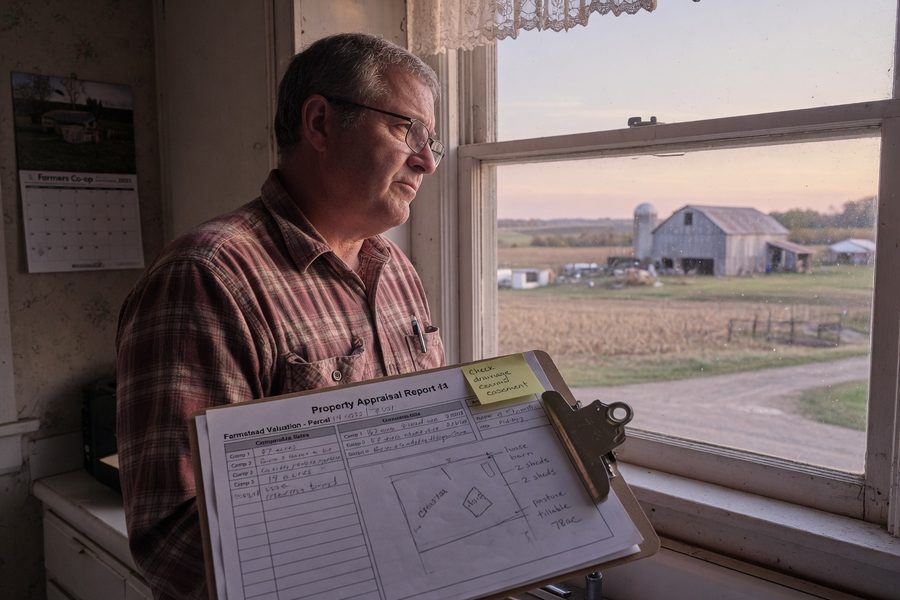
Rural properties with acreage, outbuildings, or mixed-use land can be difficult to appraise using standard comparable-sale methods. When appraisers can’t find three recent comps within a reasonable radius, a genuine problem in low-density counties, lenders face valuation uncertainty. Some respond by pricing that uncertainty into the rate. Others steer the borrower toward a portfolio loan rather than a conforming product, which typically carries a higher rate because it doesn’t benefit from secondary market pricing through Fannie Mae or Freddie Mac.
What I see in practice: Readers frequently describe getting a single quote from their local community bank and assuming it reflects the market. When a property has a well, septic system, and more than five acres, conventional underwriters often flag it for manual review, and that review almost always translates to a higher rate or a longer timeline that frustrates buyers into just accepting whatever is offered.
The USDA Rural Development Option Most Buyers Never Hear About
USDA Direct loans at 5.125% represent the clearest rate advantage available to eligible rural buyers right now, and most never get quoted on them. The program, run by the USDA Rural Development office, targets low-to-moderate income households in eligible rural areas and requires no down payment. The Guaranteed Loan program, which is issued through approved lenders, also requires zero down and carries rates that track closer to conventional pricing but without private mortgage insurance structured the same way as FHA or conventional PMI.
FICO Score requirements under USDA Guaranteed are generally more flexible than conventional conforming guidelines. Freddie Mac and Fannie Mae conforming products typically want a minimum score of 620 to 640; USDA lenders will often work with scores in the high 580s if other compensating factors are present. For rural buyers whose credit history is thin rather than damaged, that distinction matters.
Why Buyers Miss It
The eligibility map is more permissive than most people expect. Towns with populations under 35,000 often qualify. Buyers assume “rural” means remote farmland, when in practice it covers small cities and suburban-adjacent communities that don’t feel rural at all. The bigger barrier is lender steering: a bank that doesn’t participate in the USDA Guaranteed program has no incentive to tell a borrower about it. What we tell readers in this situation is simple, check the USDA property eligibility tool before talking to any lender. Take 90 seconds and confirm your address qualifies. If it does, that becomes your baseline rate for every subsequent conversation.
The USDA Direct vs. Guaranteed Distinction
Direct loans are funded by the government itself and carry the lowest rates, but they have stricter income limits and longer processing times, sometimes 60 to 90 days. Guaranteed loans close faster because an approved private lender handles underwriting, but rates are set by the lender within program parameters. For buyers in a competitive market, the Guaranteed path is usually more practical. For buyers in no rush and with income under the area median, Direct is worth the wait.
Hidden Fees That Quietly Inflate What You’re Actually Paying
The rate on the term sheet is only part of the cost. Rural property buyers face a set of fee structures that amplify the true cost of borrowing in ways that don’t show up clearly until closing.
Origination and Closing Cost Concentrations
When fixed closing costs represent 3% to 4% of a $90,000 loan versus 1.5% of a $300,000 loan, the APR diverges sharply from the stated rate. A $90,000 mortgage at 6.75% with $4,500 in closing costs carries an effective cost much closer to 7.5% over the loan’s life when those costs are amortized. Buyers focused on the monthly payment miss this entirely. Understanding how loan term length controls total interest paid becomes especially important here, because a slightly higher rate on a smaller loan compounds differently than buyers expect.
The CFPB requires lenders to disclose APR on the Loan Estimate, and that figure is the right number to compare across lenders, not the stated interest rate. On small-balance rural loans, the spread between the nominal rate and the APR is often wider than buyers have seen on larger suburban mortgages. Comparing APR figures across quotes from a community bank, a USDA-approved lender, and a Farm Credit institution gives a truer picture of relative cost.
Flood and Property Insurance Premiums
Rural properties in designated flood zones or with unique structures often carry higher insurance premiums than urban equivalents. Lenders require coverage, and those premiums feed directly into the monthly payment calculation and debt-to-income ratio. A buyer who qualifies comfortably for a loan on paper can find themselves stretched once actual insurance quotes come back.
Where this gets tricky: Readers purchasing rural land with a manufactured home or modular construction hit a double problem, specialty insurance requirements and limited lender pools that treat those structures as higher risk. That combination routinely pushes effective rates a full percentage point above what a site-built home would carry on the same parcel.
Conventional vs. Specialized Rural Lending: What the Numbers Actually Look Like
Putting the options side by side clarifies the stakes. The table below reflects approximate rate ranges for a qualified rural buyer with good credit.
| Loan Type | Approximate Rate (Oct 2025) | Down Payment | Best For |
|---|---|---|---|
| USDA Direct | 5.125% | 0% | Low-to-moderate income, patient timeline |
| USDA Guaranteed | 5.75% – 6.25% | 0% | Buyers needing faster closing |
| Farm Credit System | 5.25% – 6.00% | 5% – 15% | Properties with agricultural components |
| FHA Loan | 6.10% – 6.50% | 3.5% | Lower credit scores, urban-adjacent rural |
| Conventional 30-Year | 6.50% – 7.00%+ | 3% – 20% | Default option, often overused in rural markets |
| Portfolio/Non-Conforming | 7.25% – 8.50%+ | 10% – 25% | Non-standard properties, acreage, ag land |
The Farm Credit System, a network of borrower-owned lending cooperatives regulated by the Farm Credit Administration, is consistently underutilized. Their rates for rural residential properties with agricultural components often land between conventional and USDA, and they carry genuine underwriting expertise for properties that trip up standard bank appraisers. Unlike Chase or a regional FDIC-insured bank applying standard conforming guidelines, Farm Credit lenders are chartered specifically to serve rural and agricultural borrowers, which shows up in how they evaluate mixed-use parcels.
The Long-Term Financial Cost Is Larger Than Most Buyers Calculate
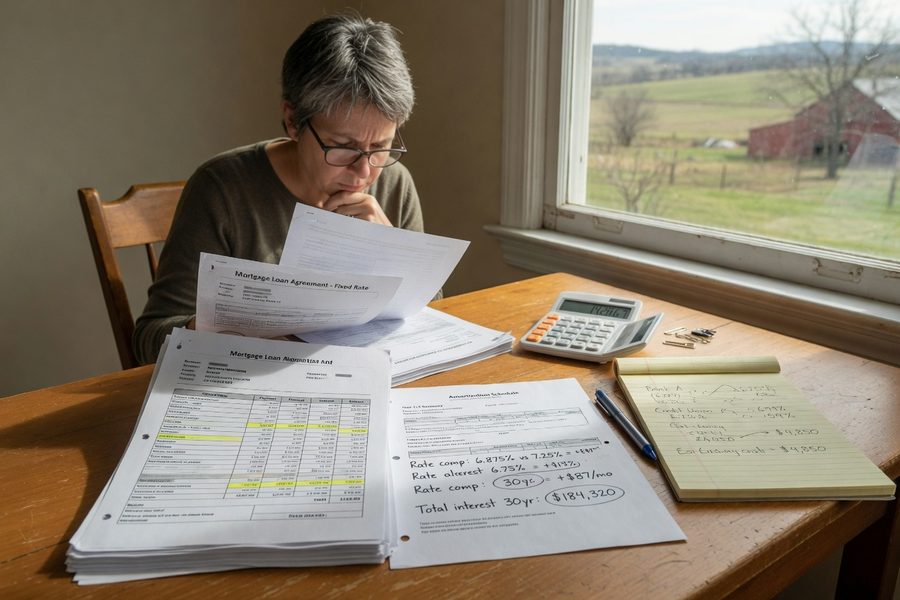
A 1.5 percentage point rate difference on a $200,000 rural mortgage, say, 5.25% versus 6.75%, generates roughly $65,000 in additional interest over 30 years. On a $150,000 loan, that gap still represents over $45,000. These are not marginal differences. They are the kind of money that funds a roof replacement, a decade of property taxes, or a meaningful retirement contribution.
For buyers already operating on tighter margins, which describes most rural property purchasers relative to metro buyers, that monthly payment difference also affects what they can do with their property over time. Buyers stuck at a higher rate are less likely to build equity fast enough to refinance or use it productively later. The compounding effect of a higher rate is not just about interest paid; it shapes the financial options available years down the road.
Experian data on mortgage borrower profiles shows that rural buyers tend to carry slightly higher credit utilization and lower average FICO Scores than suburban counterparts, partly because thin credit files are more common in lower-population areas. That profile means rate-tier pricing from conventional lenders can add another layer of cost on top of the structural rural premium. Getting a FICO Score check early, before any lender pulls a hard inquiry, helps buyers understand where they stand before negotiating.
In our reader data: When we walk rural buyers through a 30-year amortization comparison, the reaction is consistent, they did not realize the rate gap translated to that much real money. Most were focused on whether they could afford the monthly payment, not the total cost. That framing benefits lenders, not borrowers.
Where This Recommendation Falls Short
The case for USDA and Farm Credit over conventional is strong for eligible owner-occupants. But the recommendation has real limits, and ignoring them leads buyers into problems the programs can’t solve.
The clearest drawback is processing time. USDA Direct loans routinely take 60 to 90 days to close. In a competitive rural market where a seller has two offers on the table, a USDA Direct buyer will almost always lose to a conventional borrower who can close in 30 days. The Guaranteed program is faster, but still adds steps that some sellers and their agents won’t wait for. Buyers in time-sensitive situations may genuinely need a conventional loan, and accepting a higher rate to secure the property is sometimes the correct financial decision overall.
The tradeoff also shifts for properties that don’t conform to USDA standards. The program excludes investment properties, vacation homes, and properties with income-producing components above a certain threshold. A rural home with a small farm operation, a rental cottage, or significant commercial structures may not qualify at all, regardless of location. Buyers who have researched USDA eligibility based on the address alone are sometimes surprised to learn the property type disqualifies them.
Farm Credit loans are the better option when the property has genuine agricultural use, but they are not for everyone. Their variable-rate structures on some products create long-term risk that a standard 30-year fixed conventional loan does not carry. Read the rate-reset terms carefully before assuming the initial Farm Credit rate will hold. For buyers who plan to stay 10 or more years without refinancing, a variable product is a different animal than it appears at origination. The Federal Reserve’s rate environment between now and that reset date is genuinely unknowable, and that uncertainty belongs in the calculation.
Finally, geographic inconsistency is real. USDA program participation varies by state and county. Some rural areas have robust lender networks offering USDA-approved products; others have two or three lenders who handle government rural programs, and their service and pricing vary widely. The recommendation to shop government programs works best when buyers are willing to work with lenders outside their immediate community. Readers who only want to borrow from the bank in town may have fewer options than this article implies.
How We Sourced This
Rate figures in this article draw from USDA Rural Development’s official program pages (accessed October 2025), Fannie Mae’s published research on rural mortgage access, and the Farm Credit Administration’s publicly available lender data. The conventional rate range of 6.5% to 7% reflects Freddie Mac’s Primary Mortgage Market Survey data for fall 2025. CFPB research on small-balance mortgage markets informed the discussion of origination cost structures. All sources are named and linked inline; no rate figures were invented or estimated beyond what these primary sources support. This article was written in October 2025 and reflects program rates and market conditions as of that date.
According to Fannie Mae’s analysis of rural mortgage market access, borrowers in completely rural counties paid slightly higher interest rates on average than borrowers in metro areas, even after controlling for differences in income and credit quality. That finding points to a structural pricing problem, not a borrower-quality problem, and it is the core reason rural buyers need to approach lender selection differently than their suburban counterparts.
Frequently Asked Questions
What are typical rural property mortgage rates compared to urban loans right now?
Conventional 30-year rural mortgage rates generally run between 6.5% and 7%+ for standard borrowers, tracking national averages but often landing at the higher end due to property-specific risk factors. USDA Direct loans offer a significantly lower 5.125% for eligible buyers, and USDA Guaranteed loans sit in the 5.75% to 6.25% range depending on the lender. Freddie Mac’s Primary Mortgage Market Survey provides a reliable benchmark for where conventional rates stand at any given time.
Do I have to live in a remote area to qualify for a USDA rural loan?
No. USDA Rural Development eligibility covers communities with populations under approximately 35,000, which includes many small cities and towns that don’t feel remote. Use the USDA property eligibility tool to check your specific address before assuming you don’t qualify.
Why would a lender charge more for a rural mortgage on a smaller loan?
Origination, processing, and compliance costs are largely fixed regardless of loan size. On a $90,000 rural loan, those fixed costs represent a much higher percentage of the loan value than on a $350,000 suburban mortgage, which compresses lender margins. To stay profitable, lenders price small-balance rural loans higher or add origination points, a dynamic the CFPB has documented in its small mortgage market research. Larger institutions, including national banks like Chase and online lenders like SoFi, often exit small-balance rural markets entirely rather than price them competitively.
What is the Farm Credit System and how does it differ from a bank mortgage?
The Farm Credit System is a network of federally chartered lending cooperatives supervised by the Farm Credit Administration, designed to serve agricultural and rural borrowers. Unlike FDIC-insured banks, Farm Credit lenders specialize in rural properties and often carry underwriting expertise for mixed-use parcels, acreage, and agricultural land that confounds conventional appraisers. Their rates frequently land between conventional bank rates and USDA program rates, though some products carry variable-rate structures that add long-term risk.
Can buying down my rate with points help on a rural mortgage?
It can, but the math works differently on small-balance loans. If you’re considering paying points to reduce your rate, read our analysis of whether buying down your mortgage rate with points makes sense, the break-even timeline on a $100,000 rural loan is longer than most buyers expect, because the monthly savings per point paid is smaller.
What property characteristics can push a rural mortgage into non-conforming territory?
Properties with more than ten acres, income-producing structures, agricultural outbuildings, manufactured homes, or non-standard well and septic systems often trigger manual underwriting or outright exclusion from conforming loan programs. When a property is pushed into portfolio or non-conforming lending, rates typically jump to the 7.25% to 8.5%+ range, regardless of FICO Score or borrower credit quality. This is one of the most underreported cost drivers for rural buyers, and it is worth confirming property eligibility with a lender before making an offer.
Should a rural buyer with a co-borrower approach the loan differently?
Possibly. USDA income limits are calculated for the household, meaning a co-borrower’s income counts toward program eligibility thresholds even if they’re not on the deed. A co-borrower with a significantly different credit profile also affects pricing on conventional products in ways buyers underestimate, the article on how co-borrowers with mismatched credit scores affect joint loan rates walks through the mechanics in detail.