
Reviewed by the CapitalLendingNews Editorial Team
Our Take
For most people struggling with overspending in 2-3 specific categories, the cash envelope system wins because it creates a hard, irreversible stop that no app notification has matched. The case for budgeting apps is strongest when you have irregular income, shared household finances, or significant online and subscription spending. The core tradeoff is enforcement versus flexibility: cash physically cannot be spent once it’s gone, while even the best digital envelope apps let you reallocate funds with a few taps. Pick cash envelopes for your highest-temptation categories and an app for the rest.
Budgeting method failure is not a willpower problem. It is a system design problem. Pew Research Center data shows that most Americans use at least two payment types regularly, which means the cash envelope vs budgeting app question is not theoretical; it shapes real spending behavior every single week. The stakes are higher when variable expenses like groceries, dining, and entertainment are the categories most people blow past.
This article is for anyone who has tried a budget and abandoned it within 90 days. The recommendation works when you apply it to the right categories, and it falls apart when you try to force one method across your entire financial life.
Key Takeaways
- Physical cash creates a hard spending stop that zero-based budgeting apps like YNAB and Goodbudget cannot fully replicate because apps allow category reallocation mid-month.
- The “pain of paying” effect documented in behavioral research consistently shows consumers spend less with physical cash than with cards or digital payments, according to NBER-published consumer behavior research.
- App-linked debit cards through platforms like Qube Money and Goodbudget offer near-real-time spending controls but still require users to resist voluntary fund reallocation, the step where most people quietly overspend.
- Carrying cash exposes users to physical loss with no fraud recovery, while app accounts face account-takeover risks that, per FDIC consumer guidance, can often be reversed with prompt reporting.
- In practice, people who fail with apps almost universally report the same behavior: they move money between categories and tell themselves they’ll fix it next month. They rarely do.
What the Cash Envelope System Actually Looks Like in 2026
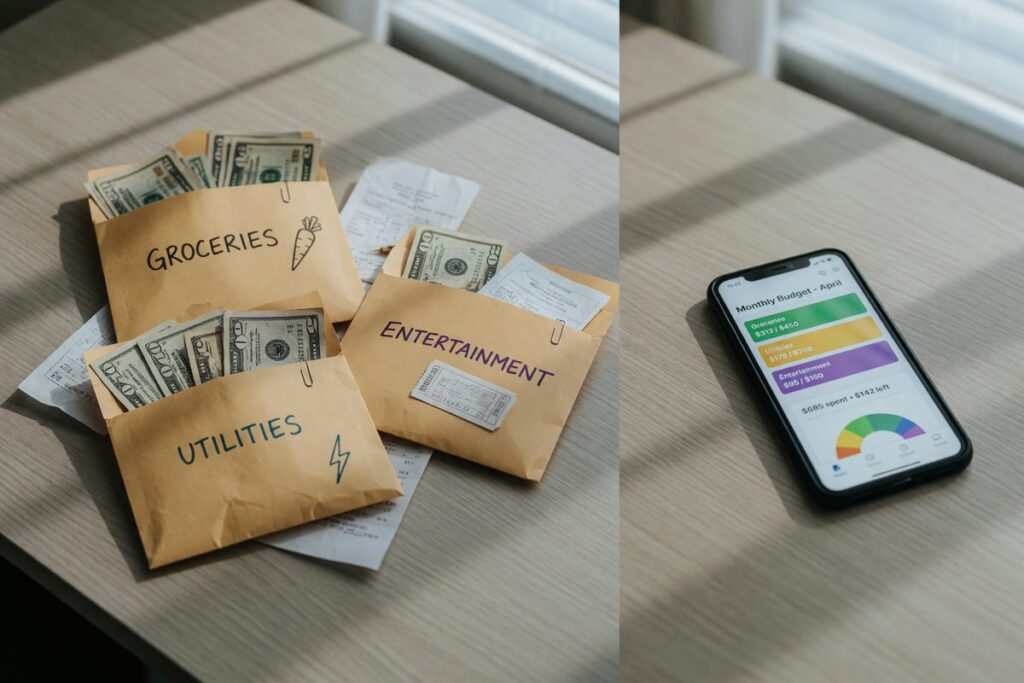
The cash envelope method is simpler than most people remember from Dave Ramsey videos, and more adaptable than its critics admit. You withdraw a set amount of physical cash at the start of each pay period, divide it into labeled envelopes by spending category, groceries, dining, gas, entertainment, and when an envelope hits zero, spending in that category stops. No transfer. No note. No override. The money is simply gone.
The setup takes about 30 minutes the first time. Identify your four to six highest variable expense categories. Calculate a realistic monthly limit for each based on your last two to three months of actual spending, not aspirational numbers. Withdraw the total from your bank or credit union, divide it, and keep the envelopes somewhere accessible but not too convenient. Recurring fixed bills, rent, utilities, subscriptions, stay on autopay from your checking account. The envelope system was never designed to handle those.
The Override Problem Apps Still Haven’t Solved
The reason cash envelopes persist in 2026, despite the sophistication of modern budgeting apps, comes down to one behavioral fact: the envelope enforces its own rule. There is no notification to dismiss, no “borrow from next month” button, no way to rationalize continued spending once the physical cash is gone. That irreversibility is the feature, not a limitation of the method.
What I see in practice: Readers who return to cash envelopes after failing with apps almost always say the same thing, they didn’t realize how often they were quietly moving money between digital categories until they switched to cash and couldn’t do it anymore. The physical constraint exposed a habit they didn’t know they had.
Common adaptations include keeping a small “miscellaneous” envelope for unexpected small purchases and using a clear savings priority framework alongside the envelopes so leftover cash each month has a designated next use rather than disappearing back into general spending.
How Modern Budgeting Apps Handle the Same Problem
Zero-based budgeting apps like YNAB (You Need a Budget) and category-based tools like Goodbudget have genuinely improved since their early versions. They assign every dollar to a category before it gets spent, the same logic as envelopes, just digital. Newer banking-integrated apps like Qube Money go a step further by linking a debit card directly to category balances, so swiping the card for groceries literally pulls from your grocery fund. SoFi’s budgeting tools and Chase’s in-app spending insights take a lighter-touch approach, categorizing transactions after the fact rather than enforcing pre-set limits.
The catch is that every one of these platforms still allows users to reallocate funds mid-month. That single design decision, almost certainly kept because users demanded it, is what separates them from physical envelopes in behavioral terms. The friction of reallocating is real but minimal: a few taps on a screen versus no mechanism at all. For some people, that difference is inconsequential. For the majority who struggle with discretionary overspending, it is everything.
The Psychology of Spending: Why Physical Limits Often Beat Notifications
The pain of paying is a well-documented behavioral phenomenon. When spending involves physical cash, the act of handing over bills registers as a loss in a way that tapping a card or approving an app transaction simply does not. Psychology Today’s coverage of payment research summarizes the consistent finding: physical payment creates more emotional friction, and that friction reduces overspending.
App notifications try to replicate that friction. A YNAB alert that your dining category is at 15% does not feel like running out of cash. It feels like a suggestion. Most users either dismiss the notification or simply stop checking. The behavioral gap between a reminder and a physical limit is not a design failure, it is a fundamental difference in how the brain processes tangible versus abstract scarcity.
Where Apps Genuinely Win on Psychology
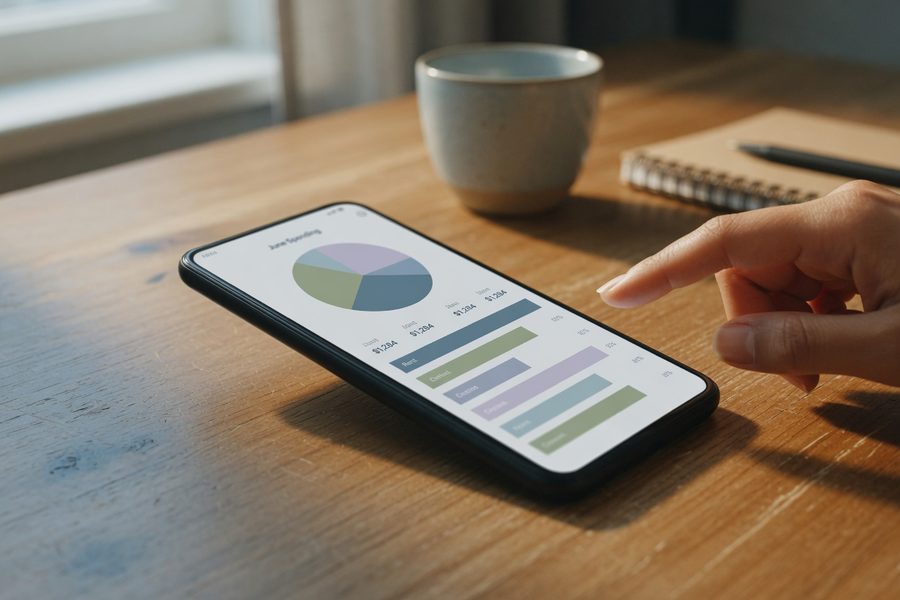
Apps do one psychological thing better than envelopes: visibility across the whole budget simultaneously. Seeing every category on one screen at once reduces the “I’ll just use the credit card this once” rationalization because the full picture is always present. For people who overspend by forgetting about commitments rather than by ignoring limits, that macro view is valuable. If your challenge is keeping your overall debt-to-income ratio (DTI) in check rather than controlling a single impulse category, an app’s panoramic view has real merit. Lenders at institutions like Wells Fargo and Bank of America use DTI directly in credit decisions, so sustained overspending that raises your DTI can affect your access to future credit and your effective APR on new loans.
Where this gets tricky: People with variable income, gig workers, freelancers, seasonal employees, often struggle more with the cash envelope system than salaried earners do, because the withdrawal amounts change each pay period. Apps with rolling category balances handle irregular income more gracefully. That is a genuine concession, not a minor footnote.
Convenience, Security, and Where Each Method Actually Wins
Carrying physical cash has a security profile that deserves honest treatment. Lost or stolen cash is gone. There is no fraud dispute, no FDIC protection, no chargeback process. The Consumer Financial Protection Bureau (CFPB) documents rising contactless payment fraud, yet cash still carries more absolute loss risk. A stolen debit card linked to a budgeting app can often be frozen within minutes and disputed with the issuing bank, Chase, Citibank, or whichever institution holds your account. Stolen cash cannot be recovered under any circumstance. The CFPB’s fraud resource center outlines consumer rights specifically for electronic fund transfers, rights that simply do not exist for physical currency.
On the convenience side, cash envelopes are incompatible with online purchases and subscription billing. Anyone with a Netflix subscription, an Amazon account, or a utility on autopay is already managing a hybrid system whether they intend to or not. Apps handle digital spending natively and sync with bank feeds automatically, which is a genuine advantage for anyone with significant online spending. The question is whether that convenience undermines the spending discipline you were trying to build.
The Rewards Trade-Off
One cost of strict cash envelope use that most budgeting guides skip: you forfeit credit card rewards. If you are consistently spending $800 a month on groceries and gas and earning 2-3% cash back on a rewards card, say, a Chase Freedom Unlimited or an American Express Blue Cash Preferred, switching entirely to cash costs you roughly $200-$300 per year in unrealized rewards. That math matters for disciplined spenders who could use a card and not overspend. For people who overspend with cards by more than that amount, the trade-off still favors cash. Know which category you are in before making the call.
What clients often miss: The rewards calculation only favors cards if you pay the balance in full every month. If you’re carrying any balance, the interest at current Federal Reserve reported card rates wipes out rewards quickly, usually within the first billing cycle. Experian data on average credit card APRs consistently shows rates well above 20% for most consumer cards, meaning even a small revolving balance eliminates any cash-back benefit within weeks.
| Factor | Cash Envelope System | Budgeting App (e.g., YNAB, Goodbudget) |
|---|---|---|
| Spending enforcement | Hard stop when envelope is empty | Notification + voluntary override possible |
| Online/subscription use | Not compatible | Fully compatible; syncs automatically |
| Security if lost/stolen | No recovery; total loss | Card can be frozen; often reversible |
| Credit card rewards | Forfeited entirely | Retained if card linked to app |
| Variable income handling | Requires manual recalculation each cycle | Rolling balances adjust more easily |
| Shared household budgets | Difficult; requires physical coordination | Shared app access available |
| Monthly cost | $0 | $0-$14.99/month (YNAB is $14.99/month) |
Where This Recommendation Falls Short
The recommendation to use cash envelopes for high-temptation categories is not right for everyone. Here is where it breaks down.
The most significant drawback is shared household finances. When two partners manage a budget together, physical cash envelopes require both people to access the same envelopes, agree on remaining balances without an app, and coordinate every time one person makes a purchase the other didn’t know about. That coordination cost is real, and it creates conflict. A shared budgeting app with joint visibility, YNAB and Goodbudget both support this, is simply a better tool for couples. Trying to enforce a cash-only system across a household where one person prefers digital tracking almost always results in one partner maintaining secret parallel spending or both abandoning the system within two months. If shared finances are your primary challenge, an app wins.
The risk is also higher for people with variable income. Gig workers, freelancers, and anyone managing irregular cash flow between contracts will find cash envelopes difficult to calibrate. When your paycheck changes by $400 from one week to the next, knowing how much to withdraw and divide at the start of each period requires constant manual recalculation. Budgeting apps that handle rolling balances and irregular income windows, YNAB’s age-of-money approach is the clearest example, are better designed for this reality. The unique pressure on seasonal workers during income gaps compounds this problem further. The Federal Reserve’s Survey of Household Economics and Decisionmaking has documented consistently that income volatility is among the top drivers of budget failure, a finding that cuts directly against the fixed-withdrawal logic of cash envelopes.
The tradeoff also shows up for anyone who has moved most of their life online. If your grocery delivery, utilities, phone bill, and entertainment are all digital charges, carrying cash envelopes covers perhaps 20% of your actual spending. The system only controls what flows through it. Partial enforcement is better than nothing, but it also means you are running two parallel systems with only one doing real work. In that situation, a digital-first approach with strong category discipline, and intentional resistance to mid-month reallocations, is probably the more honest tool. A hybrid approach, addressed below in the FAQ, is often the most sustainable answer rather than either extreme.
How We Sourced This
This article draws on published behavioral research on cash versus card spending available through NBER, the Consumer Financial Protection Bureau’s consumer guidance, Federal Reserve G.19 consumer credit data, Pew Research Center payment behavior surveys, and FDIC consumer protection materials. Data referenced covers sources published through early 2026. We excluded anecdotal forum posts and any proprietary app-company data without independent verification. Statistics on app pricing reflect publicly listed subscription rates and were confirmed against each platform’s official pricing page.
Frequently Asked Questions
Is the cash envelope system still practical in 2026 when so much spending is digital?
Yes, but only as a partial system. Cash envelopes work best for variable in-person categories like groceries, dining, and entertainment, not for online purchases or bills. Most people who succeed with cash envelopes in 2026 run a hybrid: envelopes for the 2-4 categories where they consistently overspend, and an app or bank account for everything else.
Which budgeting apps come closest to replicating the hard stop of physical envelopes?
Qube Money and Goodbudget come closest because they tie spending directly to a debit card linked to specific category balances. YNAB uses the envelope logic but does not prevent you from moving money between categories mid-month. No app currently removes the user’s ability to override a category limit entirely.
What happens when a cash envelope runs out before the end of the month?
That is the system working. You have three choices: go without spending in that category for the rest of the month, borrow from another envelope and reduce that category’s balance, or acknowledge that your original allocation was unrealistic and adjust it for next month. Document why the envelope ran short so you can recalibrate rather than just refilling it without analysis.
Can couples use the cash envelope system together?
It is possible but genuinely difficult. Both partners need physical access to the same envelopes, which creates friction for any household where spending decisions happen independently throughout the day. A shared budgeting app with joint login access is a more practical solution for couples. If one partner insists on cash and the other prefers digital, a hybrid where cash covers one partner’s discretionary spending and the app tracks everything else tends to be the most stable compromise.
Do you lose money by using cash instead of a rewards credit card?
You do, if you would have paid the card in full every month anyway. At a typical 2% cash-back rate on a rewards card, someone spending $1,000 monthly on tracked categories gives up roughly $240 per year by switching to cash. The break-even point is whether your overspending with a card exceeds that amount, for most people who are budgeting for a reason, it does. Checking your current interest costs against how interest accumulates over time is a useful exercise before deciding. Your FICO Score can also factor in here: carrying a high credit utilization ratio while chasing rewards points is a combination that tends to hurt more than it helps.
Sources
- National Bureau of Economic Research: Consumer Payment Behavior Research (Prelec & Simester)
- Consumer Financial Protection Bureau: Fraud and Scam Consumer Tools
- Federal Reserve: G.19 Consumer Credit Statistical Release
- Federal Reserve: Survey of Household Economics and Decisionmaking (SHED)
- FDIC: Consumer Resource Center, Deposit Insurance and Fraud Protection
- Pew Research Center: More Americans Are Joining the Cashless Economy
- Consumer Financial Protection Bureau: Consumer Credit Trends
- Experian: State of Credit Report, Average APR and Credit Utilization Data
- FICO: Understanding Credit Scores and the Factors That Affect Them
- Federal Reserve: Payments Study, Cash and Card Usage Trends
- The Wall Street Journal: Cash vs. Card, How Payment Method Shapes Spending Behavior
- Consumer Reports: Best Budgeting Apps Evaluated
- NerdWallet: How the Cash Envelope System Works