
Fact-checked by the CapitalLendingNews editorial team
The Verdict
Pushing your credit score up by 20 points is worth the effort if it moves you across a pricing tier before a major loan. The payoff is biggest below 760, where each band drop can add 0.10–0.25% to your mortgage rate and thousands in auto loan interest. Above 760, incremental gains shrink fast and other factors like debt-to-income ratio often matter more.
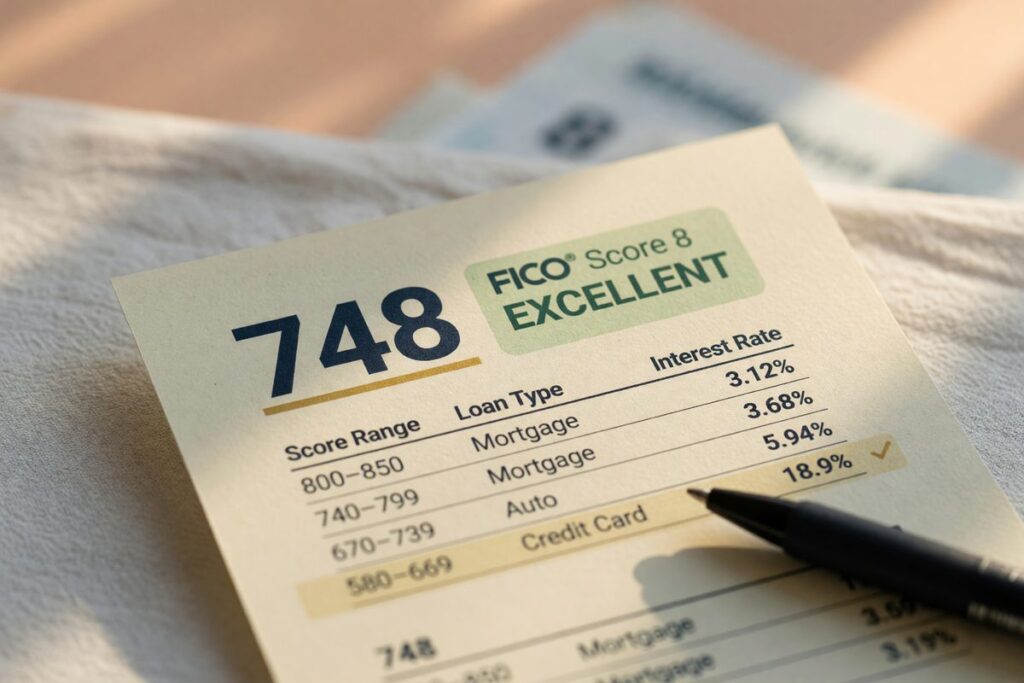
A borrower at 639 and a borrower at 641 look nearly identical on paper, but one of them just crossed a lender’s pricing threshold. That is how credit score interest rate tiers work: lenders translate your FICO score into a specific rate bucket, typically in 20–40 point bands, and a single point can mean the difference between two different APRs. According to Experian’s mortgage rate data, borrowers need a score of 760 or higher to access the best conventional mortgage rates, while those at 620 face rates more than 0.70 percentage points higher on a 30-year loan.
With home prices still elevated and auto loan balances near record highs as of mid-2026, the cost of sitting in the wrong credit tier has never been easier to quantify. The math is worth running before you sign anything.
| Factor | Reasons to Improve Your Score First | Reasons to Borrow Now |
|---|---|---|
| Rate impact | Each 20-point step below 760 can cut mortgage APR by 0.10–0.25% | Rates may move up while you wait, erasing score-related savings |
| Auto loan cost | Moving from near-prime to prime drops new-car APR from 9.97% to 6.78% | Short loan terms mean less total interest exposure than mortgages |
| PMI threshold | Hitting 760 can eliminate or reduce PMI surcharges on conventional loans | PMI removal via equity appreciation may happen regardless of score |
| LLPA fees | Loan-level price adjustments drop sharply at 680, 700, 720, and 740 | If loan closes above these bands already, gains are marginal |
| Timeline | A 20-point gain can happen in 1–3 months with targeted paydown | Delaying 6+ months costs real money if housing inventory is tight |
| Above 760 | Diminishing returns; most lenders cap best pricing at 760–780 | Borrowing at 762 vs. 790 produces nearly identical mortgage terms |
Key Takeaways
- Improving your score is likely worth delaying a loan if you are within 20–40 points of the next pricing tier and the improvement can happen in under 90 days.
- The single highest-value threshold for mortgages is 760; borrowers below this score pay meaningfully more, while gains above it are minimal.
- On a $30,000 auto loan, moving from near-prime (601–660) to prime (661–780) saves roughly $1,900 in interest over a 5-year term based on June 2025 Experian APR data.
- Loan-level price adjustments (LLPAs) set by Fannie Mae and Freddie Mac create real, non-rate costs that shift at specific score bands including 680, 700, 720, and 740.
- Credit card APRs for superprime borrowers (FICO 740+) average around 11% effective APR versus 20%+ for subprime accounts, per a 2024 CFPB report.
- Above 780, most lenders offer no further rate improvement; directing energy toward a lower debt-to-income ratio will have more impact on approval odds.
- The break-even on delaying a mortgage purchase to raise your score 20 points is typically under 12 months of loan payments saved.
How Lenders Translate Credit Scores into Rate Tiers
Risk-based pricing is the model: lenders assign a rate not based on your individual story but on which statistical bucket your score falls into. The Federal Trade Commission explains that businesses use your credit score to decide both whether to extend credit and what interest rate you will pay, with lower scores directly triggering higher rates. Lenders set those rates in advance for each score band, so crossing a threshold changes your quoted rate before underwriting even begins.
Most conventional mortgage lenders and auto lenders use 20–40 point increments for pricing adjustments. That means a score of 699 and a score of 700 can produce different loan costs even though the underlying creditworthiness is nearly identical. The 20-point unit is not arbitrary; it reflects how Fannie Mae and Freddie Mac structure their loan-level price adjustments, which then cascade into the rates retail lenders quote borrowers. Understanding this structure is what makes targeted credit improvement possible rather than just hopeful.
For borrowers already close to a band boundary, this matters immediately. If your score sits at 718, getting to 720 may cut your LLPA cost by a measurable fraction of a point. If you are at 758, pushing to 760 is the most financially significant 2-point move you can make on a mortgage. The Equifax credit scoring guide notes there is no magic number guaranteeing better rates, but the band structure means some numbers are considerably more valuable than others.

What Each 20-Point Jump Saves on a Mortgage
On a $300,000 30-year conventional mortgage, moving from a 620 score to 760 saves roughly $130 per month in principal and interest alone, based on the rate spread visible in current Experian and Curinos data. That is before accounting for loan-level price adjustments.
Experian’s mortgage rate tracker shows 30-year rates stepping down from approximately 7.33% at the 620–639 band to 6.61% at 760 and above, a spread of 0.72 percentage points. Each 20-point increment in the 620–760 range produces a drop of roughly 0.10–0.18%, with the steepest cuts happening in the 620–680 range. The Consumer Financial Protection Bureau confirms that higher scores reflect better credit history and make borrowers eligible for lower interest rates, with the gap between poor and excellent credit representing tens of thousands of dollars over a loan’s life.
Here is the arithmetic on one specific jump. A borrower at 680 on a $300,000 30-year loan at approximately 7.10% pays about $2,014 per month. The same borrower at 700, qualifying at roughly 6.90%, pays around $1,982 per month. That is $32 per month, or $384 per year, or nearly $11,500 over the 30-year term. Now apply that same logic to the jump from 740 to 760, where the rate might drop from 6.75% to 6.61%: the monthly saving is closer to $28, and the lifetime saving drops to around $10,000. The savings are real but start converging above 740, which is why the 760 threshold deserves special attention rather than chasing scores into the 800s.
LLPAs add a separate layer. Fannie Mae and Freddie Mac price adjustments can add 0.25–1.5% to your effective rate depending on score and loan-to-value ratio. These are not rolled into the advertised APR upfront but show up as higher closing costs or a slightly elevated rate. A borrower at 719 may face a meaningfully higher LLPA than one at 720, independent of the base rate difference. This is why understanding the full cost of a rate, not just the headline figure, is essential before closing.
Auto Loans: Smaller Jumps, Faster Stakes
Auto loan tiers show the sharpest single-band drop in the data. The jump from near-prime to prime cuts the average new car APR by more than 3 full percentage points.
According to Experian’s June 2025 auto loan data, the average new car APR for super-prime borrowers (781+) is 5.27%. Prime borrowers (661–780) pay 6.78%. Near-prime (601–660) borrowers face 9.97%. Subprime (501–600) borrowers are at 13.38%, and deep subprime (300–500) reaches 15.97%. The near-prime to prime gap alone is 3.19 percentage points, which on a $30,000 five-year loan translates to roughly $2,500 in additional interest paid.
The worked example: a $30,000 new car financed over 60 months at 9.97% (near-prime) carries a monthly payment of approximately $638 and total interest of about $8,280. The same loan at 6.78% (prime) runs roughly $590 per month with total interest near $5,400. The difference is $48 per month and $2,880 over the loan term. For a car loan, that gap can be crossed with a single focused credit action, paying down a revolving balance to reduce utilization below 30%. If you are at 655 and need a car in 60 days, even a modest utilization drop can push you across the near-prime boundary before you sign.
The stakes are lower than mortgages in absolute dollars, but the timeline is shorter. A 5-year loan closes the cost window in 60 months; a mortgage stretches it over 30 years. This is exactly why loan term length quietly controls total interest cost as much as the rate itself. On auto loans, crossing a tier matters most when the loan amount is large and the term is long.

Who Should and Who Should Not
Good candidates
Borrowers who are close to a pricing threshold and have a specific loan application within 90 days stand to gain the most from a targeted score push.
- A borrower at 738–759 planning a mortgage: getting to 760 eliminates the most expensive LLPA tier and can save $20,000+ over the loan life.
- A near-prime auto borrower (640–660) within 30 days of a car purchase: a utilization reduction that pushes the score above 661 cuts the APR by up to 3 points.
- A renter planning to buy within 6 months with a score between 680 and 700: even a 20-point gain reduces both the rate and LLPA costs, with a break-even of under 12 months.
- Anyone carrying a high credit card balance relative to their limit: a single paydown can shift utilization and raise scores 20–40 points within one billing cycle.
Who should skip it
Waiting to improve your score is the wrong move when you are already in the top tiers or when other loan factors are the actual constraint.
- Borrowers above 780: most lenders offer no additional rate improvement above this threshold, so further score gains produce no pricing benefit.
- Borrowers whose debt-to-income ratio exceeds 43%: DTI is often the bigger barrier to approval and favorable terms than the credit score itself.
- Anyone who needs emergency financing now: delaying 2–3 months to improve a score by 15 points rarely offsets the cost of the underlying problem going unaddressed.
- Borrowers applying for smaller personal loans under $5,000: the absolute dollar savings across tiers are modest and may not justify waiting several months.
Frequently Asked Questions
How much does a 20-point credit score increase lower your mortgage rate?
In the 620–760 range, each 20-point step typically reduces a 30-year conventional mortgage rate by 0.10–0.18 percentage points. On a $300,000 loan, that translates to roughly $20–$35 per month and $7,000–$12,000 over the loan’s life, depending on which bands you cross.
Is a 760 credit score really the magic number for the best mortgage rates?
For most conventional loans backed by Fannie Mae and Freddie Mac, yes. Experian confirms that 760 is the threshold where borrowers access the best conventional mortgage pricing. Pushing above 780 or 800 produces virtually no additional rate benefit from most lenders, though some portfolio lenders set their own tiers.
What credit score do you need to get the best auto loan rate?
Super-prime status, defined as a score of 781 or higher, gets you the lowest available APR, which averaged 5.27% for new cars per Experian. The next tier down (prime, 661–780) paid 6.78%. Crossing into prime from near-prime is the single highest-value jump for auto borrowers in dollar terms.
Do credit score tiers affect credit card interest rates the same way?
The effect is real but less structured than mortgage or auto pricing. Superprime credit card accounts (FICO 740 and above) carried an effective APR of around 11% in 2024 per a CFPB report, while subprime accounts often run above 20%. Unlike mortgages, credit card issuers rarely publish explicit tier tables, so the pricing is less predictable per 20-point increment.
Can improving your credit score by 20 points actually happen in 30 days?
For some borrowers, yes. If the primary drag on your score is high revolving utilization, paying down a credit card balance before the statement closes can raise your score 20–40 points within one billing cycle. Errors on your credit report, if disputed successfully through Experian, Equifax, or TransUnion, can also produce fast gains. Derogatory marks and thin credit history take much longer to resolve and will not respond to a 30-day push.