
Fact-checked by the CapitalLendingNews editorial team
Quick Answer
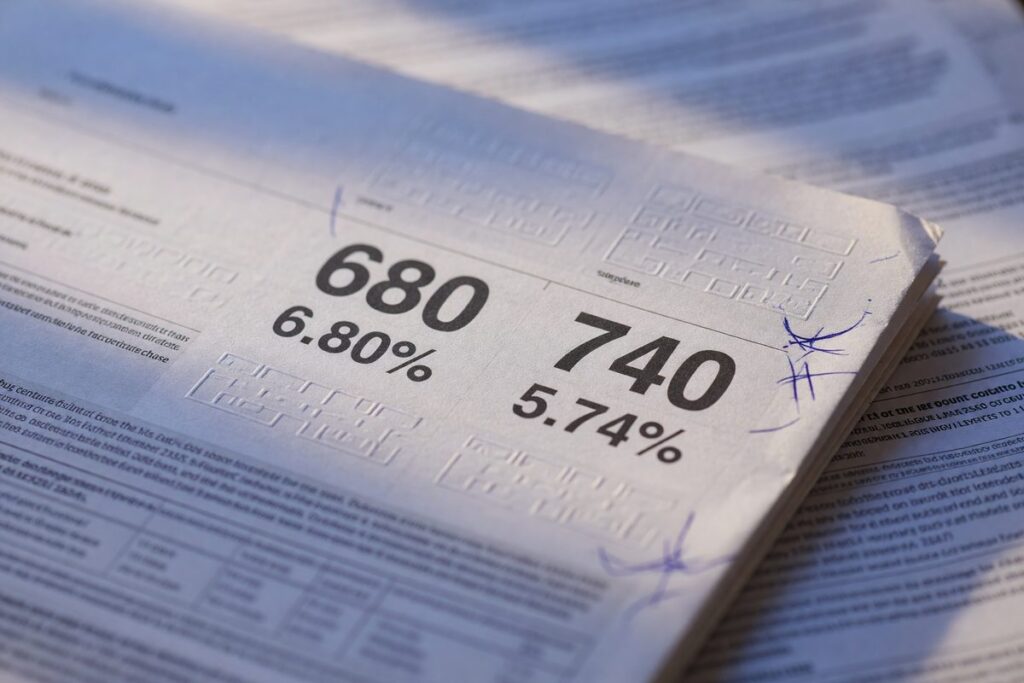
A 60-point gap from 680 to 740 can slice 0.25–0.35 percentage points off a conventional 30-year mortgage rate. On a $350,000 loan, that credit score mortgage rate difference translates to around $50–$65 less per month and over $20,000 saved across the loan term. Lenders price 740 as a best-tier threshold, while 680 often lands in a higher-risk bucket.
The credit score mortgage rate difference between 680 and 740 is not subtle. It is a hard pricing boundary carved into most conventional loan programs. When a borrower steps from a 680 FICO into the 740+ tier, they clear a full risk band, the kind of jump that CFPB rate data shows can move offered APRs by a quarter-point or more. In August 2025, that spread hasn’t narrowed.
A 680 borrower generally sees quotes that are one pricing tier more expensive than what the same lender would show a 740 applicant. That gap ripples through monthly cash flow, total loan cost, and even down payment flexibility. Understanding where the breakpoints sit, and what other factors soften or sharpen the divide, lets borrowers decide whether to lock in now or pause and push their score higher first.
Key Takeaways
- A 60-point FICO gap between 680 and 740 typically triggers a rate difference of 0.25 to 0.35 percentage points on a conventional 30-year mortgage, according to CFPB rate data.
- The cost driver is structural: Loan-Level Price Adjustments (LLPAs) published by Fannie Mae add roughly 0.50–0.75 points for a 680–699 score at 20% down versus a 740+ borrower with the same down payment.
- On a $350,000 loan, the difference works out to roughly $59 less per month and more than $21,000 in total interest savings over 30 years for the 740 borrower.
- A larger down payment narrows but rarely eliminates the gap: stretching to 25–30% down at 680 can reduce the rate add-on by about 0.25 percentage points, per the agency LLPA grid.
- Raising a score from 680 to 740 typically takes six to twelve months, though borrowers with high credit card utilization can sometimes see meaningful gains within 30 to 60 days of paying balances down.
- The higher payment at 680 also raises a borrower’s debt-to-income ratio, which in tight qualifying situations can shift an approval into a conditional counteroffer, a dynamic explained in detail by Capital Lending News’s DTI analysis.
Why a 60-Point Credit Score Gap Triggers Different Mortgage Quotes
Lenders don’t price scores on a smooth line. They bucket them into risk tiers, and the line between the “fair” and “very good” bands sits right between 680 and 740. A 680 FICO usually places a borrower in a pricing category that carries a Loan-Level Price Adjustment (LLPA), a fee baked into the interest rate or paid upfront, while a 740 score often bypasses that charge entirely. The Consumer Financial Protection Bureau explains that these adjustments directly raise the rate quoted to lower-score applicants.
For a conventional conforming loan in mid-2025, the LLPA for a 680–699 score with a 20% down payment can add roughly 0.50–0.75 points to the rate compared with a 740+ borrower putting the same money down. That’s why the credit score mortgage rate difference shows up as a visible, repeatable spread, not as a few basis points of noise. It’s a structural gap, written into Fannie Mae and Freddie Mac pricing grids, that doesn’t disappear just because a lender runs a soft pull.
Credit unions and portfolio lenders sometimes soften this. Because they keep loans on their books, they can relax LLPA-style markups for borrowers with compensating strengths: a deep down payment, low debt ratios, or a long local relationship. But in the open market, the 680 bucket is a costlier bucket, and every lender that sells to the agencies will price it that way.
Key Takeaway: The jump from 680 to 740 removes a full LLPA risk band, typically cutting the offered rate by 0.25% or more. This tier logic, detailed by the CFPB, explains why two borrowers with identical loans except for that 60-point gap get distinctly different mortgage quotes.
How Loan-Level Price Adjustments Translate the Credit Score Mortgage Rate Difference Into Real Dollars
LLPAs aren’t vague risk premiums. They are a published grid of fee increments that raise the note rate or require cash at closing. A borrower at 680 with a 20% down payment typically faces a 0.50% to 0.75% rate add-on relative to a 740 borrower with the same down payment. On a $350,000 loan, a 0.50% higher rate means an extra $105–$110 in monthly principal and interest, and a 0.25% jump adds roughly $53–$58. The credit score mortgage rate difference directly feeds these dollar amounts.
Lenders often convert the LLPA into a slightly higher interest rate rather than charging an upfront fee, which makes the gap feel smaller on paper but inflates total interest over three decades. Even a modest 0.25% rate lift on a $350,000 mortgage stacks on more than $18,000 in extra interest over 30 years, assuming the borrower never refinances. Many 680 borrowers will try to pay down other obligations to boost their score before locking, precisely because the long-run math is so punishing.
The LLPA grid isn’t fixed; Fannie Mae and Freddie Mac adjust it periodically. In the current rate environment, where the Fed funds rate sits near 3.63% and bank prime at 6.75%, the cost of each LLPA step gets magnified because it’s layered onto a higher base rate. That’s why the spread between 680 and 740 today can feel more painful than it did when rates were at 4%.
Key Takeaway: An LLPA of 0.25%–0.50% for a 680 borrower adds $53 to $110 monthly on a $350,000 mortgage and $18,000+ in extra interest over the loan’s life. The CFPB’s rate explorer and agency pricing grids confirm this credit score mortgage rate difference is structural, not a negotiation quirk.
Monthly and Lifetime Cost: A $350,000 Loan Example
Putting a concrete number on it helps. Assume a 30-year fixed conventional loan for $350,000, roughly the median-priced home in many U.S. metros. A 740 borrower might lock in a rate near 6.75%, while a 680 borrower sees something closer to 7.00%. The monthly payment difference lands around $59: $2,270 at 6.75% versus $2,329 at 7.00%. Over 30 years, that seemingly small gap accumulates.
| Metric | 680 FICO (7.0%) | 740 FICO (6.75%) |
|---|---|---|
| Monthly P&I | $2,329 | $2,270 |
| Total Interest (30 years) | $488,000 | $467,000 |
| Lifetime Savings | ~$21,000 |
The credit score mortgage rate difference here isn’t theoretical. A 740 borrower saves over $21,000 in interest over the loan’s life on this $350,000 example. The monthly cash-flow relief, about $59, matters too, especially when debt-to-income ratios are tight. In many underwriting models, that $59 could be the difference between approval and a counteroffer asking for a larger down payment, which ties directly to how lenders calculate and stress-test DTI.
Key Takeaway: On a $350,000 conventional mortgage, moving from 680 to 740 shaves about $59 per month and $21,000 in total interest, a lifetime savings that dwarfs the one-time cost of prioritizing credit repair before locking a rate.
When Your Down Payment and Loan Type Narrow the Credit Score Rate Difference
A larger down payment doesn’t erase LLPAs, but it shrinks the charge. At 680, putting 25% down instead of 20% can reduce the rate add-on by about 0.25 percentage points, effectively closing half the gap to the 740 tier. Borrowers who can stretch to 30% down sometimes see rates that look nearly as good as a 740 quote with a smaller down payment. That’s because the LLPA grid rewards low loan-to-value ratios, especially in the 680–699 bucket.
Loan type complicates the picture. FHA loans use a completely different pricing engine, mortgage insurance premiums and a single national rate that doesn’t shift much with credit score above 580. So a 680 borrower jumping to FHA might find a quote that’s close to what a 740 borrower gets, but with permanent mortgage insurance. On the other side, a 740 borrower using a conventional loan can often drop PMI entirely with a decent down payment, while a 680 borrower might still pay it. The credit score mortgage rate difference in the conventional world sometimes pushes 680 borrowers toward FHA, where the rate and payment can look better in month one but cost more over time due to insurance.
Frequently Asked Questions
How much higher is the mortgage rate at 680 versus 740 credit score?
In a typical mid-2025 rate environment, the difference between a 680 and a 740 FICO score on a conventional 30-year mortgage is roughly 0.25 to 0.35 percentage points. That gap is driven primarily by Loan-Level Price Adjustments built into Fannie Mae and Freddie Mac pricing grids. The exact spread varies by lender, down payment size, and loan-to-value ratio, but the structural difference is consistent across the conventional market because it reflects published agency pricing tiers rather than individual lender discretion.
Is 680 considered a bad credit score for a mortgage?
No, 680 is not a bad credit score for mortgage purposes, and most conventional lenders will approve a borrower at that level. However, 680 sits in a pricing bucket that carries higher Loan-Level Price Adjustments compared to scores of 740 and above. You will qualify for a mortgage, but you will pay more for it than a borrower with a 740 score. FHA loans are also readily available at 680, often with competitive rates, though permanent mortgage insurance adds long-term cost.
What is the minimum credit score to get the best mortgage rate?
Most conventional lenders treat 740 to 760 as the threshold where best-tier pricing begins. Some lenders extend favorable pricing to borrowers at 720 with a strong down payment and low debt-to-income ratio, but the clearest pricing improvement in Fannie Mae and Freddie Mac LLPA grids occurs at 740. Going above 760 or 780 produces diminishing returns on rate, so there is little incentive to wait for a score above 760 before applying if you are already in that range.
How long does it take to raise a credit score from 680 to 740?
Raising a FICO score by 60 points, from 680 to 740, typically takes six to twelve months of consistent positive behavior, though the timeline depends heavily on what is suppressing the score. Borrowers carrying high credit card utilization can sometimes see improvements within 30 to 60 days after paying balances down. Negative marks like late payments fade in impact over time but do not disappear quickly. During this period, it is worth evaluating whether the interest savings from waiting outweigh the cost of delayed homeownership or continued renting.
Does applying for a mortgage hurt your credit score?
A hard credit inquiry from a mortgage application typically lowers a FICO score by fewer than five points temporarily. More importantly, credit scoring models treat multiple mortgage inquiries within a short window, generally 14 to 45 days depending on the scoring version, as a single inquiry. This means shopping multiple lenders in a compressed period does not stack multiple penalties. Borrowers near a scoring tier threshold, such as 682 or 738, should be aware of this before applying and pulling their score repeatedly outside that rate-shopping window.
Can a larger down payment offset a 680 credit score?
Yes, partially. The LLPA grid used by Fannie Mae and Freddie Mac is a two-dimensional table that prices both credit score and loan-to-value ratio. A borrower at 680 who puts 25% to 30% down will see a lower LLPA surcharge than a 680 borrower at 20% down. In some cases, the additional down payment can reduce the effective rate gap by half. However, it rarely eliminates it entirely, and the trade-off of deploying extra cash as a down payment versus keeping it in reserve or using it to pay down debt deserves careful analysis before deciding.
Will refinancing later erase the higher rate I locked in at 680?
Refinancing is a valid strategy, but it is not guaranteed to work out financially. To refinance into a better rate at 740, you need rates to remain accessible, your score to actually reach 740, and enough time to recoup closing costs, typically $3,000 to $6,000 or more, before you benefit from the lower payment. If rates rise between now and when your score improves, you could lock a higher rate despite a better score. Many borrowers assume refinancing will rescue them from a higher rate, but the timing and cost math does not always favor waiting to refinance over waiting to buy.
Do all lenders use the same credit score tiers for mortgage pricing?
Lenders who sell loans to Fannie Mae or Freddie Mac must use the agency LLPA grids, which create consistent pricing tiers across most of the conventional market. However, portfolio lenders, those who keep loans on their own books, can set their own pricing and may be more flexible with borrowers near tier thresholds. Credit unions, community banks, and some regional lenders are worth shopping specifically if your score is in the 680 range, because they sometimes offer rates that compete with agency pricing without the same hard tier cutoffs. Getting quotes from both types of lenders is the most effective way to understand your real options.
How does the credit score mortgage rate difference affect my debt-to-income ratio eligibility?
The connection is direct and often underappreciated. A higher mortgage payment caused by a lower credit score raises your monthly debt obligations, which increases your debt-to-income ratio. If a 680 borrower’s payment is $59 higher per month than a 740 borrower’s on the same loan, that extra payment is counted against the borrower’s DTI ceiling. In tight qualifying situations, where a borrower is already near the 43% to 45% DTI limit, that $59 difference can cause an approval to become a conditional counteroffer requiring a larger down payment, co-borrower, or smaller loan amount.
Should I wait to buy a home until my score reaches 740?
This is a genuinely personal calculation with no universal answer. The case for waiting is compelling when your score is close, say, 710 to 725, and you could realistically reach 740 within three to six months through credit utilization reduction. The case for buying now strengthens when home prices in your market are rising faster than your interest savings would be, when you are paying high rent that offsets the cost of a higher rate, or when your score is unlikely to reach 740 quickly due to negative marks that need time to age. Running the actual numbers for your loan size, your market, and your realistic improvement timeline gives a more useful answer than any general rule.
Sources
- Consumer Financial Protection Bureau, Explore Interest Rates Tool
- Federal Reserve Bank of St. Louis (FRED), Federal Funds Effective Rate
- Fannie Mae, Loan-Level Price Adjustment (LLPA) Matrix
- Freddie Mac, CreditSmart: Understanding Credit Scores and Mortgage Pricing
- myFICO, How Credit Scores Affect Your Mortgage Rate
- U.S. Department of Housing and Urban Development, FHA Single Family Mortgage Insurance Overview
- Capital Lending News, Debt Payoff Versus Down Payment: What Helps Your Mortgage More
- Capital Lending News, DTI Ratio Misconceptions and Personal Loan Approval