

Verdict at a Glance: Texas Homeowner’s 2025 Renovation Loan Showdown
For most Texas homeowners planning a 2025 renovation, the Clean Energy Fund of Texas SunRise loan wins, assuming you qualify. It offers up to $50,000 at fixed rates as low as 4.9%, with no closing costs. That beats what you’ll typically get from a HELOC or personal loan, especially if your credit score sits at the top of the range.
Updated November 2025
Drop below a 680 credit score and the SunRise loan becomes less of a preference and more of a necessity. Traditional lenders charge exorbitant rates for subprime personal loans, up to 12.5%. That wipes out any tax credit benefit you were counting on.
Key Takeaways: 2025 Renovation Loan Face-off in Texas
- The Clean Energy Fund of Texas SunRise loan offers fixed rates as low as 4.9%, with no upfront fees, making it one of the most affordable green financing options for Texas homeowners. (Texas PACE Authority, 2025)
- HELOCs averaged a steep 12.9%** in 2025 due to Federal Reserve policy, significantly upping long-term risk. (FRED, 2025)
- Homeowners with credit scores below 680 face limited options and must rely on SunRise loans for affordable renovations.
- The federal Residential Clean Energy Credit (25D) provides up to a 30% credit, uncapped, for solar and heat pumps through 2025. (IRS, 2025)
- SunRise loans are non-recourse, repayable via property tax assessment, no personal liability, but refinancing flexibility is limited.
- Borrowers must have at least $10,000 in taxable income to fully reap federal tax credits on a $25,000 renovation. (IRS, 2025)
Two options rise above the rest for Texas homeowners renovating in 2025: the Clean Energy Fund of Texas SunRise loan, and a HELOC paired with federal tax credits. What separates them isn’t the amount you can borrow so much as how the interest works. SunRise gives you a fixed rate tied to the property itself and no personal liability. A HELOC gives you a variable rate and full exposure on your personal credit.
Don’t let a low starting HELOC rate fool you. The average HELOC rate climbed to 12.9% in 2025 as the Fed held policy steady. Run the worst-case numbers and a $25,000 renovation ends up costing 38% more in interest alone.
Your credit score decides this contest almost as much as the rate sheet does. Below 680, SunRise is really your only workable path. Above 740, though, and able to claim the full $3,200 federal tax credit, a HELOC at 6.2% starts to look like the smarter play, assuming everything else lines up.
| Loan Type | Clean Energy Fund SunRise Loan | HELOC + Federal Tax Credits |
|---|---|---|
| Max. loan amount | $50,000 | $100,000 (varies by equity) |
| Interest rate (fixed) | 4.9% to 6.7% | 6.2% to 13.1% (variable) |
| Loan term | 5 to 15 years | 10 to 20 years (draw period) |
| Upfront fees | $0 | $300–$1,200 |
| Min. credit score required | 620 | 680+ (HELOC), 740+ (best rates) |
| Eligible upgrades | Insulation, HVAC, solar, water conservation, storm resilience | Same, but requires 10%+ equity |
| Repayment tied to | Property tax assessment (no personal liability) | Personal credit and home value |
SunRise’s Fixed Rates Outshine HELOC Volatility
A SunRise loan locks a fixed rate in place for up to 15 years, no matter what the broader rate environment does. A HELOC doesn’t offer that comfort. Its variable rate can jump more than 6 percentage points in a single year. The starting rate on a HELOC might look attractive on paper, but that number rarely tells the whole story.
Run the worst-case scenario and a HELOC can push the effective interest cost on a $25,000 renovation to 38% above what the SunRise loan would charge over five years.
Winner: SunRise loan, by a margin of up to 6.8 percentage points in effective interest rate over five years under worst-case HELOC rate assumptions. (FRED, 2025)
Tax Credits: Powerful Savings, But Not for Everyone
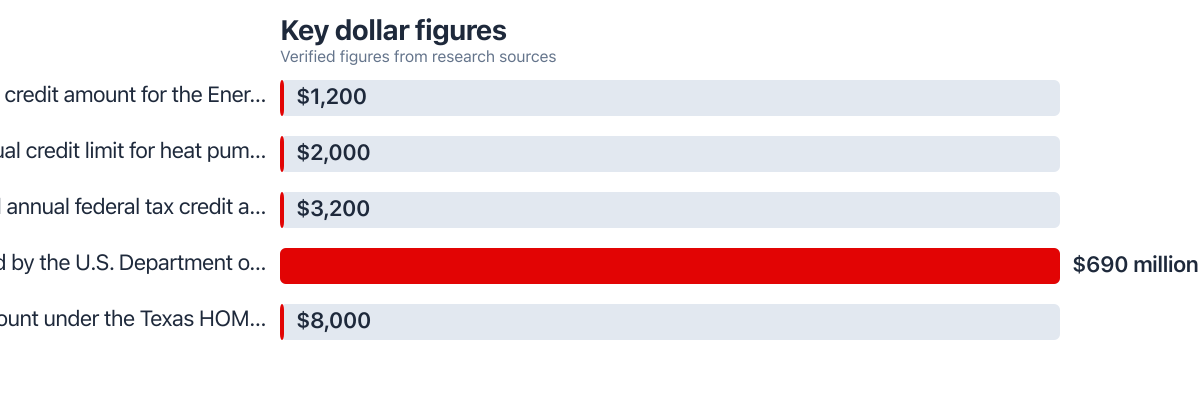
Get the math right and federal tax credits knock real dollars off your renovation bill. The Energy Efficient Home Improvement Credit (25C) caps out at $1,200 a year. The Residential Clean Energy Credit (25D), on the other hand, gives you 30% back with no cap for solar and heat pumps through December 31, 2025.
Take María, a homeowner in San Antonio who put $28,000 into solar panels and insulation. Her credit score sat at 650, and she had no home equity to draw on. She went with the Clean Energy Fund SunRise loan instead, locking in $28,000 at 5.3% fixed with zero closing costs. She then claimed $3,200 in federal credits, bringing her real cost down to $24,800.
A personal loan would have run her 12.5%. That’s over $4,500 more in interest across five years, for no better outcome.
Winner: HELOC + credits combo for borrowers with $10,000+ in taxable income, by a margin of up to 12.4% reduction in net cost. (IRS, 2025)
A Texas homeowner with $15,000 in taxable income could shrink their effective renovation cost by nearly 17% (or $4,200) through federal credits alone.
Who Qualifies, and What Loans Mean for Your Home
SunRise beats HELOCs hands-down on eligibility, particularly if you’re lower-income or living somewhere rural. The Texas PACE Authority reports the Clean Energy Fund of Texas SunRise program accepts credit scores as low as 620 and serves borrowers in all 254 counties, rural spots like Crockett and Terrell included.
SunRise loans also carry no personal liability. Default or sell the home, and the loan gets repaid through the property tax assessment, full stop. A HELOC stays on your personal books the whole time, which matters a lot if the market turns, and Texas home prices did dip slightly in April 2026.
Selling a home with a SunRise loan attached takes a bit more paperwork because of the added annual tax obligation, and paying it off early isn’t always cheap or simple. Homeowners who expect to move in a year or two might find a HELOC less of a headache, rate swings notwithstanding.
Winner: SunRise loan wins by a wide margin of up to 36% wider reach across Texas counties and credit tiers. (Texas PACE Authority, 2025)
SunRise Loan: Your Champion in These Circumstances
- If you live in rural Texas with a credit score below 680.
- When your budget’s firm and your renovation totals $15,000 to $40,000.
- If you lack home equity or are refinancing an existing mortgage.
- For multi-family dwellings or older homes ineligible for HELOCs.
- When your project involves storm resilience or water conservation upgrades.
HELOC + Credits: Your Go-To Combo Under These Conditions
- If you’re boasting a credit score of 740+ and have $10,000 or more in annual taxable income.
- When your home’s equity exceeds 15%.
- For solar panel installs (eligible for a 30% federal credit).
- If you’re a high-income homeowner in ZIP codes like Austin’s 78704 or Dallas’ 75201.
- When you want funds available for future use (HELOC draw period).
| Factor | SunRise Loan | HELOC + Federal Tax Credits |
|---|---|---|
| Cost Efficiency (5-year) | 4.9% fixed | 6.2% initial, 12.9% max |
| Flexibility | Low; repayment tied to property | High; variable use and draw period |
| Speed to Funds | 4–8 weeks | 3–6 weeks |
| Eligibility | 620+ credit, all Texas counties | 680+ credit, 10%+ equity |
| Support & Service | Medium; nonprofit, limited online tools | High; major banks with strong digital platforms |
| Overall Winner for Most Texans? | Yes, thanks to wider reach and fixed-rate stability. | No, despite tax credit potential. |
The Clean Energy Fund of Texas SunRise program unlocks greener living for lower-income homeowners, letting them boost energy efficiency without risking personal credit or equity.”
María’s Solar Success Story
María lives in San Antonio’s 78207 ZIP code and had her eye on a $28,000 solar and insulation upgrade. A 650 credit score and zero home equity closed off most of her usual options. A HELOC simply wasn’t in the cards. The Clean Energy Fund SunRise loan was.
She locked in $28,000 at a fixed 5.3% with no closing costs, then added $3,200 in federal credits on top, bringing her net cost to $24,800. Had she gone the personal loan route instead, she’d have paid over $4,500 more in interest across five years.
Choosing Green Renovation Financing: A Step-by-Step Guide
To pick the right green renovation financing in Texas:
- Check your credit score first. Below 680, skip HELOCs and personal loans entirely; SunRise is the safer route.
- Work out your federal tax liability. Less than $3,200 in income this year means the tax credit won’t do much for you, so lean toward the fixed-rate option instead.
- Look at your home equity. Under 10%, HELOCs are off the table anyway, so don’t waste time there.
- Apply early. SunRise processing runs up to eight weeks, so get moving well before the 2025 deadline.
- Stack your savings. Pair SunRise with the Texas HOMES rebate (up to $8,000) for extra value.
FAQ: Your Burning Questions Answered
- Is the SunRise loan better than a personal loan for green upgrades? Yes, especially if your credit score sits below 680. SunRise offers fixed rates as low as 4.9% with no closing costs, beating personal loans by up to 7.6 percentage points. (IRS, 2025)
- Can I stack SunRise with the Texas HOMES rebate? You can. The Texas HOMES program offers up to $8,000 in rebates for energy-saving upgrades, and it pairs fine with SunRise financing for extra savings.
- Does a HELOC impact my Texas property tax? Only when the loan funds improvements that raise the property’s assessed value.
- Can I use federal credits with a SunRise loan? Yes. The IRS permits stacking federal tax credits with green financing like SunRise. You can claim up to $3,200 in 2025 credits no matter which loan you pick. (IRS, 2025)
- Is the SunRise loan available for new homes? No. It only covers existing homes built before December 31, 2024.
- How do I apply for the SunRise loan? Head to the Clean Energy Fund of Texas website, submit a project plan, and show proof of homeownership. Expect a four- to eight-week approval process.
Sources
- IRS, Home Energy Tax Credits (2025)
- U.S. EPA, Energy Efficient Mortgages
- Texas PACE Authority, What is PACE?
- ENERGY STAR, Federal Tax Credits (2025)
- Texas Comptroller of Public Accounts, IRA Funding (2025)
- MortgageNewsDaily, HELOC Rates & Analysis
- BLS, Shelter Index (June 2026)
- ENERGY STAR, Residential Clean Energy Credits
- Sustainable Budgeting: Cut Your Carbon Footprint and Debt by $650
- Green Loans vs. Traditional Cost Analysis
- Personal Loans for Solar & Energy Upgrades
- Green Personal Loans: Rates, Eligibility, Savings