
Fact-checked by the CapitalLendingNews editorial team
Quick Answer
To get digital loans no credit history immigrants need, you must identify lenders using alternative underwriting, gather documents like your passport, visa, and bank statements, and apply through fintech platforms that accept ITIN or Social Security Numbers., over 40 fintech lenders now accept alternative data, and approvals can take as little as 24–48 hours.
Securing digital loans no credit history immigrants face as a barrier has become far more achievable thanks to a wave of fintech platforms that evaluate borrowers using alternative data instead of traditional FICO scores., platforms like Nova Credit, Stilt, and Petal are actively underwriting immigrants using income verification, employment history, and international credit reports, meaning a blank U.S. credit file is no longer an automatic rejection. According to Consumer Financial Protection Bureau research, more than 45 million Americans are considered “credit invisible” or unscorable, and recent immigrants make up a significant share of that group.
This matters right now because the U.S. immigrant population crossed 47 million in 2024, and fintech lending has expanded rapidly to serve this underbanked segment. Open banking regulations and AI-powered underwriting have made it possible for lenders to assess creditworthiness without a single U.S. tradeline. You can learn more about how that technology works in our guide to AI-powered underwriting changes for loan applicants in 2026.
This guide is for recent immigrants, visa holders, DACA recipients, and anyone arriving in the U.S. with no domestic credit history. By following these steps, you will be able to identify the right lender, prepare a competitive application, borrow responsibly, and begin building the U.S. credit history that opens access to better rates over time.
Key Takeaways
- Over 40 fintech platforms now offer digital loans no credit history immigrants can access, using alternative data like income, rent payments, and international credit reports, according to Federal Reserve Bank of New York research.
- Nova Credit’s Credit Passport translates foreign credit histories from 20+ countries into U.S.-equivalent scores accepted by select American lenders, per Nova Credit’s official platform.
- Stilt reports that its average loan APR for immigrant borrowers without U.S. credit is 12–25%, significantly lower than the 36% cap it enforces, making it one of the most competitive options available, per Stilt’s lending terms page.
- An ITIN (Individual Taxpayer Identification Number) is accepted by many fintech lenders in place of a Social Security Number, and can be obtained from the IRS in as few as 7 weeks, according to IRS ITIN guidance.
- Borrowers who make on-time payments on a reported digital loan can establish a FICO score within 3–6 months, opening access to mainstream credit products, per myFICO’s credit-building guidelines.
- Digital loan applications that use open banking data connections are approved 30% faster on average than those relying solely on document uploads, according to Oliver Wyman’s 2023 open banking lending report.
In This Guide
- Step 1: Why Does Having No U.S. Credit History Block You From Borrowing?
- Step 2: What Documents Do You Need to Apply for a Loan as an Immigrant?
- Step 3: Which Digital Lenders Accept Immigrants With No U.S. Credit History?
- Step 4: How Do You Apply for a Digital Loan Using Alternative Data Instead of a Credit Score?
- Step 5: How Do You Build U.S. Credit While Repaying Your Digital Loan?
- Step 6: How Do You Spot and Avoid Predatory Lenders Targeting Immigrants?
- Frequently Asked Questions
Step 1: Why Does Having No U.S. Credit History Block You From Borrowing?
The U.S. credit system is self-referential, you need credit to get credit, which creates an immediate structural barrier for recent immigrants. Traditional lenders use FICO scores, which require at least one open account reported to a U.S. bureau for six months before a score can even be generated.
How the Traditional System Creates a Catch-22
The three major U.S. credit bureaus, Equifax, Experian, and TransUnion, only track accounts opened and reported within the United States. Foreign credit histories from countries like India, Mexico, the Philippines, or the U.K. are completely invisible to these systems, even if you had an excellent track record abroad.
According to the CFPB’s Credit Invisibles report, approximately 26 million Americans have no credit file at all, while another 19 million have a file too thin or stale to produce a scorable result. New immigrants account for a disproportionate share of both groups.
The result: most banks and traditional lenders automatically decline applications from borrowers with no FICO score, regardless of their actual financial stability, income, or professional background.
What to Watch Out For
Do not assume that having money in a U.S. bank account automatically helps your loan application. Traditional underwriters rarely consider deposit balances as a substitute for credit history. This is why specialized fintech platforms exist, they are built around different data inputs entirely.
A recent immigrant physician earning $250,000 annually can be declined for a $5,000 personal loan by a traditional bank simply because they lack a U.S. credit score. Income alone does not override the credit visibility requirement at most conventional lenders.
Step 2: What Documents Do You Need to Apply for a Loan as an Immigrant?
Before applying for any loan, assemble a complete document package. The exact requirements vary by lender, but most fintech platforms serving immigrants ask for a predictable set of materials that prove identity, immigration status, and income.
How to Do This
Gather the following documents before starting any application:
- Government-issued photo ID: Passport (most universally accepted), national ID card, or driver’s license.
- Immigration status document: Visa (F-1, H-1B, O-1, L-1, green card), Employment Authorization Document (EAD), or I-94 arrival record.
- Taxpayer identification: Social Security Number (SSN) or ITIN. Many fintech lenders accept ITIN, apply through the IRS ITIN application portal if you do not yet have an SSN.
- Proof of income: Pay stubs (last 60 days), employment offer letter, or 3–6 months of bank statements if self-employed.
- Proof of U.S. address: Utility bill, lease agreement, or bank statement showing your current address.
- International credit report (optional but valuable): Request a report from your home country’s bureau or use Nova Credit’s Credit Passport if your country is supported.
If you are on an F-1 student visa, you may also need your I-20 form. If on an H-1B, your employer verification letter significantly strengthens your application at lenders like Stilt or Jasper.
What to Watch Out For
Some lenders advertise “no documents needed”, treat this as a red flag, not a benefit. Legitimate lenders always verify identity and income. A lender that skips verification is either predatory or operating outside regulatory compliance.
Request your international credit report before applying. If your home country is among Nova Credit’s supported nations, including India, Mexico, Canada, Australia, the U.K., and 15 others, share your Credit Passport at application. It can directly lower your offered interest rate by demonstrating a documented history of responsible borrowing abroad.
Step 3: Which Digital Lenders Accept Immigrants With No U.S. Credit History?
Several fintech lenders have built their business models specifically around helping digital loans no credit history immigrants can qualify for, using income, employment, visa type, and international credit data instead of FICO scores. These are not subprime lenders; many offer competitive rates to qualified borrowers.
How to Do This
The most established lenders in this space include:
- Stilt: Specifically designed for visa holders and immigrants. Accepts H-1B, F-1, OPT, DACA, green card holders, and others. Loans from $1,000 to $35,000 with APRs capped at 35.99%. No U.S. credit history required.
- Nova Credit (lender partnerships): Nova Credit itself is not a lender but partners with banks including American Express, JPMorgan Chase, and MPOWER Financing to use its Credit Passport data in underwriting.
- MPOWER Financing: Focuses on international and DACA students. Offers student loans and personal loans using a “future income potential” model. No cosigner or U.S. credit history required.
- Petal Card (credit builder): Issues credit cards using bank account data for underwriting. Useful for building credit alongside a personal loan strategy.
- Self Financial: Offers a credit-builder loan that reports to all three bureaus, a good supplemental product to run alongside a primary loan.
- Deserve: Issues student and professional credit cards to visa holders with no U.S. credit history using education and income data.
Understanding how these platforms report your payments is critical. Our detailed breakdown of digital lending platforms that report to credit bureaus explains exactly which lenders send data to all three bureaus and which do not.
The comparison table below shows how the leading platforms stack up across the metrics that matter most.
| Lender | Loan Amount Range | APR Range | SSN or ITIN Required | Visa Types Accepted | Reports to Credit Bureaus |
|---|---|---|---|---|---|
| Stilt | $1,000 – $35,000 | 7.99% – 35.99% | SSN or ITIN | H-1B, F-1, OPT, L-1, O-1, DACA, Green Card | Yes, all 3 bureaus |
| MPOWER Financing | $2,001 – $100,000 | 12.99% – 15.99% | SSN or passport | F-1, M-1, J-1, DACA | Yes, all 3 bureaus |
| Petal Visa Card | $500 – $10,000 (credit limit) | 18.99% – 29.99% | SSN or ITIN | All legal residents | Yes, all 3 bureaus |
| Self Financial | $520 – $1,663 (credit-builder) | 15.65% – 15.97% | SSN or ITIN | All legal residents | Yes, all 3 bureaus |
| Deserve EDU Card | $500 – $5,000 (credit limit) | 20.24% – 22.24% | SSN or passport | F-1, J-1, international students | Yes, all 3 bureaus |
The immigrant fintech lending market is projected to reach $23.5 billion in originated loan volume by 2027, up from approximately $8 billion in 2022, according to market research from Business Research Insights. This growth is being driven by alternative underwriting models that remove the credit score requirement.
Step 4: How Do You Apply for a Digital Loan Using Alternative Data Instead of a Credit Score?
Applying for digital loans no credit history immigrants can qualify for requires a different strategy than a standard loan application, you must proactively present the alternative data these lenders use to make their decision.
How to Do This
Follow this process when submitting your application:
- Pre-qualify with a soft pull first. Most immigrant-focused fintech lenders offer a pre-qualification step that does not affect your credit. Use this to compare offers from at least two lenders before committing to a hard inquiry.
- Connect your bank account via open banking. Lenders like Stilt use Plaid or similar open banking connectors to verify income and cash flow directly from your bank account. This real-time data often carries more weight than pay stubs alone. Our guide on how open banking is changing financial product access explains this process in detail.
- Upload your Nova Credit Passport if eligible. Log into Nova Credit’s platform, authorize the data pull from your home country bureau, and share the resulting U.S.-equivalent report directly with your lender partner.
- Provide an employment offer letter or contract. Even if you have not started a job yet, a signed offer letter from a U.S. employer is a strong underwriting signal. Stilt specifically lists this as a qualifying document.
- Write a brief financial statement if requested. Some lenders allow a short written explanation of your financial background. Use it to describe your foreign credit history, assets, or savings clearly.
Immigrant borrowers are often among the most creditworthy applicants these lenders see. The problem has never been actual risk, it has been that traditional credit scoring models were designed without any mechanism to capture a financial life lived outside the United States. Immigrant-focused fintech lenders build their underwriting models specifically to fill that gap, drawing on income data, employment contracts, and foreign credit records that standard FICO calculations simply ignore, per Stilt’s lending approach documentation.
What to Watch Out For
Avoid applying to multiple lenders simultaneously with full applications. Each hard inquiry can lower a thin or newly established credit file significantly. Pre-qualify broadly, then apply formally to one or two top choices. You can also read our guide on how to compare digital loan offers without hurting your credit score for a full strategy.

When connecting your bank account via Plaid or similar tools, make sure your account has at least 3 months of transaction history visible before applying. Lenders use income consistency and recurring deposits as primary underwriting inputs. A sparse transaction history, even with a high balance, provides less underwriting confidence than a steady income pattern.
Step 5: How Do You Build U.S. Credit While Repaying Your Digital Loan?
Repaying a digital loan is the most direct way to build a U.S. credit history from zero. Every on-time payment reported to the credit bureaus adds a positive entry to your credit file, which can generate a scorable FICO result within 3–6 months.
How to Do This
Run a parallel credit-building strategy alongside your main loan:
- Confirm bureau reporting before signing. Ask any lender directly: “Do you report to Equifax, Experian, and TransUnion?” Only accept a loan from a lender that reports to all three. Reporting to one bureau only creates gaps in your file.
- Add a secured credit card. A Discover it Secured Card or Capital One Platinum Secured requires a deposit but reports to all three bureaus. Using it for small purchases and paying in full each month adds a second positive tradeline.
- Add a credit-builder loan. Platforms like Self Financial hold your loan proceeds in a savings account and release them after repayment, a forced savings mechanism that builds credit simultaneously.
- Enroll in Experian Boost. Experian Boost allows you to add utility, phone, and streaming service payments to your Experian file. This can increase a thin-file score by an average of 13 points, according to Experian’s Boost program data.
- Monitor progress monthly. Use a free tool like Credit Karma or Credit Sesame to track your TransUnion and Equifax scores without a hard inquiry.
Gig workers and freelancers face similar credit-building challenges. The strategies in our guide on how gig workers can use fintech tools to build credit from scratch apply equally well to immigrants starting from zero.
What to Watch Out For
Do not close your loan account early just to eliminate the debt. Loan longevity contributes to your credit mix and payment history, the two factors that together account for 65% of your FICO score, according to myFICO’s score factor breakdown. Paying off a loan is good; doing so at month three when you planned for 24 months reduces that scoring benefit.

FICO 8, the most widely used credit scoring model, weights payment history at 35% and amounts owed at 30%. This means that making on-time payments on even a single small loan while keeping your balance below 30% of your credit limit can produce a mid-600s score within six months of your first reported account.
Step 6: How Do You Spot and Avoid Predatory Lenders Targeting Immigrants?
The same vulnerability that makes immigrants ideal customers for legitimate fintech lenders also makes them targets for predatory lending operations. Knowing the warning signs protects you from high-cost traps that can create long-term financial damage.
How to Do This
Apply this checklist before signing any loan agreement:
- Check state licensing. Verify the lender is licensed in your state using your state’s financial regulator database. Unlicensed lenders have no legal obligation to follow consumer protection rules.
- Know the APR cap. The Military Lending Act caps rates at 36% for servicemembers, and many state consumer protection laws set similar limits for civilians. Any lender charging above 36% APR is operating in predatory territory.
- Reject upfront fees. Legitimate lenders deduct origination fees from your loan proceeds, they never ask for a fee before funding. Any “processing fee” or “insurance payment” required before you receive funds is a scam.
- Read the prepayment terms. Some predatory loans include prepayment penalties that trap you in a high-rate product even after your credit improves.
- Verify bureau reporting. A lender that does not report to credit bureaus takes your payments but gives you nothing in return for your credit file. This is common among payday lenders and short-term installment loan shops.
Consumer protection attorneys who work with immigrant communities consistently point to the same pattern: predatory lenders target these borrowers because they expect them to have fewer alternatives and less familiarity with their legal rights. The single most protective action you can take is to verify a lender’s state license and read the APR, not the monthly payment, before signing anything, according to the National Consumer Law Center.
What to Watch Out For
Be especially cautious of lenders advertising in community-specific media or through social networks in languages other than English. While legitimate lenders do advertise in multiple languages, fraudulent operators specifically use this approach to avoid mainstream regulatory scrutiny. Always cross-reference any lender name through the CFPB’s complaint database at consumerfinance.gov/data-research/consumer-complaints before applying.
Understanding the full cost of borrowing is equally important. Our article on how interest rate compounding works and why it costs more than you expect shows how even a modest APR difference compounding over 24 months can cost hundreds of dollars more than you anticipate.
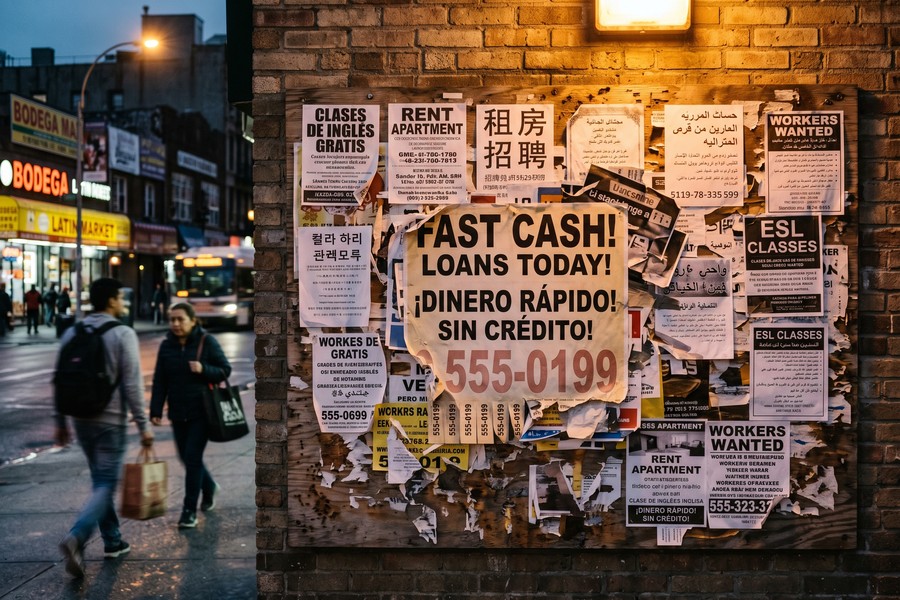
Payday lenders and some installment loan storefronts often advertise heavily in immigrant neighborhoods. Their effective APRs frequently exceed 200–400% when annualized, despite appearing affordable as a weekly or bi-weekly payment. A $500 payday loan repaid over two weeks at a $75 fee equals an APR of 391%, never use these products to solve a short-term cash need.
Related reading: How to Qualify for a Digital Lending Loan With a 580 Credit Score in 2025.
Frequently Asked Questions
Can I get a personal loan in the U.S. without a Social Security Number?
Yes, many fintech lenders accept an Individual Taxpayer Identification Number (ITIN) in place of a Social Security Number. Lenders including Stilt, Self Financial, and Petal explicitly accept ITINs from borrowers who are not yet eligible for an SSN. You can apply for an ITIN through the IRS using Form W-7, and processing typically takes 7–11 weeks.
Which visa types qualify for immigrant digital loans?
The most commonly accepted visa types are H-1B, L-1, O-1, F-1, J-1, OPT, EAD, and permanent resident (green card) holders. DACA recipients are accepted by several lenders including Stilt and MPOWER. Undocumented individuals without any legal status document generally cannot qualify with regulated lenders, though some nonprofit credit unions offer limited programs. Always check the lender’s visa eligibility page before applying.
How long does it take to get approved for a digital loan as an immigrant with no credit history?
Most fintech lenders that specialize in immigrant lending deliver a decision within 24–72 hours of a completed application. Stilt, for example, advertises decisions in as little as one business day when income verification is completed through a bank account connection. Funding typically follows within 1–3 business days after approval. Incomplete applications or document verification issues are the most common cause of delays.
What is Nova Credit and how does it help immigrants get loans?
Nova Credit is a fintech company that translates foreign credit reports from 20+ countries, including India, Mexico, Canada, Australia, the U.K., South Korea, and Brazil, into a standardized U.S.-equivalent report called the Credit Passport. Partner lenders including American Express and MPOWER use this data to underwrite applicants who would otherwise appear credit invisible. Using Nova Credit costs you nothing as a borrower, lenders pay for the data access.
Will taking out a loan affect my immigration status or visa renewal?
Taking out a loan does not directly affect your immigration status or visa renewal in most cases. However, a history of defaulted debts can theoretically be considered under the “public charge” rule if you apply for certain immigration benefits. For current guidance, consult an immigration attorney or review the USCIS public charge guidance. Making on-time payments and avoiding default eliminates this risk entirely.
What interest rate should I expect on a digital loan with no U.S. credit history?
Expect APRs ranging from approximately 8% to 36% depending on your income, visa type, employment stability, and any available international credit data. Borrowers with verifiable H-1B employment at a major U.S. company and a Nova Credit Passport showing strong foreign credit history often qualify near the lower end of that range. As your U.S. credit file builds, you can refinance into lower-rate products. Our guide to mistakes borrowers make when comparing loan interest rates will help you evaluate offers accurately.
Can I use a digital loan to build credit if I just arrived in the U.S.?
Yes, this is one of the most direct strategies available to new arrivals. A digital loan that reports to all three major credit bureaus creates a payment history tradeline from your very first payment. Combined with a secured credit card and Experian Boost, a new immigrant can reach a scorable FICO result within 3–6 months and a mid-600s score within 12 months of consistent on-time payments, according to myFICO’s new credit scoring guidance.
Should I use a credit union instead of a fintech lender if I have no credit history?
Credit unions are an excellent alternative or complement to fintech lenders. Many community-based credit unions, especially those serving immigrant communities, offer payday alternative loans (PALs) capped at 28% APR by the National Credit Union Administration (NCUA). The tradeoff is that credit unions may require membership and have slower application processes than digital-first fintechs. Using both in parallel, a fintech loan for speed and a credit union relationship for long-term banking, is a strong combined strategy.
What happens if I am rejected for a digital loan as an immigrant?
Rejection does not mean you are out of options. First, request the specific reason for rejection, lenders are legally required to provide an adverse action notice under the Equal Credit Opportunity Act (ECOA). Common reasons include insufficient income documentation, an unsupported visa type, or a missing ITIN. Address the specific reason, then reapply after 30–60 days. You can also start with a credit-builder loan from Self Financial or a secured card while building the documentation needed for a larger loan approval.
Are there any downsides to using immigrant-focused fintech lenders instead of a traditional bank?
Yes, and they are worth knowing before you commit. Loan amounts from immigrant-focused fintechs tend to be capped lower than what a traditional bank might offer a well-qualified borrower, Stilt’s ceiling of $35,000 is typical, and some platforms go no higher than $10,000–$15,000. Interest rates, even at the competitive end of the 8–36% range, can still exceed what a prime borrower would pay at a bank or credit union. Some platforms also have limited product variety: they may offer personal loans but not home equity products, auto loans, or business credit. As your U.S. credit file matures, it is worth reassessing whether mainstream lenders have become accessible, since that is where rates and product flexibility tend to improve most significantly.
Sources
- Consumer Financial Protection Bureau, Data Point: Credit Invisibles
- Internal Revenue Service, Individual Taxpayer Identification Number (ITIN)
- myFICO, What’s in Your Credit Score?
- myFICO, New Credit and How Scoring Works for New Files
- Experian, Experian Boost Program Overview and Average Score Increase Data
- Consumer Financial Protection Bureau, Consumer Complaint Database
- U.S. Citizenship and Immigration Services, Public Charge Rule Overview
- Federal Reserve Bank of New York, Immigrant Household Finance Research (2021)
- Consumer Financial Protection Bureau, Consumer Credit Trends Dashboard
- Nova Credit, Credit Passport and Partner Lender Program
- National Consumer Law Center, Consumer Protection Resources