
Fact-checked by the CapitalLendingNews editorial team
Quick Answer
For purchases under $500 paid on time, BNPL Pay in 4 is cheaper because the effective interest rate is zero. For purchases above $1,500 requiring more than six weeks to repay, digital personal loans are almost always cheaper, BNPL installment plans carry APRs of 10% to 37%, while borrowers with decent credit can qualify for personal loans at 12% to 18% APR with credit bureau reporting included.
You planned the perfect purchase, a new laptop, a home appliance, a piece of furniture that finally makes your space feel livable, and then came the moment of reckoning at checkout. Two options blinked back at you: split it into four easy payments with a BNPL provider, or apply for a digital personal loan. Both promised affordability. Both felt modern and frictionless. But one of them almost certainly costs you more money, and the answer is rarely as obvious as the checkout screen makes it look.
Buy Now, Pay Later has exploded into mainstream finance at a staggering pace. According to the Consumer Financial Protection Bureau (CFPB), Americans took out 180 million BNPL loans in 2021 alone, a figure that had grown nearly tenfold over three years. Meanwhile, digital personal loan originations surpassed $19 billion in a single quarter in 2023, according to TransUnion data. Two enormous lending categories are competing for the same wallet, and millions of consumers are choosing between them without fully understanding the true cost of either.
This guide cuts through the marketing language and gives you a side-by-side financial breakdown. You will see the exact fee structures, interest calculations, credit impact scenarios, and hidden cost traps for both products, across purchases ranging from $500 to $5,000. By the end, you will know precisely which option saves you more money, when each product is actually appropriate, and how to negotiate the best possible terms if you use either one.
Key Takeaways
- BNPL “Pay in 4” plans carry 0% interest but late fees can reach $34 per missed payment, and some longer-term BNPL plans charge APRs as high as 36.99%.
- The average digital personal loan APR ranges from 11.5% to 24.9% for borrowers with credit scores between 670 and 739, according to Bankrate’s 2024 data.
- For a $2,000 purchase paid over 12 months, a 20% APR personal loan costs approximately $222 in total interest, while a BNPL plan with three late fees costs roughly $102 in fees alone, with zero interest credit if payments are on time.
- BNPL approval rates exceed 70% for first-time applicants, often requiring no hard credit pull, but 70% of BNPL users report spending more than they intended, per a 2023 LendingTree survey.
- Digital personal loans report monthly to all three credit bureaus; only 8 of the top 10 BNPL providers report on-time payments, meaning BNPL may not help build your credit score.
- BNPL purchases above $1,500 almost always trigger longer repayment plans with real APRs, making digital personal loans frequently cheaper for large purchases above $1,000.
In This Guide
- How BNPL Actually Works: The Fee Structure Behind the “Free” Payment Plan
- How Digital Personal Loans Work: Speed, APR, and What Lenders Really Charge
- True Cost Comparison: BNPL vs Digital Personal Loans Across Purchase Sizes
- Credit Score Impact: Which Product Helps (or Hurts) You More
- Hidden Costs and Traps Most Borrowers Miss
- Approval Requirements: Who Qualifies for What
- Best Use-Case Scenarios: When Each Product Actually Makes Sense
- Consumer Protections: What the Law Actually Covers
- The Verdict by Purchase Size
How BNPL Actually Works: The Fee Structure Behind the “Free” Payment Plan
Most consumers encounter BNPL through its most visible product: the Pay in 4 model. You make a purchase, pay 25% upfront, and pay the remaining balance in three biweekly installments, all at 0% interest. Companies like Afterpay, Klarna, and Zip built their user bases almost entirely on this format. It genuinely is interest-free if you pay on time.
The business model, however, does not run on goodwill. BNPL providers charge merchants a fee of 2% to 8% per transaction, significantly higher than a standard credit card processing fee of 1.5% to 3%. Retailers accept this because BNPL increases average order values by 20% to 30%, according to a 2023 McKinsey report. You, the consumer, are not paying interest. But you are participating in a system designed to make you spend more.
The Longer-Term BNPL Plans: Where Real Interest Appears
Pay in 4 is the entry product. For purchases above $500 to $1,000, most BNPL providers offer installment loan products with repayment terms of 3, 6, or 12 months. These products carry real APRs. Klarna’s “Financing” product charges up to 29.99% APR. Affirm’s rates range from 0% to 36% APR depending on the merchant agreement and borrower profile. PayPal’s “Pay Monthly” product ranges from 9.99% to 35.99% APR.
The critical detail: the 0% offers on these longer plans are promotional rates, available only through specific merchant partnerships. If you use the BNPL app directly or the merchant has no promotional agreement, you pay the full APR. Most consumers do not realize which version they are accepting at checkout.
Late Fees and Returned Payment Penalties
BNPL late fees vary by provider but are structurally significant. Afterpay charges up to $8 per missed payment, capped at 25% of the order value. Klarna charges up to $7. Zip charges up to $5 per missed payment plus a $5 late fee. While these numbers sound small, they compound quickly across multiple purchases, and multiple BNPL accounts running simultaneously is common. Before using a BNPL service, review our guide on 5 Mistakes People Make When Using Buy Now Pay Later Apps to understand the traps that catch most users off guard.
The average BNPL user in the U.S. has 2.3 active BNPL accounts simultaneously, according to a 2023 Experian consumer study. Running multiple plans increases the probability of a missed payment, and a cascade of fees, significantly.
Returned payment fees add another layer. If a scheduled payment bounces due to insufficient funds, most providers charge $15 to $30 per incident, similar to a bank’s NSF fee. Klarna’s returned payment fee is $25. Afterpay’s is $8 but the account is immediately paused, blocking future purchases until the balance is cleared.
How Digital Personal Loans Work: Speed, APR, and What Lenders Really Charge
Digital personal loans are unsecured installment loans issued entirely online, typically funded within 1 to 5 business days. Providers include fintechs like SoFi, LightStream, Upstart, and Marcus by Goldman Sachs, as well as traditional banks with digital application portals. The loan amount typically ranges from $1,000 to $100,000, with repayment terms of 12 to 84 months.
Interest accrues on the outstanding principal using a fixed APR disclosed at the time of approval. There are no surprise rate changes mid-loan. The monthly payment is fixed and predictable from day one. This structural transparency is one of the most significant advantages over BNPL’s fragmented, multi-account model.
APR Ranges by Credit Score Tier
The cost of a digital personal loan depends heavily on your credit profile. According to Bankrate’s 2024 personal loan rate data, borrowers with excellent credit (760+) qualify for APRs as low as 7% to 11%. Good credit borrowers (670–739) typically see rates of 14% to 24%. Fair credit borrowers (580–669) often face rates of 25% to 36%. Borrowers below 580 are frequently declined or offered rates that rival credit card APRs.
| Credit Score Range | Typical APR Range | Monthly Payment on $2,000 / 12 Months |
|---|---|---|
| 760+ (Excellent) | 7% – 11% | $174 – $177 |
| 700–759 (Good) | 12% – 18% | $178 – $183 |
| 670–699 (Fair-Good) | 19% – 24% | $184 – $189 |
| 580–669 (Fair) | 25% – 36% | $190 – $200 |
| Below 580 (Poor) | Often declined or 36%+ | $200+ or no offer |
Origination Fees: The Cost Most Borrowers Undercount
Many digital lenders charge an origination fee of 1% to 8% of the loan amount, deducted from the disbursement. On a $3,000 loan with a 5% origination fee, you receive $2,850 but repay $3,000 plus interest. This fee is factored into the APR calculation, but borrowers comparing offers by monthly payment alone may miss it. LightStream and SoFi charge no origination fees. Upstart’s fee ranges from 0% to 12%. Always compare APR, not just interest rate, when evaluating digital loan offers.
The average origination fee on a personal loan in 2024 was 5.2% of the loan amount, according to LendingTree. On a $3,000 loan, that equals $156 in upfront costs, before interest accrues.
For a deeper understanding of how these costs compound over time, read our explainer on how interest rate compounding works and why it costs more than you expect.
True Cost Comparison: BNPL vs Digital Personal Loans Across Purchase Sizes
Abstract percentages are less useful than concrete dollar comparisons. The table below models the true out-of-pocket cost for three common purchase sizes under three scenarios: BNPL Pay in 4 (paid on time), BNPL with two late fees, and a digital personal loan at 20% APR.
| Purchase Size | BNPL Pay in 4 (On Time) | BNPL with 2 Late Fees | Digital Loan at 20% APR / 12 Mo. |
|---|---|---|---|
| $500 | $500 total | $500 + $16 = $516 | $500 + $56 interest = $556 |
| $1,500 | $1,500 total | $1,500 + $16 = $1,516 | $1,500 + $168 interest = $1,668 |
| $3,000 | N/A (triggers installment plan) | N/A | $3,000 + $336 interest = $3,336 |
| $3,000 via BNPL Installment at 25% APR / 12 Mo. | N/A | N/A | $3,000 + $422 interest = $3,422 |
The math is clear for small purchases under $1,000: BNPL Pay in 4, used responsibly, is cheaper than any personal loan because the effective interest rate is 0%. The calculus flips for larger amounts. A $3,000 purchase on a 25% APR BNPL installment plan costs $86 more over 12 months than the same purchase on a 20% APR personal loan, and that gap widens at higher APRs.
The Hidden Multiplier: Simultaneous BNPL Accounts
The comparison above assumes one purchase. In reality, BNPL users rarely stop at one transaction. The CFPB found that BNPL users carry a median of 3.5 active loans at any given time. If you have four $500 BNPL plans running simultaneously, a common scenario for regular online shoppers, your total monthly BNPL obligation can exceed $500, with no single dashboard showing the complete picture.
A single personal loan for $2,000, by contrast, produces one fixed monthly payment, one account to track, and one payoff date. The administrative simplicity has real financial value for people prone to missed payments.
According to the CFPB’s 2023 Buy Now, Pay Later report, BNPL users were 3 times more likely to be overdrawn on their bank accounts and 2 times more likely to pay credit card late fees compared to non-BNPL users, suggesting that BNPL adds financial stress rather than reducing it for many borrowers.
Credit Score Impact: Which Product Helps (or Hurts) You More
One of the most underappreciated differences between BNPL and digital personal loans is their effect on your credit profile. This matters enormously for anyone trying to qualify for a mortgage, auto loan, or competitive credit card in the next 12 to 36 months.
How Digital Personal Loans Affect Your Credit
Applying for a digital personal loan triggers a hard inquiry, which temporarily reduces your credit score by 5 to 10 points. Once approved, the loan appears on your credit report as an installment account with a reported balance and credit limit. Each on-time payment is reported monthly to Equifax, Experian, and TransUnion, building your payment history, which constitutes 35% of your FICO score.
Paying off a personal loan also improves your credit mix (10% of FICO), particularly if your current profile is dominated by revolving accounts like credit cards. For borrowers actively building credit, a well-managed personal loan is a net positive instrument, even accounting for the initial hard inquiry dip. For more on this topic, explore how digital lending platforms that report to credit bureaus can matter more than most borrowers realize.
How BNPL Affects Your Credit
BNPL’s credit reporting landscape is fragmented and inconsistent. Most Pay in 4 plans do not report on-time payments to the major bureaus. Klarna began reporting some plans to TransUnion in 2022 but excludes Pay in 4 in many cases. Affirm reports some loans but not others depending on the plan type. Experian has noted that BNPL plans do not yet have a standardized scoring treatment across FICO models.
The asymmetry is damaging: missed BNPL payments can be sent to collections and reported negatively, but on-time payments frequently do not build positive history. You bear the downside risk without gaining the upside credit benefit.
| Credit Factor | BNPL (Pay in 4) | BNPL (Installment Plan) | Digital Personal Loan |
|---|---|---|---|
| Hard Inquiry on Application | Usually no (soft pull) | Sometimes (soft or hard) | Yes (hard pull) |
| On-Time Payments Reported | Rarely | Sometimes | Always (all 3 bureaus) |
| Late Payments Reported | If sent to collections | Yes (typically) | Yes (after 30 days) |
| Improves Credit Mix | Not usually | Sometimes | Yes |
| Builds Payment History | Rarely | Sometimes | Yes (monthly) |
The National Consumer Law Center has described this asymmetry as creating a class of “credit-invisible” borrowers who make payments every month and receive none of the credit benefit, building financial discipline with no reward on the credit side. The CFPB’s 2023 BNPL report echoed this concern, noting that the absence of standardized bureau reporting leaves consistent payers with no record of that consistency.
Hidden Costs and Traps Most Borrowers Miss
Both BNPL and digital personal loans contain cost structures that are technically disclosed but rarely understood at the moment of commitment. Knowing where these traps exist is the most actionable financial intelligence in this comparison.
BNPL’s Invisible Traps
The first trap is account proliferation. Because BNPL apps are siloed, Afterpay does not communicate with Klarna, which does not communicate with Affirm, it is easy to accumulate $1,500 to $3,000 in total BNPL obligations across four or five apps without any single lender or even the borrower having a complete picture. There is no credit bureau aggregation that catches this in real time.
The second trap is deferred interest on promotional 0% offers. Some BNPL providers (and retailer-branded BNPL products) use deferred interest structures, not true 0% plans. If you do not pay the full balance before the promotional period ends, interest is charged retroactively on the original purchase amount from day one, not just the remaining balance. On a $1,500 purchase at 29.99% deferred interest with a 12-month promotional period, a single late payment can trigger $450 in retroactive interest charges.
Deferred interest is not the same as 0% APR. Read the fine print carefully, if the offer says “no interest if paid in full by [date],” that is deferred interest. True 0% APR means interest never accrues regardless of when the balance is cleared. The distinction can cost you hundreds of dollars.
Digital Loan Traps: Prepayment Penalties and Rate Bait-and-Switch
Most reputable digital lenders charge no prepayment penalties. However, some lenders, particularly marketplace lenders and credit union partners, include clauses that charge a fee equal to 1% to 2% of the remaining balance if you pay off the loan early. On a $5,000 loan, that is $50 to $100 in fees for doing the financially responsible thing.
The second trap is the rate bait-and-switch. Lenders advertise their lowest possible APR, often 7.99% or 8.99%, in large font. The fine print clarifies that this rate is available only to borrowers with 800+ credit scores who select the shortest repayment term and enroll in autopay. The actual APR offered to most applicants at approval is 4 to 12 percentage points higher. For a thorough breakdown of this issue, our article on 5 mistakes borrowers make when comparing loan interest rates walks through exactly how to avoid being misled.
Approval Requirements: Who Qualifies for What
Access to either product is not equal across borrowers. Understanding qualification requirements helps you identify which door is actually open to you, and whether opening it is wise.
BNPL Qualification: Low Bar, Fast Decision
Most BNPL providers use a soft credit inquiry and proprietary risk models that factor in spending history, bank account data, and purchase context, not traditional credit scores. Klarna, for example, approves applicants at checkout within seconds using machine learning models. Approval rates frequently exceed 70% for first-time users with no prior BNPL history.
This accessibility is a genuine benefit for borrowers with thin credit files or recent negative marks who cannot qualify for a traditional personal loan. However, the low bar also means less underwriting scrutiny, providers are not required to assess whether the borrower can realistically afford the payments. The CFPB has flagged this as a systemic consumer protection concern, noting that BNPL’s ease of access can contribute to overextension.
Personal Loan Qualification: Higher Bar, More Rigorous
Personal loan lenders typically require a minimum credit score of 580 to 620, verifiable income (W-2, 1099, or bank statements), and a debt-to-income ratio below 40% to 50%. The application process takes 5 to 15 minutes online, but approval and funding typically require 1 to 5 business days. This timeline is slower than BNPL’s instant checkout integration, but it forces a deliberate pause that many borrowers benefit from.
Some lenders have expanded access through alternative underwriting models. Upstart, for example, uses education and employment data alongside credit scores. For borrowers without conventional credit history, our guide on digital lending for recent immigrants without a U.S. credit history covers specialized pathways that may be relevant.
Before applying for a digital personal loan, check your rate through prequalification tools, available at SoFi, LightStream, Marcus, and Upstart. Prequalification uses a soft pull and does not affect your credit score. You can compare real rate offers from multiple lenders before committing to a single hard inquiry.
Best Use-Case Scenarios: When Each Product Actually Makes Sense
No financial product is universally superior. The right choice depends on purchase size, your credit profile, your payment discipline, and your timeline. Below are the specific scenarios where each product has a clear advantage.
When BNPL Is the Right Call
BNPL Pay in 4 is genuinely optimal for purchases between $50 and $800 when you have a strong track record of on-time payments, you are not carrying multiple simultaneous BNPL plans, and the merchant offers a true 0% promotional plan (not deferred interest). In this scenario, you borrow at zero cost, something no personal loan can match.
BNPL also works well as a cash flow management tool when you have the money but prefer to keep it liquid for 6 weeks. Paying a $500 item in four biweekly installments while keeping $500 in a high-yield savings account earning 4.5% APY generates a small but real $4.50 in interest income over that period. It is a marginal benefit, but it illustrates how disciplined BNPL use can be net-positive.
When a Personal Loan Is the Right Call
Personal loans are clearly superior for purchases above $1,000 where repayment will extend beyond 6 weeks. The math becomes unfavorable for BNPL the moment you enter installment plan territory with real APRs. A personal loan at 18% APR is cheaper than a BNPL installment plan at 25% APR, and comes with the added benefit of credit bureau reporting.
Personal loans also make more sense when you are consolidating multiple BNPL balances that have become unmanageable. A single $2,500 personal loan that pays off five BNPL accounts simplifies your financial life, may reduce your effective interest rate, and begins building positive credit history, three improvements in one transaction. Our comparison of debt avalanche vs. debt snowball repayment strategies can help you plan the payoff sequence if you are managing multiple balances.
| Scenario | Better Choice | Reason |
|---|---|---|
| $300 electronics purchase, paid on time | BNPL Pay in 4 | 0% cost, no credit impact |
| $800 appliance, tight cash flow | BNPL Pay in 4 (if disciplined) | 0% if on time; risk of fees if not |
| $2,000 furniture, 12-month repayment | Digital Personal Loan | Lower APR than BNPL installment |
| $4,000 medical expense | Digital Personal Loan | Fixed rate, credit reporting, no account proliferation |
| Consolidating 4 BNPL accounts | Digital Personal Loan | Single payment, lower total cost |
| No credit history, small purchase | BNPL (with caution) | Accessible; use to build habits, not credit |

Consumer Protections: What the Law Actually Covers
Understanding what legal protections apply, and where they are absent, is critical before committing to either product. The regulatory environment for BNPL is significantly less mature than for personal loans.
Digital Personal Loan Protections
Personal loans are regulated as consumer installment loans under the Truth in Lending Act (TILA), which requires full APR disclosure, standardized fee disclosure, and a right to dispute billing errors. They are also subject to the Equal Credit Opportunity Act (ECOA), the Fair Credit Reporting Act (FCRA), and state-specific usury caps that limit the maximum allowable interest rate. These protections are well-established and actively enforced.
If a digital lender makes an error, misapplies a payment, reports inaccurate information to a credit bureau, or charges an unauthorized fee, you have clear statutory remedies including CFPB complaints, FCRA disputes, and in egregious cases, class action litigation. The regulatory framework for personal loans has been stress-tested over decades.
BNPL’s Regulatory Gap
BNPL exists in a regulatory gray zone. Because Pay in 4 plans are structured as purchase agreements rather than traditional loans, most have historically avoided TILA coverage, meaning APR disclosure was not required, even when fees created an effective APR. The CFPB issued an interpretive rule in 2024 classifying BNPL as a credit card under TILA for certain purposes, but implementation and enforcement remain in early stages.
The National Consumer Law Center has stated directly that consumers using BNPL lack many of the protections they would have with a credit card, specifically the right to dispute a charge and the right to have a refund credited back to the account. The law has not kept pace with the product, and until enforcement catches up, consumers have fewer statutory remedies when something goes wrong.
Refund processing is a particular pain point. If you return a BNPL purchase, the refund process varies widely by provider. Some BNPL companies pause future installments immediately upon merchant confirmation of the return. Others require the borrower to continue making payments until the merchant processes the refund and the BNPL company receives confirmation, a process that can take 7 to 21 days, during which a scheduled payment may auto-debit and create a temporary negative balance.
The Verdict by Purchase Size
The comparison between BNPL vs digital personal loans does not produce a single winner, it produces a decision framework based on the specific numbers involved. Below is the definitive breakdown.
Under $500: BNPL Wins, With Conditions
For purchases under $500 using a true Pay in 4 product, BNPL is cheaper than any personal loan if, and only if, you make all four payments on time. The minimum personal loan amount at most digital lenders is $1,000, so BNPL may be the only real option at this level anyway. Use autopay, link to a checking account with a consistent balance, and treat the plan as a short-term cash flow tool, not a license to overspend.
$500 to $1,500: Evaluate Both
In this range, both products are genuinely competitive. BNPL Pay in 4 is cheaper at 0% if you are reliable. A personal loan at 12% to 18% APR is more expensive in raw interest but offers credit bureau reporting and a single consolidated payment. If you are building credit, the personal loan may be worth the marginal extra cost. If your credit is already strong and your payment discipline is solid, BNPL wins on cost.
Above $1,500: Personal Loans Win
For purchases above $1,500 that require more than 6 weeks to repay, digital personal loans are almost always cheaper than BNPL installment products. Across this comparison, the personal loan consistently wins: lower APR, credit bureau reporting, consumer law protections, and a fixed payoff date. The only exception is a confirmed 0% promotional BNPL offer from a merchant with no deferred interest clause, verify this in writing before accepting.
For a $3,000 purchase repaid over 12 months, the cost difference between a BNPL installment plan at 28% APR and a digital personal loan at 18% APR is $168. Over 24 months on a $5,000 purchase, the same 10-percentage-point APR spread costs $556 more in interest, enough to fund a modest emergency savings account.
Ted Rossman, Senior Industry Analyst at Bankrate, has observed that consumers using BNPL for a $3,000 purchase are often paying more in interest than they would with a personal loan from a reputable digital lender, but the frictionless checkout experience makes it feel cheaper. That gap between perception and reality is where the financial damage occurs.
Real-World Example: Marcus vs. Affirm for a $2,800 Laptop Purchase
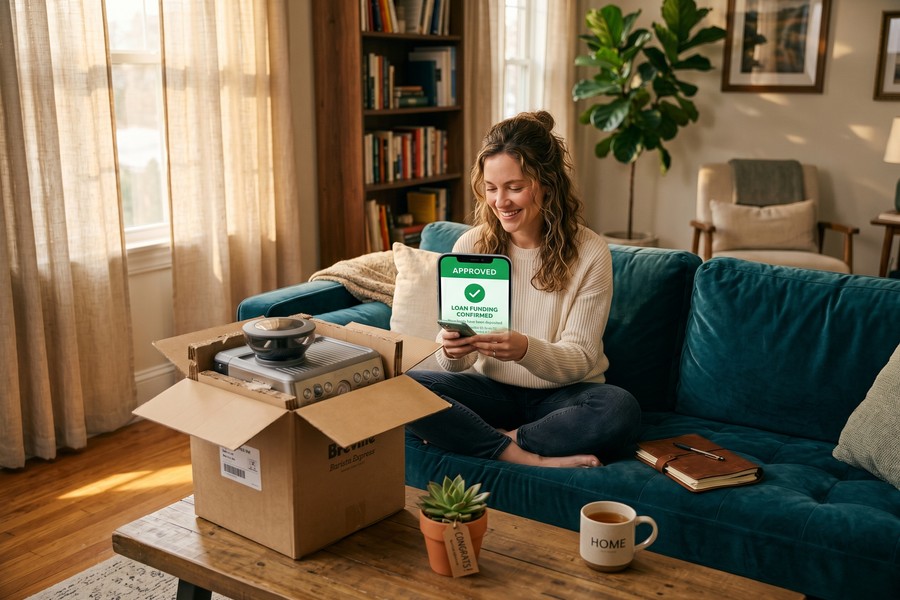
In late 2023, a 29-year-old graphic designer named Priya needed a new MacBook Pro for client work, a $2,800 purchase that exceeded her current cash reserves. At checkout on the Apple website, Affirm offered her a 12-month installment plan at 21.99% APR, which calculated to a monthly payment of $261 and a total repayment of $3,132–$332 in interest charges over the year.
Before accepting, Priya spent 20 minutes checking prequalification offers on Marcus by Goldman Sachs and LightStream. Her 714 credit score earned her a prequalification offer from Marcus at 14.99% APR with no origination fee and a 12-month term, a monthly payment of $252 and a total repayment of $3,024. The difference was $108 in interest savings, and the Marcus loan would be reported to all three credit bureaus each month.
Priya accepted the Marcus offer, declined Affirm at checkout, and used the loan funds to purchase the laptop. Twelve months later, she had paid $108 less in interest than she would have through BNPL, her credit score had increased 22 points from the consistent on-time payment history, and she qualified for a 0.75% lower rate on her car refinance the following spring, a downstream benefit worth approximately $200 in additional interest savings over the remaining loan term.
The total financial benefit of choosing the digital personal loan over BNPL, accounting for the credit score improvement and downstream rate benefit, was approximately $308. The 20-minute research investment had an effective hourly return of $924. This is the real math behind the BNPL vs digital personal loans decision at scale.
Your Action Plan
-
Define the exact purchase amount before evaluating any product
The single biggest variable in the BNPL vs digital personal loan decision is purchase size. Amounts under $500 favor BNPL Pay in 4; amounts above $1,500 favor digital personal loans in most credit scenarios. Know your number first, then evaluate products.
-
Check your credit score before applying anywhere
Pull your free credit report at AnnualCreditReport.com and check your score through your bank or a free service like Credit Karma. Your credit score determines the APR tier available to you on a digital personal loan, and whether that loan will cost less than a BNPL installment plan.
-
Prequalify for digital personal loans before accepting BNPL at checkout
Use the prequalification tools at Marcus, SoFi, LightStream, and Upstart. This process takes 5 minutes and uses a soft pull that does not affect your credit. You will see real rate offers, not advertised minimums, that let you make an apples-to-apples cost comparison before committing to anything. Our guide on how to get a digital loan approved faster walks through exactly what information to prepare.
-
Read the BNPL terms for deferred interest language
Before accepting any BNPL promotional offer, especially at retail partners, search for the phrase “no interest if paid in full.” This signals deferred interest, not true 0% APR. Look instead for language that says “0% APR” explicitly. If you cannot find clear language, decline the offer and use a personal loan or your own savings instead.
-
Calculate the total repayment cost for both options in dollars, not percentages
Use a loan calculator (available at Bankrate.com or NerdWallet.com) to convert APR into a total dollar cost for your specific purchase size and repayment timeline. Compare that dollar figure to the BNPL cost including any projected late fees. Decision-making with specific dollar amounts is significantly more accurate than comparing percentage rates abstractly.
-
Set up autopay immediately upon accepting any installment obligation
Whether you choose BNPL or a personal loan, configure automatic payments before your first due date. BNPL late fees (up to $34 per missed payment) and personal loan late fees (typically 5% of the payment amount or $15 minimum) both erode your cost advantage. Autopay is the single most effective tool for keeping the product you chose actually as cheap as it should be.
-
If using BNPL, limit yourself to one active plan at a time
Account proliferation is the single biggest financial risk in BNPL usage. Commit to paying off one BNPL plan before opening another, regardless of how attractive a new offer looks. Treat each BNPL obligation as you would a credit card balance: one at a time, paid in full before adding more debt.
-
Review your debt repayment strategy if you are carrying multiple accounts
If you are already managing multiple BNPL accounts alongside other debt, consider whether a consolidation personal loan makes sense. Explore structured repayment approaches by reading our comparison of debt avalanche versus debt snowball methods to determine which strategy eliminates your balances fastest given your specific interest rates.
Frequently Asked Questions
Is BNPL always interest-free?
No. BNPL Pay in 4 products are interest-free if you make all four biweekly payments on time. BNPL installment products for larger purchases carry real APRs ranging from 9.99% to 36.99% depending on the provider and your credit profile. Always check the specific plan terms, not the general brand reputation, before accepting any BNPL offer above $500.
How does BNPL affect my credit score?
The impact is asymmetric and largely negative. Most BNPL Pay in 4 plans do not report on-time payments to credit bureaus, so you receive no credit benefit from responsible use. Missed payments, however, can be sent to collections and reported negatively. BNPL installment plans have more varied reporting, some lenders report to one or more bureaus, but coverage is inconsistent. Digital personal loans report monthly to all three bureaus, making them far more useful for credit building.
Can I use a digital personal loan to pay off BNPL balances?
Yes, and this is often a financially sound move. If you are managing multiple BNPL accounts with a combined balance above $1,000, a consolidation personal loan at a lower APR simplifies repayment, may reduce total interest paid, and begins building positive credit history. Use the loan proceeds to pay off each BNPL account in full, then make a single monthly loan payment going forward.
What credit score do I need for a digital personal loan?
Most digital lenders require a minimum score of 580 to 620 for approval, though the most competitive APRs require 700 or above. Some lenders like Upstart use alternative underwriting that considers education and employment history, which can help borrowers with thin credit files. Even if you qualify, compare the offered APR carefully against BNPL installment rates, approval does not guarantee the loan is cheaper.
Are there purchase limits for BNPL?
Yes. BNPL Pay in 4 plans typically cap at $1,000 to $2,000 per transaction, with some providers capping as low as $500 for first-time users. BNPL installment loans can reach $17,500 to $30,000 with providers like Affirm and Klarna for qualified borrowers. For large purchases above these limits, a digital personal loan is the only structured installment option available through a single account.
Do BNPL providers charge fees for early repayment?
Generally, no. Most BNPL providers allow early payoff without penalty, and paying off a BNPL plan early can free up purchasing power for future transactions with that provider. Personal loans from reputable lenders also typically have no prepayment penalties, but verify this before signing. A handful of marketplace and credit union lenders do include early repayment fees of 1% to 2% of the remaining balance.
What happens if I miss a BNPL payment?
Consequences vary by provider. Afterpay immediately pauses the account, blocking new purchases, until the missed payment and fee are cleared. Klarna charges a late fee and sends email reminders before escalating. If the debt remains unpaid, most BNPL providers will eventually sell the balance to a collections agency, at which point it appears on your credit report as a negative item. Missing BNPL payments has tangible consequences; the frictionless checkout does not eliminate the financial obligation.
Is BNPL regulated the same way as personal loans?
Not yet, though the regulatory picture is evolving. Personal loans are fully regulated under TILA, ECOA, and the FCRA, with consumer protections including APR disclosure, dispute rights, and usury caps. BNPL has historically operated with fewer regulatory requirements, though the CFPB’s 2024 interpretive rule classifying BNPL as a credit card for certain TILA purposes represents a significant step toward parity. Until enforcement catches up, consumers have fewer statutory protections when using BNPL.
Which is better for someone with poor credit: BNPL or a personal loan?
For borrowers with scores below 580, BNPL may be the only accessible option since most digital personal lenders will decline the application or offer prohibitively high APRs. BNPL is accessible without a traditional credit score, but the absence of positive credit reporting means it does not help rebuild credit either. A secured personal loan or a credit-builder loan from a credit union may be a better long-term strategy for rebuilding credit while meeting immediate purchase needs.
How do I know if a BNPL offer is truly 0% APR or deferred interest?
Read the fine print carefully. True 0% APR means no interest accrues on any portion of the balance during the promotional period. Deferred interest means interest accrues during the promotional period but is waived if the balance is paid in full by the end date, and charged retroactively if it is not. The phrase “no interest if paid in full by [date]” signals deferred interest. True 0% offers will state “0% APR” explicitly and will not reference a single payoff deadline.
What should I do if a merchant refund is delayed while my BNPL payments continue?
Contact the BNPL provider directly and document the refund confirmation from the merchant in writing. Most providers will pause scheduled payments upon receiving merchant confirmation of a return, but this requires you to initiate the conversation, it rarely happens automatically. If a payment auto-debits before the refund posts, request a fee waiver in writing. Under the CFPB’s 2024 interpretive rule, BNPL providers classified as credit card issuers for TILA purposes are required to investigate disputed transactions, giving you a clearer avenue to escalate if the provider does not respond promptly.
Can running multiple BNPL accounts affect my ability to get a mortgage?
Potentially yes, though the mechanics are indirect. BNPL installment plans that appear on your credit report increase your debt-to-income ratio, which mortgage underwriters scrutinize closely. Even plans that do not appear on your credit report may show up in bank statement reviews, most mortgage lenders request 2 to 3 months of statements, and recurring BNPL debits are visible. Mortgage underwriters can and do ask borrowers to explain recurring payment patterns. Managing a large number of simultaneous BNPL accounts in the months before a mortgage application is worth reconsidering.
The CFPB received more than 5,000 consumer complaints about BNPL products in 2023, the most common issues were disputes over merchant refunds not being processed correctly and unexpected fees charged on accounts borrowers believed were current. This complaint volume exceeds that of many regulated credit card issuers with far larger customer bases.
A borrower choosing a digital personal loan at 16% APR over a BNPL installment plan at 26% APR for a $3,500 purchase repaid over 18 months saves $283 in total interest, money that, redirected to a high-yield savings account, could seed a $300 starter emergency fund in the same timeframe.
On BNPL vs digital personal loans: BNPL is a precision tool that works well within narrow parameters, small purchases, reliable payment history, and a true 0% offer. Outside those parameters, digital personal loans are almost always cheaper, better protected by law, and more beneficial to your long-term credit profile. The checkout screen makes BNPL feel like the easy choice. The math, examined honestly, often tells a different story. For anyone managing multiple financial obligations alongside this decision, building a financial buffer is equally critical, our guide on how to build an emergency fund when you live paycheck to paycheck provides a practical starting framework.