
Fact-checked by the CapitalLendingNews editorial team
Quick Answer
The most damaging credit score mistakes include carrying high credit utilization above 30%, missing payments, closing old accounts, applying for too much credit at once, and ignoring errors on your credit report. These five errors can silently drop your score by 50–100+ points, costing you thousands in higher interest rates over time.
Avoiding the most common credit score mistakes is one of the highest-return financial moves you can make. According to the Consumer Financial Protection Bureau, even a 100-point difference in your credit score can mean paying $40,000 or more in extra interest over the life of a 30-year mortgage. The gap between a good score and an excellent one is often just a handful of correctable habits.
Credit scores have never mattered more. With mortgage rates remaining elevated and lenders tightening underwriting standards, the difference between a 680 and a 760 FICO score can determine whether you qualify for a competitive rate, or pay a punishing premium. Understanding how mortgage rates have shifted in recent years makes it clear why your credit profile is now more consequential than ever.
This guide covers exactly which credit score mistakes to stop making, and what to do instead.
Key Takeaways
- Payment history accounts for 35% of your FICO score, making it the single most impactful factor, according to myFICO’s credit education data.
- Keeping your credit utilization above 30% can lower your score by up to 45 points, according to Experian’s scoring research.
- One missed payment can stay on your credit report for 7 years and drop your score by as much as 110 points if your starting score is excellent, per myFICO’s impact analysis.
- Roughly 1 in 5 Americans have at least one error on their credit report that could affect their score, according to a Federal Trade Commission study.
- Closing an old credit card can reduce your available credit and shorten your credit history, potentially costing you 10–15 points or more, per Experian’s account age research.
- Each hard inquiry from a new credit application can reduce your score by up to 10 points and stays on your report for 2 years, according to Equifax’s inquiry impact data.
In This Guide
- How does high credit utilization hurt my credit score?
- What happens to my credit score if I miss a payment?
- Should I close old credit card accounts I no longer use?
- How many credit applications are too many, and why does it matter?
- How do I find and fix errors on my credit report?
- Frequently Asked Questions
Step 1: How Does High Credit Utilization Hurt My Credit Score?
Credit utilization, the percentage of your available revolving credit that you are currently using, is the second most important factor in your FICO score, accounting for 30% of the total. Keeping it above 30% is one of the most common credit score mistakes, and it quietly depresses your score every single month.
How to Fix This
The fastest way to lower your utilization is to pay down existing balances, ideally before your statement closing date so the lower balance is what gets reported to the bureaus. You can also request a credit limit increase on existing cards. Experian recommends targeting a utilization ratio below 10% for the best score outcomes. Tools like Credit Karma and Experian Boost let you monitor your ratio in real time at no cost.
Spreading balances across multiple cards rather than maxing out one card also helps, since FICO evaluates both overall utilization and per-card utilization. A card at 90% utilization drags your score even if your overall ratio looks fine.
What to Watch Out For
Many people assume utilization is calculated at the end of the month. It is actually based on the balance your lender reports to the credit bureaus, often the statement closing date. Pay before that date, not just before the due date, to ensure a low balance is what gets reported.
One genuine limitation worth acknowledging: requesting a credit limit increase to lower your utilization ratio only works if your lender does a soft pull. Some issuers conduct a hard inquiry for limit increases, which would temporarily ding your score. Ask which type of inquiry the lender will run before making the request.
Consumers with FICO scores above 800 use an average of just 7% of their available credit, according to myFICO’s analysis of top-tier scorers.
If you are also carrying high-interest balances across multiple cards, it may be worth reviewing strategies like the debt avalanche vs. debt snowball method to decide the fastest and cheapest path to paying them down.

Step 2: What Happens to My Credit Score If I Miss a Payment?
Missing a payment is the single most damaging credit score mistake you can make, because payment history makes up 35% of your FICO score. A single missed payment reported to the credit bureaus can drop an excellent score (780+) by as much as 110 points, according to myFICO’s late payment impact modeling.
How to Fix This
Set up autopay for at least the minimum payment on every account. This eliminates the risk of accidentally forgetting a due date. Most banks and credit unions, including Chase, Bank of America, and Wells Fargo, allow you to automate payments directly in their mobile apps. If you have already missed a payment, call your lender immediately and ask for a goodwill adjustment, many lenders will remove a single late mark if you have an otherwise clean history.
If a missed payment has already been reported, dispute it through the AnnualCreditReport.com portal if it is inaccurate, or simply wait. The negative impact of a late payment diminishes significantly after 24 months, though it remains on your report for seven years.
What to Watch Out For
Lenders typically do not report a payment as late until it is at least 30 days past due. If you realize you missed a payment within that window, pay it immediately. The impact of a 30-day late mark is severe, and a 60-day or 90-day late mark is significantly worse.
Autopay set to the minimum payment only protects your score, it does not protect you from accumulating interest. Always aim to pay more than the minimum. Also, be aware that rising interest rates make carrying even small balances increasingly expensive.
According to myFICO’s late payment impact modeling, payment history is the most heavily weighted factor in your credit profile. One late payment can undo years of responsible credit behavior almost overnight, and rebuilding takes consistent on-time payments over time, not a single corrective action.
Step 3: Should I Close Old Credit Card Accounts I No Longer Use?
You should generally avoid closing old credit card accounts, even if you do not use them. Closing an account is one of the most misunderstood credit score mistakes because it simultaneously reduces your available credit (raising your utilization ratio) and can shorten your average age of accounts, which accounts for 15% of your FICO score.
How to Fix This
Instead of closing an old card, keep it open and use it for a small recurring charge, like a streaming subscription, and pay the balance in full each month. This keeps the account active and prevents the issuer from closing it due to inactivity. Capital One and American Express, for example, may close accounts that have had zero transactions for 12–24 months.
If an annual fee is the concern, call the issuer and ask to downgrade to a no-fee version of the same card. Most major issuers offer this option, which preserves your account age and credit limit without costing you anything.
What to Watch Out For
The exception here is a card with a high annual fee that provides no value, or a card linked to a spending pattern you are actively trying to break. In those cases, weigh the financial cost against the score impact before deciding. Keeping a card open is not always the right answer, it is just the right answer more often than people expect.
Before closing any card, calculate how much your utilization ratio will increase. Divide your total balances by your total credit limits, then remove the card’s limit from the denominator and recalculate. If the new ratio exceeds 30%, keep the card open.
The table below compares the impact of the five most common credit score mistakes so you can prioritize which to address first.
| Credit Score Mistake | FICO Factor Affected | Typical Score Impact | Recovery Time |
|---|---|---|---|
| Missing a Payment (30+ days) | Payment History (35%) | -60 to -110 points | 12–24 months |
| High Credit Utilization (above 30%) | Amounts Owed (30%) | -20 to -45 points | 1–2 billing cycles after paydown |
| Closing an Old Account | Length of History (15%) | -10 to -25 points | Months to years (can be permanent) |
| Multiple Hard Inquiries | New Credit (10%) | -5 to -10 points per inquiry | 12 months per inquiry |
| Uncorrected Report Errors | All factors, depending on error | -20 to -100+ points | 30–45 days after successful dispute |
Understanding how each mistake stacks against the others helps you triage your recovery strategy. In most cases, fixing payment history and utilization issues first will produce the fastest improvement.
Step 4: How Many Credit Applications Are Too Many, and Why Does It Matter?
Applying for multiple new credit accounts in a short period triggers multiple hard inquiries, each of which can reduce your score by up to 10 points and remains on your report for two years. This is a common credit score mistake when people are rate-shopping without understanding how to do it correctly.
How to Fix This
When shopping for a mortgage, auto loan, or student loan, FICO’s scoring model clusters multiple inquiries of the same loan type within a 14–45 day window and counts them as a single inquiry, according to myFICO’s inquiry guidelines. Do all your rate-shopping within that window. For credit cards, there is no such clustering, each application counts separately.
Before applying for any new credit, use soft inquiry tools to pre-qualify. NerdWallet, Bankrate, and most major lenders now offer pre-qualification checks that do not affect your score, letting you gauge approval odds before committing to a hard pull. Learning how to compare digital loan offers without hurting your credit score can help you shop smarter.
What to Watch Out For
Retail store cards are a frequent culprit. Many shoppers apply impulsively at checkout for a discount, not realizing they have just triggered a hard inquiry. Over a holiday shopping season, this can add up to four or five inquiries in a matter of weeks.
Hard inquiries from mortgage, auto, and student loan applications made within a 45-day rate-shopping window are treated as a single inquiry by newer FICO scoring models (FICO 8 and above), according to the Consumer Financial Protection Bureau.

Step 5: How Do I Find and Fix Errors on My Credit Report?
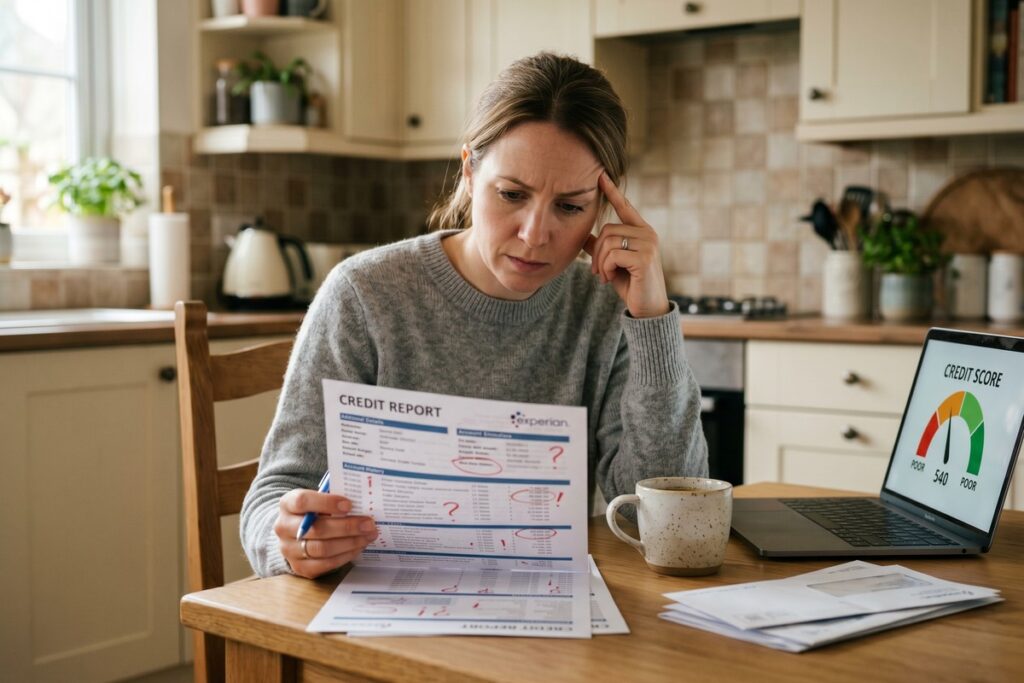
Ignoring your credit report is one of the most expensive credit score mistakes possible, because errors are far more common than most people realize. The Federal Trade Commission found that roughly 1 in 5 Americans have at least one error on their credit report that could affect their score, yet most people never check.
How to Fix This
You are legally entitled to one free credit report per week from each of the three major bureaus, Equifax, Experian, and TransUnion, through AnnualCreditReport.com, the only federally authorized source. Review each report carefully for accounts you do not recognize, incorrect balances, wrong payment statuses, and duplicate entries.
If you find an error, file a dispute directly with the bureau reporting it. Under the Fair Credit Reporting Act (FCRA), bureaus must investigate within 30 days and correct or remove inaccurate information. You can dispute online, by mail, or by phone. Keep records of every communication.
What to Watch Out For
Disputing accurate negative information, such as a legitimately missed payment, will not succeed. Focus only on factual inaccuracies. Also be cautious of third-party “credit repair” companies that charge fees to dispute errors you could dispute yourself for free. The CFPB warns that many such companies make promises they cannot legally keep.
It is also worth setting realistic expectations: even a successful dispute takes time. Bureaus have up to 30 days to investigate, and some complex disputes (involving mixed files or identity theft) can take considerably longer to resolve. If your credit score is needed for an imminent mortgage application, starting the dispute process months in advance is far better than scrambling at the last minute.
According to the Federal Trade Commission’s credit report research, consumers who review their reports and dispute errors frequently find meaningful inaccuracies, errors that have been costing them a higher interest rate on every loan they carry, sometimes for years before anyone catches it.
Stagger your free report requests, pull one bureau’s report every four months rather than all three at once. This gives you year-round monitoring coverage at no cost. Pair this with a free tool like Credit Sesame or Experian’s free monitoring for real-time alert coverage.

Frequently Asked Questions
How fast can I raise my credit score after fixing these mistakes?
You can see measurable improvement in as little as 30–60 days for utilization-related fixes, since credit card balances update each billing cycle. Payment history improvements take longer, typically 12–24 months of on-time payments to significantly offset the impact of a missed payment. Dispute resolutions for errors typically post within 30–45 days of a successful outcome.
What credit score do I need to get the best mortgage rate available?
Most lenders require a FICO score of at least 760 to qualify for their best mortgage rates, though some jumbo lenders set the threshold at 780 or higher. Borrowers with scores between 620 and 759 typically pay noticeably higher rates. According to current mortgage rate data for first-time homebuyers in 2026, even a 40-point score improvement can reduce your rate by 0.25% to 0.75%.
Does checking my own credit score hurt it?
No. Checking your own credit score generates a soft inquiry, which has zero impact on your score. Only hard inquiries, triggered by lender applications, affect your score. You can check your score as often as you like through tools like Experian, Credit Karma, or your bank’s free score feature without any negative consequence.
Can I remove a legitimate late payment from my credit report?
Accurate negative information generally cannot be removed before its natural expiration date of seven years. However, you can submit a goodwill letter to the creditor asking them to remove it as a courtesy, especially if you have a long history of on-time payments and this was a one-time mistake. Some creditors will honor this request, it is not guaranteed, but it costs nothing to ask.
How many credit cards should I have to maximize my credit score?
There is no magic number. Most credit experts recommend having at least 2–3 open revolving accounts to build a diverse credit profile. How you manage those accounts matters far more than how many you have, keeping utilization below 30% and paying on time consistently will do more for your score than simply owning additional cards. Opening too many accounts within a short window can temporarily hurt your score due to hard inquiries and a lower average account age.
Does carrying a small balance on my credit card help my credit score?
No, this is a widely repeated myth. Carrying a balance does not boost your score and only results in paying unnecessary interest. Paying your statement balance in full each month registers as responsible credit usage and keeps your utilization low. As myFICO’s scoring model documentation makes clear, a reported balance of any amount, including $1, counts toward your utilization ratio.
Will consolidating my credit card debt hurt my credit score?
Debt consolidation can temporarily lower your score due to a hard inquiry and a new account being opened, but it often leads to a higher score over time by reducing your overall utilization and simplifying on-time payments. The net effect depends on your individual profile. Review the most common mistakes people make when paying off credit card debt before choosing a consolidation strategy to avoid compounding the problem.
What is the fastest single action I can take to improve my credit score today?
Pay down credit card balances to reduce your utilization ratio, ideally before your next statement closing date. For many people, lowering utilization from 50% to below 10% can add 20–50 points within a single billing cycle. This beats all other short-term tactics because utilization is recalculated fresh every month, unlike payment history, which is cumulative.
How do Buy Now Pay Later loans affect my credit score?
The impact of Buy Now Pay Later (BNPL) loans on credit scores is evolving. Major BNPL providers like Affirm and Klarna are increasingly reporting payment data to credit bureaus, meaning missed payments can now hurt your score. Before using these services, it is worth understanding the most common Buy Now Pay Later mistakes to avoid so short-term convenience does not become a long-term credit problem.
Are these credit score fixes worth pursuing if I am not planning to borrow soon?
Yes, but the urgency is lower. Credit improvement is most valuable in the 6–12 months before a major application, mortgage, auto loan, or apartment rental. If you have no near-term borrowing plans, a consistent, lower-intensity approach (autopay, periodic report review, keeping old accounts open) is enough. Aggressive score optimization makes the most sense when a specific financial goal is on the horizon; chasing a perfect score for its own sake is rarely the best use of your time and energy.