
Fact-checked by the CapitalLendingNews editorial team
A 2024 analysis of Home Mortgage Disclosure Act data found that just 0.248% of all mortgages originated that year included a prepayment penalty clause, a figure so small it might suggest the problem has largely been solved. It hasn’t. The real action has shifted to unsecured digital loans, credit-builder products, and BNPL-style installment financing, where disclosure standards are thinner, design patterns reward fast scrolling, and digital loan prepayment penalties routinely hide inside contract language that deliberately avoids the word “penalty” altogether. Borrowers who celebrate a 24-hour approval are often the least likely to read what happens if they try to pay that loan off in 18 months.
The volume of personal lending through digital channels has accelerated sharply. According to TransUnion data cited by The Financial Brand, originations of unsecured personal loans rose 15% in Q3 2024 versus Q3 2024 the year prior. As origination volume grows, so does the pool of borrowers carrying terms they did not fully absorb. The CFPB’s 2023 Consumer Response Annual Report found that 22% of personal lending complainants reported being charged interest and fees they said they did not expect, the single most common grievance in that category. That is not a rounding error. It is a structural pattern in how digital loan products are sold and disclosed.
By the time you finish reading this article, you will know exactly how prepayment penalties are structured on digital loans, where in the documents they are buried, which lenders and loan types are most likely to charge them, what the real cost math looks like at different payoff points, and what your options are whether you are still shopping or already locked into a loan. The goal is not just awareness but a specific set of actions you can take at each stage of the borrowing process.
Key Takeaways
- Federal law caps prepayment penalties on qualified mortgages at 2% of the remaining balance in year one and 1% in year three, but these caps do not apply to most unsecured digital personal loans, where no federal ceiling exists on penalty size.
- 22% of personal loan complainants to the CFPB in 2023 cited unexpected interest charges or fees as their primary grievance, the most common complaint category for that loan type.
- The CFPB’s 2025 decision to rescind its BNPL interpretive rule means BNPL-style installment products operate outside TILA’s disclosure framework, creating a genuine gray zone for early-repayment fee disclosure.
- Some digital lenders trigger prepayment penalties not only on full payoff but on any lump-sum payment exceeding 20% of the remaining balance, meaning aggressive extra payments can be penalized without a formal payoff.
- SBA 7(a) loans with terms of 15 years or longer carry a prepayment penalty if the borrower prepays 25% or more of the remaining balance within the first three years, per NerdWallet’s analysis of SBA loan program rules.
- Federal credit unions are prohibited from charging prepayment penalties on any loan product, a concrete, enforceable protection that gives borrowers a clear alternative benchmark when evaluating digital lender terms.
In This Guide
- What a Digital Loan Prepayment Penalty Actually Is
- The Language Digital Lenders Use to Disguise These Fees
- Which Digital Lenders Charge Prepayment Penalties, And Which Don’t
- What the Law Does and Doesn’t Require Online Lenders to Disclose
- The Real Cost Math: When a Prepayment Penalty Wipes Out Your Savings
- How to Find and Negotiate a Prepayment Penalty Before You Sign
- If You Already Have a Digital Loan With a Prepayment Penalty
- The State-Law Patchwork That Determines Whether You’re Protected
What a Digital Loan Prepayment Penalty Actually Is
A prepayment penalty is a contractual fee a lender charges when you pay off your loan, fully or partially, ahead of the original schedule. The logic is straightforward from the lender’s perspective: when they approve you for a 48-month loan at 14% APR, their profit model is built on 48 months of interest income. If you pay off in month 18, they collect far less than projected. The penalty is how they recover a portion of that lost revenue.
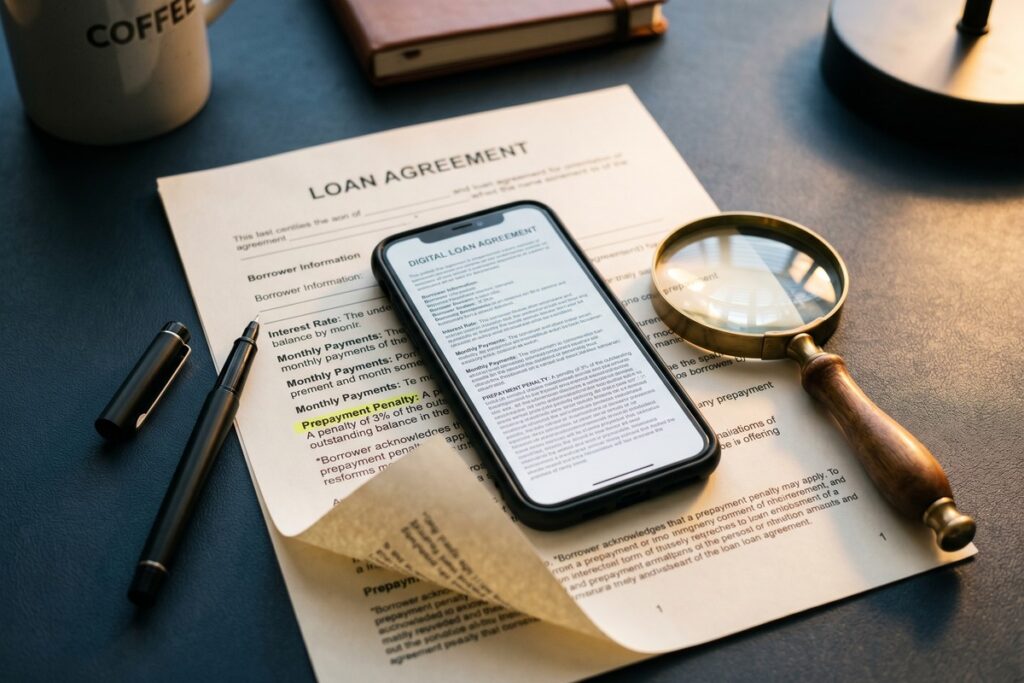
Digital lenders are no different in that basic math. What changes online is how the penalty gets communicated, or more accurately, how it doesn’t. A bank branch loan officer will typically walk you through a paper disclosure at a desk. A digital loan application is designed to move you toward the “confirm and sign” button as efficiently as possible. Penalty language lives in an addendum, a collapsible section, or a checkbox flow that users routinely click through without reading. The same UX principles that make fast approval feel frictionless also make important disclosures easy to miss.
Three Common Penalty Structures
Not all prepayment penalties work the same way, and the structure matters when you calculate your actual exposure. The three formats most common among digital and online lenders are percentage of remaining balance, flat fee, and interest-based penalties.
A percentage-of-remaining-balance penalty is exactly what it sounds like: if you owe $15,000 and the penalty rate is 2%, you pay $300 to exit the loan early. This is the most transparent structure, and it mirrors what the CFPB’s Regulation Z caps at 2% for high-cost mortgages, though again, that cap does not extend to unsecured personal loans. A flat fee is a fixed dollar amount regardless of balance, which can be disproportionately punishing on smaller loans. The interest-based penalty, often phrased as “three months of interest” or “60 days of interest on the amount prepaid”, is the trickiest, because the dollar amount varies depending on when you pay off and how much you owe at that point.
The Psychological Mismatch
Borrowers who feel they’ve “won” by getting fast approval through a digital platform are psychologically in a different mode than someone sitting across from a loan officer with a paper packet. The approval experience is designed to feel like a positive event. Reading fine print is a friction that conflicts with that momentum. This is not a moral failing on borrowers’ part, it is a predictable response to how these products are designed, and lenders who include prepayment penalties benefit from it.
Federal law requires lenders to disclose prepayment penalties in loan documents, but on most personal loans there is no federal rule prohibiting the penalty itself, only a requirement that it be stated somewhere in the paperwork. “Somewhere” can mean page 11 of a 14-page PDF.
The Language Digital Lenders Use to Disguise These Fees
The word “penalty” is almost never used. That is not an accident. Loan agreements drafted by experienced counsel use terms that are technically accurate but unfamiliar enough to pass unnoticed by most borrowers. If you know what to look for, these phrases become flags. If you don’t, they blend into contract boilerplate.
Terms That Mask Early-Payoff Costs
“Precomputed interest” is one of the most consequential, and most overlooked. A loan using precomputed interest (also called an add-on interest loan) calculates all the interest for the entire loan term upfront and adds it to the principal before any payment schedule is set. In a simple-interest loan, paying early reduces the interest you owe. In a precomputed interest loan, the total interest has already been built in. Paying off early doesn’t reduce what you owe, it just accelerates it. The borrower may walk away believing they paid off early and “saved,” when in fact they paid the same total interest as if they had carried the loan to term.
“Interest recapture” is a related phrase used in some digital lending agreements, particularly in certain auto and personal loan products. It means the lender can recoup interest income that was waived or not yet collected if the loan is paid off before a specified date. “Early repayment charge” is more common in UK-originated fintech products that now operate in U.S. markets. And “Rule of 78s” refers to a historical calculation method, now illegal in many states for loans longer than 61 months, that front-loads interest in a way that penalizes early payoff structurally, even when no explicit penalty is listed.
Where to Look in a Digital Loan Agreement
The prominently displayed APR and monthly payment are designed to be seen. The penalty language is typically not. In a digital loan agreement, look specifically at three places: the addendum to the promissory note (sometimes titled “Additional Terms” or “Schedule A”), the Truth in Lending Act (TILA) disclosure section, which should explicitly state whether a prepayment penalty applies, and any checkbox embedded in the e-sign flow, which may contain a brief summary that is technically compliant but practically invisible at 9 p.m. on a mobile screen.
Precomputed interest loans are a structural prepayment penalty that never appears labeled as one. If your loan agreement uses the phrase “precomputed interest” or “add-on interest,” paying early may not save you any money, even if the lender advertises “no prepayment penalty.”
Understanding how loan term length quietly controls total interest cost is a prerequisite for evaluating whether early payoff actually benefits you on any given product. The interaction between term length, interest structure, and early-payoff fees is where borrowers most often get surprised.
Which Digital Lenders Charge Prepayment Penalties, And Which Don’t
The honest answer is more nuanced than most personal finance coverage lets on. Major branded fintech lenders, SoFi, LightStream, Upgrade, Upstart, do advertise no prepayment penalties on their standard unsecured personal loan products. For borrowers who qualify for those products, this is a genuine advantage. But that population is not the whole market.
Where the Risk Is Concentrated
Sub-prime and near-prime digital lenders, credit-builder loan platforms, and certain secured digital loan products are considerably more likely to include prepayment penalties. These lenders serve borrowers with fair or poor credit who have fewer options and less negotiating leverage. This is precisely the population most hurt by penalties they didn’t know to look for. Smaller, less-marketed platforms that appear in comparison shopping results below the top-ten lists are not subject to the same reputational pressure that pushes major brands toward no-penalty policies.
If you are borrowing through a fintech platform that determines your loan limit using non-traditional data, you are also in a product category where terms vary more widely than they do at traditional lenders. The same algorithmic underwriting that may approve you when banks won’t can also produce loan agreements with more complex fee structures.
The Credit Union Benchmark
Federal credit unions are prohibited from charging prepayment penalties on any loan product under the National Credit Union Administration’s regulations. Full stop. This is not a policy they voluntarily adopt, it is a regulatory prohibition. That makes federal credit unions a concrete, actionable alternative when you are comparison shopping, particularly for borrowers who might otherwise turn to a high-rate digital lender. The tradeoff is that credit unions may have slower application processes and more limited digital interfaces than the fintech platforms they compete with.
| Lender Type | Likely Prepayment Penalty? | Notes |
|---|---|---|
| Major Fintech (SoFi, LightStream, Upstart) | No, for standard unsecured personal loans | Advertised no-penalty policy; verify in TILA disclosure |
| Sub-Prime Digital Lenders | More likely, especially on secured products | Often serve fair/poor credit borrowers with fewer alternatives |
| Credit-Builder Loan Platforms | Varies, read terms carefully | Structural precomputed interest may function as a penalty |
| BNPL Installment Products | Typically no explicit penalty | Disclosure gray zone as of Feb 2026; fee structures can change in ToS updates |
| Federal Credit Unions | No, prohibited by regulation | NCUA regulations ban prepayment penalties on all loan types |
| SBA 7(a) Loans (15+ year terms) | Yes, within first three years | Penalty applies if borrower prepays 25% or more of remaining balance |
The average auto loan prepayment penalty is approximately 2% of the borrower’s outstanding balance, according to Bankrate. On a $25,000 remaining balance, that is $500 out of pocket before you receive any interest-savings benefit from the early payoff.
What the Law Does and Doesn’t Require Online Lenders to Disclose
The Truth in Lending Act (TILA) requires lenders to disclose prepayment penalties. What it does not do, on most personal loans, is prohibit them. The distinction matters enormously. A lender can charge a significant prepayment penalty on an unsecured digital personal loan as long as that penalty is disclosed somewhere in the loan documentation. Disclosure buried in page 11 of a digital agreement is technically compliant.
Mortgage Protections Don’t Transfer to Personal Loans
The Dodd-Frank Act and CFPB rules that took effect in 2014 created meaningful restrictions on prepayment penalties for qualified mortgages: capped at 2% of the remaining balance in the first two years and 1% in the third year, with no penalty allowed after year three. The CFPB’s ATR/QM compliance guide also requires that if a creditor offers a loan with a penalty, it must first offer the consumer an alternative loan without one. These are genuine borrower protections. They apply to qualified mortgages. They do not apply to unsecured personal loans, meaning digital personal lenders face no federal ceiling on penalty size, only a requirement to disclose.
The CFPB’s Regulation Z disclosure rule requires that the Loan Estimate form disclose the maximum amount and time period of any prepayment penalty within three business days of application. For mortgage loans, this creates a clean, standardized disclosure window. For personal loans, no equivalent standardized form exists, disclosures are embedded in lender-drafted documents at varying levels of prominence.
The BNPL Regulatory Gap
The specific risk that has emerged in 2025 and 2026 involves buy-now-pay-later and BNPL-style installment products. The CFPB issued an interpretive rule in 2024 that would have classified certain BNPL digital accounts under Regulation Z credit-card standards, requiring standardized disclosures including early-repayment fee language. In 2025, the CFPB reversed course, indicating it would rescind that rule entirely., BNPL installment products from major platforms operate largely outside TILA’s disclosure framework. Borrowers using these products do not receive the standardized early-payoff fee disclosures they would get on a conventional personal loan. If the fee structure changes in a terms-of-service update, which BNPL platforms can execute with limited fanfare, you may not realize your repayment terms have shifted until you try to pay early.
“LendingClub fleeced consumers looking for a loan online, and will pay $18 million for its alleged misconduct.”
The FTC’s enforcement action established a meaningful precedent: burying fee disclosures in tooltips or below-the-fold mobile text constitutes an unfair and deceptive practice under Section 5(a) of the FTC Act. The $18 million settlement was specifically tied to LendingClub’s failure to clearly disclose origination and upfront fees, the same category of disclosure failure that affects prepayment penalty language. The settlement created regulatory pressure on prominent fintech brands. It has had less effect on smaller, less-visible digital lenders.

The Real Cost Math: When a Prepayment Penalty Wipes Out Your Savings
The instinct to pay off a loan early is generally sound. Paying less interest is good. But when a prepayment penalty is in play, the math requires a specific calculation before you act. Paying off early without running the numbers can cost you money rather than save it.
A Worked Example: $20,000 at 14% APR
Consider a $20,000 personal loan at 14% APR with a 48-month term and a 2% prepayment penalty on the remaining balance. Monthly payment is approximately $543. The total interest over 48 months would be about $6,064.
| Payoff Point | Remaining Balance (approx.) | Interest Saved vs. Full Term | Penalty Cost (2%) | Net Gain / (Loss) |
|---|---|---|---|---|
| Month 12 | $15,800 | ~$3,800 | $316 | +$3,484 |
| Month 24 | $10,900 | ~$2,100 | $218 | +$1,882 |
| Month 36 | $5,500 | ~$620 | $110 | +$510 |
| Month 42 | $2,700 | ~$155 | $54 | +$101 |
In this example, the penalty never wipes out the savings entirely, which is reassuring, but specific to a 2% rate on a simple-interest loan. Change the structure to a precomputed interest loan, or raise the penalty rate, and the calculus shifts. On a precomputed interest loan, the “interest saved” column in the table above would be dramatically reduced or eliminated, because much of that interest has already been front-loaded into your payment schedule.
The Breakeven Point and the Partial-Payment Trap
The net-benefit formula is straightforward: interest saved minus prepayment penalty equals net gain or loss. If the result is positive, early payoff makes financial sense. If the result is negative or near zero, you are better off making scheduled payments and redirecting extra cash elsewhere, perhaps toward higher-rate debt where no penalty applies.
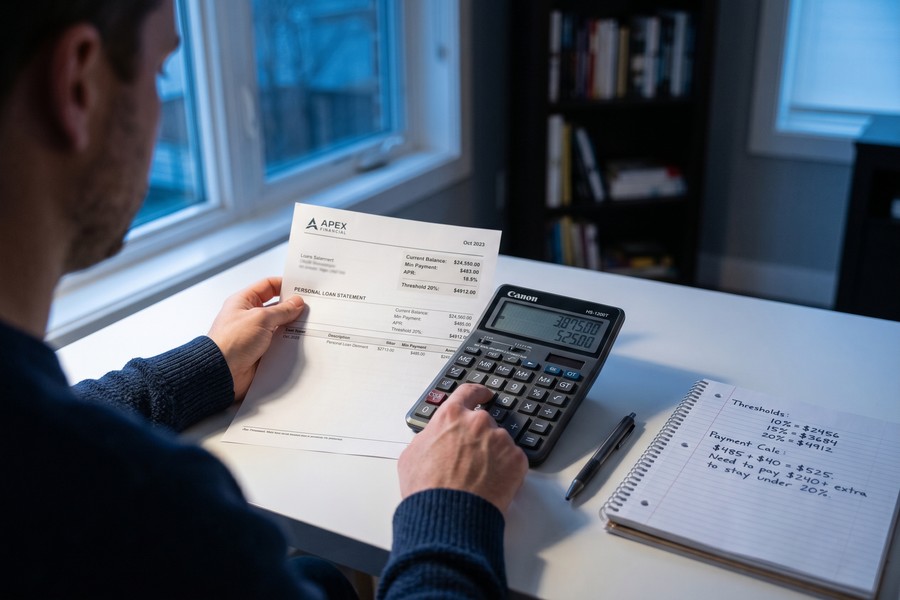
The partial-payment trap is a risk that almost no personal finance content covers. Some digital lenders write penalty triggers that activate not only on full loan payoff but on any single lump-sum payment exceeding a defined threshold, often 20% of the remaining balance. A borrower who receives a $5,000 tax refund and sends it to a loan with an $18,000 remaining balance has just made a payment that exceeds 20% of that balance. Depending on the loan agreement, this could trigger the prepayment penalty even though they have not paid off the loan. Always check whether the penalty clause specifies a partial-payment threshold before making any lump-sum extra payment.
Unsecured personal loan originations rose 15% in Q3 2024 versus Q3 2023, per TransUnion data. As origination volume rises, more borrowers are entering loan agreements without fully evaluating prepayment terms, increasing the population at risk of unexpected penalty costs.
How to Find and Negotiate a Prepayment Penalty Before You Sign
The best time to address a prepayment penalty is before you sign. After signing, your options narrow considerably. The good news is that the pre-signing window, properly used, gives you real leverage, and the CFPB specifically advises borrowers to request a competing quote for a similar loan without a prepayment penalty in order to compare total costs.
A Pre-Signing Checklist
Start with the loan estimate or TILA disclosure. On any digital personal loan, the lender is required to provide a TILA disclosure that explicitly states whether a prepayment penalty applies. If it is not clearly labeled, treat the absence of information as a question, not reassurance. Ask via chat or email, something written, before you e-sign: “Does this loan include any prepayment penalty, partial-payment penalty, or early repayment charge? Does the loan use precomputed or add-on interest?” Getting a written answer protects you if a dispute arises later.
Use soft-pull prequalification tools across multiple platforms to compare not just APR but prepayment terms simultaneously. Rate is only one variable. A 13.5% APR loan with a 2% prepayment penalty may cost more than a 14.2% APR loan with no penalty, depending on how long you carry it. That comparison requires knowing both numbers before you commit.
Negotiating the Penalty Out
Negotiation is possible, though it is not universal. Some digital lenders will agree to remove a prepayment penalty clause in exchange for a slightly higher interest rate or a commitment to automatic payments. This conversation must happen before signing, not after. Once the agreement is executed, the lender has no contractual obligation to amend it. If a lender refuses to negotiate at all and the penalty clause is material to your repayment plans, that is a clean signal to move to the next lender in your comparison set.
When using a digital lender’s live chat before signing, ask specifically: “Does this loan have a prepayment penalty, and does a lump-sum payment over 20% of the remaining balance trigger any fee?” Save the transcript. If the chat agent says no and your agreement says yes, that written exchange becomes evidence in a complaint to the CFPB or your state attorney general’s office.
Understanding the full cost picture also means considering how your debt-to-income ratio affects your application and loan terms on digital platforms. Borrowers with tighter DTI ratios have less flexibility to absorb penalty costs if their financial situation changes and early payoff becomes necessary.
If You Already Have a Digital Loan With a Prepayment Penalty
You signed the loan. The penalty clause is in the agreement. Your options are more limited than they would have been before signing, but they are not zero. The right choice depends on how large the penalty is, how far you are into the loan term, and what interest rate you could get on a refinance.
The Decision Framework
First, identify whether the penalty window is still open. Most prepayment penalties on personal loans run two to three years from origination. If you are within six months of the penalty window closing, the simplest answer is usually to wait. Continue making scheduled payments, and once the penalty period expires, you can pay off or refinance without the fee.
If the penalty window is not closing soon, run the refinance math. The question is whether refinancing into a no-penalty loan at your current credit profile produces a lower total cost even after paying the existing penalty. If your credit score has improved since origination, which is common after 12 to 24 months of on-time payments, you may qualify for a materially better rate. The calculation: (remaining interest on current loan) minus (total interest on new loan plus the prepayment penalty) equals the net benefit of refinancing. If that number is positive and meaningful, refinancing makes sense.
Working Within the Penalty Structure
If the penalty window is open and refinancing doesn’t pencil out, focus on making payments below the partial-payment threshold. Make extra payments equal to 15% or less of the remaining balance at a time, if your agreement specifies a 20% trigger, though the exact threshold varies by lender, so confirm yours. Redirect any lump sums beyond that amount to higher-interest debt where no penalty applies. This approach does not eliminate the penalty exposure but stops you from accidentally triggering it through well-intentioned extra payments.
Borrowers who used fintech platforms specifically because of income variability, including gig workers and seasonal workers, face the sharpest version of this challenge. If income spiked temporarily and you want to use the windfall to reduce debt, the penalty trap can convert a smart financial instinct into an unexpected cost. This is a particular concern covered in our guide on digital lending strategies for gig workers navigating income gaps.
BNPL products from platforms like Klarna, Afterpay, and Affirm generally do not carry traditional prepayment penalties. But the CFPB’s 2025 withdrawal of the BNPL interpretive rule means these products operate outside TILA’s standardized disclosure framework. Fee structures can change through terms-of-service updates with limited notice, so what is true today may not be true when you try to pay off early six months from now.
The State-Law Patchwork That Determines Whether You’re Protected
Where you live matters, but not as much as most borrowers assume, because the charter of your lender can override your state’s protections entirely. This is one of the most consequential and least-explained aspects of prepayment penalty law.
California’s 2020 Ban and Its Limits
California prohibited prepayment penalties on consumer loans under $5,000 and implemented restrictions on larger consumer loans as part of the California Consumer Financial Protection Law, which took effect in 2020. If you are a California resident borrowing from a California state-chartered lender, you have meaningful protection. That protection may not reach you if you borrow from a nationally chartered bank operating under federal preemption rules. Federal banking law allows nationally chartered institutions to export the laws of their home state to borrowers in other states, a doctrine that has been used to circumvent state-level consumer protections for decades.
In practical terms: if your digital loan is originated by a nationally chartered bank rather than a state-chartered lender, your state’s prepayment penalty rules may not apply to you, regardless of where you live. The borrower has almost no way to know their lender’s charter type without deliberately researching it. Look for the lender’s regulatory disclosures, typically in the footer of their website or in the loan agreement itself, which should identify the regulatory agency that supervises them (OCC for nationally chartered banks, FDIC for state-chartered banks, CFPB/state regulators for non-bank fintechs).
State-by-State Variation
| State | Prepayment Penalty on Consumer Loans | Key Caveat |
|---|---|---|
| California | Restricted/prohibited under state law (2020) | May not apply to federally chartered bank lenders |
| New York | Limited restrictions for certain loan types | Varies by loan type; personal loans have fewer protections than mortgages |
| Texas | No state ban on personal loan prepayment penalties | Federal disclosure rules apply; no state-level penalty cap |
| Florida | No state ban on personal loan prepayment penalties | Borrowers rely on TILA disclosure requirements only |
| Federal Credit Unions (all states) | Prohibited by NCUA regulation | Applies regardless of state; strongest available protection |
The practical implication is that your best protection is not your state of residence, it is your choice of lender type. Federal credit unions and major fintech lenders with explicit no-penalty policies offer more reliable protection than relying on state law, because state law can be preempted and varies by lender charter in ways that are opaque to most borrowers.
The CFPB’s ATR/QM rules require that if a creditor offers a mortgage loan with a prepayment penalty, they must also offer the consumer an alternative loan without one. No equivalent “parallel offer” requirement exists for unsecured digital personal loans, leaving the burden of comparison shopping entirely on the borrower.
This connects directly to the broader question of how digital lending platforms decide your terms. If you are curious about the mechanics of how a fintech lender’s algorithm sets your specific rate, understanding how fintech lenders use payroll and alternative data to approve borrowers provides useful context for why terms vary so significantly across the non-bank lending market.
22% of personal loan complainants to the CFPB in 2023 cited unexpected interest or fee charges, the single most common complaint category, according to CFPB’s 2023 Consumer Response Annual Report. Unexpected fees are not a fringe experience, they are the norm for a significant share of digital loan borrowers.
Real-World Example: The Extra Payment That Cost $400
Consider an illustrative example: a borrower we’ll call Maya takes out a $22,000 personal loan through a digital platform in January 2024. The loan carries a 36-month term, a 15.9% APR, and a prepayment penalty equal to 2% of the remaining balance if any single payment exceeds 20% of the outstanding balance within the first 24 months. The penalty language appears in the “Additional Terms” section of the e-sign document, not in the prominently displayed TILA summary Maya reviewed before clicking “Accept.”
In November 2024, Maya receives an $8,000 year-end bonus. She wants to apply $5,500 of it to her loan, reasoning that reducing the principal will cut her future interest costs. At that point, her remaining balance is approximately $18,400. A payment of $5,500 represents roughly 29.9% of the remaining balance, well above the 20% threshold in her agreement. The lender charges a prepayment penalty of $256 (2% of the $12,900 remaining after the payment). Maya also calls to confirm the remaining balance after the payment and is informed she is now in a “modified repayment calculation” that extends her minimum payment slightly due to the penalty fee being capitalized. The net result: she saves approximately $1,100 in future interest from the reduced principal, but she pays $256 in penalty and spends three hours on the phone resolving the confusion, a meaningful but avoidable friction cost.
Had Maya known the 20% partial-payment threshold in advance, she would have split the payment into two separate payments made 31 days apart, each representing 14–15% of the remaining balance. This would have been below the trigger threshold, avoided the penalty entirely, and achieved almost the same interest savings on an identical timeline. The information needed to make that decision was in her loan agreement. She did not know to look for it.
After this experience, Maya uses the CFPB’s prepayment penalty complaint process to flag the disclosure placement with her state regulator and requests that her next digital loan comparison include explicit documentation of any partial-payment threshold. She also refinances the remaining balance into a no-penalty loan 14 months later, when her credit score has improved enough to qualify for a 12.4% APR product, saving an estimated $480 in additional interest over the remaining term, net of the small prepayment penalty she pays to exit the original loan.
Your Action Plan
-
Identify whether your target loan uses simple interest or precomputed interest
Before anything else, ask the lender directly, in writing, whether the loan uses simple interest or precomputed (add-on) interest. If it uses precomputed interest, early payoff will not reduce the total interest you owe in the same way. Treat a precomputed interest structure as a structural penalty, regardless of whether the agreement uses that word.
-
Locate the prepayment penalty clause in the TILA disclosure and loan addendum
Do not rely on the APR summary or the monthly payment screen. Open the full loan agreement and TILA disclosure and search specifically for the terms “prepayment,” “early repayment,” “precomputed,” “interest recapture,” and “Rule of 78s.” If any of these appear, read the surrounding paragraph carefully and note the penalty rate, the trigger conditions, and the penalty window duration.
-
Ask about the partial-payment threshold before sending any lump-sum payment
If a penalty clause exists, contact your lender, by chat or email, so you have a written record, and ask: “What is the maximum single payment I can make without triggering a prepayment penalty?” The answer will tell you whether a partial-payment threshold applies and what it is. Keep this number visible any time you plan to make an extra payment.
-
Run the net-benefit calculation before deciding to pay off early
Calculate: (total remaining interest under the original schedule) minus (prepayment penalty cost at current balance) equals the net benefit of early payoff. If the result is less than $200, the financial case for early payoff is weak. Redirect that cash to higher-interest debt with no penalty instead.
-
Check your lender’s charter type if you are relying on state-law protections
If you live in a state that restricts prepayment penalties on consumer loans, verify whether your lender is state-chartered or nationally chartered. Look for the supervisory agency listed in the lender’s regulatory disclosures. If the lender is supervised by the OCC (Office of the Comptroller of the Currency), your state’s prepayment penalty rules may not apply to you.
-
If you are still shopping, request a competing quote without a penalty clause
The CFPB explicitly recommends this approach. Get at least one quote from a lender with a clear no-penalty policy, a major fintech brand or a federal credit union, and compare the total cost including interest and fees over your expected repayment timeline. A slightly higher rate without a penalty may cost less overall if you plan to pay off before the scheduled end date.
-
For BNPL installment products, monitor terms-of-service updates proactively
Given the CFPB’s 2025 withdrawal of BNPL regulatory oversight under Regulation Z, BNPL platforms can adjust fee structures with limited standardized disclosure. If you use BNPL financing for purchases over $500, set a reminder to check your platform’s terms every 90 days, and note the current early-repayment policy in writing so you have a baseline for comparison.
-
Consider whether refinancing makes sense if you are already locked into a penalty loan
If your credit profile has improved since origination and the refinance math produces a positive net benefit, even after paying the existing penalty, act before the rate environment shifts against you. Use a soft-pull prequalification check at two or three no-penalty lenders to get comparative quotes without affecting your credit score. For detailed analysis of how loan term length interacts with refinancing economics, see our guide on whether to pay off a personal loan or build an investment portfolio first.
Related reading: How to Choose the Right Student Loan Refinancing Platform in 2025.
Frequently Asked Questions
Are prepayment penalties legal on personal loans?
Yes, in most U.S. states and on most loan types, prepayment penalties are legal. Federal law requires disclosure of these penalties under the Truth in Lending Act, but it does not prohibit them on unsecured personal loans. Some states, including California, have enacted restrictions for certain consumer loan categories, but federal preemption can limit those protections when the lender is nationally chartered. The strongest borrower protection available is choosing a federal credit union, which is prohibited by NCUA regulations from charging prepayment penalties on any product.
What is the difference between a prepayment penalty and a precomputed interest loan?
A traditional prepayment penalty is an explicit contractual fee charged when you pay off early. A precomputed interest loan is a structural arrangement where all interest for the full loan term is calculated upfront and built into the repayment schedule. Paying off a precomputed interest loan early may not reduce your total interest cost, because the lender has already front-loaded that interest into the loan. In effect, this operates as a penalty that never appears labeled as one. Always ask whether a loan uses simple or precomputed interest before signing.
Do major fintech lenders charge prepayment penalties?
Most large, branded fintech lenders, including SoFi, LightStream, Upgrade, and Upstart, advertise no prepayment penalties on their standard unsecured personal loan products. This is genuine, and for borrowers who qualify for these products it is a meaningful advantage. The risk exists primarily with sub-prime digital lenders, credit-builder loan platforms, secured digital loans, and smaller platforms that do not appear in mainstream top-ten lender comparisons. The borrower population most exposed to prepayment penalties from digital lenders is the one with fair or poor credit, precisely the group with the fewest alternatives.
Can I negotiate a prepayment penalty before signing?
Yes, and this is worth attempting. Some lenders will remove or reduce a prepayment penalty clause in exchange for a slightly higher interest rate or enrollment in autopay. This negotiation must happen before you sign the agreement. Once the loan is executed, the lender has no contractual obligation to amend the terms. Contact the lender directly, by chat or email so you have written documentation, and ask whether a penalty-free alternative is available. If the lender declines, use that information in your comparison shopping with other lenders.
What is the partial-payment threshold I should watch for?
Some digital loan agreements include a trigger that activates the prepayment penalty not only on full loan payoff but on any single lump-sum payment that exceeds a defined percentage of the remaining balance, often 20%. This means a large tax refund or bonus payment applied to the loan could trigger a fee even though you are not paying off the loan entirely. Always ask your lender, in writing, whether a partial-payment threshold exists in your agreement and what the specific percentage is before making any single large payment.
Are BNPL products subject to prepayment penalty rules?
BNPL products generally do not carry traditional labeled prepayment penalties. However, the CFPB’s 2025 withdrawal of its BNPL interpretive rule means these products operate largely outside TILA’s standardized disclosure framework. There is no standardized form requiring BNPL platforms to disclose early-repayment fee structures the way a conventional personal loan requires. Fee terms can be updated through terms-of-service changes with limited borrower notice. Treat BNPL products as a category where the rules are currently less settled than traditional personal loans.
Does paying off a digital loan early hurt my credit score?
Paying off a loan early generally does not hurt your credit score, but it can affect it in indirect ways. Closing a credit account reduces your available credit mix and may reduce the average age of your accounts, both of which can cause a small, temporary score decrease. This effect is typically modest and short-lived. It is a separate question from the prepayment penalty cost, and in most cases the financial benefit of eliminating high-interest debt outweighs any minor credit score impact from early payoff.
What should I do if a lender charged a prepayment penalty I was not told about?
First, review your full loan agreement and TILA disclosure to confirm whether the penalty was disclosed, even in fine print. If you cannot find any disclosure of the penalty and you believe you were not adequately informed, file a complaint with the CFPB at consumerfinance.gov/complaint. Also file a complaint with your state attorney general’s consumer protection office. If you have a written record, a chat transcript, email, or verbal representation from a loan officer, that contradicts the penalty charge, include that documentation. The FTC’s $18 million enforcement action against LendingClub established that digital lenders cannot effectively hide fee disclosures in tooltips or below-the-fold mobile text.
How do SBA loan prepayment penalties work differently from personal loan penalties?
SBA 7(a) loans with terms of 15 years or longer carry a specific prepayment penalty structure: if the borrower prepays 25% or more of the remaining balance within the first three years, a penalty applies. The penalty rate starts at 5% in year one, drops to 3% in year two, and 1% in year three, then expires. This is a clearly defined government program rule, which differs from the more opaque penalty structures in many private digital loans. Small business owners using digital loans for equipment financing or emergency capital should verify whether their specific product follows SBA rules or lender-specific terms.
Is refinancing out of a prepayment penalty loan worth it?
It depends on three variables: how much the penalty costs at your current balance, what interest rate you can qualify for on a new loan, and how much interest remains on your original schedule. Run the full calculation: total remaining interest on the current loan minus total interest on the refinanced loan minus the prepayment penalty cost equals the net benefit of refinancing. If the result is a meaningful positive number, refinancing makes financial sense. If your credit score has improved since you took out the original loan, the rate improvement on the new loan may be substantial enough to justify the penalty cost. Our analysis of fintech refinancing options for borrowers evaluating total cost covers the mechanics in detail.
Sources
- Consumer Financial Protection Bureau, What is a prepayment penalty?
- CFPB, Regulation Z, 12 CFR § 1026.32 (High-Cost Mortgage Requirements)
- CFPB, Regulation Z, 12 CFR § 1026.37 (Loan Estimate Disclosure Requirements)
- CFPB, Ability-to-Repay / Qualified Mortgage Small Entity Compliance Guide
- Federal Trade Commission, LendingClub Agrees to Pay $18 Million to Settle FTC Charges
- Homebuyer.com, Prepayment Penalty: HMDA Data Analysis (2024)
- PYMNTS, CFPB Report: Installments Top Consumer Complaints on Personal Loans (2024)
- Bankrate, Car Loan Prepayment Clause and Average Penalty Rates (2025)
- The Financial Brand, Consumer Lending Trends 2025, citing TransUnion Data
- NerdWallet, Prepayment Penalties on SBA 7(a) Loans Explained (2026)
- CFPB, Loan Estimate Standardized Disclosure Timeline Requirements
- FTC, Digital Lender Disclosure Standards Under Section 5(a) of the FTC Act
- Homebuyer.com, State-Level Prepayment Penalty Rules and Federal Preemption Overview