
Fact-checked by the CapitalLendingNews editorial team
Quick Answer
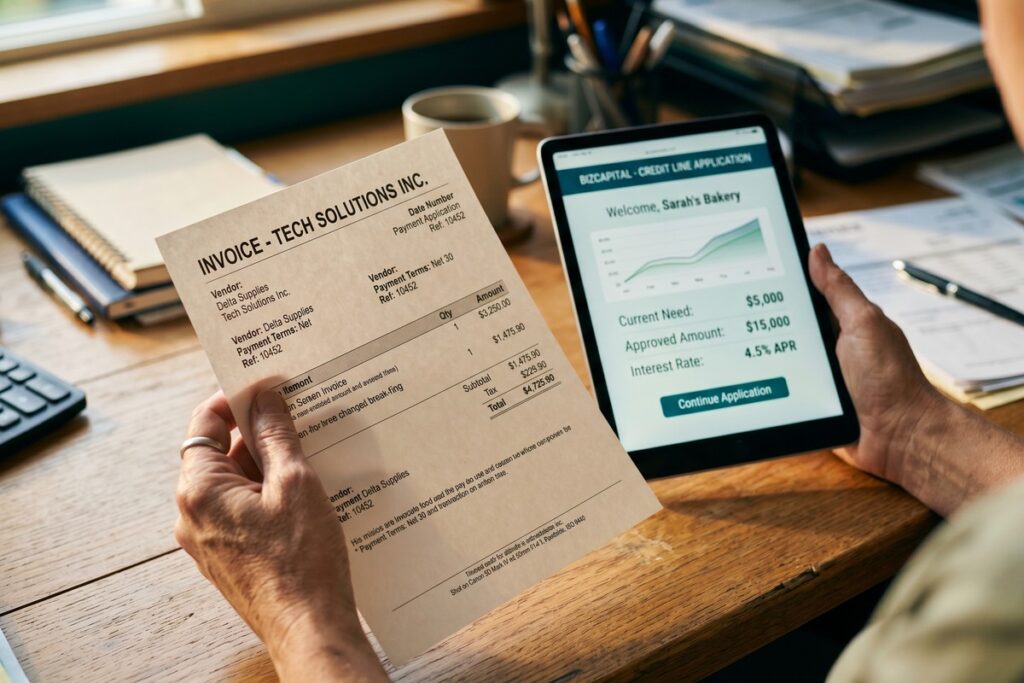
To fix cash flow faster, match the tool to the root cause: use a fintech credit line for unpredictable operating expenses and payroll gaps, or invoice factoring when Net-30/60/90 customer payment terms are the specific problem. Fintech credit lines typically fund draws in 24 hours after setup; factoring advances 80–95% of an invoice’s value within 24–72 hours after onboarding is complete.
Choosing between a fintech credit line vs invoice factoring is not a matter of preference, it is a diagnostic question about where your cash flow gap actually originates. If you are waiting 60 days for a B2B client to pay an invoice you have already earned, factoring that receivable can put cash in your account within 72 hours of setup. If your shortfall is driven by irregular expenses, seasonal swings, or payroll timing, a revolving fintech credit line from a platform like Fundbox, OnDeck, or Kabbage (now operated by American Express) gives you on-demand capital you draw only when you need it. According to the Federal Reserve Banks’ 2025 Report on Employer Firms, 51% of small employer firms cited uneven cash flows as a financial challenge in 2024, which means the problem is widespread, but the right fix depends on your specific version of it.
The fintech lending market has expanded considerably. The 2025 Small Business Credit Survey found that 29% of small business financing applicants sought funding from online fintech lenders, up from just 17% in the 2020 survey. That growth reflects real accessibility gains. But the same survey also found that 60% of small businesses borrowing from online lenders reported actual costs were higher than expected, a sharp warning that speed and availability do not guarantee a fair deal. The rate environment matters too: with the Federal Reserve cutting rates through 2025, variable-rate fintech credit lines have become comparatively cheaper, narrowing the historical cost gap between them and factoring.
This guide is for small business owners, freelancers with B2B clients, and founders who need capital within days, not months. By the end, you will know which product fits your situation, how to calculate the true cost of each, and which red flags to avoid so you do not pay more than necessary to solve a temporary problem.
Key Takeaways
- 51% of small employer firms cited uneven cash flows as a financial challenge in 2024, according to the Federal Reserve Banks’ 2025 Report on Employer Firms, making fast-access financing tools a core business need, not a luxury.
- Invoice factoring advances 80–95% of an invoice’s face value within 24–72 hours after account setup, but a factoring fee of 2% per month on a 60-day invoice annualizes to roughly 24% APR on the advanced amount, comparable to or above many fintech credit lines.
- Fintech credit lines typically require a personal credit score of 620 or higher, at least one year in business, and $50,000–$100,000 in annual revenue; factoring approval depends on your customers’ credit, not yours, making it accessible even with a 580 score.
- 60% of small businesses that borrowed from online fintech lenders reported actual borrowing costs were higher than expected, per the 2025 Small Business Credit Survey, a reason to model total cost before signing any agreement.
- Invoice factoring does not appear as debt on your balance sheet because you are selling a receivable you already own, preserving borrowing capacity for equipment loans or SBA financing, a structural advantage a credit line draw does not share.
- 56% of small business financing applicants in the 2025 Small Business Credit Survey sought funding primarily to meet operating expenses, confirming that revolving credit tools, not one-time loans, are the right category for most cash flow needs, according to the Federal Reserve Banks.
In This Guide
- Step 1: Diagnose What Is Actually Causing Your Cash Flow Gap
- Step 2: How a Fintech Credit Line Actually Works in 2025
- Step 3: How Invoice Factoring Actually Works in 2025
- Step 4: Calculate the Real Cost, APR Math Most Articles Get Wrong
- Step 5: How Fast Does Each Option Fund, and Who Actually Gets Approved?
- Step 6: The Hidden Risks Neither Product Advertises
- Step 7: Which One Should You Use? A Decision Framework for Real Situations
- Frequently Asked Questions
Step 1: Diagnose What Is Actually Causing Your Cash Flow Gap
Before comparing products, identify the source of the shortfall, because the fintech credit line vs invoice factoring decision should be driven by root cause, not by which product is easier to find. The wrong tool solves the wrong problem and often at a higher cost.
How to Do This
Ask yourself one direct question: is the gap caused by money you are waiting to receive, or by expenses that arrived faster than your revenue did? If you have issued invoices with Net-30, Net-60, or Net-90 payment terms and those unpaid balances are what is draining your account, factoring addresses the exact problem. You already earned that revenue, you are just waiting for it. If, on the other hand, your shortfall stems from irregular payroll timing, a supplier invoice that landed before a client paid you, or a seasonal slow period with no specific receivable attached, a revolving credit line fits better because you can draw and repay it as expenses fluctuate.
The median small business holds only 27 days of cash buffer according to JPMorgan Chase Institute research, and a quarter of small businesses operate on 13 days or fewer. That thin margin means choosing the wrong fix does not just cost fees, it can cost you the ability to meet payroll or honor a supplier contract. Getting this diagnosis right is worth more time than most owners give it.
What to Watch Out For
Many business owners assume that if they are short on cash, any fast-capital product will do. That assumption leads to taking on a factoring arrangement for a business that invoices sporadically, or drawing repeatedly on a credit line to cover receivables that could have been factored at a lower effective cost. Also be aware that 56% of small business financing applicants in the 2025 survey sought funding primarily to cover operating expenses, per the Federal Reserve Banks, which means most businesses need a recurring tool, not a one-time fix.
Invoice factoring is strictly a B2B product. If your customers are individual consumers rather than businesses or government entities, factoring is not available to you at all, a fintech credit line is your only fast-capital option in this category.
Step 2: How a Fintech Credit Line Actually Works in 2025
A fintech credit line is a revolving facility: the lender approves a maximum limit, you draw what you need, pay interest only on the drawn balance, and the available credit replenishes as you repay. Platforms like Fundbox, OnDeck, and Kabbage (operated by American Express Business Blueprint) have compressed what once took bank underwriters two to four weeks into a same-day or next-day decision in most cases, after the initial onboarding is complete.
How to Do This
To apply for a fintech credit line, you will typically connect your business bank account and accounting software (QuickBooks, Xero, or a direct bank feed) so the platform can analyze cash flow algorithmically. Most fintech lenders require at least one year in business, between $50,000 and $100,000 in annual revenue, and a personal credit score of 620 to 700 or higher. That bar is lower than a traditional bank, but it is still a real filter. If you fall below these thresholds, fintech lenders that use payroll data to assess borrowers banks would reject may offer an alternative path.
Once approved, most platforms let you initiate draws from a dashboard or mobile app. Funds arrive via ACH the same day or the next business day, depending on the platform and the time of the draw request. Repayment terms typically run 12 to 52 weeks, with weekly or monthly payment schedules. Interest is calculated on the outstanding drawn balance, so if you draw $30,000 from a $75,000 line and repay it in three weeks, you pay interest only on that $30,000 for those three weeks.
What to Watch Out For
Fintech credit lines often carry variable rates tied to the prime rate, which means your cost of borrowing changes as rates shift., with the Fed having cut rates through the year, this works in borrowers’ favor, but it is not permanent. Lenders can freeze or reduce your available credit if your revenue deteriorates or the broader economy tightens. This happened to thousands of small businesses during 2020 when lenders across the board pulled back capacity precisely when owners needed it most. Fintech credit lines also typically require a personal guarantee, meaning your personal assets are on the hook if the business defaults.
A fintech credit line draw appears as a liability on your balance sheet. If you plan to apply for an SBA loan, equipment financing, or a commercial real estate mortgage within the next 12 months, carrying a large drawn balance can increase your debt-to-income ratio and affect approval. Understand how debt-to-income ratio affects digital lending applications before drawing a large amount.

Step 3: How Invoice Factoring Actually Works in 2025
Invoice factoring is the sale of an accounts receivable, not a loan. You submit an unpaid invoice to a factoring company, receive an immediate advance of 80–95% of the invoice value (typically within 24 to 72 hours after account setup), the factor collects directly from your customer when the invoice is due, and then remits the remaining balance to you minus their fee. Because you are selling an asset you already own, factoring does not create new debt on your balance sheet.
How to Do This
The onboarding process for factoring involves submitting business documentation, a sample of your invoices, and information about your key customers, because the factor is underwriting your customers’ creditworthiness, not yours. Companies like BlueVine, Triumph Business Capital, and altLINE have digital portals that handle onboarding in three to seven business days for straightforward B2B receivables. After setup, submitting new invoices for advances is a quick process, often same-day or next-day funding.
Factoring fees typically range from 1% to 5% per month of the invoice face value, depending on your industry, customer credit quality, and invoice volume. Some factors quote a flat fee per invoice instead. The factor also holds a reserve (the portion not advanced upfront) and releases it once your customer pays in full.
What to Watch Out For
There is a critical split you must understand before signing: recourse vs. non-recourse factoring. Under a recourse agreement, if your customer does not pay the invoice, you must repay the advance to the factor. That turns what felt like a receivable sale into a de facto loan with added collection risk. Non-recourse factoring transfers the credit risk to the factor if the customer defaults due to insolvency, but it costs more and the protections are narrower than most business owners realize, factors often carve out disputes and slow payment from non-recourse coverage. Read the contract carefully before assuming you are protected.
According to the 2025 Small Business Credit Survey, 60% of small businesses that borrowed from online lenders said actual costs were higher than expected, a finding that applies equally to factoring arrangements, where fees compound quickly on slow-paying invoices.
| Feature | Fintech Credit Line | Invoice Factoring |
|---|---|---|
| How it works | Revolving facility; draw and repay as needed | Sell unpaid invoices; receive 80–95% advance |
| Typical cost | 15–25% APR on drawn balance | 1–5% per month; ~24–60%+ APR on 60–90 day invoices |
| First-time funding | Application: 1 day to 2 weeks; draws after: same day or next day | Onboarding: 3–14 days; advances after: 24–72 hours |
| Minimum credit score | 620–700 (personal) | No minimum; based on customer credit |
| Balance sheet impact | Appears as a liability (debt) | Does not appear as debt; reduces receivables |
| Business type required | B2B or B2C eligible | B2B only; no consumer invoices |
| Customer notification | None | Yes; customers are directed to pay the factor |
| Revenue requirement | $50,000–$100,000 annually | Based on invoice volume and customer quality |
| Lien filed | Sometimes; UCC-1 on business assets | UCC-1 blanket lien on all receivables (common) |
| Risk if customer does not pay | No direct impact on credit line | Recourse: must repay advance; Non-recourse: factor absorbs (limited) |
Step 4: Calculate the Real Cost, APR Math Most Articles Get Wrong
The most common mistake in fintech credit line vs invoice factoring comparisons is treating a factoring fee percentage and a credit line APR as directly comparable numbers, they are not, and the math matters enormously.
How to Do This
Here is the calculation that makes the difference concrete. Say a factor charges a 2% monthly fee on a $100,000 invoice with Net-60 payment terms. You receive $90,000 upfront (a 90% advance rate). Over 60 days, you pay $2,000 per month, totaling $4,000 in fees. To annualize that: ($4,000 / $90,000) x (365 / 60) = roughly 27% APR on the advanced amount. If the customer pays late and it stretches to 90 days, the effective APR on a 2% monthly fee climbs above 30%. At 3% per month on a slow-paying 90-day invoice, the effective APR can exceed 60%.
Now compare a fintech credit line at 20% APR. On the same $90,000 drawn for 60 days: ($90,000 x 0.20) x (60/365) = approximately $2,959 in interest. That is less than the $4,000 you would pay for the 2% factoring fee on the same dollar amount over the same period. The factoring fee only beats the credit line in absolute dollar terms when your customers pay in 30 days or fewer.
What to Watch Out For
Both products carry fees that advertisements rarely highlight. Fintech credit lines may charge origination fees of 1–3%, draw fees per transaction, or maintenance fees for unused portions of the line. Factoring agreements often include lockbox fees, wire transfer fees, credit check fees on each customer, and monthly minimum volume requirements. When you model total cost, include all fees, not just the advertised rate. You should also understand how loan term length quietly controls how much interest you actually pay, because the same nominal rate costs dramatically more if your repayment extends.
When evaluating a factoring offer, ask the factor to quote you an annual percentage rate on a hypothetical 30-day, 60-day, and 90-day invoice. If they refuse or say the question does not apply, that is a signal the product is priced in a way that benefits from your not doing the math. Reputable factors will give you a straight answer.

Step 5: How Fast Does Each Option Fund, and Who Actually Gets Approved?
Both products are marketed with “fast cash” language, but the timeline that actually matters is not first-draw speed, it is total time from zero to funded, including onboarding. Neither tool delivers cash on the same day you decide to use it for the first time.
How to Do This
For a fintech credit line, expect the application and approval process to take anywhere from one business day for the simplest cases (strong credit, clean bank data) to two weeks for businesses requiring manual review. Once approved and the line is established, subsequent draws typically fund within the same day or next business day. Platforms like same-day vs. next-day digital lending platforms vary on how quickly they process draw requests, so confirm the cutoff time before you rely on a same-day transfer.
For invoice factoring, onboarding also takes three to fourteen days, during which the factor verifies your business, reviews your customer list, and sets up payment instructions. After setup, submitting an invoice and receiving an advance typically takes 24 to 72 hours. The “get funded today” claim you see in factoring ads applies only to invoices submitted after your account is fully active.
Qualification Differences That Actually Determine Access
A fintech credit line is underwritten on your business: credit score, revenue history, time in business, and sometimes collateral or a personal guarantee. A business with a personal credit score below 620, less than a year of operating history, or revenue under $50,000 will face rejection from most fintech lenders, even lenient ones. This matters because it means newer or credit-damaged businesses may have no access to credit line products at all.
Invoice factoring is underwritten on your customers. A business owner with a 580 personal credit score and six months of operating history can qualify for factoring if they invoice creditworthy businesses or government entities. That makes factoring a realistic path for startups and businesses rebuilding credit. The disqualifier is eligibility, not creditworthiness: factoring is unavailable for B2C businesses entirely, and sectors like construction (because of retainage and lien waiver complexity) and healthcare (because of insurance assignment rules) face higher fees or exclusions from most factors.
The Federal Reserve’s 2025 Small Business Credit Survey found that fintech lenders had a net satisfaction rate of just 2% among small business applicants in 2024, down sharply from 15% the prior year, driven by high interest rates and unfavorable repayment terms. Satisfaction improves as rates decline, but still: shop at least two or three lenders and compare full-cost disclosures before committing.
Step 6: The Hidden Risks Neither Product Advertises
Most comparisons of fintech credit lines and invoice factoring focus on rates and speed. The risks that most directly affect real business outcomes are ones that rarely appear in marketing materials.
The UCC-1 Lien Problem With Factoring
When you enter a factoring agreement, the factoring company typically files a UCC-1 blanket lien on your receivables, and often on all business assets. This lien is publicly recorded and signals to other lenders that your receivables are encumbered. The practical consequence: if you later apply for an SBA loan, a second credit line, or equipment financing while a factoring UCC-1 is active, the new lender may decline or require the factoring lien to be subordinated. This is a real constraint for growing businesses, and very few competitors in this space explain it clearly. If you are concerned about loan stacking, active UCC-1 liens are a primary trigger for lender flags.
The Customer Notification and Relationship Risk
When you factor an invoice, your customer is notified that a third party now owns the receivable and that payment should be directed to the factor’s lockbox or bank account. For many small business relationships, this is a non-event. For others, particularly businesses with enterprise clients, government contracts, or client agreements that include anti-assignment clauses, it can create friction, legal complications, or direct relationship damage. Some government contracts explicitly prohibit the assignment of receivables to a third party, which means factoring those invoices could constitute a contract violation.
Client data passes to the factor during this process, which introduces a privacy exposure that matters for businesses with confidentiality obligations. This is a risk that factoring companies rarely surface during the sales process.
What to Watch Out For With Credit Lines
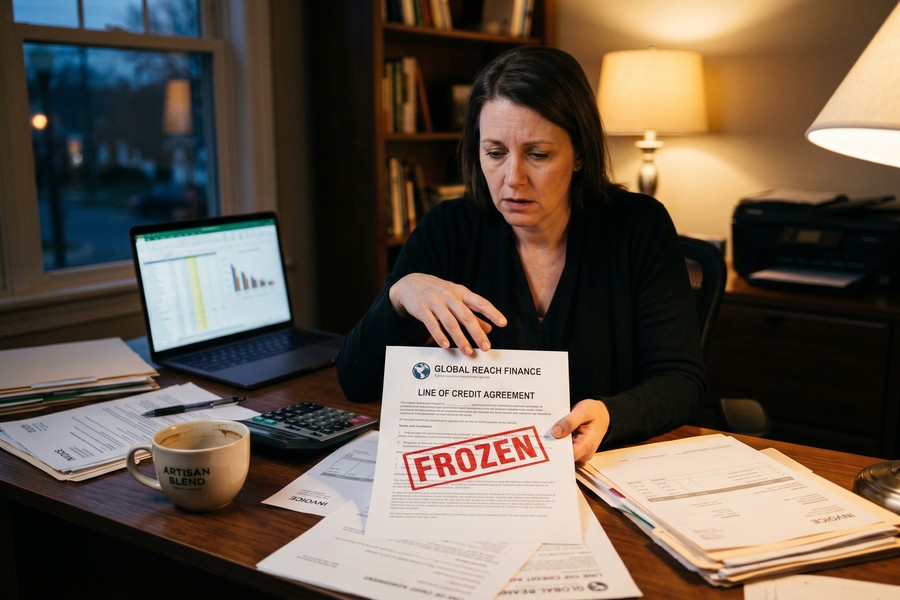
Fintech credit lines can be frozen or reduced without notice if a lender’s risk models flag deterioration in your financials. This is not hypothetical, during the 2020 economic shock, fintech lenders across the board pulled back credit limits precisely when businesses needed them most. Factoring capacity, by contrast, scales with your invoice volume regardless of lender risk appetite, as long as your customers remain creditworthy. For businesses in cyclically sensitive industries, that structural reliability of factoring has real value that a nominal rate comparison does not capture.
Step 7: Which One Should You Use? A Decision Framework for Real Situations
The clearest decision framework matches your cash flow gap type to the product designed for it, not the product with the better marketing.
Use a Fintech Credit Line If
- Your shortfall is driven by unpredictable operating expenses, not slow-paying invoices
- You sell to consumers (B2C) and factoring is not an option
- You need a flexible buffer for payroll gaps or supplier payments that vary month to month
- Your personal credit score is 620 or above and your business has at least one year of history
- You want to keep your customer relationships entirely private
Use Invoice Factoring If
- Your cash flow gap is directly caused by Net-30, Net-60, or Net-90 payment terms from B2B clients
- Your personal credit score is below 620 or your business is under one year old
- You invoice creditworthy businesses or government entities regularly
- You want to preserve your balance sheet capacity for future SBA financing or equipment loans
- Your invoice volume is high enough to justify the onboarding overhead and the per-invoice fee structure
The Two-Tool Combination
These products are not mutually exclusive. A growing business might run a $75,000 fintech credit line for overhead and payroll flexibility while factoring $200,000 in monthly receivables to fund project-based costs. The credit line handles operating volatility; factoring handles the receivables gap. The main constraint on this combination is the UCC-1 lien: if your factoring company files a blanket lien on receivables, some credit line lenders will require lien subordination before extending a line. Coordinate with both parties before layering the two.
There is also a clear exit signal: once your business qualifies for a bank credit line or a prime-rate facility, transition out of factoring. Factoring is often best used as a bridge during early growth or credit rebuilding, not as a permanent fixture. If you are evaluating when to refinance out of a high-cost facility entirely, the principles behind when to use a fintech app to refinance existing debt apply to business credit as well.
Before applying for either product, check whether your industry qualifies. Construction companies dealing with retainage and lien waivers and healthcare businesses with insurance assignment complexity often face higher factoring fees or exclusions from standard programs. In those cases, a fintech credit line or a specialty factor with industry experience is a better starting point.
Frequently Asked Questions
Can I get approved for invoice factoring if my credit score is under 600?
Yes, invoice factoring approval is based primarily on your customers’ creditworthiness, not yours. A business owner with a personal credit score below 600 can qualify for factoring if they regularly invoice financially stable businesses or government entities. The factor’s main concern is whether your customer will pay the invoice, not your personal credit history.
How long does it actually take to get the first payment from invoice factoring?
The first advance from a new factoring account typically takes between three and fourteen days from application to funding, depending on how quickly you complete onboarding. After your account is fully set up, subsequent invoice advances usually arrive within 24 to 72 hours of submission. The “same-day funding” claims in factoring ads apply only after onboarding is complete, not on the very first transaction.
What is the difference between recourse and non-recourse invoice factoring?
Under recourse factoring, if your customer does not pay the invoice, you must repay the advance to the factor, making it function like a loan with collection risk added. Under non-recourse factoring, the factor absorbs the loss if the customer defaults due to insolvency, but this protection is narrower than it sounds: most non-recourse agreements exclude disputes, slow payment, and other common non-payment scenarios. Non-recourse factoring also costs more. Read the contract carefully before assuming you have full protection.
Will invoice factoring show up on my business credit report or affect my balance sheet?
Invoice factoring does not appear as a liability on your balance sheet because you are selling a receivable you already own, not borrowing money. Your accounts receivable balance decreases, but no new debt is created. It does not directly affect your business credit score. However, the UCC-1 lien filed by the factor does appear in public records and can be visible to lenders who check your business’s lien history.
Should I use a fintech credit line or invoice factoring if I have both invoices and operating expenses causing cash flow problems?
Use both, if you can manage the coordination. A revolving fintech credit line handles operating expense volatility while factoring addresses the specific gap created by slow-paying B2B invoices. The main thing to manage is the UCC-1 lien: if the factoring company files a blanket lien on all receivables, some credit line lenders may require lien subordination before approving a concurrent credit facility. Discuss this with both providers before combining the two.
What happens if my customer disputes the invoice after I have already received a factoring advance?
A disputed invoice is one of the most common gaps in non-recourse factoring protection. Most non-recourse agreements only cover customer insolvency, if your customer disputes the invoice for any reason, the factor typically has the right to charge it back to you under a recourse clause buried in the contract. You may be required to repay the advance even though the dispute is the customer’s doing. Always read the specific conditions under which the factor can return an invoice to you before signing.
Are fintech credit line interest rates fixed or variable?
Most fintech credit lines carry variable interest rates tied to the prime rate or a proprietary index, which means your cost changes as rates shift., with the Fed having cut rates through the year, variable-rate credit lines are cheaper than they were in 2023 and 2024. However, if rate-cut cycles reverse, your borrowing cost goes up without any action on your part. Some platforms offer fixed-rate options, though these typically come at a slightly higher base rate. For more on how fintech lenders set your borrowing limit and rate, the underwriting factors are closely linked.
What industries are disqualified from invoice factoring?
Factoring is unavailable to any B2C business because consumer invoices do not qualify. Within B2B, construction companies face complications because of retainage (the portion of payment withheld until project completion) and mechanics’ lien waivers required by clients, which many factors exclude or charge significantly higher fees to accommodate. Healthcare businesses face complexity because of insurance assignment rules and Medicare/Medicaid restrictions. Staffing companies, transportation firms, and professional services firms with straightforward Net-30/60 invoices are the best candidates.
Can I lose my fintech credit line during an economic downturn?
Yes. Fintech credit lines can be frozen or reduced by the lender if your financials deteriorate or if the lender’s own risk models flag broader economic stress. This happened widely in 2020. Factoring capacity, by contrast, scales with invoice volume as long as your customers remain creditworthy and does not depend on the lender’s willingness to extend credit to your business specifically. If reliability during uncertainty is a priority, factoring has a structural advantage for businesses with strong receivables. See also how digital capital options work under pressure for more on accessing fast financing when timing is critical.
Sources
- Federal Reserve Banks, 2025 Report on Employer Firms: Findings from the 2024 Small Business Credit Survey
- Federal Reserve Banks, 2026 Report on Employer Firms: Findings from the 2025 Small Business Credit Survey
- Federal Reserve Bank of Cleveland, Press Release: Fed Survey on Small Business Pandemic Recovery (March 2025)
- JPMorgan Chase Institute, Small Business Cash Flow Patterns Report
- Consumer Financial Protection Bureau, Small Business Lending Data and Research
- NerdWallet, Invoice Factoring: How It Works and When to Use It
- Federal Reserve, Financial Accounts of the United States: Business Balance Sheet Data