
Fact-checked by the CapitalLendingNews editorial team
Quick Answer
Freelancers can build strong credit profiles without W-2 income by opening a secured card or credit-builder loan, keeping utilization below 30%, adding rent and utility payments to their credit file, and separating personal from business credit. Most freelancers see a meaningful score improvement within 6 to 12 months using this approach, though mortgage-ready credit typically requires two full years of documented income.
Freelancer credit building is achievable without a single W-2, but it requires a different playbook than the one most personal finance guides hand you. Self-employment status does not directly lower your credit score, Experian confirms that employment type is not a scoring factor, but it puts you in a harder position at the income-verification stage of every loan application. The discrimination happens there, not inside the scoring model itself.
This distinction matters enormously right now. According to the Federal Reserve Bank of New York’s 2024 Survey of Consumer Expectations, the overall credit rejection rate reached 21.0% in 2024, up from 20.1% in 2023 and well above the pre-pandemic 2019 level of 17.6%. For freelancers and self-employed workers, whose income documentation rarely fits a lender’s standard checklist, that rejection risk is compounded. Lenders are tightening, not loosening, their processes.
This guide is for independent contractors, consultants, creative professionals, and anyone else earning 1099 income who wants to build a credit profile that actually holds up when it counts. Follow the steps here and you will understand exactly which problem you are solving, which tools to use, and what score targets to aim for, including one specific benchmark that most guides never mention.
Key Takeaways
- Employment status does not affect credit scores, Experian confirms that FICO scoring models ignore whether income comes from a W-2 or 1099, meaning freelancers and salaried workers build scores the same way.
- The tax-deduction catch-22 is real: a freelancer earning $80,000 who deducts $30,000 in business expenses shows only $50,000 in qualifying income to lenders, reducing borrowing power by 37.5% on paper, a planning problem, not a credit score problem.
- According to CFPB-funded research, credit-builder loans increased the likelihood of having a credit score by 24% for participants without an existing loan, making them one of the strongest entry points for credit-invisible freelancers.
- A 2024 Intuit QuickBooks survey found that 74% of solopreneurs who used credit cards for business reported using 30% or more of their available credit limit, a utilization level that actively damages the personal credit scores they depend on.
- Self-employed mortgage applicants are typically expected to reach a credit score of 680 or higher on conventional loans, where W-2 borrowers may qualify at 620, meaning freelancers need to target a score roughly 60 points higher to access equivalent terms.
- Rent reporting services can add up to 12 months of positive payment history to a thin credit file at minimal cost, yet this strategy is almost entirely absent from mainstream freelancer credit guides, making it one of the highest-return actions available for someone starting from a sparse file.
In This Guide
- Why the Credit System Was Built for W-2 Workers, And What That Means for You
- What Credit Tools Can I Use That Don’t Require a Pay Stub?
- How Do I Show Lenders My Income Without a W-2?
- How Should I Manage Cash Flow to Protect My Credit Score?
- What Alternative Credit-Building Strategies Work for Freelancers?
- Should Freelancers Build Personal Credit, Business Credit, or Both?
- What Credit Score Do I Actually Need as a Freelancer, and How Long Will It Take?
- Frequently Asked Questions
Step 1: Why the Credit System Was Built for W-2 Workers, And What That Means for You
Your credit score does not know or care how you earn money. What the system was built around is the steady, verifiable income that a W-2 summarizes in one document, and that is where the real friction for freelancers starts.
How to Think About This
There are two separate battles in credit access, and most freelancers conflate them into one. The first battle is your credit score itself: a number calculated from payment history, credit utilization, account age, credit mix, and new inquiries. None of those five factors involves employment status. Experian is explicit that being self-employed does not directly affect a credit score, and the FICO model treats a 1099 earner identically to a salaried employee at the scoring stage.
The second battle is income verification, which happens after a lender pulls your score and then asks how you earned the money to repay the loan. This is where the system’s W-2 bias surfaces. Conventional lenders calculate your debt-to-income ratio using net taxable income, which means every legal deduction you take on Schedule C reduces the income figure a lender will use.
The math is stark. A freelancer grossing $80,000 who deducts $30,000 in legitimate business expenses, home office, equipment, software, health insurance, shows only $50,000 in qualifying income. That is a 37.5% reduction in borrowing power before the lender has even reviewed a credit score. No amount of credit score improvement corrects for this without deliberate tax planning before a major application.
What to Watch Out For
The catch-22 that catches most freelancers off guard: the same aggressive deductions that minimize your tax bill today are the ones that shrink your stated income on a mortgage application 18 months from now. This is not a perception problem or a paperwork problem, it is how conventional underwriting calculates debt-to-income ratio, and pretending the two goals are always compatible is the single most misleading thing most freelancer finance content does. Name the tradeoff early and plan around it.
According to the FDIC’s 2023 National Survey of Unbanked and Underbanked Households, 14.2% of U.S. households were classified as “underbanked”, meaning they had a bank account but also relied on nonbank financial services. Many of these households include gig workers and freelancers who lack access to mainstream credit products precisely because of income documentation gaps.
Step 2: What Credit Tools Can I Use That Don’t Require a Pay Stub?
The most accessible entry points into the credit system for freelancers are secured credit cards, credit-builder loans, and authorized user arrangements, all of which evaluate your deposit or collateral rather than your employment documentation.
How to Do This
Secured credit cards are the fastest way to open a reporting tradeline with no income verification beyond what you self-report. Cards from issuers like OpenSky and Kikoff do not require a hard credit inquiry or a bank account in some cases, making them available even to applicants with no credit history. You deposit a refundable amount, typically $200 to $500, and that becomes your credit limit. The card reports to all three major bureaus monthly. Pay the full balance every month and your utilization stays low, which is the single fastest score driver available to a new file.
Credit-builder loans work differently: you make monthly payments into a locked savings account, and the lender reports those payments to the bureaus. You receive the savings at the end of the term. Self and CreditStrong both offer products in the $500 to $1,500 range with terms of 12 to 24 months. The CFPB found that credit-builder loans increased the probability of having a credit score by 24% for participants with no existing loan, making them one of the most evidence-backed tools for a credit-invisible freelancer.
Becoming an authorized user on a family member’s or partner’s long-standing, well-managed card can add years of positive history to your file quickly. The primary cardholder bears all liability, so this works only when trust is established. You do not need to use the card at all for it to benefit your report.
What to Watch Out For
A three-month runway of consistent bank deposits matters more than any single large payment when timing a credit application. Lenders reviewing bank statements want to see a pattern, not a spike. If you receive a large project payment, do not immediately apply for credit, let the deposit pattern normalize over 90 days first. This timing discipline is one of the more underappreciated mechanics in freelancer credit building.
Separately, be aware that 2024 Intuit QuickBooks data shows 85% of solopreneurs use a credit card to make purchases for their business. Of those, 74% reported using 30% or more of their available credit limit, a utilization level that actively suppresses scores. Mixing business spending onto a personal card without a dedicated higher-limit business card is one of the fastest ways to undermine the credit profile you are trying to build.
Request a credit limit increase on your secured card after 6 months of on-time payments. A higher limit with the same spending pattern instantly lowers your utilization ratio, often producing a score increase within one billing cycle. Most issuers do this with a soft inquiry that does not affect your score.
Step 3: How Do I Show Lenders My Income Without a W-2?
Lenders do not need a W-2 to verify income, they need a consistent, organized picture of your earnings, and the documents that provide that picture are two years of tax returns, 1099 forms, profit-and-loss statements, and bank statements showing regular deposits.
How to Do This
The standard documentation package for a self-employed borrower on a conventional loan includes: two years of personal tax returns (Form 1040 with all schedules), two years of business tax returns if you operate as an LLC or S-corp, a year-to-date profit-and-loss statement prepared by a CPA, and 12 to 24 months of business bank statements. Assembling this proactively, rather than scrambling when a lender requests it, signals financial seriousness and prevents avoidable delays. Experian notes that income does not appear on a credit report or affect a credit score, but a high debt-to-income ratio from variable freelance income is one of the most common reasons lenders deny applications despite acceptable scores.
For freelancers whose taxable income has been heavily reduced by deductions, bank statement loans (also called Non-QM loans) offer a legitimate alternative. These products evaluate 12 to 24 months of gross bank deposits rather than net taxable income, which can dramatically increase qualifying income for a deduction-heavy freelancer. Lenders offering Non-QM products include Angel Oak Mortgage Solutions and Acra Lending, among others. The tradeoff is real: Non-QM rates typically run 0.5% to 1.5% higher than conventional rates, which adds meaningfully to the total cost of a 30-year mortgage.
There is also a narrow but real strategic opportunity worth naming directly: applying for a bank statement loan before filing a deduction-heavy tax return. If a major credit application is planned, applying in January or early February, before a return is filed, lets lenders evaluate gross deposits from the prior year without yet seeing the net taxable income that a heavily deducted return will show. Once filed, the return becomes part of the documentation package. This window is not a loophole; it is a timing decision with a legitimate documentation basis, and it is one that almost no freelancer credit guide discusses explicitly.
What to Watch Out For
The strategic tension between maximizing deductions and showing strong qualifying income is real, and the two goals are genuinely incompatible in the 12 to 18 months before a major credit application. If a mortgage is on your horizon, work with a CPA who understands mortgage qualification, not just tax minimization, so the decision about what to deduct is made with full knowledge of the downstream borrowing cost. This is a planning problem with a concrete answer; it is not one to ignore.
Two years of documented self-employment income is a hard floor for conventional mortgage qualification, not a soft preference. Lenders average income across both years, so a strong year-two result still gets pulled down by a weaker year one. A freelancer who launched their business in early 2023 and wants to buy a home in mid-2025 is right at the edge of this requirement, and any income inconsistency in year one will directly reduce the averaged qualifying figure.
| Loan Type | Income Documentation | Typical Rate Premium | Best For |
|---|---|---|---|
| Conventional (Fannie/Freddie) | 2 years tax returns, 1040, P&L | None (baseline) | Freelancers with 2+ years documented income, limited deductions |
| Bank Statement Loan (Non-QM) | 12–24 months bank statements | +0.5% to +1.5% | Deduction-heavy freelancers, high gross / low net income |
| FHA Loan | 2 years tax returns, 1099s, W-2s if any | +MIP (mortgage insurance) | Lower score borrowers (580+), lower down payment available |
| DSCR Loan | Property cash flow, no personal income required | +0.75% to +1.25% | Freelancers investing in rental property |
| Secured Personal Loan | Bank statements, self-reported income | Varies by collateral | Short-term credit building, smaller amounts |
For freelancers weighing the decision between a conventional and Non-QM path, the rate premium is the honest cost of the freelance income structure. It is worth calculating the actual dollar difference over the life of a loan rather than assuming the gap is negligible. Our guide on fixed vs. adjustable rate loans for self-employed borrowers breaks down how rate structure compounds this cost over time.
Step 4: How Should I Manage Cash Flow to Protect My Credit Score?
For freelancers, cash flow management is a credit strategy first and a budgeting strategy second. One missed payment during a slow month can cost 80 to 100 points and take years to fully recover, which changes the calculation for how aggressively to spend versus reserve.
How to Do This
The most reliable structural protection is a dedicated account funded at 30 to 40% of every payment received. This account covers taxes and fixed monthly obligations including minimum credit card payments and loan installments. Not a savings account, not an emergency fund in the conventional sense, a bill-payment reserve that ensures credit obligations are met even in a month where new client work is thin.
The feast-or-famine utilization trap works like this: during strong revenue months, pay card balances aggressively to keep utilization well below the 30% threshold the CFPB recommends as a guideline for consumers building credit. During slow months, protect the minimum payment above everything else except rent and utilities. This asymmetric approach differs from standard pay-it-off advice because it acknowledges that a freelancer’s income in month three may not resemble month two. Treating minimum payments as non-negotiable, regardless of income that month, is what keeps the payment history column clean.
Payment history accounts for 35% of a FICO score, which makes it the single highest-weighted factor in the model. A derogatory mark from one missed payment can take 7 years to age off a report, and its impact on a thin file is proportionally larger than on a thick one. Protecting it is not optional financial hygiene; it is the highest-return action available.
What to Watch Out For
Variable income creates a specific problem with automatic payments: a payment scheduled for the 5th of the month may arrive after a deposit has not cleared. Setting due dates strategically, requesting card issuers to move due dates to the middle of the month, after project payments typically land, removes one category of accidental late payments entirely. Most major card issuers will change your due date with a single phone call or app request.
Freelancers navigating income gaps between contracts can find strategies specifically suited to their situation in our guide on digital lending for gig workers between contracts, which addresses borrowing options without triggering unnecessary credit inquiries during slow periods.
The overall credit application rejection rate reached 21.0% in 2024, per the Federal Reserve Bank of New York’s Survey of Consumer Expectations, up from 17.6% in 2019. For freelancers with variable income and thin credit files, the effective rejection rate is meaningfully higher than this aggregate figure.
Step 5: What Alternative Credit-Building Strategies Work for Freelancers?
Rent reporting, utility payment tracking, and vendor net-30 accounts are three credit-building levers that most freelancers overlook entirely, and collectively they can thicken a thin file faster than any single product.
How to Do This
Rent is the single largest monthly expense for most freelancers who do not own property, yet rental payments have historically been excluded from credit scoring models unless reported through a third party. Services like RentTrack and PayYourRent report to all three major bureaus (Equifax, Experian, and TransUnion) for a monthly fee typically between $6 and $10. Experian Boost is a free alternative that adds rent and utility payments to your Experian report specifically. Adding up to 12 months of retroactive positive payment history via these services can raise scores by an estimated 20 to 40 points for thin-file consumers, making this one of the highest-return actions per dollar available to a freelancer starting from a sparse file.
Experian Boost also captures Netflix, Hulu, phone, and utility payments for free. For a freelancer with only one or two active credit accounts, adding four or five additional positive payment lines through Boost meaningfully changes the tradeline count that scoring models evaluate.
For those also building a business identity, vendor net-30 accounts from companies like Uline, Quill, and Grainger offer trade credit that reports to Dun & Bradstreet, the primary commercial credit bureau. These are not loan products; they are supplier accounts where you purchase supplies now and pay within 30 days. Thirty- to sixty-day payment cycles, reported consistently, build a PAYDEX score without requiring a formal loan, a personal guarantee on a business credit card, or any income documentation. This is a well-known tactic in small business credit circles but almost entirely absent from consumer-facing freelancer credit guides.
The U.S. Small Business Administration advises freelancers and self-employed individuals to register for a Dun & Bradstreet DUNS number as the first step toward establishing a business credit profile, and to monitor both personal and business credit reports separately. Getting a DUNS number is free and takes less than 30 days.
What to Watch Out For
Not all rent reporting services report to all three bureaus. Before signing up, confirm which bureaus the service reports to and whether retroactive reporting is included. A service that reports only to Experian provides partial benefit; one that skips TransUnion leaves a gap that matters when a lender pulls a tri-merge report for a mortgage application. Read the fine print on coverage before committing to a paid subscription.
Experian Boost is genuinely free and takes about 10 minutes to set up. It connects to your bank account, identifies qualifying payment history, and adds it to your Experian file with your approval. Because it requires no new account opening, it carries no hard inquiry risk, making it a zero-cost, zero-risk first action for any freelancer with a thin credit file.
Step 6: Should Freelancers Build Personal Credit, Business Credit, or Both?
The correct answer is both, but in a specific sequence, starting with personal credit and layering business credit on top once the personal foundation is solid.
How to Do This
Personal credit runs through your Social Security Number and is scored by FICO and VantageScore. Business credit runs through a separate system of commercial bureaus: Dun & Bradstreet (PAYDEX score), Experian Business, and Equifax Business. Using personal cards for business expenses does not automatically build business credit, the two systems are structurally separate and require separate actions to populate.
The practical starting sequence for a sole proprietor is straightforward. First, obtain an EIN (Employer Identification Number) from the IRS for free at IRS.gov, the process takes under 10 minutes online. Second, open a dedicated business checking account in the business name using the EIN. Third, apply for a business credit card using your SSN as a sole proprietor. At this stage, the card issuer will use personal credit to approve the account, which means your personal score determines access. Once approved, some business cards, particularly those from American Express and Capital One, report to both personal and business bureaus simultaneously, meaning the same spending behavior builds two credit profiles at once. This dual-reporting benefit is one of the more actionable insights that most freelancer credit guides miss entirely.
Equifax advises gig workers and freelancers to build credit by paying bills on time, keeping card balances low relative to limits, avoiding excessive new credit applications, and maintaining a healthy mix of revolving credit and installment loans, advice that applies equally to both personal and business credit tracks.
What to Watch Out For
Keeping business and personal credit separate is a risk management strategy, not just an organizational preference. A bad business month that runs up a business card balance affects only your business credit profile if the card reports solely to commercial bureaus, it does not damage the personal FICO score used for apartment applications, auto loans, and mortgages. That protection has real value for a freelancer whose income can swing significantly between quarters. For more on how lenders assess debt-to-income ratios in digital lending contexts, see our breakdown of how debt-to-income ratio affects digital lending applications.
Fintech lenders are increasingly evaluating alternative data, including bank account cash flow, payroll patterns, and payment histories outside traditional credit bureaus, to approve borrowers who would be rejected by conventional scoring models. Our guide on how fintech lenders use payroll data to approve borrowers banks would reject explains how this works in practice for self-employed applicants.
Step 7: What Credit Score Do I Actually Need as a Freelancer, and How Long Will It Take?
The honest answer is that freelancers need to target a higher credit score than the benchmarks most guides cite, because lenders apply different underwriting standards to self-employed borrowers at the application stage.
How to Do This
For a conventional mortgage, many lenders prefer a minimum score of 680 or higher for self-employed borrowers, where W-2 applicants may qualify at 620. That 60-point gap is not a soft preference, it reflects the additional underwriting risk lenders assign to income that cannot be confirmed with a single employer document. Freelancers who plan to apply for a mortgage should calibrate their target score accordingly. Shooting for 700 or above provides a meaningful buffer.
For unsecured personal loans and mainstream rewards cards, a score in the 670 to 699 range typically opens access to competitive products, though income verification will still require documentation. For auto financing, scores above 660 generally access non-subprime rates, though the income picture still matters to the dealer’s finance office.
The realistic timeline for credit building from scratch using the tools in this guide runs as follows. Secured cards and credit-builder products typically appear on credit reports within 30 to 60 days of account opening. After 6 to 12 months of consistent on-time payments, many mainstream unsecured cards become accessible and issuers will begin sending pre-approval offers. After two years of documented freelance income and a score above 680, conventional mortgage qualification becomes a realistic target. If the score is in range but income documentation is still developing, Non-QM bank statement loans can bridge the gap, at the cost of that rate premium discussed in Step 3.
One more honest concession: no amount of credit score optimization fully substitutes for two full years of documented self-employment income when applying for a conventional mortgage. The income documentation requirement is a separate floor that credit scores cannot raise. Freelancers who understand this early can structure their first two years of business finances with mortgage qualification specifically in mind, rather than discovering the requirement after the fact. For a closer look at how effective interest rates differ for gig workers versus traditional employees, see our analysis of why gig economy workers pay a higher effective interest rate.
What to Watch Out For
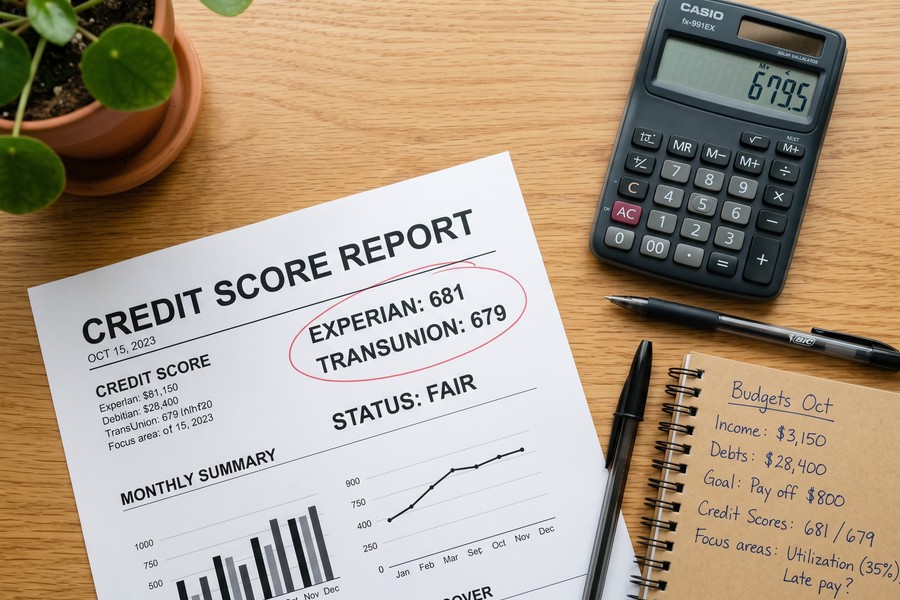
Credit score simulators and score estimators can give false precision. A score of 681 and 679 look nearly identical but can land on different sides of a lender’s cutoff threshold. When a major application is approaching, pull actual reports from all three bureaus through AnnualCreditReport.com and dispute any errors before applying. The CFPB advises consumers building credit to actively correct errors on their credit reports, noting that inaccurate negative items can be disputed and removed, sometimes meaningfully improving a score without any new account activity.
Frequently Asked Questions
Can I get a credit card with no W-2 income as a freelancer?
Yes. Most credit card applications allow you to self-report income, which can include freelance earnings, contract payments, and 1099 income, no W-2 is required. Secured cards from issuers like OpenSky require a deposit rather than income verification, making them accessible even to freelancers with thin or no credit history. Report your gross self-employment income, not your taxable income after deductions, on the application.
Does being self-employed hurt my credit score directly?
No. Employment type is not a factor in FICO or VantageScore calculations, and Experian confirms that self-employment status does not appear in credit reports. The challenge for freelancers is at the income-verification stage of loan applications, where lenders scrutinize documentation more carefully and may require 1099s, tax returns, and bank statements in place of a W-2.
How long does it take to build a credit score from scratch as a freelancer?
Most secured cards and credit-builder loan accounts appear on credit reports within 30 to 60 days of opening. After 6 months of on-time payments, a scoring model can generate a full credit score. After 12 months of consistent payment history, many mainstream unsecured products become accessible. A mortgage-ready profile, including both a strong score and two years of documented self-employment income, typically takes 24 months or more to establish.
What documents do freelancers need to qualify for a mortgage?
Conventional mortgage lenders typically require two years of personal tax returns (Form 1040 with all schedules), two years of business tax returns if applicable, a current profit-and-loss statement, and 12 to 24 months of bank statements. The two-year income average is the qualifying figure, which means a strong recent year is partially offset by a weaker prior year. Experian explains that income does not appear on a credit report, but lenders calculate debt-to-income ratio from this documentation package independently of your score.
Should I get a business credit card or stick with a personal card as a freelancer?
Getting a dedicated business card is the better choice once your personal credit score is above 670, for two reasons. First, it separates business spending from personal credit utilization, preventing business expenses from inflating your personal credit utilization ratio. Second, certain business cards report to both personal and commercial bureaus simultaneously, building two credit profiles with the same spending. The application will still use your personal credit for approval, so building personal credit first is the prerequisite.
What is a bank statement loan and is it worth it for a freelancer?
A bank statement loan is a Non-QM mortgage product that qualifies income based on 12 to 24 months of gross bank deposits rather than net taxable income from a tax return. For deduction-heavy freelancers, this can dramatically increase qualifying income and loan eligibility. The honest tradeoff is a rate premium typically between 0.5% and 1.5% above conventional rates, which adds real cost over the life of a 30-year loan. It is worth calculating the total interest difference before deciding this path is right for your situation.
How does credit utilization work when my freelance income is irregular?
Credit card balances are reported to bureaus at or near your statement closing date, not your payment due date, meaning a high balance from a big month of business spending can register as high utilization even if you pay it off days later. The fix is to pay your balance down before the statement closing date, not just the due date. During slow income months, protect the minimum payment above all else; during strong months, pay the balance as close to zero as possible before closing.
Can rent payments help me build credit as a freelancer?
Yes, and this is one of the most underused strategies available. Services like RentTrack and PayYourRent report rent payments to all three major bureaus. Experian Boost adds rent payments to your Experian report for free. For freelancers with thin credit files, adding retroactive rent payment history can add positive tradelines that raise scores by an estimated 20 to 40 points within a year, at minimal or no cost, with no new loan required.
What credit score do I need as a self-employed borrower to get a conventional mortgage?
Most lenders prefer a minimum score of 680 or above for self-employed mortgage applicants on conventional loans, compared to a threshold as low as 620 for W-2 borrowers. The gap reflects the added underwriting risk assigned to variable income. Freelancers targeting a home purchase should set 700 as a working minimum to have a buffer, and should plan for a two-year documented self-employment income requirement alongside the score target.
How do I start building business credit as a sole proprietor with no revenue yet?
Start by obtaining a free EIN from the IRS, opening a dedicated business checking account in your business name, and registering for a DUNS number from Dun & Bradstreet at no cost. The SBA recommends this sequence as the foundation of a business credit profile. Next, open vendor net-30 accounts with suppliers like Uline or Quill that report to Dun & Bradstreet. Pay within 30 days consistently, and a PAYDEX score begins to form without requiring a formal loan or personal guarantee.
Sources
- Consumer Financial Protection Bureau, Targeting Credit Builder Loans: Insights from the CFPB’s Research
- Consumer Financial Protection Bureau, Credit Invisible Checklist: Your Money, Your Goals
- Experian, Does Being Self-Employed Affect Your Credit?
- Experian, How to Calculate and Report Self-Employment Income on Credit Applications
- Equifax, Credit Scores and the Gig Economy: What Gig Workers Need to Know
- U.S. Small Business Administration, Establish Business Credit
- Intuit QuickBooks, Self-Employment Trends 2024: Solopreneur Survey Data
- Federal Reserve Bank of New York, Survey of Consumer Expectations: Credit Access Survey, October 2024
- Federal Deposit Insurance Corporation, 2023 FDIC National Survey of Unbanked and Underbanked Households