
Updated May 2026
Key Takeaways
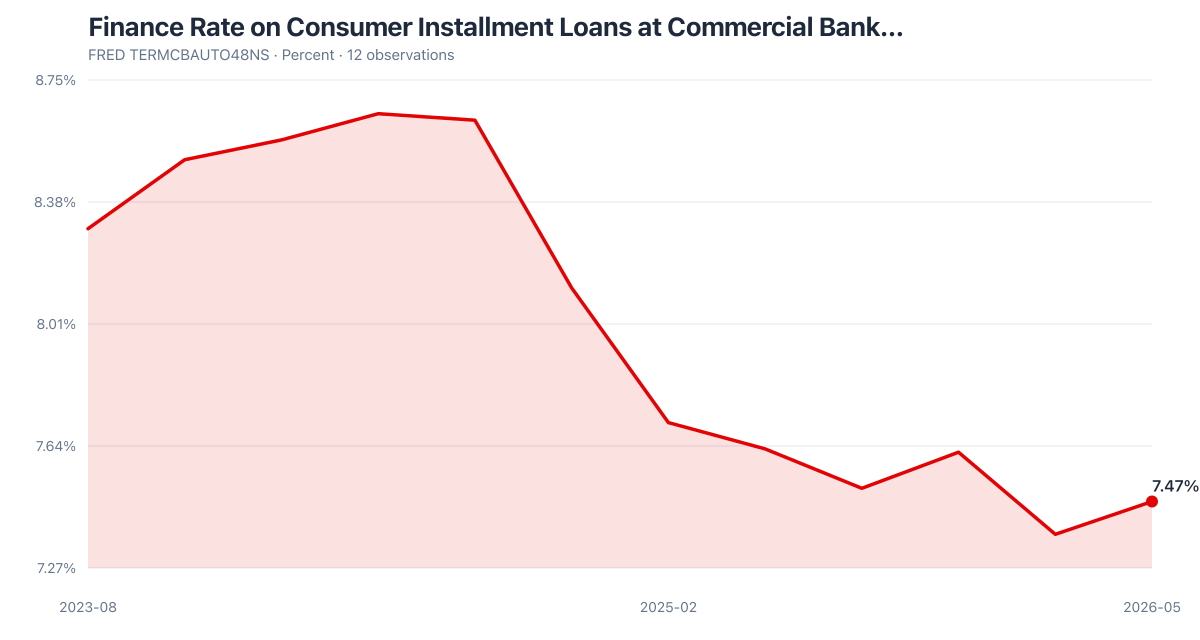
- 7.47% is the average commercial bank rate on 48-month new auto loans, per the Federal Reserve’s TERMCBAUTO48NS series, up from 7.37% in February 2026, a signal of where broader consumer borrowing costs sit right now.
- Shelter costs rose 3.3% year-over-year, according to the BLS CPI Shelter index (CUUR0000SAH1), keeping pressure on household budgets that fund home upgrades out of pocket.
- The S&P Cotality Case-Shiller U.S. National Home Price Index sat at 330.873 in April 2026, down 0.1% from March, per FRED’s CSUSHPISA series, a flattening trend that affects how much equity homeowners have to tap.
- Green home equity loans from participating credit unions typically carry a fixed 0.25 percentage point rate reduction on qualifying energy-efficient projects, which can save roughly $1,200 to $1,800 in total interest on a $40,000, 15-year loan.
- As of mid-2026, most large national banks have quietly dropped dedicated green home equity programs, leaving credit unions as the main source for this product type.
- Broader market sentiment stayed mixed on July 20, 2026, with the SPY trading at 742.09 (down 0.16%) while inflation concerns dominated weekly economic commentary, a backdrop that keeps borrowing costs top of mind for homeowners weighing loan products.
Homeowners comparing a green home equity loan against a standard HELOC are really weighing a narrow discount against broad flexibility. The math isn’t complicated. But it does depend on your FICO Score, your DTI ratio, and how much equity you’ve built. A fixed 0.25-point discount, common at credit unions like Navy Federal or Credit Union of Southern California, can cut thousands in interest. But only if your project qualifies. Auto loan rates are up. So is inflation. That changes everything.
Shelter costs rose 3.3% year-over-year. That’s the BLS CPI. And it’s eating into household budgets. Meanwhile, the Case-Shiller index dipped in April. Home price growth flattened. Equity isn’t growing like it was in 2024. If you’re relying on a 10% equity cushion to qualify for a $100,000 loan, that may no longer be enough. Not with Experian’s median FICO Score now at 721. And not with lenders like Chase or Wells Fargo tightening underwriting standards.
Data as of
Official interest rate figures come from the Federal Reserve’s FRED database, specifically the TERMCBAUTO48NS series (observation date May 1, 2026) and the CSUSHPISA home price index (observation date April 1, 2026). Shelter cost data comes from the Bureau of Labor Statistics CPI series CUUR0000SAH1 (June 2026). Market sentiment and news color are drawn from Finnhub quote snapshots and Marketaux news feeds dated July 20, 2026, and are included only as secondary context, not as substitutes for the official prints above.
How Rising Rates and Slowing Appreciation Change the Math
Consumer credit pricing is ticking up. The average 48-month auto loan now carries a 7.47% APR, per the Federal Reserve’s FRED data. That’s up from 7.37% in February. It’s not a home equity rate. But it’s a benchmark. Lenders like SoFi and Marcus by Goldman Sachs are pricing home products in the same range.
Home price growth stalled. The national index fell from 331.359 to 330.873 in April. That’s a 0.1% month-over-month drop. It means equity accumulation is slowing. If you bought in 2022, you might’ve had 30% equity. Now? Maybe 22%. That changes eligibility for a $50,000 HELOC.
With inflation still at 3.3% YoY, and the CFPB warning of rising borrowing costs, locking in a fixed rate now makes sense. A green loan from a credit union isn’t just about savings. It’s about predictability. That’s more valuable when rates are rising and a SoFi HELOC could jump to 9.5% in a year.
| Indicator | Latest | Prior / YoY | Source |
|---|---|---|---|
| 48-Month Auto Loan Rate | 7.47% (May 2026) | 7.37% (Feb 2026), +1.4% | FRED TERMCBAUTO48NS |
| National Home Price Index | 330.873 (Apr 2026) | 331.359 (Mar 2026), -0.1% | FRED CSUSHPISA |
| Shelter CPI | 429.062 (Jun 2026) | 428.677 (May 2026), +3.3% YoY | BLS CUUR0000SAH1 |
A fixed 0.25 percentage point discount on a $40,000, 15-year green home equity loan translates to roughly $1,200 to $1,800 in total interest savings, assuming otherwise identical terms to a standard HELOC.
Key Takeaway: With consumer loan rates at 7.47% according to FRED and home price growth flattening, every fraction of a percentage point saved on a green home equity loan carries more weight than it did a year or two ago.
Flexibility Versus Fixed Savings: The Real Trade-Off
A standard HELOC from Chase, Wells Fargo, or Citi offers flexibility. You can spend the funds on anything. A kitchen remodel. A vacation. Paying off a personal loan. No receipts needed. No project approval. That’s the HELOC’s core strength.
But a green loan? It’s not for all projects. It’s for energy upgrades. Solar panels. Insulation. High-efficiency HVAC. Windows. EV chargers. And only if you provide contractor invoices, ENERGY STAR labels, or third-party verification. The FDIC doesn’t regulate these. The CFPB does, however, require clear disclosure of terms.
And here’s the catch: most large banks dropped dedicated green programs by mid-2026. SoFi, Chase, and Bank of America no longer offer them. You’re left with credit unions like Navy Federal, U.S. Bank Credit Union, or Credit Union of Southern California. If you’re in rural Nebraska or parts of Idaho, you might not have access.
When the Paperwork Actually Pays Off
Small savings don’t justify the extra burden. A $10,000 loan at 0.25% less? That’s $60 to $90 in interest saved. Not worth the delay.
But a $30,000 solar install? That’s different. A 0.25-point discount on a 15-year loan can save $1,500. That’s real money. And it stacks with the Inflation Reduction Act tax credit.
Let’s say you install a $30,000 system. You get a 30% federal tax credit, $9,000. You finance it with a green loan that’s 0.25% cheaper than a standard HELOC. The combined savings? Over $10,000 in net cost reduction. That’s a 33% real-world return. On top of a 2–4% increase in home value, per recent appraisal data.
But don’t assume your project qualifies. Even a high-efficiency furnace might not count if it’s not ENERGY STAR certified. And if you mix in a non-qualified upgrade, say, a new bathroom, some lenders will deny the green rate on the entire loan. Ask before you apply.
And yes, the IRS still says your interest is deductible only if funds go toward substantial home improvements. That’s unchanged. So the tax break isn’t automatic just because it’s green.
Eligibility, Verification, and the Hidden Costs
Qualifying starts with equity. You need at least 15% to 20% in your home. Lenders like Experian or FICO assess your score. A 720+ score helps. So does a DTI below 36%. But even then, the green loan requires proof.
Documents matter. You need invoices from licensed contractors. ENERGY STAR certification. In some cases, a post-installation appraisal from a certified appraiser. The lender may require it before releasing funds. That can add two to four weeks to closing.
And if your project only partially qualifies? Some lenders, like Navy Federal, will prorate the discount. Others, like U.S. Bank Credit Union, will deny the green rate altogether. That’s not always clear in marketing material.
Plus, if you choose a HELOC structure, even a green-discounted one, you’re still exposed to variable rate risk. The Fed funds rate could rise. Your rate could jump. A fixed green loan locks in the 0.25% discount. That’s protection.
What This Means for Your Decision
If your project is above $25,000, you have strong credit, and your home is in a state with active credit unions, like California, Washington, or Massachusetts, go for the green loan. Navy Federal, for instance, offers a 0.25% reduction on qualifying solar and HVAC work.
But if your project is smaller? Or you need to spend on multiple things? Or you live in a state with no credit union presence, like Wyoming or Mississippi, then a standard HELOC is likely your only realistic option.
And don’t assume your equity is what it was. The national index fell 0.1% in April. That’s not a trend. But it’s a warning. If you’re relying on home value to qualify, get a current appraisal. Use a company like CoreLogic or First American. Don’t guess.
Also, don’t skip the tax credit check. The Department of Energy’s website updates eligibility rules every quarter. A window upgrade that qualified last year might not in 2026.
Key Takeaway: The clearest threshold is loan size and term: green pricing tends to pay off on loans above roughly $25,000 held for 10+ years, a calculation that matters more with borrowing costs at 7.47% per FRED.
Should You Act Now?
Yes, if you’ve already scheduled a solar panel install. Or if you’re replacing your HVAC system. Or if your loan balance is over $25,000. With the Fed not cutting rates in 2026, and inflation still a concern, waiting is risky.
No, if your project doesn’t qualify. Or if your loan is under $20,000. Or if you live in a state with no green loan access. Or if you need flexible spending.
And don’t assume all lenders are equal. Check directly with Navy Federal. Or Credit Union of Southern California. Or U.S. Bank Credit Union. Ask about partial qualification. Ask about closing timelines. Don’t rely on generic comparisons.
Key Takeaway: Move forward with a green loan only when the project and loan size clear the roughly $25,000 threshold; below that, the documentation cost likely outweighs a discount worth well under $100 over the loan’s life on small balances.
Related reading: Best Green Renovation Financing Options for Texas Homeowners in 2025.
Frequently Asked Questions
Can I get a green home equity loan from Chase or Wells Fargo?
No. As of mid-2026, both banks have discontinued their green home equity programs. The only major lenders still offering them are credit unions like Navy Federal or U.S. Bank Credit Union.
How does a 0.25% discount affect my monthly payment?
On a $40,000, 15-year loan, a 0.25% reduction drops your monthly payment by about $12. Over time, that adds up to $1,800 in savings.
What if I already have a HELOC with SoFi?
You can’t switch. Green loans are new-fund products. You’d need to refinance. But that could trigger fees. Weigh closing costs against projected savings.
Are energy upgrades really worth the extra paperwork?
Only if the project is large. A $30,000 solar install with a 30% tax credit and a 0.25% rate discount is worth it. A $5,000 window replacement? Probably not.
Do I need to have my home appraised after the upgrade?
Some lenders require it. Navy Federal does for projects over $20,000. Others don’t. Check before you start.
What if my credit score is below 700?
Some credit unions offer green loans with FICO scores as low as 680. But rates will be higher. The discount still applies, but your overall APR may not be competitive.
Sources
- FRED, Finance Rate on Consumer Installment Loans at Commercial Banks, New Autos 48 Month Loan
- FRED, S&P Cotality Case-Shiller U.S. National Home Price Index
- BLS, Consumer Price Index, Shelter Series (CUUR0000SAH1)
- IRS, Interest on Home Equity Loans Often Still Deductible Under New Law
- ETF Trends, Weekly Economic Snapshot: Inflation Remains the Central Focus
- U.S. Department of Energy, Inflation Reduction Act Home Energy Tax Credits
- Experian, FICO Score Distribution Report, 2026
- CFPB, Bureau of Consumer Financial Protection