

Fact-checked by the CapitalLendingNews editorial team
The Verdict
A teacher debt savings strategy is worth running simultaneously when your monthly debt payments consume less than 20% of your take-home pay and you have access to federal forgiveness programs. It is not worth it if high-interest credit card debt above 20% APR is outstanding, clear that first, then split efforts between debt and savings.
The single factor that determines whether a teacher can pay down debt and save at the same time is not willpower, it is the interest rate gap between what debt costs and what savings can earn. With a national average public school teacher salary of $74,495 for the 2024-25 school year, most educators are working with a fixed income that leaves a real, if narrow, margin for a dual-goal teacher debt savings strategy. The math is tighter than most budgeting articles admit, but it is workable.
In 2026, inflation-adjusted teacher salaries have barely moved in several states, while loan balances and everyday costs have. Acting now, rather than waiting for a raise that may not come, matters because time in retirement accounts compounds whether or not you feel ready.
| Factor | Reasons to Pay Debt and Save Simultaneously | Reasons to Prioritize One Over the Other |
|---|---|---|
| Interest Rate Math | Federal student loans at 5-7% cost less than most investment returns over 10+ years | Credit card debt above 20% APR always beats any savings rate; clear it first |
| Forgiveness Eligibility | PSLF and Teacher Loan Forgiveness reward low monthly payments, freeing cash for savings | Aggressive payoff destroys forgiveness eligibility and years of qualifying payments |
| Employer Match | 403(b) match is a guaranteed 50-100% return; no debt payoff beats that | If no match exists, debt payoff first is more defensible |
| Income Stability | 10-month contracts create predictable gaps; automating transfers smooths both goals | Summer income gaps can make dual goals feel impossible without pre-planning |
| Emergency Buffer | Even $1,000 in savings prevents new debt when a car repair hits | Zero savings with high debt means any surprise resets progress |
| Tax Efficiency | 403(b) contributions reduce taxable income, effectively subsidizing both goals | Without tax planning, every dollar saved costs more than it should |
Key Takeaways
- Your total monthly debt payments are below 20% of take-home pay (roughly $900/month on a $74,495 salary after deductions)
- You carry no credit card debt above 18% APR, or you have a clear plan to eliminate it within 6 months
- You are contributing at least enough to your 403(b) to capture any employer match, even if it is only 1-3% of salary
- You have or are building an emergency fund of at least $1,000 before splitting extra dollars between debt and savings
- You are enrolled in an income-driven repayment plan or targeting PSLF, keeping monthly federal loan payments at an income-based level rather than the standard 10-year schedule
- You automate at least $25-$50 per paycheck to a high-yield savings account, regardless of how small it feels
- You have accounted for summer income gaps by spreading 10-month paychecks across 12 months or maintaining a $500-$1,000 seasonal buffer
What Does a Teacher’s Fixed Salary Actually Leave You To Work With?
After taxes, pension deductions, and health insurance, a teacher earning the national average of $74,495 typically takes home somewhere between $52,000 and $57,000 annually, depending on state. That’s roughly $4,300 to $4,750 per month. Housing, utilities, food, and transportation consume most of it fast.
Here’s the thing: the debt load on top of that is not trivial. According to the Learning Policy Institute, teachers who are repaying student loans carry an average monthly payment of $342. On a $4,500 take-home, that is about 7.6% of monthly income, manageable alone, but it sits alongside classroom supply costs that the National Education Association estimates average several hundred dollars per year out of pocket.
The 10-month pay structure creates a specific trap. Many districts issue paychecks only during the school year, leaving summer as an income gap that can derail any savings momentum built during fall and spring. Teachers who spread salary across 12 months, an option many districts offer, remove one of the biggest obstacles to consistent debt payments and savings contributions.

Does Pursuing Loan Forgiveness Change How You Should Save?
Yes, significantly, and this is where most generic debt advice fails teachers. Public Service Loan Forgiveness (PSLF) and Teacher Loan Forgiveness (TLF) are federal programs administered by the U.S. Department of Education’s Federal Student Aid office that reward teachers for making qualifying payments while working in public service or low-income schools. Under PSLF, after 120 qualifying payments on an income-driven repayment plan, the remaining balance is forgiven tax-free.
If you are on track for PSLF, aggressively paying down your federal loans faster than required is a financial mistake. Every extra dollar sent to principal reduces the eventual forgiven balance, and you get no benefit for overpaying. The smarter move: make the minimum income-driven payment, and redirect the difference toward savings or high-interest debt. This is one of the few situations in personal finance where paying less each month is the objectively correct call.
The caveat worth naming upfront: refinancing federal loans with a private lender to get a lower interest rate permanently disqualifies you from PSLF and TLF. If forgiveness is a realistic 5-10 year horizon for you, think carefully before using a fintech platform to refinance your student loans, the short-term rate savings rarely offset the lost forgiveness value.
How to Structure a Budget That Handles Both Goals at Once
A modified 50/30/20 framework is the most practical starting point for teachers. Fifty percent of take-home to needs, 20% to debt payoff and savings combined, and 30% to discretionary spending. The key adjustment: treat debt payments and savings contributions as a single category and allocate within it rather than forcing them to compete.
Here’s the thing: on a $4,500 monthly take-home, that 20% bucket is $900. If the average student loan payment is $342, that leaves $558 for savings and additional debt reduction. Even splitting that evenly, $279 to a high-yield savings account and $279 as an extra debt payment, creates real progress on both fronts simultaneously.
A concrete example: a teacher earning $74,495 takes home roughly $4,400/month after federal taxes, a standard 403(b) pension deduction, and health insurance. Monthly student loan payment: $342. That leaves $558 in the 20% bucket beyond the loan payment. Directing $200 to an emergency fund, $150 to a Roth IRA, and $208 as extra loan principal means this teacher is building savings and cutting debt simultaneously without touching the 50% needs budget. Over 12 months, that is $2,400 into emergency savings, $1,800 into retirement, and $2,496 in extra principal reduction, all from a single structured habit.
Zero-based budgeting works equally well for teachers with irregular or summer-gap income, because it forces every dollar to have an assigned job before spending begins. The critical piece is automating transfers on payday rather than waiting to see what is left at month’s end. What is not automated rarely gets saved.
For a longer look at how loan term length affects the total cost of your debt during this process, understanding how term length quietly controls total interest paid can sharpen your payoff decisions.
Starting Small With Retirement: Why the 403(b) Is the Teacher’s Best Tool
Thirty dollars per paycheck invested at age 28 is worth more than $300 per paycheck started at 45. That compression is not motivational phrasing, it is the arithmetic of compound growth, and it is the primary reason teachers should not delay retirement contributions until debt is fully cleared.
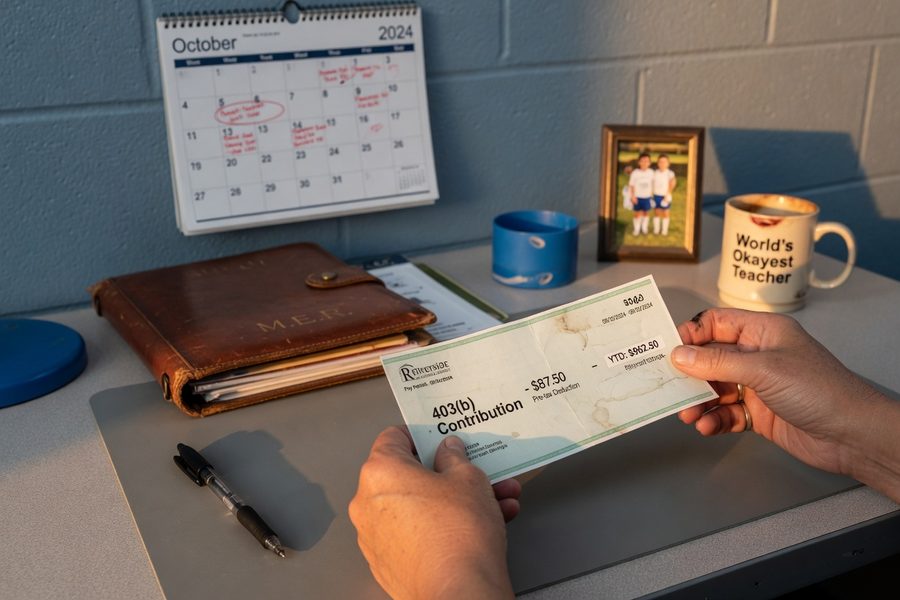
The 403(b) is the public school equivalent of a 401(k), and many districts offer employer matching up to 3-5% of salary. Capturing the full match before making any additional debt payments is the right order of operations. No debt payoff rate beats a 50-100% instant return on matched contributions.
Beyond employer matches, 403(b) contributions reduce taxable income dollar-for-dollar. A teacher contributing $3,600 per year ($150 per paycheck on a 24-paycheck schedule) to a traditional 403(b) reduces their federal taxable income by the same amount, which at the 22% bracket saves roughly $792 in federal taxes annually. That tax savings effectively subsidizes both the retirement contribution and frees marginal dollars for debt payments.
For those without access to a strong district match, a Roth IRA is the next best vehicle. Contributions are made after tax, but growth and qualified withdrawals are tax-free, a meaningful advantage for teachers who expect to be in a similar or higher bracket in retirement. In 2026, the IRA contribution limit is $7,000 annually ($8,000 if you are 50 or older), and even $50 per paycheck builds meaningful long-term momentum.
This also connects to the broader question of whether to pay off loans or build an investment portfolio first, a decision that depends heavily on your specific interest rates and timeline.
Who Should and Who Should Not
Good candidates
This dual-goal approach works well for teachers in these situations.
- Teachers in public schools with 5+ years remaining who qualify for PSLF, income-driven minimum payments free significant cash for savings without sacrificing forgiveness
- Early-career educators in districts with 403(b) employer matching, capturing the match first means every savings dollar is immediately worth more
- Teachers carrying only federal student loans at rates below 7%, with no credit card debt, the interest rate math supports splitting dollars rather than attacking debt exclusively
- Those on 12-month pay distribution who have already built a $500+ summer buffer, stability makes automation reliable and consistent
- Teachers with a second income source (tutoring, summer curriculum work) willing to direct 50% of that income to debt and 50% to savings, keeping the strategy on two tracks
Who should skip it
Some financial situations call for a single-goal focus first.
- Teachers carrying credit card balances above 18% APR, paying that off first is the highest guaranteed return available before splitting efforts
- Those already within 2 years of full PSLF forgiveness with minimal savings, clearing the finish line and then saving aggressively post-forgiveness is the cleaner path
- Teachers facing imminent income disruption (school closure, district restructuring) without any emergency fund, build $1,000 in cash reserves before anything else
- Educators who have already refinanced federal loans with a private lender, forgiveness is no longer available, so a straightforward debt-first avalanche approach typically wins
Frequently Asked Questions
Can a teacher really pay off student loans and save money at the same time on a $74,000 salary?
Yes, but only with a deliberate structure. The average monthly student loan payment for teachers is $342, which on a typical take-home pay leaves room to simultaneously direct $150-$300 per month toward savings if discretionary spending is managed tightly. It requires automation, not willpower.
Should teachers on PSLF make extra loan payments or redirect that money to savings?
Redirect it to savings. Making extra payments on federal loans you plan to have forgiven under the Public Service Loan Forgiveness program reduces the eventual forgiven balance with no financial benefit to you. Keep income-driven payments at their minimum and invest the difference in a 403(b) or high-yield savings account.
What is the best savings account for a teacher trying to build an emergency fund quickly?
A high-yield savings account at an online bank is the most practical option. As of early 2026, several FDIC-insured online banks are offering rates above 4.5% APY, which meaningfully outpaces traditional bank accounts. Keep the account at a separate institution from your checking to reduce the temptation to spend it.
How do summer income gaps affect a teacher’s debt payoff plan?
They can derail it entirely if not anticipated. Teachers on 10-month pay schedules should either elect to have their salary spread across 12 months (where districts allow) or manually reserve 1-2 months of expenses during the school year. The challenge of borrowing or budgeting during income gaps is well-documented, and educators face the same pressure as contract workers during off-season months.
Does contributing to a 403(b) affect student loan payments under income-driven repayment?
Pre-tax 403(b) contributions reduce your adjusted gross income, which directly lowers your monthly payment under income-driven repayment plans like SAVE or IBR, because those payments are calculated as a percentage of discretionary income. Contributing more to retirement actually reduces what you owe on loans each month, making both goals more affordable simultaneously.