

The number on your savings account statement is real. The problem is that it doesn’t tell the whole story. Between fees, inflation, tiered rate structures, and the compounding math that sounds better than it is, the effective return most Americans earn on their savings is considerably lower than the advertised rate suggests.
According to FDIC national rate data, the average savings account pays just 0.46% APY, while high-yield alternatives at online banks offer 4% or more. This article breaks down exactly why the rate you see may be misleading, what quietly erodes your real return, and what to do about it.
Key Takeaways
- The average savings account interest rate at traditional banks sits around 0.46% APY, far below the rate of inflation.
- APY and APR are not the same thing. Banks sometimes advertise APR, which makes returns look slightly lower than APY but can still mislead if fees offset gains.
- Fees, minimum balance requirements, and tiered rate structures can reduce your effective yield to nearly zero.
- High-yield savings accounts at online banks currently offer rates above 4.50% APY, over nine times the national average.
APY vs. APR: The Number Banks Lead With
Most banks advertise your rate as APY (Annual Percentage Yield), which includes compounding. That sounds good in theory. But compounding on a 0.46% rate produces almost no meaningful difference in your actual earnings.
Some institutions still quote APR (Annual Percentage Rate) instead, which does not factor in compounding. On a savings account, the gap between APY and APR is small, but it matters when you’re comparing offers side by side. Always confirm which figure you’re looking at before assuming you’ve found a competitive deal.
The Consumer Financial Protection Bureau explains that APY is the more complete figure for comparing savings accounts, because it captures the effect of compounding frequency. When a bank advertises APR on a deposit product rather than APY, treat that as a signal to read the fine print carefully.
Why Compounding Frequency Matters Less Than You Think
Banks compound interest daily, monthly, or quarterly. Daily compounding sounds impressive, but on a 0.46% base rate, the difference amounts to fractions of a penny per month. Compounding only becomes powerful at higher interest rates sustained over long periods. At the national average savings rate, it’s essentially irrelevant to your bottom line.
To put a number on it: $10,000 compounded daily at 0.46% APY earns roughly $46.11 after one year. The same balance compounded monthly earns about $46.08. The three-cent difference is not a reason to choose one account over another.
Fees That Silently Eat Your Interest
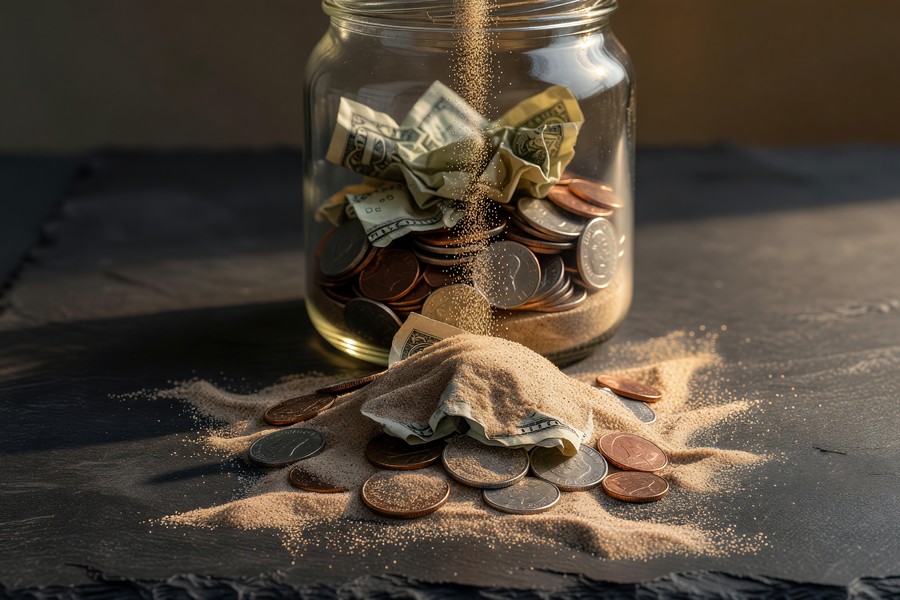
A 0.46% APY on $5,000 earns about $23 a year. A single $5 monthly maintenance fee costs you $60 a year. The math is straightforward: fees can completely wipe out your interest income and then some.
Many traditional banks charge monthly maintenance fees unless you meet certain conditions, such as maintaining a minimum daily balance or setting up direct deposit. If you dip below that threshold even once, the fee kicks in. The FDIC’s consumer guidance on bank fees recommends always reading the full fee schedule before opening any deposit account.
Hidden Charges to Watch For
Beyond monthly fees, watch for excess transaction fees, paper statement fees, and inactivity fees. Some banks charge you for making more than six withdrawals per month. That restriction, originally tied to Federal Reserve Regulation D, was relaxed in 2020, but many banks still enforce the six-withdrawal limit voluntarily. Each charge reduces your net return, often without any notification at the time of the transaction.
One charge that surprises many account holders: paper statement fees of $1 to $3 per month. On a low-balance account earning $23 in annual interest, even $24 in paper statement fees puts you in the red.
How Fees Change Your Real Return: A Comparison
The table below shows how different fee structures affect the net annual return on a $5,000 savings account earning the national average of 0.46% APY. The gross interest earned is $23 per year in every scenario. What changes is how much you actually keep.
| Account Type | Gross Annual Interest ($5,000) | Annual Fees | Net Annual Return | Effective Yield |
|---|---|---|---|---|
| Traditional bank, no fee waiver met | $23.00 | $60.00 ($5/month) | -$37.00 | -0.74% |
| Traditional bank, fee waiver met | $23.00 | $0.00 | $23.00 | 0.46% |
| Traditional bank, paper statements | $23.00 | $24.00 ($2/month) | -$1.00 | -0.02% |
| Online high-yield savings, no fees | $225.00 (at 4.50% APY) | $0.00 | $225.00 | 4.50% |
| Credit union savings, no fees | $30.00 (at 0.60% APY) | $0.00 | $30.00 | 0.60% |
Tiered Rate Structures: You Probably Don’t Qualify for the Best Rate
Banks often advertise a headline rate that applies only to customers with balances above a high threshold, sometimes $25,000 or more. If your balance is below that tier, you earn a lower rate, often far lower. The advertised number isn’t technically false. It just doesn’t apply to most people.
This is called a tiered interest rate structure, and it’s common at credit unions and large retail banks alike. Before opening an account, ask specifically what rate applies to your expected average balance, not the maximum possible rate. A bank advertising 1.20% APY may be paying that rate only on balances above $10,000, while balances below $1,000 earn 0.10%.
The CFPB’s bank account comparison tools can help you evaluate the actual rate tier your balance would fall into before you commit to an account.
Introductory Rates: A Related Problem
Some accounts use a different tactic: a high introductory rate that expires after three to six months. You open the account attracted by a 5.00% APY offer, then find yourself earning 0.50% once the promotional period ends. This is legal and common. The only defense is reading the account disclosure before you open it, specifically looking for language about “introductory,” “promotional,” or “limited-time” rates.
Inflation Is Eroding Your Real Return
Even if your savings account interest rate looks acceptable, inflation can make it negative in real terms. If inflation runs at 3% and your account pays 0.46%, you’re losing purchasing power every month even as your nominal balance grows.
The concept here is the real interest rate: your nominal rate minus the inflation rate. When inflation exceeds your savings rate, your money buys less over time. According to Bureau of Labor Statistics CPI data, inflation has averaged well above 2% in recent years, which makes the national average savings rate a losing proposition in real terms for most of that period.
This is one reason financial advisors consistently recommend keeping only a short-term emergency fund in a standard savings account. Money you won’t need for years belongs in a vehicle offering a better real return.
What the Real Rate Looks Like Across Account Types
If you assume an inflation rate of 2.9% (consistent with recent CPI trends), here is how different savings vehicles compare in real return terms:
- Traditional savings account at 0.46% APY: real return of approximately -2.44%
- High-yield online savings at 4.50% APY: real return of approximately +1.60%
- 6-month Treasury bill at roughly 4.30% (per U.S. Treasury rate data): real return of approximately +1.40%
- 1-year CD at 4.80% APY: real return of approximately +1.90%
Only one of those options actively destroys purchasing power. It also happens to be where the majority of Americans keep their savings.
How the Federal Reserve Rate Affects What You Earn
Savings account rates don’t move in a vacuum. They track the federal funds rate set by the Federal Open Market Committee. When the Fed raises its benchmark rate, banks can afford to offer higher yields on deposits. When it cuts, savings rates tend to follow quickly.
The catch is asymmetry. Banks are generally quick to lower deposit rates after Fed cuts but slower to raise them after hikes. A 2023 analysis by the Bankrate research team found that large retail banks passed through only a fraction of the Fed’s rate increases to standard savings accounts, even as those same banks raised rates on loans almost immediately. Online banks, facing more competitive pressure for deposits, tend to be more responsive on both sides of that equation.
Understanding this dynamic matters for timing. If the Fed has been cutting rates, the peak high-yield savings rates you saw advertised six months ago may have already declined. Rates are variable, and the number offered today may not be the number you earn six months from now.
Better Savings Account Interest Rate Options Exist
Online banks and fintech platforms can offer dramatically higher rates because they carry lower overhead. No physical branches means fewer operating costs, and they pass those savings to customers through higher APYs.
Several high-yield savings accounts from online banks have been paying between 4.50% and 5.25% APY. On a $10,000 balance, the difference between 0.46% and 5.00% APY is roughly $454 per year in additional interest earned. That’s not a rounding error. That’s a meaningful difference in your annual take-home return.

What to Look for in a High-Yield Account
Look for accounts with no monthly fees, no minimum balance requirements, and FDIC insurance up to $250,000 (or NCUA insurance if it’s a credit union). Check whether the high rate is a promotional introductory offer or the standard ongoing rate. Some accounts lure you in with a 6-month bonus rate, then drop to something far less competitive once you’re settled in.
It’s also worth thinking about how you manage other financial habits alongside savings. If you’re using tools like buy now pay later services for everyday purchases, those deferred payments could be reducing the balance you keep in savings, which directly cuts your interest earnings.
Alternatives Worth Considering
High-yield savings accounts aren’t the only option worth evaluating. I bonds from TreasuryDirect offer inflation-adjusted returns and are backed by the U.S. government, though they come with a one-year minimum holding period and a $10,000 annual purchase limit per person. CD ladders allow you to lock in competitive fixed rates at multiple maturity dates, preserving some liquidity while capturing higher yields. Money market accounts at online banks often carry rates similar to high-yield savings with slightly more flexible withdrawal structures.
None of these are right for every situation. The right choice depends on how quickly you may need access to the funds, your tax situation, and how much operational friction you’re willing to accept. But all of them offer better real returns than the average traditional savings account.
What You Should Do Right Now
Start by finding out your current savings account interest rate: the actual APY, not the promotional or tiered maximum. Then compare it against what high-yield online savings accounts are currently offering. The Consumer Financial Protection Bureau’s bank account tools provide clear guidance on comparing account types.
If your current rate is below 1% and you’re not earning a relationship rate or bonus, switching is worth the effort. Opening a new account online typically takes about 15 minutes. The potential gain on a $10,000 balance is several hundred dollars per year. Your current bank is unlikely to raise your rate without being asked, and even then, retail banks rarely match what online competitors offer.
Switching doesn’t have to mean abandoning your existing bank entirely. Many people keep a checking account at a traditional bank for ATM access and routine transactions, while moving their emergency fund and idle savings to a high-yield online account. That structure keeps convenience where you need it without sacrificing return.
Frequently Asked Questions
Why is my savings account interest rate so low compared to what I hear about?
Traditional brick-and-mortar banks typically offer much lower rates than online banks because they carry higher operating costs. The rates you hear advertised are often from online institutions or credit unions, not the large retail banks where most Americans still keep their savings.
Is a higher APY always better?
Generally, yes, but only if there are no fees or restrictive conditions attached. A 5% APY account with a $25 monthly fee could leave you worse off than a 4% account with no fees, depending on your balance. Always calculate your net return after fees before deciding.
How often do savings account interest rates change?
Savings account rates are variable, meaning banks can change them at any time. They typically move in response to changes in the federal funds rate set by the Federal Reserve. When the Fed raises rates, high-yield savings accounts tend to follow. When the Fed cuts rates, savings rates often drop quickly, sometimes faster than they rose.
Does my savings account interest count as taxable income?
Yes. The IRS requires you to report savings account interest as ordinary income, even if you don’t withdraw it. Your bank will send you a 1099-INT form if you earn $10 or more in interest during the tax year. Per IRS Topic No. 403, even smaller amounts technically need to be reported on your federal return.
How much of my money should I keep in a savings account?
Most financial advisors recommend keeping three to six months of living expenses in an accessible savings account as an emergency fund. Beyond that, your money may work harder in other vehicles, like a high-yield account, I bonds, or a CD ladder. The goal is liquidity for emergencies, not long-term growth.
Sources
- U.S. Bureau of Labor Statistics — Consumer Price Index (CPI)
- Federal Reserve — Selected Interest Rates (H.15 Release)
- Federal Reserve — Open Market Operations and the Federal Funds Rate
- IRS — Topic No. 403: Interest Received
- Consumer Financial Protection Bureau — Bank Account Comparison Tools
- FDIC — Deposit Insurance Coverage
- TreasuryDirect — I Bonds