

Fact-checked by the CapitalLendingNews editorial team
Quick Answer
Fintech credit products alternatives to personal loans include Buy Now, Pay Later (BNPL), earned wage access (EWA), invoice financing, and embedded credit inside banking apps. U.S. BNPL originations reached $156.7 billion in 2025, while EWA typically charges flat fees of $1–$5 versus effective APRs near 400% on payday loans. The right product depends on the exact cash problem you need to solve.
A personal loan is a blunt instrument. It works well for consolidating credit card debt or financing a renovation, but for most borrowers facing a narrow, immediate cash problem, a single large purchase, a gap between paydays, or an unpaid invoice sitting in a client’s queue, the structure rarely fits. Fintech credit products alternatives have emerged precisely to fill those gaps, and they’ve moved well past novelty status: U.S. BNPL credit originations hit $156.7 billion in 2025 according to the Federal Reserve Board of Governors.
This guide maps seven specific product categories to the cash problems they actually solve, including two categories most consumer guides overlook entirely: invoice financing for freelancers and employer-sponsored earned wage access. You’ll get real cost comparisons, honest trade-offs, and a framework for choosing the right tool without stacking products that compound your debt load.
Key Takeaways
- U.S. BNPL originations reached $156.7 billion in 2025, with 63% of that volume carrying 0% APR (Federal Reserve, 2026).
- Earned wage access products typically charge flat fees of $1–$5 per advance, compared to effective APRs near 400% on traditional payday loans (U.S. GAO, 2023).
- Pay-in-4 BNPL accounted for an estimated $70 billion in U.S. purchase volume in 2025, roughly 1.1% of total U.S. credit card spending (Federal Reserve Bank of Richmond, 2026).
- The CFPB has flagged regulatory uncertainty around earned wage access products and whether the Truth in Lending Act applies, meaning consumer protections vary by provider (GAO, 2023).
- Fintech credit users who stack multiple products report higher rates of debt distress, making these tools most defensible when matched to a single, specific cash shortfall (CFPB, 2023).
In This Guide
- Why Personal Loans Often Miss the Mark for Targeted Cash Shortfalls
- Buy Now, Pay Later: Financing a Specific Purchase Without a Full Loan
- Earned Wage Access: Tapping Wages You’ve Already Earned
- Invoice Financing and Freelancer Advances for Self-Employed Cash Gaps
- Cash Advance and Micro-Credit Apps for Immediate, Small Needs
- Embedded Credit Options Inside Banking and Payment Apps
- Fintech Credit Products Alternatives: Comparing Real Costs, Risks, and Fit
Why Personal Loans Often Miss the Mark for Targeted Cash Shortfalls
For a $300 gap between your paycheck and a utility bill, a personal loan is the wrong tool. Approval typically requires a hard credit pull, documentation of income, and a processing window that can run several business days, all of which are disproportionate to the problem. The result is a fixed monthly payment that extends six to 60 months for a shortfall that will resolve itself in two weeks.
The Structural Mismatch Problem
Personal loan structures are optimized for larger, longer-horizon needs. The minimum loan amounts at most banks and credit unions start at $1,000, and many digital lenders set floors at $2,000. Borrowing $2,000 when you need $250, and paying interest on the full balance for two years, is an expensive approximation of what you actually need. It also affects your debt-to-income ratio on digital lending platforms, potentially blocking you from other credit when you need it.
There’s a separate access problem, too. Thin-file borrowers, gig workers, and lower-income applicants frequently fail traditional underwriting screens despite having stable cash flow. Lenders using alternative signals beyond credit scores have narrowed that gap, but standard bank personal loans haven’t moved much. The newer fintech credit products covered in this guide bypass the credit score entirely in many cases, using transaction history, employment data, or outstanding invoices as the underwriting basis instead.
The Federal Reserve and federal banking agencies formally encouraged banks to offer responsible small-dollar loans to consumers and small businesses, an acknowledgment that existing loan structures leave real gaps for short-term, low-dollar needs.
Buy Now, Pay Later: Financing a Specific Purchase Without a Full Loan
BNPL splits the cost of a single purchase into installments, most commonly four equal payments over six weeks at 0% interest, with approval handled at checkout in seconds. No loan application, no credit score requirement at most providers, and no interest if you pay on time. That last point is critical: 63% of the $156.7 billion in 2025 U.S. BNPL originations carried 0% APR according to Federal Reserve data.
BNPL Providers, Fee Structures, and Real Costs
Major providers including Affirm, Klarna, Afterpay, and PayPal Pay Later each run slightly different models. Pay-in-4 products at 0% carry no finance charge but typically impose late fees of $5–$10 per missed payment. Longer-term BNPL plans, 6 to 36 months, do carry interest, often ranging from 10% to 36% APR depending on creditworthiness and provider. The 0% window is real but narrow.
Research from Stanford Graduate School of Business describes pay-in-4 BNPL as convenient and essentially free credit for borrowers who pay on time, a qualification that carries real weight. Pay-in-4 BNPL accounted for an estimated $70 billion in U.S. purchase volume in 2025, per Federal Reserve Bank of Richmond research, about 1.1% of total U.S. credit card spending. The CFPB’s consumer research found that BNPL users skew toward lower credit scores and are more likely to carry other high-cost debt, which means the “free if you pay on time” framing only holds if you actually do.
The clearest use case: a specific, defined purchase you would have made regardless, a medical device, a laptop for work, a flight, where splitting four payments fits your existing cash flow without adding net debt. Using BNPL to buy things you otherwise wouldn’t afford is a different calculation entirely.

Earned Wage Access: Tapping Wages You’ve Already Earned
Earned wage access (EWA) lets you draw a portion of wages you’ve already worked for before your scheduled payday. It doesn’t create new debt. The advance is deducted from your next paycheck automatically, so repayment is built into the mechanics, with no separate bill to track.
Employer-Sponsored EWA vs. Third-Party Apps
This is the distinction most consumer guides skip. Employer-integrated EWA platforms, like DailyPay, Even, and PayActiv, connect directly to your employer’s payroll system. They typically charge a flat fee of $1–$3 per transfer, and because the repayment flows through payroll, the risk of overdraft or non-repayment is minimal. Some employers absorb the fee entirely as a benefit.
Third-party EWA apps, like Earnin or Branch, operate without employer integration, using bank account data to estimate earned wages. They often charge $0 with an optional “tip” model or charge $2–$5 for instant delivery. The catch is verification: without a direct payroll link, some apps are slower to confirm wage eligibility or may offer lower advance limits. The CFPB has analyzed both categories of paycheck advance products and flagged that regulatory treatment varies substantially between them.
Traditional payday loans carry effective APRs near 400%, according to the U.S. Government Accountability Office. Employer-integrated earned wage access typically runs $1–$3 flat per advance, a fraction of that cost for an equivalent dollar amount.
EWA is best suited to workers with predictable hourly or salaried income who face a timing problem, not an income problem. For gig workers with irregular pay cycles, the mechanics can get messier; a dedicated framework for gig workers borrowing during income gaps addresses those edge cases in more depth. The GAO has also noted that whether EWA products are covered by the Truth in Lending Act (TILA) remains unsettled, meaning disclosure requirements differ by platform.
Invoice Financing and Freelancer Advances for Self-Employed Cash Gaps
The gig economy now employs tens of millions of Americans, yet almost no mainstream borrowing guide mentions the credit product most relevant to their cash problem: invoice financing. The mechanics are distinct from personal loans. A platform advances you a percentage of an outstanding invoice (typically 70%–90% of face value), and repayment flows automatically when the client pays. Your eligibility is based on the creditworthiness of your client, not your personal credit score.
How Freelancer Advance Platforms Work
Platforms like Pipe, Payoneer Capital, and niche freelancer tools embedded in platforms like Upwork and Fiverr have expanded access to this structure. Fees typically range from 1%–5% of the invoice value per month until the client pays, which translates to a meaningful APR on slow-paying accounts but a modest flat cost on invoices resolved within 30 days. For a $2,000 invoice with a 3% monthly fee paid in 30 days, the cost is $60, no credit check, no monthly payment schedule, no debt on your balance sheet beyond the single advance.
This product solves a problem personal loans handle poorly: cash flow timing for self-employed workers whose income is real but delayed. For context on how lenders increasingly assess non-traditional income sources to approve borrowers, the mechanics behind fintech lenders using payroll data for approvals offer useful background on how this underwriting logic works.
Cash Advance and Micro-Credit Apps for Immediate, Small Needs
Apps like Dave, Brigit, and Cleo occupy a specific niche: advances of $20 to $500 delivered instantly or within hours, repaid from your next deposit. The fee model is typically a flat monthly subscription ($1–$10/month) plus an optional express fee for instant transfer. No credit pull, no interest rate in the traditional sense.
Honest Limits of the Micro-Credit Model
The subscription model obscures true cost. A $9.99/month subscription to access a $50 advance works out to an effective APR of roughly 240% if you only use the advance once that month. Power users who draw advances several times monthly pay a lower effective rate. For most borrowers, these apps make sense for occasional bridge gaps, not as a recurring mechanism for covering routine expenses, which signals a cash flow problem that requires a different solution.
Before paying an express fee for instant transfer on a cash advance app, check whether your bank offers real-time payment rails (like RTP or FedNow). Some standard transfers now settle within minutes for free, eliminating the main reason to pay the speed premium.
Embedded Credit Options Inside Banking and Payment Apps
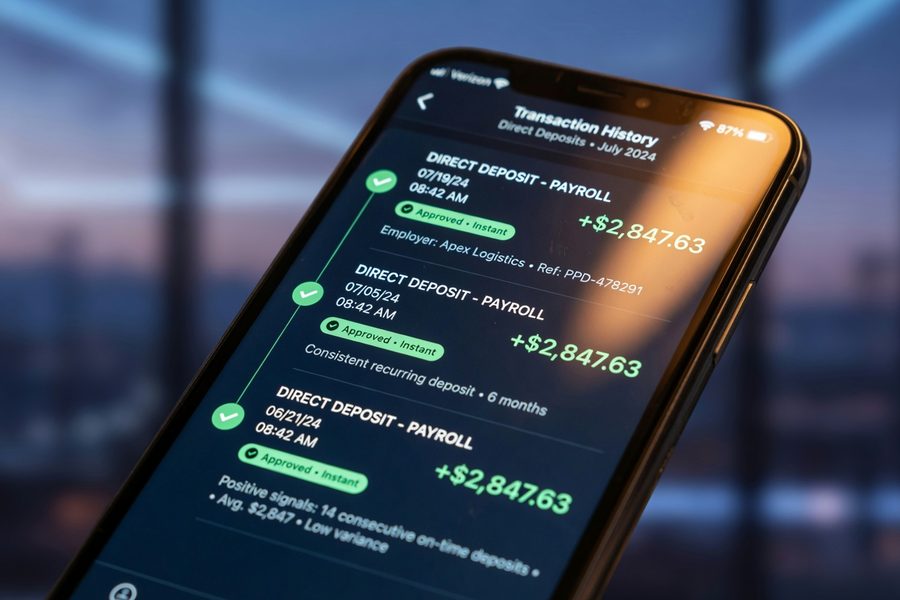
Embedded credit is what happens when your bank account, payment app, or neobank extends a small credit line or overdraft facility that activates automatically during a shortfall, without a separate application. Chime’s SpotMe, Current’s Overdrive, and similar features within neobanks now do this at scale, using transaction history and deposit cadence as underwriting inputs rather than a FICO score.
Data-Driven Approvals and Convenience Trade-Offs
The approval signal is your behavior inside the app. Regular direct deposits, low overdraft frequency, and consistent account activity all improve your embedded credit limit over time. For users already managing their finances through a single app, this is genuinely the lowest-friction credit product available, no application, no separate login, no additional disclosure to sign.
The trade-off is data exposure. Using embedded credit means your lender and your bank are the same entity, with full visibility into your spending patterns. If that relationship ends, you switch banks, the app changes its fee structure, you lose the credit access without warning. For a fuller picture of what happens to your financial data long after a digital credit relationship closes, the analysis of data retention practices after digital loans close is worth reading before committing to any single-app financial ecosystem.
Fintech Credit Products Alternatives: Comparing Real Costs, Risks, and Fit
Side-by-side cost comparisons change how you evaluate these products. The table below uses a $500 need as the comparison baseline across six product types, reflecting mid-2026 market conditions.
| Product Type | Typical Cost on $500 | Effective APR Range | Best Fit For |
|---|---|---|---|
| BNPL (Pay-in-4, 0%) | $0 if paid on time; $10–$30 in late fees if not | 0% (on-time) / 30%+ (late) | Single defined purchase at checkout |
| Earned Wage Access (employer) | $1–$3 flat fee | ~3%–15% annualized | Payday timing gap, salaried/hourly workers |
| Invoice Financing | $15–$50 (3%–5% on $500 invoice, 30-day term) | 36%–60% annualized | Freelancers with outstanding client invoices |
| Cash Advance App | $5–$15 (subscription + express fee) | 60%–300% annualized | Small, one-time shortfall until next deposit |
| Embedded Neobank Credit | $0–$5 (typically free up to limit) | 0%–15% (varies by app) | Existing neobank users, small overdraft gaps |
| Personal Loan (fintech lender) | $15–$45 in interest (12%–22% APR, 12-month term) | 12%–36% | Larger needs, multi-month repayment horizon |
A worked example makes the EWA case concrete. If you access $500 via employer-integrated EWA at a $2 flat fee, your all-in cost is $2. The same $500 via a typical payday loan at 400% APR, repaid in two weeks, costs roughly $77 in fees and interest. Over a year of monthly access, EWA at $2 per advance runs $24; payday loans for the same 12 shortfalls would cost approximately $924. The gap is not marginal.
The Stacking Problem and When to Use a Personal Loan Instead
The CFPB’s research on BNPL borrower profiles found that users with multiple active BNPL plans report materially higher rates of financial distress. The same pattern applies across fintech credit categories: using BNPL for a laptop, a cash advance app for groceries, and EWA for rent in the same month isn’t diversification, it’s debt stacking with fragmented repayment timelines. That scenario, explored in more depth in this guide to fintech loan stacking and the risks lenders flag, can surface on your credit report and complicate future applications.
For most borrowers, a traditional personal loan remains the better answer when the need exceeds $2,000, extends beyond 60 days, or involves multiple overlapping expenses. The products covered here are precision tools. Using them for the narrow problem they were built for is where the cost advantage holds. Using them as substitutes for a missing emergency fund is where the math breaks down. Building that buffer first, even in small increments, is the structural fix; a practical framework for doing that while carrying existing debt is covered in this guide on building an emergency fund while paying off debt using fintech.
Related reading: hidden mistakes trigger higher interest.
Frequently Asked Questions
Is Buy Now, Pay Later considered a loan?
BNPL functions like a short-term installment loan, but it is not always classified as one under current U.S. law. The CFPB has examined whether BNPL products should be subject to the same disclosures as credit cards; as of mid-2026, regulatory treatment remains inconsistent across providers. Practically, you owe money that must be repaid on a schedule, the credit risk is real regardless of the legal label.
Does using earned wage access hurt your credit score?
Most EWA platforms, both employer-integrated and app-based, do not report to the three major credit bureaus, Equifax, Experian, and TransUnion, and do not perform hard credit inquiries. That means on-time use doesn’t help your score, and defaulting typically won’t hurt it directly. The risk is indirect: repeated EWA use that leaves your paycheck depleted can cascade into overdrafts that do affect your banking relationships.
Can freelancers or gig workers qualify for invoice financing?
Yes, and it’s one of the strongest use cases. Invoice financing platforms evaluate the credit quality of your client, not your personal credit history, which makes it accessible to thin-file freelancers with solid business clients. The main qualification requirement is a documented, outstanding invoice from a verifiable business entity, not a consumer transaction.
How do I avoid the debt stacking trap with fintech credit products?
Use one product per cash problem, and define the problem specifically before applying. A clear rule helps: BNPL for a specific purchase, EWA for a payday timing gap, a cash advance app for a one-time shortfall under $200. If you find yourself using more than two of these products simultaneously, the underlying issue is likely a structural cash flow problem that a short-term product won’t fix.
Are embedded credit features inside neobanks regulated?
They are, but the regulatory framework varies by how the product is structured. Overdraft lines of credit fall under Regulation Z and the Truth in Lending Act. Fee-based spot coverage programs, like those offered by several neobanks, occupy a grayer area, the CFPB has proposed stricter rules on overdraft fees from larger institutions, but app-based fintech coverage products remain subject to less uniform disclosure requirements.
When does a standard personal loan beat all of these alternatives?
When the amount exceeds roughly $2,000, the repayment window extends beyond 60 days, or the cash need spans multiple categories at once. Personal loans also report to credit bureaus, so they can help build credit history, a benefit none of the short-term alternatives reliably provide. For borrowers weighing the full cost picture, a direct comparison of payroll loans versus personal loans shows where each product’s cost advantage actually holds.
Sources
- Board of Governors of the Federal Reserve System, Buy Now, Pay Later: Beyond Pay-in-4 (2026)
- Federal Reserve Bank of Richmond, Economic Brief: BNPL Purchase Volume (2026)
- Consumer Financial Protection Bureau, Consumer Use of Buy Now, Pay Later (2023)
- Consumer Financial Protection Bureau, Data Spotlight: Developments in the Paycheck Advance Market
- U.S. Government Accountability Office, Fintech: Benefits and Risks to Consumers, Including Earned Wage Access (GAO-23-105536)
- Federal Reserve, Interagency Statement on Small-Dollar Lending (2020)
- Stanford Graduate School of Business, Hidden Costs of Clicking the Buy Now, Pay Later Button