

Fact-checked by the CapitalLendingNews editorial team
Verdict at a Glance
Full joint borrowing wins for couples with a credit score gap under 50 points and balanced debt loads, it unlocks better rates on mortgages, auto loans, and personal loans while building joint credit history. If your scores differ by more than 100 points, choosing a solo application with an authorized-user strategy protects both profiles without sacrificing loan approval.
Navigating joint borrowing with different credit scores is one of the trickiest financial moves a couple can make. Full joint borrowing, where both partners sign as co-borrowers, merging liability and credit, contrasts sharply with alternative arrangements like a solo application plus an authorized user or a co-signer. One specific data point drives the urgency: in the first half of 2025, 79.6% of mortgage originations went to super-prime borrowers with scores above 720, according to a LendingTree analysis of Federal Reserve data. A single low score can lock both partners out of those best-in-class rates.
The factor that swings the decision more than any other is the gap between the two credit scores. A narrow gap changes how lenders price risk; a wide one puts the higher scorer’s profile on the line for years, even if the lower scorer eventually improves. The rest of this guide walks through exactly how lenders look at mismatched profiles, and gives you a clear, six-step action plan to make the right call without damaging either credit report.
Key Takeaways
- Lenders use the lower middle score on joint applications, not an average, a 50-point gap can cost thousands in extra interest over a loan’s life (Fannie Mae).
- When the lower score falls below 620, mortgage denials increase by roughly 40% on joint applications, making a solo filing worth serious consideration (LendingTree / Federal Reserve data).
- A single missed payment on a joint account can drop a 780 FICO by 90 to 110 points, far more than a lower score would fall, because the model registers a larger deviation from established behavior (Equifax).
- Adding a lower-scoring partner as an authorized user on a long-standing, low-utilization card can lift their score by 30 to 80 points within two statement cycles, with no shared liability created (Experian).
- The average number of joint credit accounts per couple fell to 1.20 as of Q2 2023, down from 1.47 in 2014, signaling a broad shift away from shared debt structures (Experian Research).
- Roughly 32 million U.S. adults are credit invisible, meaning a thin-file partner can push a mortgage file to manual underwriting and eliminate access to automated prime pricing (Federal Reserve, October 2025).
| Attribute | Full Joint Borrowing (Co-Borrower) | Alternative Arrangements (Solo + Auth. User, etc.) |
|---|---|---|
| Credit Score Evaluation | Lender uses lower middle score of the two borrowers (FICO 2/4/5 for mortgages, FICO 8/9 with major variations for personal loans) | Only the primary applicant’s score is used; authorized user’s score may appear on report but doesn’t drive underwriting |
| Approval Odds With a 100-Point Gap | Drop sharply: mortgage denials increase by roughly 40% when the lower score falls below 620 | Remain strong if the solo borrower’s score is above 700; authorized user arrangement doesn’t block approval |
| Typical Rate Differential (Mortgage) | If low score is 680 vs. 780, APR can rise by 0.75–1.25%, adding $150–$250/month on a $400k loan | Solo borrower with 780 gets prime rate as low as 6.25% in late 2025; no penalty for the lower score |
| DTI Factor | Combined income can lower DTI, but both sets of debts are included, can backfire if one partner carries high credit card balances | Only one income and one set of debts; easier to keep DTI under 36% if the solo applicant has clean finances |
| Liability for Debt | Both are 100% liable; if payments slip, lenders pursue both, and default shows on both reports for 7 years | Only the primary borrower is liable; authorized user has no contractual responsibility and can be removed at any time |
| Credit Report Impact | Account appears on both reports immediately; payment history builds both scores fast, but missed payments ding both equally | Only the primary’s report is affected; authorized user may get a trade line boost for on-time payments without negative marks |
| Time to Close | Two applicants means twice the documentation; can add 5–10 business days to underwriting for a mortgage | Faster: one set of pay stubs, bank statements, and tax returns; funding can occur in 3–7 days for digital personal loans |
| Maximum Loan Amount | Combined income often unlocks a larger principal, up to 45% higher on a conventional mortgage if both incomes are stable | Cap is based on single income; less firepower for a jumbo mortgage or high-limit personal loan |
| Co-Borrower Removal / Exit Strategy | Requires refinancing or loan assumption; can cost 2–5% of the remaining balance and a fresh credit check | Simply call the card issuer to remove the authorized user; no refinance needed, zero cost, no credit inquiry |
| State Law Nuances | In community property states, both partners may be liable for joint debts regardless of who signed; divorce can get complicated | Solo debt stays with the signer; authorized user status doesn’t create property rights or marital liability |
How Lenders Actually Score Joint Applications With Different Credit Profiles
The answer first: lenders don’t average both borrowers’ scores, they pull a version of the lower middle score. For conforming mortgages, Fannie Mae’s guidelines require the loan-level credit score to be the “average median credit score” of the borrowers when underwriting manually. In practice, most automated underwriting systems at Chase, Wells Fargo, and online lenders pull the middle FICO from each of the three bureaus for both applicants, then select the lower of those two middles. That lower middle score sets the pricing tier, and 32 million U.S. adults are unscoreable or credit invisible, according to the Federal Reserve, which means a thin-file partner can effectively anchor the rate to whatever score the bureau can generate, or push the file to manual underwriting.
Personal loans from fintechs like SoFi, Upgrade, and LightStream follow similar logic but often use FICO 8 or VantageScore 4.0, which weight payment history and utilization slightly differently. Some digital lenders apply proprietary models that pull both applicants’ credit, run scoring algorithms, and then price off whichever score lands in the lower risk bucket of their internal scorecard. Still, the core principle holds: the weaker score sets the floor for the interest rate, and a 50-point gap can cost thousands in extra interest over a five-year term.
Worth stating clearly: this framework is not a good fit for every couple. If the lower-scoring partner’s income is genuinely required to meet the lender’s minimum qualifying threshold, then going solo is not actually an option regardless of the rate benefit. The choice becomes how to minimize the damage of joint borrowing, not whether to do it at all. That constraint is common in high-cost housing markets where a single income falls short of debt-to-income requirements even before rate pricing enters the picture.

When Joint Borrowing Is Worth It, and When the Risk Outweighs the Reward
The shortest answer: if your scores are within 50 points of each other and both debt-to-income ratios stay under 36%, joint borrowing usually makes sense. The rate penalty is negligible, and the combined income can unlock a larger loan amount. But if the gap stretches past 100 points or one partner brings high revolving debt, the cost and shared liability almost always outweigh the benefit.
Protecting the Higher-Scoring Partner’s Credit During and After the Application
The higher scorer’s profile takes the bigger risk. A single missed payment on a joint account can drop a 780 FICO by 90 to 110 points, far more than a 620 score would fall, because the model sees a bigger discrepancy from the established credit behavior. You can mitigate that from the start. Before applying, note that there is a 14-day hard-inquiry window during which multiple mortgage pulls count as one for scoring purposes. Equifax notes that joint accounts appear on both reports immediately, so the higher scorer’s inquiry count matters. Time the pull so it falls within that window and the lower scorer’s score is as optimized as possible, even a 20-point bump from paying down credit card utilization can move the needle.
Post-approval, the protection playbook is straightforward: set up autopay immediately, keep the combined utilization on revolving joint accounts under 10%, and monitor both credit reports monthly through a free service. The higher scorer should also maintain an active individual credit card to preserve credit mix and history length. That way, if the joint loan is ever refinanced into a solo name, that profile doesn’t look thin.
The Debt-to-Income Trap in Joint Applications
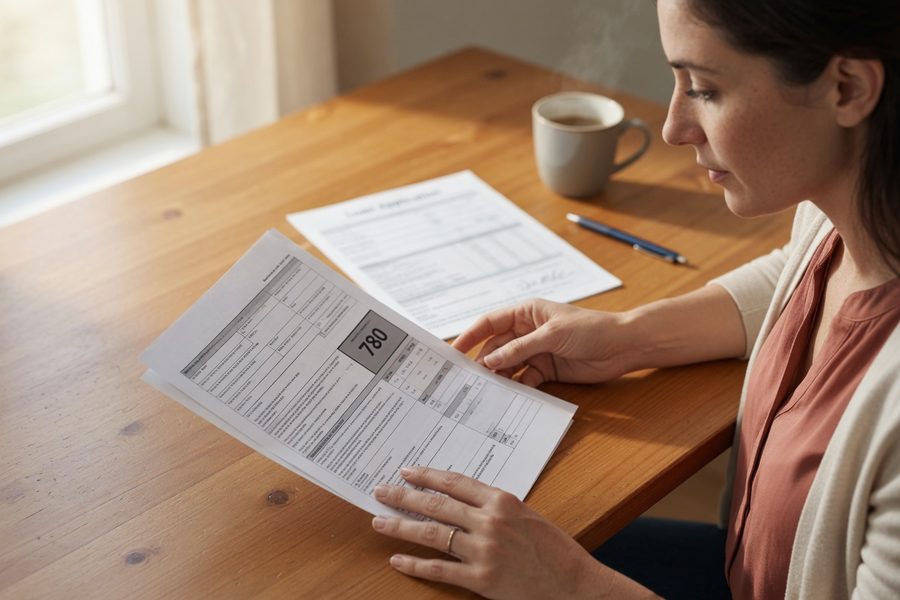
Joint borrowing can either slash or inflate your debt-to-income ratio. The math is simple: both incomes are added, but both sets of monthly debt payments are too. If the lower-scoring partner also carries $800 in monthly student loans and credit card minimums, that eats into the back-end DTI that lenders require to stay below 43% for a qualified mortgage. Even with a combined income of $12,000 per month, if total debt service hits $5,300, the DTI hits 44%, above the conforming loan limit. In that scenario, leaving the high-debt partner off the loan entirely actually improves approval odds. It’s a nuance that many couples overlook, and one that a strategic solo application with an authorized user arrangement solves.
The average number of joint credit accounts per couple has fallen to 1.20 as of Q2 2023, down from 1.47 in 2014, per Experian, a sign that couples are increasingly wary of shared liability even as marriage rates hold steady.
When One Borrower Has No Credit Score at All
A partner with a thin or nonexistent credit file, roughly 32 million U.S. adults, faces a different challenge than a partner with a low score. Lenders can’t pull a score, so automated underwriting may fail. That doesn’t automatically disqualify the couple. For a mortgage, Freddie Mac’s guidelines allow at least one borrower to have a usable credit score, but the loan file moves to manual review. Some community banks and credit unions will accept alternative credit references, rent, utility, and phone bills, but rates won’t be prime. For personal loans, adding the unscoreable partner as an authorized user on the other’s oldest credit card for 3 to 6 months can generate a FICO score that, even in the mid-600s, lands a joint loan with a fixed rate around 18–24% APR instead of the 35%+ a pure no-credit-file application might trigger.
The Authorized User Strategy: Boost the Lower Score Without Shared Liability
The fastest, lowest-risk way to help a lower-credit-score partner without full joint borrowing is to add them as an authorized user on a long-standing, low-utilization credit card. The account’s payment history and age can appear on the lower scorer’s report, often lifting the score by 30 to 80 points within two statement cycles. Critically, the authorized user bears no contractual obligation, they can be removed in minutes, and the primary cardholder retains full control. This approach sidesteps the joint borrowing/different-credit-score dilemma entirely for couples who don’t need the second income for the loan amount. Combined with a solo personal loan or mortgage in the stronger partner’s name, the lower scorer builds credit passively while the household still gets prime rates.
One honest caveat: not all lenders report authorized user accounts to the bureaus, and some scoring models downweight them when there’s no established relationship between the primary cardholder and the user. The boost is real in most cases, but it isn’t guaranteed, checking in advance whether the card issuer reports authorized users to all three bureaus is a step worth taking before counting on the score lift.
Loan-Type Playbooks: Mortgages, Auto Loans, and Personal Loans
Mortgage underwriting is the strictest. Fannie Mae and Freddie Mac dominate the conforming market, and both pull the lower middle score. An auto loan from a major bank will often use the higher of the two scores if the higher scorer is listed as the primary borrower, Experian confirms, which can make joint auto borrowing more forgiving. Personal loans from online lenders, by contrast, tend to apply the lower score or an internal scorecard blend, but many now offer pre-qualification with a soft pull, you can test joint vs. solo rates without hurting either credit report. Before you commit, it’s worth checking how peer-to-peer lending prices a single applicant with fair credit, because some P2P platforms accept scores as low as 600 and still beat bank joint-loan rates when the gap is wide.
When Full Joint Borrowing Is the Better Choice
Joint borrowing is the right move when the numbers stack up and the relationship is stable. Here’s when to pull the trigger:
- Credit score gap is under 40 points and both scores are above 680, the rate penalty is minimal and the combined income unlocks more house.
- You need the second income to qualify for a mortgage in a high-cost area, and both debt-to-income ratios are below 36%.
- One partner has a high income but a thin file; adding them as a co-borrower on an auto loan may score them a better rate than the primary alone.
- You’re building a long-term credit partnership (spouses filing jointly) and value the simplicity of shared tradelines.
- The loan has a co-borrower release option after 12 to 24 on-time payments, allowing the higher scorer to exit cleanly.
When Alternative Arrangements Are the Better Choice
A solo application with an authorized user or co-signer route wins when protecting the stronger profile matters more than loan size. These scenarios tilt the scale:
- The credit score gap exceeds 100 points and the lower score is below 620, the rate jump can add $200+/month on a mortgage.
- One partner carries high revolving debt that would push the combined DTI over 43%.
- You’re unmarried and not in a community property state; separating joint debt later is legally messy without divorce proceedings.
- The lower scorer needs to build credit: an authorized user setup adds the account to their report but costs nothing extra.
- The loan is a short-term personal loan for a specific expense; you can then add the partner later via a balance transfer or sinking fund instead of locking both into shared debt.

| Criterion | Full Joint Borrowing | Alternative Arrangements |
|---|---|---|
| Cost (rate) | 3/5, Lower-middle score penalty can raise APR 1%+ | 5/5, Prime rates if solo score is excellent |
| Approval Odds | 2/5 with large gap; 4/5 with small gap | 4/5, Only one underwritten; higher odds with high score |
| Speed | 3/5, Twice the docs; underwriting delay | 5/5, Fast, digital-native solo loans in days |
| Risk to Higher Score | 2/5, Full liability, late payments hit hard | 5/5, No liability for authorized user; credit impact controlled |
| Credit Building for Both | 5/5, Both build history simultaneously | 3/5, Only primary builds; authorized user gets a boost but not full tradeline depth |
| Exit Flexibility | 2/5, Refinance required to remove; fees and score pull | 5/5, Remove authorized user instantly; no cost |
| Overall Winner | X (Alternative arrangements dominate for couples with score gaps >50 pts; joint borrowing wins in narrow-gap, high-income scenarios) |
For joint auto loans, lenders may use the higher of the two applicants’ scores, the lower, or consider both, enabling a co-borrower with a higher score to help one with a lower score qualify. (Experian, Ask Experian Blog)
6-Step Action Plan for Couples With Different Credit Scores
This plan moves you from “should we?” to “here’s exactly what to do” in under an hour of work.
- Pull both credit reports. Get free weekly reports from annualcreditreport.com. Note each score, any delinquencies, and utilization rates.
- Measure the score gap and DTI. If the gap is under 50 points and combined DTI under 36%, joint borrowing is on the table. If not, move to step 3.
- Optimize the lower score fast. Pay down the partner’s credit card balances to under 30% utilization, ideally 10%. Dispute any errors; even one removal can add 25 points.
- Add the lower scorer as an authorized user. Use a card with a long history and low balance. Wait two statement cycles for score improvement.
- Test rates both ways. Use soft-pull pre-qualification tools at a digital lender. Compare a solo application with the stronger profile against a joint application. Factor in the long-term cost difference, not just the monthly payment.
- Set up a post-approval shield. Whether you go joint or solo, establish autopay, set a utilization alert at 10%, and schedule an annual credit check-in together.
Frequently Asked Questions
Does joint borrowing with a spouse hurt the higher credit score?
Applying jointly triggers a hard inquiry on both reports, which can temporarily lower the higher scorer’s score by 3 to 5 points. The bigger risk is if payments are missed, a single 30-day late mark on a joint account can drop a 780 score by over 90 points. If payments are made on time, the account can actually help the higher scorer by adding positive payment history and diversifying credit mix.
Is it better to apply for a loan jointly or individually when credit scores are different?
It depends on the gap. When the difference is under 50 points, joint often wins because the rate penalty is small and the combined income boosts the loan amount. With a gap above 100 points, individual borrowing plus an authorized user arrangement almost always yields a lower rate and shields the stronger profile from unnecessary risk.
How do lenders calculate the credit score for a joint personal loan?
Most lenders use a version of the lower middle score or a proprietary score that weights the weaker score more heavily. For example, SoFi and Upgrade typically pull FICO 8 from all three bureaus for both applicants, then use a blended score that leans toward the lower of the two. This means a partner with a 620 can anchor the rate even if the other has an 800.
Can I be added as a co-borrower on a mortgage if my credit score is below 620?
Yes, some Fannie Mae and Freddie Mac loans allow a co-borrower with a score below 620, but the loan must go through manual underwriting and the higher-scoring borrower must have compensating factors, a larger down payment, low DTI, or significant reserves. The rate will be higher, and mortgage insurance may cost more. In many cases, leaving the low-score partner off the loan entirely and using their income only as a compensating factor is a cleaner path.
Will adding my partner as an authorized user help them qualify for a joint loan later?
Yes. Authorized user accounts can add years of credit history and low utilization to the partner’s file, potentially boosting their score into the 680+ range within 3 to 6 months. Once that score is competitive, a joint application becomes far more favorable. It’s one of the few strategies that builds credit without creating shared debt liability.
What happens to joint debt if we separate and aren’t married?
Lenders don’t distinguish between married and unmarried joint borrowers. Both remain 100% liable for the debt, and if one stops paying, the other must cover the full amount or face collection and credit damage. Refinancing to remove a co-borrower requires the remaining borrower to qualify on their own income and credit, not always possible. Before going joint, unmarried couples should have a written agreement about how the debt will be handled if the relationship ends.
Can one partner apply for a loan and add the other later without refinancing?
Typically no. Most term loans, mortgages, auto loans, personal installment loans, don’t allow adding a co-borrower after closing without a full refinance. Revolving accounts like credit cards can add an authorized user easily, but that doesn’t create borrowing power for the added person. If you think you’ll want both names on a loan, get it right on the original application or plan for a refinance once the lower score improves.
Sources
- Experian, Whose Credit Score Is Used on a Joint Auto Loan?
- Experian, How to Get a Joint Personal Loan
- Equifax, Myths vs. Facts: Marriage and Credit
- Fannie Mae, General Requirements for Credit Scores
- Freddie Mac, Borrower Credit Score Requirements
- AmeriSave / LendingTree (via Federal Reserve data), Co-borrower guide and mortgage origination statistics
- Federal Reserve, Consumer & Community Context, October 2025
- Experian Research, Joint Accounts Are on the Decline for Couples