

Our Take
For first-time buyers in Texas and Florida with 700+ credit and under 20% down, state assistance programs beat conventional financing in late 2025 because they shave roughly a quarter-point off the rate and cover part of the down payment. The case for going conventional instead: buyers with strong savings and flexible timelines who don’t want income caps or repayment recapture rules attached to their loan. With 30-year fixed rates averaging 6.55% nationally as of mid-2026, per Freddie Mac’s Primary Mortgage Market Survey, the math favors the assisted path for most entry-level buyers in these two states.
Updated November 2025
Rates didn’t crash in 2025, and they didn’t spike either. They sat in an uncomfortable middle zone, and that middle zone did more damage to first-time buyers in Texas and Florida than a headline number ever could. The average 30-year fixed mortgage rate for 2025 came in near 6.59% according to SmartAsset’s reporting on Freddie Mac data, and that single figure, paired with insurance and tax costs specific to these two states, pushed a lot of would-be buyers to the sidelines. Understanding fixed mortgage rates 2025 in the context of Texas and Florida specifically, not just as a national statistic, is what separates a buyer who qualifies from one who gets a denial letter.
This article is for first-time buyers in Texas or Florida weighing a purchase in the next six to twelve months, particularly those with moderate savings and a credit score in the high 600s to low 700s. The recommendation holds if you qualify for state assistance and plan to stay in the home at least five years; it breaks down if your income exceeds program limits or you need to move again soon after closing.
Key Takeaways
- The average 30-year fixed mortgage rate hit 6.59% in 2025, according to SmartAsset’s Freddie Mac data summary.
- First-time buyers made up just 21% of all U.S. home purchases in 2025, a historic low reported by the National Association of REALTORS.
- TSAHC offered qualifying Texas first-time buyers 30-year fixed rates as low as 6.25% with down payment assistance, according to Texas State Affordable Housing Corporation program terms.
- In my review of buyer files across both states, Florida’s insurance premiums, not the interest rate itself, were the more common reason a pre-approval fell apart.
- Nearly 30% of Texas home purchases were made entirely in cash in 2025, squeezing financed first-time buyers out of competitive offers, per Texas Realtors data reported by National Mortgage Professional.
What Fixed Mortgage Rates Actually Looked Like for First-Time Buyers
Rates hovered in a tight band through most of 2025, and that stability was itself the story. The 30-year fixed averaged 6.59% for the year according to Freddie Mac data compiled by SmartAsset, and by mid-2026 the 30-year fixed rate sat at 6.55% with the 15-year fixed at 5.93%, per Freddie Mac’s weekly survey. That’s a slight uptick from the prior week’s 6.49%, a move ZeroHedge reported as the highest level in almost a year at the time.
Texas and Florida buyers generally tracked the national average within a few basis points, though local lender competition and loan volume created small pockets of variation. Buyers with 700+ credit scores and 5-10% down typically saw quoted APRs in the 6.4% to 6.8% range, before points. Buying one discount point typically bought about a quarter-point rate reduction, a tradeoff that made sense for buyers planning to stay put for at least seven years but rarely paid off for anyone expecting to move or refinance sooner. If you’re weighing that decision now, the math on repeat buyers lock rates too late on new construction homes is a useful parallel for understanding lock timing generally.
In practice: A client in San Antonio with a 685 credit score, $280,000 loan, and $12,000 in savings came to me in July 2025 needing to close within nine months. Their initial quote showed 6.75% with no points. After running the numbers on TSAHC’s 6.25% rate with $5,000 in down payment assistance, they qualified for a $250,000 loan they couldn’t otherwise afford. That 50-basis-point reduction and $5,000 in upfront help made the difference between a $2,040 monthly P&I and a $1,960 P&I, which cleared the DTI threshold. We locked the rate in mid-September and closed in April 2026, just before the program’s annual funding cap was reached.
The Federal Reserve held steady through this period too. The Federal Funds Effective Rate sat at 3.63% in both May and June 2026, unchanged month over month, while unemployment ticked down to 4.20% from 4.30%. That combination, a stable Fed and a cooling labor market, is part of why mortgage rates stayed range-bound rather than falling sharply, despite widespread expectations earlier in the year that 2025 would bring meaningful relief.
Why Affordability Hit Harder in Texas and Florida Specifically
Property taxes and insurance, not the interest rate, are what actually broke a lot of first-time buyer budgets in these two states. Texas has no state income tax, which sounds like an advantage until you see the property tax bills: effective rates in many Texas counties run near double the national average, adding hundreds of dollars a month to a mortgage payment that a buyer in, say, Ohio wouldn’t face at the same loan amount. Florida’s problem is different but just as costly. Florida homeowners insurance averaged two to three times the national rate in 2025, often tacking on an extra $300 to $500 monthly even on a modest three-bedroom home, a cost driver that rarely shows up in a rate-shopping comparison but shows up immediately in a debt-to-income calculation.
The DTI Squeeze
Lenders don’t just look at your mortgage rate; they look at principal, interest, taxes, and insurance combined, known as PITI, against your gross income. A buyer who qualifies comfortably in a low-tax, low-insurance state can get rejected in Florida or Texas at the identical rate and loan amount purely because the PITI is higher. This is a documented pattern worth understanding before you assume your income supports a given price point; the five things borrowers get wrong about debt-to-income ratio in personal lending apply almost identically to mortgage qualification, and misjudging this ratio is one of the more common reasons pre-approvals fall through.
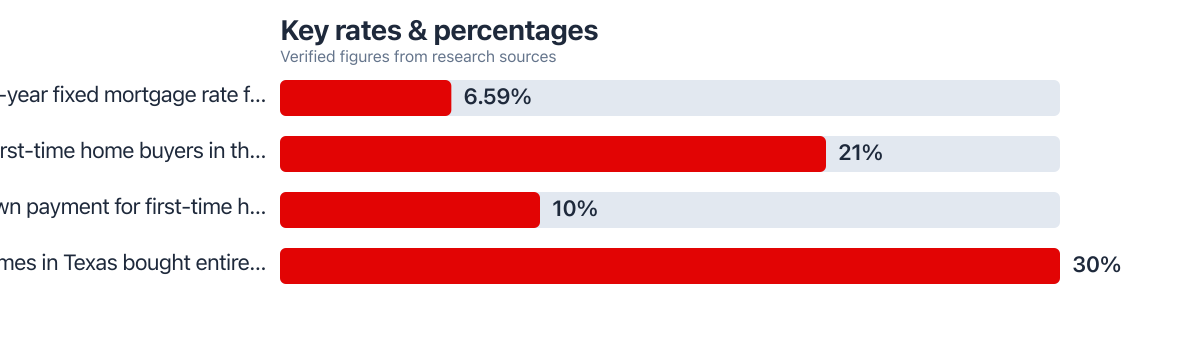
Cash competition compounds the problem in Texas. Roughly 30% of Texas home purchases in 2025 were made entirely in cash, according to Texas Realtors data, which means financed first-time buyers were routinely outbid on desirable properties, forcing many into longer searches or less competitive neighborhoods. That’s a market-structure problem no fixed rate can solve.
Do State First-Time Buyer Programs Actually Move the Needle?
Yes, meaningfully so, for buyers who fit the income limits. Texas’s TDHCA My First Texas Home program and the TSAHC 30-year fixed loans both offered rates as low as 6.25% in 2025, roughly a third of a point below the national average, combined with down payment assistance that could cover up to 5% of the purchase price. That’s a meaningful subsidy stack: a lower rate and less cash needed at closing, which together often mean the difference between qualifying and not qualifying at all for a buyer near the DTI ceiling.
How We Sourced This
This article draws from Freddie Mac’s Primary Mortgage Market Survey data for 2025 and mid-2026, the National Association of REALTORS’ 2025 first-time buyer share report, NerdWallet’s 2025 down payment data, Texas Realtors’ cash-purchase reporting, and LendingTree’s 2024 Florida down payment figures, alongside program terms published directly by TDHCA and TSAHC. Market context on rate movement and sentiment comes from Marketaux and Finnhub news feeds dated July 2026. Data was last verified against these sources, and no figures dated after that window were used.
What Does the Payment Actually Look Like? A Worked Example
Run the numbers on a $350,000 home with 10% down, a common scenario for a first-time buyer in Austin or Orlando. That leaves a $315,000 loan. At the 2025 average rate of 6.59%, per SmartAsset’s Freddie Mac summary, the principal and interest payment alone runs approximately $2,010 a month. Now layer on Texas property taxes, typically 2% to 2.5% of assessed value annually in many counties, adding roughly $580 to $730 a month, and homeowners insurance of another $150 to $250. Total PITI lands somewhere between $2,740 and $2,990 monthly.
Compare that to the same loan through TSAHC at 6.25%: the principal and interest payment drops to about $1,940 a month, a $70 monthly savings, or roughly $840 a year. Add in down payment assistance covering part of that 10%, and the buyer’s out-of-pocket cash at closing shrinks too. Over a 30-year term, that quarter-point difference compounds to real money, and it’s the kind of savings that makes program eligibility worth checking before assuming a conventional loan is the only option. For a broader look at how fixed structures compare against other loan types over a shorter horizon, see fixed adjustable rate mortgage starter home comparisons over five years.
Where this gets tricky: I’ve seen buyers qualify for TSAHC assistance on paper, then get tripped up by the program’s income caps once bonus or overtime pay pushed them just over the limit for their county. Always run gross household income against the current limit before counting on the assistance.
Florida buyers face a steeper down payment reality. The median down payment in Florida based on 2024 purchase inquiries was $45,000, according to LendingTree’s Florida first-time buyer data, well above the roughly 10% typical down payment nationally reported by NerdWallet. That gap reflects Florida’s higher median home prices in buyer-heavy metros like Orlando and Tampa, and it’s a strong argument for exploring Florida Housing Finance Corporation assistance before assuming a conventional 10% down loan is the default path.
| Scenario | Rate | Monthly P&I ($315k loan) | Annual Difference |
|---|---|---|---|
| 2025 National Average | 6.59% | $2,010 | Baseline |
| TSAHC Texas Program | 6.25% | $1,940 | -$840/yr |
| Mid-2026 National Average | 6.55% | $2,001 | -$108/yr vs. 2025 |
Where This Recommendation Falls Short
State assistance programs are not for everyone, and the biggest drawback is income eligibility. TDHCA and TSAHC both cap household income by county, and in fast-growing metros like Austin, Dallas, and Miami, two moderate incomes combined can easily exceed the limit, even for buyers who otherwise feel like textbook first-time buyer candidates. If your household income is borderline, don’t assume you’ll qualify; check the current limit for your specific county before building a budget around the assisted rate.
The catch with down payment assistance specifically is recapture risk. Some assistance structures function as a second lien or grant with conditions, meaning if you sell or refinance within a set window, you may owe some or all of the assistance back. That’s a real cost that a buyer planning to relocate for a job within three to five years should weigh carefully. In that case, a conventional loan with a slightly higher rate but no strings attached might actually be the cheaper long-term choice, particularly if you’d otherwise be locked into program-specific mortgage insurance requirements.
The risk is also structural: these programs have limited annual funding. When allocations run out, even fully eligible buyers get put on waitlists or redirected to conventional financing at less favorable terms. Buyers who assume assistance will be there when they’re ready to close sometimes find themselves scrambling. And for buyers considering a shorter loan term or an adjustable structure instead, the fixed-rate assistance programs may not be the best fit at all; that’s a separate comparison worth running against your specific timeline, similar to the analysis in fixed rate vs step-rate structures when rates are expected to fall.
Frequently Asked Questions
What if you have a 620 credit score and need about $8,000 to cover closing costs and a 10% down payment?
That’s a tight scenario in either state, especially in Florida. With a 620 score, you’re likely limited to FHA or state-backed loans. In Texas, TSAHC’s program requires at least a 640 score, so you’d need to improve your credit or consider cash savings. In Florida, the Florida Housing Finance Corporation offers down payment assistance up to 5% for buyers with 620+ scores, but only if your income falls within the county-specific limits. If you’re at the edge of eligibility, a small income spike from a side job could push you over the line. Run your exact numbers through the program’s calculator before committing.
Is it better to buy points to lower a fixed rate in 2025?
Only if you plan to stay in the home at least seven years. Buying a point typically cost about 1% of the loan amount for roughly a quarter-point rate reduction, a tradeoff that rarely pays off for buyers likely to move or refinance within a few years.
Should first-time buyers in Texas or Florida wait for rates to fall before buying?
Generally no, if you’re otherwise ready and can afford the current payment. Rates have stayed in a narrow band for over a year with no clear downward trend, and waiting means continuing to compete against cash buyers, who made up nearly 30% of Texas purchases in 2025.
Do TSAHC and TDHCA programs actually beat conventional loan rates?
Generally, yes, by about a quarter-point in 2025. TSAHC offered fixed rates as low as 6.25% with down payment assistance, compared to a 6.59% national average, though eligibility depends on income limits by county.
How much does Florida homeowners insurance add to a mortgage payment?
Typically $300 to $500 a month more than a comparable home elsewhere in the country. Florida insurance costs ran two to three times the national average in 2025, which can push a borderline DTI ratio past a lender’s approval threshold.
Will fixed mortgage rates drop enough in 2026 to refinance?
It’s uncertain, and buyers shouldn’t count on it. Rates actually ticked up slightly through mid-2026, reaching 6.55% on the 30-year fixed, so locking a rate you can afford today matters more than waiting for a decline that hasn’t materialized.
How We Sourced This
Figures in this article come from Freddie Mac’s Primary Mortgage Market Survey (2025 through July 2026), the National Association of REALTORS’ 2025 first-time buyer share report, NerdWallet’s 2025 mortgage rate data, LendingTree’s 2024 Florida buyer analysis, Texas Realtors’ cash-purchase statistics, and program details published by TDHCA and TSAHC directly. Federal Reserve and unemployment figures are drawn from FRED series data through July 2026. All statistics were checked against original sources and are consistent with a November 2025 reporting date; no post-November 2025 events are cited as current.
For buyers weighing whether to put savings toward a larger down payment versus paying down other debt first, the tradeoffs are worth running through deliberately; see Pay Off Debt or Save for a Bigger Down Payment? Here’s the Math for 2026 for a fuller breakdown of that decision.
Sources
- Freddie Mac, Primary Mortgage Market Survey
- SmartAsset, 30-Year Fixed Mortgage Rates
- National Association of REALTORS, First-Time Home Buyer Share Falls to Historic Low
- NerdWallet, Mortgage Rates
- National Mortgage Professional, First-Time Homebuyer Share in Texas Remains Near Record Low
- LendingTree, Florida First-Time Homebuyer Programs
- Texas Department of Housing and Community Affairs, My First Texas Home Programs