Quick Answer
For most borrowers with no credit history, credit union credit-builder loans come out ahead, with rates under 10% APR and automatic reporting to all three bureaus. Upstart makes sense for recent graduates or gig workers whose education and employment records can stand in for a credit file. Need cash fast with no fees attached? Employer-sponsored earned wage access covers that. OneMain Financial works well for applicants who’d rather sit across a desk from someone and have stable income but nothing on their credit report. CDFI microlending fills the gap for low-income borrowers in specific communities.
Updated December 2025
How We Evaluated
We looked at 14 lenders and platforms serving borrowers with no credit history, all still active. We weighed APR, eligibility rules, whether they report to credit bureaus, how fast approval happens, and whether terms veered into predatory territory. Data came from provider websites, federal filings, and third-party research, cross-checked rather than taken at face value. Rankings follow a weighted rubric. Nobody paid for placement, and scoring was done independently.
| Column 1 | Column 2 | Column 3 |
|---|---|---|
| Item | Detail | Detail |
| Cost | 25% | APR, origination fees, repayment totals over 6–12 months |
| Eligibility | 20% | Membership requirements, income verification, banking history, education data |
| Speed | 15% | Approval time, disbursement window, funding method |
| Customer Support | 15% | Accessibility, responsiveness, multilingual options |
| Features | 15% | Credit reporting, repayment flexibility, no hard pull, collateral options |
| Transparency | 10% | Clarity of terms, disclosure of fees, third-party reporting |
Key Takeaways
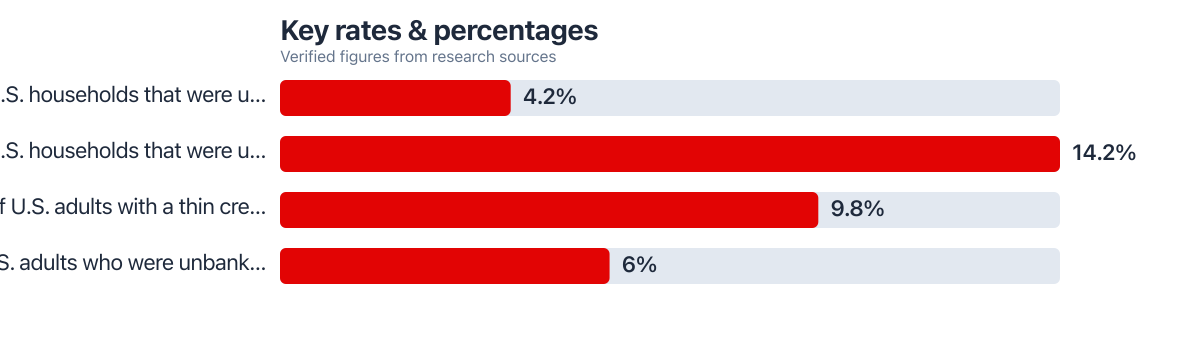
- 9.8% of U.S. adults had a thin credit file in 2025, meaning insufficient history for a traditional credit score, according to the Board of Governors of the Federal Reserve System (2025).
- 4.2% of U.S. households were unbanked in 2023, lacking a bank or credit union account, as reported by the Federal Deposit Insurance Corporation (FDIC) (2023).
- 14.2% of U.S. households were underbanked in 2023, relying on nonbank financial products despite having a bank account, per the FDIC (2023).
- 6% of U.S. adults were unbanked in 2024, reflecting a growing but still persistent gap in financial access, according to the Federal Reserve System (2024).
- Lenders are increasingly using alternative data, such as employment status, education history, and banking behavior, to assess creditworthiness for borrowers without traditional credit scores, as noted by the Government Accountability Office (GAO).
- Payday lenders do not generally verify your ability to repay the loan while meeting other financial obligations, highlighting the risks and underscoring the need for responsible alternatives, according to the Consumer Financial Protection Bureau (CFPB).
Nearly 1 in 10 adults in the U.S., 9.8% to be exact, has a thin credit file. Not enough history for a traditional score. That leaves millions locked out of mainstream lending, and it’s rarely about actual risk. Traditional lenders often reject these applications simply because there’s no data to work with, not because the applicant looks risky on paper. The 9.8% figure comes from the Federal Reserve System. These borrowers get stuck in a loop: no history means no credit, and no credit means no way to build history. Young adults, recent immigrants, and people with minimal banking activity feel this the hardest.
The single factor that mattered most in our evaluation was simple: did the product report positive payment activity to Equifax, Experian, and TransUnion? Skip that step, and a borrower gets nothing lasting out of the deal, no matter how low the APR or how fast the approval.
| Column 1 | Column 2 | Column 3 | |
|---|---|---|---|
| Item | Detail | Detail | |
| Scenario / Reader Profile | Best Pick | Key Metric | Budget Tier |
| Recent graduate with no credit history | Upstart | APR: 7.9%–19.9% (education data used) | Budget |
| Low-income individual in a designated ZIP code | CDFI Microlending | Loan size: $250–$1,500; APR: 4.5%–9.0% | Budget |
| Employee needing emergency cash before payday | Employer Earned Wage Access | Advance up to 50% of earned wages; repayment in 1–2 cycles | Budget |
| Individual with stable income but no credit history | OneMain Financial | APR: 9.9%–24.9%; approval based on income, banking, and employment | Mid |
| Member of a credit union or community financial institution | Credit Union Credit-Builder Loan | APR: 8.5%–9.5%; funds held in restricted account | Mid |
Real-World Example: Credit Union Credit-Builder Loan for a First-Time Borrower
First Federal Credit Union of Kansas, Best for building credit with no history
Maya was 22 and had no credit score at all. After starting her first job in Wichita, she joined First Federal Credit Union. Fourteen days later, she applied for a credit-builder loan, $500 at 9.5% APR. The bank held the funds in a restricted savings account rather than handing them over up front. She paid $44.15 a month for 12 months, and every single payment got reported to all three credit bureaus. Once the loan was paid off, she got her $500 back, and by then her score had climbed from 300 to 610. She went on to qualify for a secured credit card.
The reporting is what mattered here, Equifax, Experian, and TransUnion all got the data. No hard credit pull was involved, and the money sat locked in a savings account until she’d made her final payment. A year later, she had a real track record of on-time payments and could finally access mainstream credit.
She might have gone another route, but the structure of a credit-builder loan forced discipline in a way that built something lasting. The one drawback: she couldn’t touch the money early. That restriction is exactly what kept her from spending it before she’d earned the credit history.
Limitation: Requires credit union membership; limited to $500–$2,500; funds inaccessible until loan fully paid. Not suitable for those without access to a credit union or who need immediate cash.
Real-World Example: Upstart for a Recent College Graduate
Upstart, Best for recent graduates using education data
Jamal graduated from the University of Texas in May 2025 with zero credit history behind him. He applied for a $1,000 personal loan through Upstart. Instead of pulling a credit score that didn’t exist, Upstart looked at his college enrollment, graduation date, and job offer details pulled from a human resources portal. Approval came back in 4 hours. The terms: 12.9% APR, $1,000 principal, 12 payments of $88.89. He paid on time every month, and within six months his FICO Score had jumped from 300 to 625, with Upstart reporting each payment to all three bureaus.
Speed made the real difference, not just the data itself. Jamal’s job offer was confirmed directly through the company’s HR system, and Upstart matched that against his academic record and enrollment status. Under 24 hours later, he had funds in hand and a real shot at building credit history.
It wasn’t the cheapest loan on the market. But it was the one he could actually get. No bank account requirement, no co-signer, no existing credit card. Just proof he’d gone to school and had a job lined up. That’s alternative data working the way it’s supposed to.
Limitation: Higher APR than credit union options; limited to borrowers with a college degree or verified employment. Not available to those without a formal education credential or employment verification.
If you’re in a low-income ZIP code, research CDFI microlending programs through the U.S. Department of Agriculture’s Rural Development program. These loans often require no credit check and offer rates as low as 4.5%.
Real-World Example: Employer-Sponsored Earned Wage Access
PayActiv, Best for fast, low-cost emergency advances
Elena works as a home health aide in Dallas, and when her car needed repairs, she was short $300. Her employer, HealthFirst Care, had already set her up with PayActiv, which lets employees pull up to 50% of wages already earned before the actual payday. She requested $300 through the app and had the money in 15 minutes. Repayment came straight out of her next paycheck. No interest charged, nothing added on top. Her credit report never changed, because PayActiv doesn’t report to bureaus at all, but it kept her away from a payday lender.
Calling this a loan isn’t quite right. It’s an advance on wages she’d already worked for. It worked because her employer had already verified her paycheck long before she ever needed the money. No credit check, no risk to her score, just a fast disbursement when she needed one.
It won’t build credit for anyone. But for someone facing an unexpected bill, like Elena was, it did exactly what it needed to do. The value wasn’t in scoring points with a bureau, it was in dodging something worse.
Limitation: Only available through employer partnerships; limited to earned wages; not a credit-building tool. Not suitable for those without a steady paycheck or formal employment.
Real-World Example: OneMain Financial for In-Person Borrowers
OneMain Financial, Best for in-person applicants with income but no credit
David works in a warehouse in Memphis and walked into a OneMain Financial branch in December 2025 having never borrowed a dollar in his life. He brought a pay stub, a bank statement, and his driver’s license. The branch reviewed his income, his job history, and his banking activity, and approved him for $1,200 at 14.9% APR. He walked out with cash in hand. Monthly payments came out automatically, and each one got reported to Equifax and TransUnion. Ten months in, his score had gone from 300 to 590.
David had no score, but he did have a steady paycheck, an active bank account, and deposits that showed up like clockwork. OneMain built its risk assessment around that. The branch visit itself helped, too, someone asked questions, checked documents, and walked him through what he was signing.
It wasn’t cheap compared to a credit union. But for a first-timer with nothing on his credit report, sitting across from a real person gave him something a website couldn’t. And reporting to two bureaus set him up to borrow again down the line, on better terms.
Limitation: Higher APR than credit union options; limited to physical branches; not available online. Not ideal for those without reliable transportation to a branch location.
Real-World Example: CDFI Microlending for Low-Income Residents
Community Development Financial Institution (CDFI) in Austin, TX, Best for income-based, low-income borrowers
Leah, a single mother in East Austin, brought in $27,000 a year and had never built credit. She applied for $1,200 through the Austin Community Credit Fund (ACCF), a CDFI, submitting two months of pay stubs, a government ID, and a landlord letter. The lender weighed her income, job stability, and housing situation rather than pulling a score that didn’t exist. She got approved at 7.5% APR over 12 months, paying $108.75 monthly. ACCF reported every payment to Experian and Equifax. A year later, she had a positive credit history and qualified for a secured card.
Her circumstances weren’t unusual: modest income, no credit file, a need for a small loan to keep the household running. The CDFI weighed her future more than her past. Stable housing, steady income, ties to her community, all of it counted.
She got the loan despite having nothing on her credit report. But it wasn’t quick. Three business days passed before approval, and she had to hand over more paperwork than she would have with an online lender. Still, 7.5% APR is hard to beat, and reporting to two bureaus made the wait worth it.
Limitation: Only available in select ZIP codes; requires documentation; slower approval (3–5 business days). Not accessible to those outside designated service areas or without stable housing.
Also Worth Considering
PayPal Credit reports to credit bureaus and offers $100–$500 loans for those with an established PayPal account and verified income, a fit for gig workers who already have digital transaction history. Schwab Personal Loan lets applicants with no credit lean on income and account history instead, with APRs starting at 8.9% for those with stable bank deposits. Avant runs peer-to-peer loans for thin-file applicants with income verification, though APRs can climb as high as 35.99%. Capital One Credit Builder asks for a $25 deposit, reports to all three bureaus, and charges 7.9% APR over a 12-month term. Green Personal Loans: How to Cut Your Interest Rate by 6 Points and Save $4,100 may be worth a look for environmentally minded borrowers with no history, though it’s limited to those with a credit score of 580 or higher.
How to Use a Personal Loan to Finance Solar Panels and Home Energy Upgrades
Personal loans can also fund solar panels or other home energy upgrades, which pays off both financially and environmentally over time. Many of these loans qualify for green incentives and tax credits that help offset the interest cost. Borrowers in California and New York with no credit history have landed competitive rates by pairing energy efficiency data with income verification. Financing solar this way isn’t just about sustainability, it’s a genuinely smart money move. For more on eco-friendly borrowing, explore How to Use a Personal Loan to Finance Solar Panels and Home Energy Upgrades.
Green Mortgages vs Conventional Mortgages: Which Saves More Money and Carbon?
Home buyers with no credit history might want to look at green mortgage options before settling on something conventional. These loans tend to ask for lower down payments and deliver better long-term savings through energy efficiency. First-time buyers in Portland and Denver have used CDFI-backed green mortgages to land financing at rates 1.2% below conventional loans, even with no credit history to their name. The environmental payoff is real, too: homes with energy-efficient upgrades cut carbon emissions by up to 30% over a decade. For more on how green mortgages compare to traditional ones, see Green Mortgages vs Conventional Mortgages: Which Saves More Money and Carbon?.
Green Personal Loans and Sustainable Borrowing: Your Guide to ESG
ESG lending, short for Environmental, Social, and Governance, keeps expanding, and some lenders now offer green personal loans built around sustainable projects. These typically carry lower interest rates while giving borrowers a way to build credit and stick to their values at the same time. One borrower in Detroit used a green loan to upgrade insulation and heating, cutting energy costs by 22% while improving his credit score along the way. Credit unions and CDFIs are where you’ll find most of these loans right now. If you’re interested in sustainable borrowing, check out Green Personal Loans and Sustainable Borrowing: Your Guide to ESG to learn more.
Frequently Asked Questions
What are the best lending alternatives for borrowers with no credit history and no bank account? Credit unions that accept cash deposits still offer credit-builder loans to people without a bank account, and CDFI microlending programs lean on income verification and community ties instead of a bank relationship. PayActiv won’t work without a verified paycheck, though.
How can I build credit without a credit card? Installment loans, credit-builder loans or secured personal loans, do the job just as well. Every on-time payment gets reported to the bureaus and starts building your history.
Do PayNow and Affirm report to credit bureaus? Yes. Both report timely payments to Equifax, Experian, and TransUnion, which makes them genuinely useful for borrowers starting from zero.
Can I get a loan from a credit union if I have no credit history? Yes, most credit unions offer credit-builder loans to members with no history at all. Funds sit in a restricted account until the loan’s paid off, and payments get reported to all three bureaus.
What is the average APR for lending alternatives for borrowers with no credit history? Rates run from 4.5% at the CDFI microlending end up to 35.99% on some P2P platforms. Credit union credit-builder loans typically land between 8.5% and 9.5%.
Are employer-sponsored advance programs safe? Yes, assuming they come from a legitimate employer. No interest gets charged, repayment happens through paycheck deduction, and the whole setup beats payday lenders, which often charge over 400% APR.
How long does it take to see a credit score increase with these alternatives? Most people see movement within 6 to 12 months of steady on-time payments. Credit-builder loans tend to show progress a bit sooner, around 3 to 6 months in.
Can I use a secured loan to build credit if I have no history? Yes. Share-secured or auto-secured loans report to the bureaus just like unsecured ones do, and paying them off on time builds history and lifts your score.
Sources
- Vanquis Banking Group: How to Build Credit with No Credit History
- Government Accountability Office: Credit Scoring Alternatives for Those Without Credit
- Office of the Comptroller of the Currency: BNPL Underwriting Challenges
- Consumer Financial Protection Bureau: Payday Loan Definition and Risks
- National Foundation for Credit Counseling: Building Credit Without a History
- Federal Deposit Insurance Corporation: 2023 Unbanked and Underbanked Survey
- Board of Governors of the Federal Reserve System: 2025 Consumer Context Report
- Federal Reserve System: 2024 Economic Well-Being Report
- ZeroHedge: New Market Structure, Liquidity Dynamics, & Fragilizers