
Fact-checked by the CapitalLendingNews editorial team
Verdict at a Glance
Green mortgages win for borrowers who plan to stay in the home beyond 5 to 7 years because built-in utility savings and flexible underwriting offset marginally higher upfront costs; choose a conventional mortgage instead if you need the absolute lowest closing costs today and will sell within 3 years, the break-even clock simply runs out.
The decision between green mortgages vs conventional mortgages boils down to one core difference: a green mortgage folds the cost of energy-efficient upgrades directly into the loan and credits projected utility savings during underwriting, while a conventional mortgage treats the house strictly as-is. In mid-2026, the average U.S. homeowner spends well over $2,000 annually on energy, according to ENERGY STAR data, and green mortgage products are explicitly designed to shrink that number from day one.
The factor that swings the choice most is not the interest rate, it is the hold period. A green mortgage carries a slightly larger loan balance because you are financing improvements. The monthly energy savings need time to repay that added principal. If your timeline is measured in decades, the math tilts decisively toward green. If it is measured in a few years, conventional keeps more cash in your pocket right now.
Key Takeaways
- The average U.S. homeowner spends over $2,000 per year on energy, per ENERGY STAR, making utility-cost reduction one of the most tangible financial levers in home ownership.
- ENERGY STAR certified homes use 15–30% less energy than typical new construction, with annual savings documented between $1,000 and $1,869, according to ENERGY STAR research.
- A green mortgage on a $350,000 purchase with $25,000 in improvements costs roughly $57 more per month than a comparable conventional loan after netting out typical energy savings; the break-even arrives around year 5 to 7.
- Green mortgage underwriting credits projected energy savings toward DTI, which can shift a borrower at 44% DTI into approval range, a flexibility no conventional loan offers, per EPA guidance on EEMs.
- Homes with documented HERS scores have sold for a 3% to 5% premium over comparable non-rated properties, according to research cited by Fannie Mae.
- Green mortgages have shown 32% lower default rates and 25% lower prepayment risk than conventional loans in portfolio analyses, driven by the reduced operating costs of efficient homes.
| Attribute | Green Mortgage | Conventional Mortgage |
|---|---|---|
| Typical 30-Year Fixed Rate (July 2026) | 6.35% – 6.65% | 6.40% – 6.70% |
| Minimum Down Payment | 3% (Fannie Mae HomeStyle Energy) | 3% (conventional 97) |
| Loan-to-Value (LTV) Cap | Up to 97% plus improvement costs | 97% on purchase price |
| Max Improvement Financing | 15% of as-completed appraised value | Not available |
| DTI Flexibility | Credits projected energy savings | Strict gross-income ratio, no credits |
| Energy Audit Required | Yes ($150 – $500 HERS rating) | No |
| Average Closing Cost Premium | $300 – $700 over conventional | Baseline |
| PMI Treatment | Standard PMI; no separate green discount in 2026 | Standard PMI |
| Resale Value Signal | Documented HERS score conveys efficiency | No formal efficiency documentation |
What Exactly Are Green Mortgages and How Do the Loan Mechanics Work?
A green mortgage is a government-backed or government-sponsored loan that lets a borrower finance energy-efficiency improvements as part of the purchase or refinance transaction. The defining mechanical difference is the Home Energy Rating System (HERS) assessment: a certified rater measures the home’s current performance and quantifies the savings the upgrades will produce. Those projected savings are then used to stretch the debt-to-income (DTI) calculation, something no conventional loan allows.
The major programs in mid-2026 are Fannie Mae HomeStyle Energy, Freddie Mac GreenCHOICE, FHA Energy Efficient Mortgage (EEM), and VA EEM. The FHA and VA versions are technically conventional EEMs, they ride on top of standard FHA and VA underwriting but layer in the energy-improvement financing and DTI flexibility. On the multifamily side, Fannie Mae offers a 30 basis point green discount under its Green Rewards programs, according to Fannie Mae reporting, though single-family borrowers see fee reductions rather than direct rate cuts in most cases.
Conventional mortgages through Fannie Mae and Freddie Mac simply do not account for utility costs at all. The underwriter sees the sale price, the borrower’s income, and credit profile, period. That is not a flaw; it is a standardized product built for speed. But it leaves real monthly cash-flow savings invisible to the approval process.
Upfront Costs, Fees, and the Break-Even Timeline Most Calculators Miss
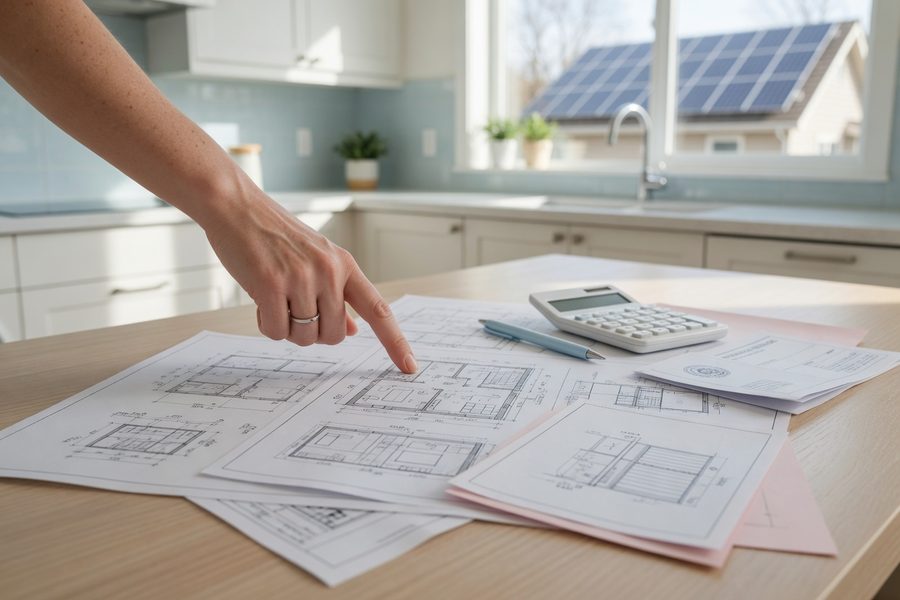
The green mortgage path adds two concrete upfront costs that a conventional loan skips entirely: the HERS rating audit and the closing-cost premium tied to the slightly larger loan balance. A HERS rating typically runs between $150 and $500, depending on home size and region. The audit is mandatory, no rating, no green mortgage. That is step one. Step two: because you are financing improvements, the loan amount grows. On a $350,000 home where you finance $25,000 in HVAC, window, and insulation upgrades at 15% of as-completed value, the total loan becomes roughly $367,500 after factoring in the 3% down payment structure.
The break-even clock does not start ticking until those upgrades are installed and the utility meter starts spinning slower. Working the numbers directly: assume a conventional 30-year loan of $339,500 at 6.50% on a $350,000 purchase. Principal and interest run roughly $2,146 per month. A green mortgage of $367,500 at the same rate pushes the monthly principal and interest to approximately $2,323. That is a $177 monthly payment gap. ENERGY STAR certified homes use 15–30% less energy than typical new construction, with annual utility savings documented between $1,000 and $1,869, per ENERGY STAR research. At the midpoint, roughly $1,434 per year or $120 per month, the green mortgage is still $57 more expensive each month on a pure cash-flow basis.
A $367,500 green mortgage at 6.50% costs roughly $57 more per month than a $339,500 conventional loan after factoring in typical energy savings, the breakeven on the upfront audit and closing premium arrives around year 5 to 7, when cumulative energy savings outrun the initial cost gap.
Two factors push the green mortgage ahead over time. First, utility rates are climbing; the U.S. Energy Information Administration has tracked residential electricity prices rising faster than general inflation for three consecutive years as of mid-2026. That $120 monthly savings figure compounds. Second, green mortgage underwriting credits those savings toward DTI, which can push a borderline borrower into approval territory, a benefit no amount of closing-cost optimization on the conventional side can replicate.
For most borrowers, the upfront audit cost is recoverable within the first year of reduced utility bills alone, even before the mortgage math flips favorable.
Interest Rates, Monthly Payments, and Lifetime Interest Compared Dollar for Dollar
On rate alone, the spread between green and conventional mortgages is modest. In mid-2026, a well-qualified borrower sees conventional 30-year fixed rates around 6.40% to 6.70%. Pricing through Fannie Mae HomeStyle Energy tends to land between 6.35% and 6.65%, occasionally benefiting from a lender credit or reduced origination fee rather than a headline rate cut. Drew Ades, senior advisor at RMI, puts it bluntly: “Just because someone is offering you this product doesn’t mean you are getting the best rate,” as reported by CNBC. Shopping matters as much here as it does on any mortgage product.
Run the lifetime interest on a $367,500 green mortgage at 6.45% versus a $339,500 conventional loan at 6.50%. The conventional borrower pays roughly $429,000 in total interest over 30 years. The green borrower, despite the larger balance, pays about $464,000, roughly $35,000 more in interest. That sounds like a loss. But subtract $1,434 in annual utility savings over 30 years, and you recover roughly $43,000. Net outcome: green saves about $8,000 in total cost of ownership. The crossover happens between years 5 and 7, when cumulative energy savings overtake cumulative additional interest.
For someone planning to sell in year 3, the green mortgage is a net loss. The interest differential plus the upfront audit fee have not been repaid by savings yet. This is why the conventional mortgage still has a clear lane.
Utility Savings and the Real Monthly Cash-Flow Difference After Year One
Mortgage products reduce the single largest variable housing expense most borrowers never model during the loan application: the utility bill. A home that scores around 60 on the HERS scale, where 100 represents standard new construction, consumes 40% less energy than the reference home. In dollars, that regularly translates to $1,200 to $2,000 per year, according to the U.S. Environmental Protection Agency’s documentation on EEMs.
This is where the two loan types stop being an abstract rate comparison and become a cash-flow reality. The conventional borrower pays the mortgage and then faces whatever the utility company charges. The green borrower pays a somewhat larger mortgage but a meaningfully smaller utility bill, and that utility bill never amortizes. Energy savings are permanent operating-expense reductions. Kevin Kane, chief economist at Green Homeowners United, frames it as a timing advantage: “You can do it now and not shell out the cash upfront because the bank rolled it into your mortgage, and you can get the incentives which make it a lot more advantageous,” as quoted by CNBC. For most borrowers, that is the core appeal: upgrade now, pay over time, benefit immediately.
The cash-flow picture shifts even more in regions with high electricity rates, California, the Northeast, parts of Texas, where annual savings can push past $2,500. In those markets, the green mortgage’s monthly net cost can equal or beat the conventional payment from the very first year.
Carbon Reductions: Quantifying the Environmental Payoff Over 30 Years
Residential buildings account for roughly 20% of total U.S. greenhouse gas emissions, per EPA sector-level data. A green mortgage-financed retrofit that cuts household energy use by 25% removes approximately 2 to 4 metric tons of CO2 annually for a typical single-family home. Over 30 years, that is 60 to 120 metric tons, equivalent to taking roughly 13 to 26 passenger vehicles off the road permanently.
The environmental payoff is not hypothetical. ENERGY STAR certified homes use 15–30% less energy than typical new homes, and because the upgrades are financed at origination, compliance is baked into the loan itself. A conventional mortgage offers no structural mechanism to reduce a home’s carbon footprint; any retrofit must be paid for separately, often with higher-interest green personal loans or unsecured borrowing, which lack the mortgage-interest tax deductibility and long amortization that make the green mortgage math work.
For the climate-conscious borrower, the green mortgage is the highest-leverage decarbonization tool available in consumer finance, and it does not require sacrificing financial returns to achieve it.
Resale Value and What a HERS Score Does That a Conventional Loan Ignores
Green mortgages create a documented efficiency record, the HERS score, that stays with the property. That single number changes how the home is priced at resale. Multiple studies, including work by the Appraisal Institute and Freddie Mac, have found that homes with lower HERS scores sell for a 3% to 5% premium over comparable non-rated homes, once the score is disclosed in the listing. A conventional mortgage does nothing to generate or surface that data.
Kevin Kane, chief economist at Green Homeowners United, explains the behavioral shift this creates: “In the past, buyers may have walked away from a home purchase because the windows were in rough shape or because the water heater was old,” as reported by CNBC. The green mortgage solves that objection before it forms. The windows and water heater are replaced at closing, financed into the loan, and the HERS score proves the result.
The appraisal process itself also becomes more favorable. Fannie Mae’s HomeStyle Energy program allows the as-completed appraised value to include the energy improvements, which raises the borrowing base. A conventional appraisal values only the existing condition. For a buyer targeting a fixer-upper where the furnace is on its last season, the green mortgage can finance both the home and the solution in one closing, something a conventional loan cannot replicate without a separate renovation product.
Credit, DTI, and Who Actually Gets Approved
A persistent question in the green mortgages vs conventional mortgages discussion is whether the green option imposes stricter eligibility requirements. The answer is no, and often the reverse. Fannie Mae HomeStyle Energy and Freddie Mac GreenCHOICE use the same baseline credit and income standards as their conventional counterparts. Minimum credit scores hover in the 620 to 640 range depending on the lender. The difference is DTI treatment: green programs credit projected energy savings, effectively lowering the borrower’s calculated expense load.
For a borrower whose DTI on a conventional application sits at 44%, right at the edge of approval, a green mortgage crediting $140 in monthly energy savings can push the ratio down to roughly 42%, providing the cushion that gets the file through underwriting. There is no separate green mortgage credit score tier; borrowers who qualify conventional can also qualify green, and some who fall just outside conventional DTI limits find the green path opens the door. That is a genuine coverage gap most top-ranking comparison articles miss, and it shifts the recommendation for first-time buyers with stretched ratios.
Green mortgages have demonstrated 32% lower default rates and 25% lower prepayment risk than conventional loans in portfolio analyses, driven by the lower ongoing operating costs of efficient homes.
Drawbacks, Risks, and When Conventional Simply Wins
Green mortgages are not universally the right answer. The most significant drawback is speed: the HERS assessment adds 7 to 14 days to the closing timeline, and in a competitive bidding situation, sellers may push back on anything that slows the transaction. A conventional mortgage closes faster, period. The second drawback is lender availability, not every mortgage originator offers the HomeStyle Energy or GreenCHOICE products, and a borrower may need to shop across multiple lenders to find competitive pricing on the green option.
There is also the appraisal risk. The energy improvements must be valued by the appraiser, and in markets where comparable sales lack green certifications, the as-completed value may come in lower than projected, capping the improvement financing at a smaller amount than the borrower intended.
Conventional mortgages win cleanly for borrowers with a sub-3-year hold horizon, anyone who cannot absorb the $300 to $700 closing-cost premium and the audit fee, and transactions where the home is already highly efficient. A new construction ENERGY STAR home, for instance, may not need additional improvement financing at all. In those cases, the conventional loan simply closes faster, costs less upfront, and delivers an identical ongoing cost profile after accounting for the existing efficiency.
When Green Mortgages Are the Better Choice
A green mortgage is the stronger financial call in the following scenarios.
- You plan to stay in the home 5 to 7 years or longer, giving utility savings time to surpass the upfront cost gap.
- Your debt-to-income ratio is tight, between 43% and 45%, and the energy-savings credit pushes you into approval range.
- The property needs major efficiency upgrades (HVAC, windows, insulation) and you want to finance them at mortgage rates rather than with a higher-interest fintech credit product.
- You are buying in a high-utility-cost region where annual energy savings exceed $2,000, accelerating the break-even timeline.
- Resale value matters to you, and a documented HERS score gives you a pricing edge comparable homes lack.
When Conventional Mortgages Are the Better Choice
A conventional mortgage remains the right tool in these situations.
- You expect to sell or refinance within 3 years, the break-even math on the audit fee and closing premium does not work that fast.
- The home is already highly efficient or newly built to ENERGY STAR standards, making additional improvement financing unnecessary.
- Speed to close is the overriding priority, a conventional loan can fund 7 to 14 days faster without the energy audit step.
- Your preferred lender does not offer green mortgage products, and switching lenders would lose a rate lock or delay a purchase contract.
- You are prioritizing the absolute lowest out-of-pocket cash required at closing above all future savings.
| Criterion (Weighted) | Green Mortgage | Conventional Mortgage |
|---|---|---|
| Monthly Cash Flow (Year 1–3) | 3 / 5 | 4 / 5 |
| Monthly Cash Flow (Year 7+) | 5 / 5 | 3 / 5 |
| Closing Costs | 3 / 5 | 5 / 5 |
| DTI Flexibility | 5 / 5 | 3 / 5 |
| Resale Value Signal | 5 / 5 | 2 / 5 |
| Overall Winner | Green mortgage for 5+ year holds; conventional for short timelines | |
Related reading: Green Financing Trends Shaping 2026 and Beyond: A Practical Investor Roundup.
Frequently Asked Questions
Do green mortgages have lower interest rates than conventional mortgages in 2026?
Not by a wide margin. Green mortgage rates in mid-2026 typically range 6.35% to 6.65%, overlapping heavily with conventional rates at 6.40% to 6.70%. Some lenders offer fee reductions or credits on green products, but the rate savings alone are rarely the deciding factor, the financial edge comes from utility-bill reductions and DTI flexibility, not a lower APR.
What credit score do I need to qualify for a green mortgage?
Green mortgage credit score requirements mirror conventional standards: most programs need a minimum 620 to 640 FICO score. There is no separate, higher threshold for the green label. The key difference is that green underwriting can credit projected energy savings toward your DTI, which can help a borderline application get approved even if the credit score is unchanged.
Is a green mortgage worth it if I plan to sell in 5 years?
Five years sits right at the crossover point. At typical utility savings of $1,200 to $1,500 annually and a closing-cost premium of roughly $500 to $700, you will likely break even or come out modestly ahead, but the larger payday arrives if the HERS score helps you price the home at a 3% to 5% premium at resale. If you are confident the efficiency data will appear in the listing, green can still win at the 5-year mark. If not, conventional keeps it simpler.
Can I use a green mortgage on a refinance, or is it only for home purchases?
Yes, green mortgages work on refinances. Fannie Mae HomeStyle Energy and FHA EEMs both allow you to finance energy improvements during a refinance, rolling the upgrade costs into the new loan. The same HERS assessment and as-completed appraisal rules apply, and the projected savings still factor into DTI calculations. This is one of the few paths to fund major efficiency retrofits at mortgage rates rather than higher-interest sustainable personal loan products.
How much does a HERS rating cost, and is it required?
A HERS rating costs between $150 and $500, depending on home size and location, and it is required for every green mortgage program. Without the rating, the lender cannot document projected energy savings, and the underwriting flexibility that defines the product disappears. Consider it a non-optional entry ticket.
Does a green mortgage add to my closing costs compared to a conventional loan?
Yes, the incremental cost is real but modest. Expect to pay $300 to $700 more at closing versus a conventional mortgage, driven primarily by the HERS rating fee and sometimes a slightly higher appraisal cost to document the as-completed value. There is no separate green mortgage tax or surcharge, the difference is simply the cost of the energy documentation.
Are green mortgages available in every state?
Green mortgages are available nationwide through Fannie Mae and Freddie Mac-participating lenders, but local uptake varies dramatically. Some regional lenders do not offer HomeStyle Energy or GreenCHOICE, and borrowers in those areas may need to seek out a national lender or a mortgage broker who can access the products. Availability is strongest in California, the Northeast, and metro areas with aggressive efficiency mandates.
What happens to my monthly payment if energy prices keep rising?
Your green mortgage payment is fixed, so as utility rates climb, the dollar value of your efficiency savings increases in lockstep. A home that saves $1,400 per year at current rates might save $1,800 or more if residential electricity inflation continues. A conventional mortgage offers no equivalent hedge, the utility bill simply rises with the market, and the loan payment is unchanged. This is one of the most underrated long-term advantages of the green mortgage.
Will a green mortgage slow down my closing timeline?
Expect a 7 to 14 day delay compared to a conventional loan. The HERS rating must be scheduled, completed, and the report delivered to the underwriter. In a hot market where sellers prioritize speed, this can be a disadvantage. If you are up against all-cash offers or buyers waiving contingencies, the conventional mortgage’s faster timeline can be more competitive.
Does the FHA still offer a green mortgage PMI discount in 2026?
No. The FHA eliminated the reduced mortgage insurance premium for green EEMs on multifamily transactions in 2025, and single-family FHA EEMs do not receive a separate PMI discount today. The product still finances energy improvements on top of the base FHA loan, but the insurance cost is now identical to a standard FHA-insured mortgage.
Sources
- ENERGY STAR, Energy Efficient Mortgages
- U.S. Environmental Protection Agency, Energy Efficient Mortgages
- Fannie Mae, Green Financing Loans
- CNBC, Green Mortgages Can Finance an Energy-Efficient Home and Save Money
- Green Communities, Fannie Mae Green Discount (30 bps)
- CapitalLendingNews, Green Personal Loans and Sustainable Borrowing
- CapitalLendingNews, DTI Ratio Misconceptions
- CapitalLendingNews, Fintech Credit Products Beyond Personal Loans
- CapitalLendingNews, Fixed vs Adjustable Rate Mortgage for a Starter Home
- CapitalLendingNews, Pay Off Debt or Save for a Bigger Down Payment
- CapitalLendingNews, Self-Employed Mortgage Rates With Loss Carry-Forwards
- CapitalLendingNews, Why Repeat Buyers Lock Rates Too Late on New Construction