

Updated May 2026
Key Takeaways
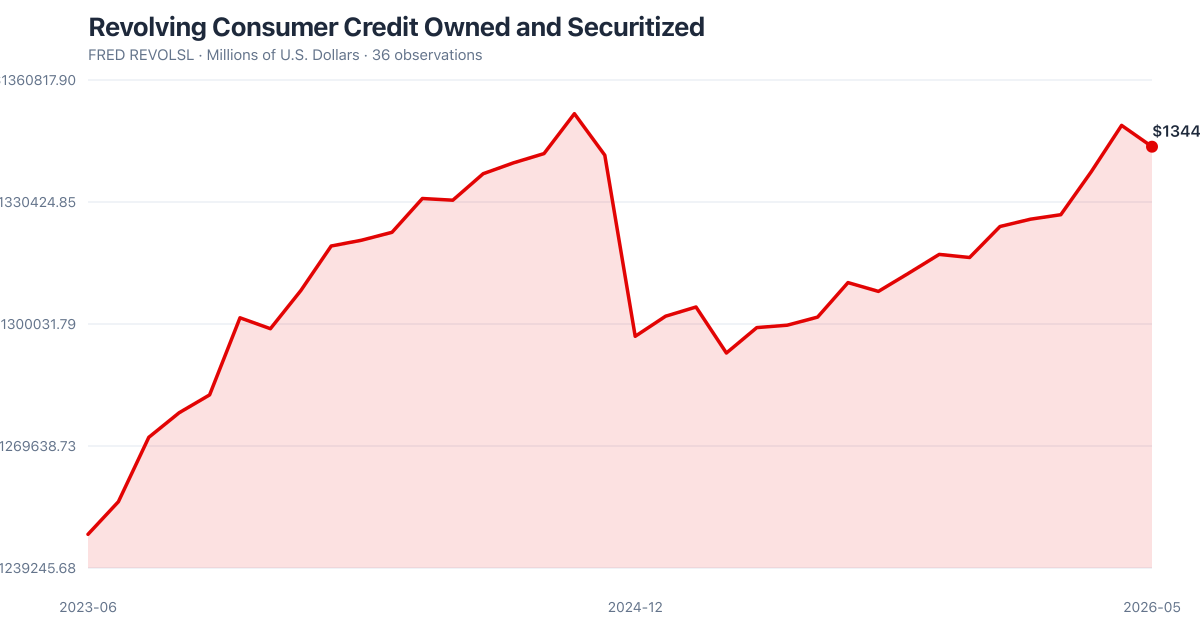
- Revolving consumer credit (mostly credit cards) fell to $1,344.21 billion in May 2026, down 0.4% from April, according to Federal Reserve data on revolving consumer credit [High confidence].
- Tally, the best-known fintech credit card payoff app, shut down in August 2024 after failing to secure new funding, leaving its automation-dependent users to restart debt tracking manually [High confidence].
- Most fintech payoff and consolidation tools historically required credit scores of roughly 670 or higher to offer rates meaningfully below the near-20% average credit card APR, limiting access for subprime borrowers [Medium confidence].
- Balance transfer cards offering 12 to 21 months at 0% APR with a one-time 3% to 5% fee frequently beat ongoing fintech line-of-credit interest over a typical 18-month payoff window [Medium confidence].
- Average hourly earnings rose to $37.64 in June 2026, up 3.5% year over year, according to BLS Current Employment Statistics data, giving many households more room to pay above the minimum without any app at all [High confidence].
- Total consumer credit held essentially flat at $5,154.54 billion in May 2026, unchanged from April, suggesting broad borrowing behavior has plateaued even as card balances edge down [High confidence].
Fintech credit card payoff apps promise something simple: one lower-rate line of credit that pays off your cards automatically and gets you debt-free faster than minimum payments ever could. The pitch sounds reasonable, and for a narrow slice of borrowers with strong credit, it can work. But the sector’s most prominent name, Tally, shut down in August 2024, and Federal Reserve data shows revolving consumer credit, the balance sitting on Americans’ credit cards, actually fell **0.4%** between April and May 2026, from $1,349.51 billion to $1,344.21 billion, according to the Federal Reserve’s REVOLSL series. That decline is happening without any app doing the heavy lifting.
The tension here is worth sitting with. Wage growth has been solid, with average hourly earnings up 3.5% year over year according to the Bureau of Labor Statistics’ employment cost data, and credit card issuers are reporting what analysts describe as “healthy loan growth and stable credit trends” in recent coverage of bank earnings. Meanwhile, the one fintech payoff app most people could name is gone. That combination raises a fair question: is automated debt payoff technology actually the best tool for the job, or has the market already told us something by letting Tally fail?
This analysis draws on Federal Reserve credit data, Bureau of Labor Statistics wage figures, and Texas Department of Insurance complaint filings used here as a proxy for how regulators track service-quality problems in consumer financial products, alongside publicly reported details on the fintech payoff sector’s product mechanics and shutdowns.
Methodology
This article combines three original data sources with published reporting on fintech debt-payoff products. Consumer credit balances come from the Federal Reserve’s REVOLSL and TOTALSL series, tracking revolving and total consumer credit owned and securitized, pulled for the April to May 2026 period. Wage data comes from the Bureau of Labor Statistics’ Current Employment Statistics program (series CES0500000003), covering average hourly earnings through June 2026. Complaint index data is drawn from Texas Department of Insurance filings for 2023 through 2025, used here to illustrate how regulators quantify complaint volume relative to policies in force, a methodology comparable to how consumer complaints against fintech lenders would be measured if similarly tracked. Product claims about fintech payoff apps, including Tally’s shutdown, are based on public reporting and company statements.
Limitations
The Texas complaint index data covers insurance products, not fintech lending directly; it is included as a methodological parallel showing how complaint-per-policy ratios reveal outlier performers, a lens that has no direct public equivalent for fintech debt apps because most are not required to report complaint data at this granularity. Federal Reserve and BLS figures are national aggregates and do not isolate fintech-app users specifically. No first-party survey of fintech payoff app users was conducted for this piece.
What Fintech Credit Card Payoff Apps Actually Do
The core mechanic behind most fintech credit card payoff apps is a single line of credit or algorithmic payment engine that consolidates several card balances into one automated repayment schedule. Instead of manually paying four different card issuers, the app either extends its own credit line to pay off your cards directly, then bills you on its own terms, or it schedules optimized payments across your existing cards using money you already have, targeting the highest-APR balance first while still meeting every card’s minimum.
This is different from a budgeting or reminder app in one important way: money actually moves. A budgeting app tells you what to pay; a payoff app pays it. Tally, which operated from 2015 until its shutdown in August 2024, was the most recognized version of this model, offering a revolving line of credit to qualified users and automating payments across their linked cards. Other tools in this space have taken narrower approaches, some functioning more like automated debt-avalanche calculators without extending new credit at all., the market for true credit-line consolidation apps has narrowed considerably since Tally’s exit, and consumers researching options should treat “fintech payoff app” as a category still in flux rather than a stable product type.
Revolving consumer credit dropped from $1,349.51 billion in April 2026 to $1,344.21 billion in May 2026, a 0.4% one-month decline, per the Federal Reserve’s REVOLSL data.
So what: Fintech payoff apps move money for you, but the underlying category has shrunk since 2024, so verify any provider is still operating and funded before linking your accounts.
The Promise of Faster Payoff: Interest Savings Versus Reality
The pitch is straightforward: pay above the minimum through a single lower-rate source, and you cut both your timeline and your total interest paid. This is mathematically true in principle. The average credit card carries an APR close to 20%, and any consolidation vehicle priced meaningfully below that, say 10% to 15% for borrowers with strong credit, reduces the interest portion of every payment and accelerates principal paydown.
But “meaningfully below” is doing a lot of work in that sentence. The savings only materialize if three conditions hold: the new rate is genuinely lower, the fees don’t eat the difference, and the borrower doesn’t re-accumulate balances on the now-empty original cards. Skip any one of those and the payoff timeline can stretch back out or even reverse. This is the same math that governs consolidate multiple personal loans pay decisions generally: consolidation only helps when the new terms actually beat the weighted average of what you’re replacing.
Worked example: say you owe $12,000 across three cards averaging 22% APR, paying $400 a month total. At that rate and payment, payoff takes roughly 40 months and costs about $3,900 in interest. Move that same balance to a fintech line at 13% APR with the same $400 monthly payment, and payoff drops to about 34 months with roughly $2,000 in interest, a savings near $1,900. Add a 2% one-time setup fee ($240) and the net savings shrinks to about $1,660. That’s still meaningful, but it’s a third less than the headline “13% vs 22%” comparison suggests once fees enter the picture.
Eligibility and Credit Score Requirements
Most fintech payoff tools have historically targeted borrowers with credit scores of 670 or higher, the boundary FICO classifies as “good” credit. Below that threshold, the rates these apps can offer often fail to beat existing card APRs at all, which defeats the purpose of consolidating in the first place.
This creates a structural gap: the borrowers who most need help escaping high-APR debt, those with fair or poor credit stuck at 24% to 29% APRs, are frequently the ones denied access or offered rates that provide little to no improvement. A parallel shows up clearly in the Texas complaint data collected for this analysis: CELTIC INSURANCE COMPANY posted a complaint index of 109.99 in 2024 against a state average of 1.00, meaning its complaint rate per policy ran roughly 110 times the norm, a pattern of concentrated dissatisfaction among a narrower customer base that mirrors how lower-credit borrowers often report worse outcomes with subprime-focused lenders. It’s not a direct comparison, but the shape of the problem, a product performing acceptably for its core audience while badly underserving a marginal one, recurs across consumer finance.
So what: If your score sits below 670, expect most fintech payoff apps to either deny you or offer a rate that doesn’t beat your current cards, making the tool largely irrelevant to your situation.
Hidden Costs, Fees, and Long-Term Tradeoffs
Origination fees, monthly service charges, and late fees are where fintech payoff math often breaks down. A line of credit priced at 13% sounds better than a 20% card average, but a 2% to 5% origination fee, common across many consolidation products, functions as effective added interest, particularly on shorter payoff timelines under two years.
There’s also a behavioral cost that spreadsheets miss: automation can quietly erode financial discipline. When an app handles payments in the background, some users stop tracking balances closely, and if the original cards stay open with available credit, new charges creep back in. This is the same dependency risk documented in broader research on digital loan stacking: borrowing multiple platforms, where convenience features designed to simplify debt management end up masking rising balances until the total becomes harder to see clearly.
Interest rate structure matters too. A fintech line of credit is often revolving, meaning if you carry a balance longer than planned, interest compounds much like a credit card would, just at a lower rate. Compare that to a fixed-term personal consolidation loan, where the payoff date is locked in from day one regardless of your spending habits afterward; the discipline enforced by that time boundary alone often outperforms an open-ended revolving line, even at a marginally higher displayed rate. Readers weighing fixed versus flexible structures generally should look at fixed variable rate personal loans: comparisons before assuming lower advertised APR always wins.
Finally, closing the original cards after payoff, something several apps encourage or automate, can hurt your credit utilization ratio and average account age in the short term, a tradeoff explored further below.
What Happened to Tally and What It Signals for 2026
Tally ceased operations in August 2024, citing an inability to secure additional funding to keep the business running. For a product built entirely around automated line-of-credit management, the shutdown left users in an awkward spot: automation they’d relied on for months or years simply stopped, and balances that had been managed through Tally’s system needed to be manually reassigned to direct card payments or a replacement product overnight.
That failure is instructive beyond the headline. Consumer lending fintechs depend on continuous access to capital markets to fund the lines of credit they extend; when funding tightens, as it did broadly across venture-backed lending startups in 2023 and 2024, products built on that model are exposed in a way that a traditional bank-issued personal loan or credit union consolidation loan generally isn’t. A regional bank’s fixed-rate loan doesn’t disappear because the bank’s venture funding round fell through. That structural fragility is arguably the single biggest reason to weigh a bank or credit union option, discussed further in analysis of personal loan peer lending alternatives, alongside any fintech-specific product.
, the market has not fully replaced what Tally offered. Some competitors have absorbed parts of that customer base, but the sector overall looks smaller and more cautious than it did in 2022 and 2023, and issuers like American Express have been raising fees elsewhere in the card ecosystem, including a 29% hike to its Platinum card annual fee reported in mid-2026, a sign that card issuers are leaning harder into fee revenue even as fintech challengers retreat.
So what: A payoff app built on continuous outside funding can vanish with little warning, as Tally did in August 2024, so treat any automated line-of-credit product as less durable than a bank loan with a fixed term.
DIY Payoff Strategies That Often Outperform Apps
The avalanche method, paying minimums on every card while directing all extra cash toward the highest-APR balance, costs nothing beyond the payments you were already making. No origination fee, no monthly service charge, no new credit line, no dependency on a third party’s solvency. Run against the same $12,000 example above, avalanche paydown with an aggressive but achievable $450 monthly payment (just $50 more than the fintech scenario) closes the gap in a similar timeframe without ever touching a new lender.
Balance transfer cards remain the most direct fintech-app competitor, and often the stronger option. Offers of 12 to 21 months at 0% APR with a one-time 3% to 5% transfer fee routinely beat an ongoing 10% to 15% fintech line of credit, particularly for balances that can realistically be cleared within the promotional window. On that same $12,000 balance, an 18-month 0% offer with a 3% fee ($360) and $667 monthly payments clears the debt with zero interest, beating both the avalanche and fintech scenarios on total cost, provided the borrower has the credit profile and cash flow to hit that higher payment.
Credit union and bank consolidation loans offer a middle path: fixed terms, fixed rates, no revolving exposure, and typically lower origination fees than fintech alternatives. For readers who’ve already run these comparisons and are deciding between consolidating everything into one loan versus tackling debts individually, the analysis in consolidate multiple personal loans guide lays out when each approach wins on pure math.
| Strategy | Approx. Total Cost (on $12,000 example) | Timeline | Key Tradeoff |
|---|---|---|---|
| Fintech line of credit (13% APR + 2% fee) | ~$2,240 interest and fees | ~34 months | Depends on lender staying funded and solvent |
| Avalanche method (no new credit) | ~$1,900 to $2,300 interest, no fees | ~33 to 36 months at $450/mo | Requires manual discipline, no automation |
| 0% balance transfer (3% fee, 18-month promo) | ~$360 total (fee only) | 18 months | Needs strong credit and higher monthly payment |
| Bank/credit union consolidation loan | Varies by rate; typically fixed 8-16% APR | 24 to 60 months, borrower’s choice | Fixed term limits flexibility if income drops |
So what: A 0% balance transfer card with a 3% fee can clear a $12,000 balance for roughly $360 total, often beating both fintech apps and DIY avalanche paydown if you qualify and can hit the higher monthly payment.
When a Fintech App Might Still Be Worth Considering
There is a legitimate use case, narrower than the marketing suggests. Borrowers juggling four or more high-APR cards, with strong credit (generally 700+), who have struggled specifically with the logistics of multiple due dates and minimum payments rather than the math itself, can benefit from automation that removes missed-payment risk entirely. If the alternative is genuinely missing payments and racking up late fees or penalty APRs, a fintech tool that guarantees on-time payment every cycle has real value even at a moderate rate premium versus a balance transfer card.
The red flags are also fairly clear: if your credit sits below 670, if you’d need to keep the original cards open and active (increasing relapse risk), or if the provider’s rate barely beats your current average APR once fees are included, the math rarely justifies the added complexity and counterparty risk. Borrowers in that position are usually better served comparing Personal Loan vs Peer options directly, or working the avalanche method by hand for a few months before paying anyone a fee to automate it.
If a fintech payoff provider’s total cost, rate plus fees, doesn’t beat a 0% balance transfer card’s one-time 3% to 5% fee over your realistic payoff window, the automation isn’t buying you savings, only convenience.
So what: Borrowers with 700+ credit scores juggling four or more cards may find real value in payment automation, but anyone below a 670 score should expect little to no rate advantage.
What This Means for You
The data points in one direction: fintech payoff apps solve a logistics problem more reliably than they solve a cost problem. If your main struggle is forgetting payments or juggling due dates, automation has value. If your main struggle is the interest rate itself, a 0% balance transfer card or a fixed-rate consolidation loan usually beats a fintech line of credit once fees are counted.
- Before linking any accounts, calculate the all-in cost (rate plus origination fee plus any monthly service charge) against a simple avalanche payoff on your current cards.
- If your credit score sits below 670, skip fintech consolidation apps entirely and look at credit union loans or nonprofit credit counseling instead.
- Treat any provider’s financial stability as part of your decision; Tally’s August 2024 shutdown shows that venture-funded lending apps can disappear with little notice.
- If you close original cards after payoff, expect a temporary utilization and average-age hit to your credit score, generally recoverable within 12 to 18 months of continued on-time payments elsewhere.
Broader financial context supports patience over urgency here. Average hourly earnings climbed to $37.64 in June 2026, up 3.5% year over year according to the Bureau of Labor Statistics, and total consumer credit has essentially plateaued at $5,154.54 billion. Rising wages combined with flat borrowing suggest many households can accelerate payoff through budget adjustments alone, a route covered in depth in sinking funds explained: budgeting strategy, without ever needing a new credit product.

Related reading: Should You Use a Digital Loan to Pay Off Student Debt or a Refinancing Platform?.
Frequently Asked Questions
Do fintech credit card payoff apps actually save money compared to paying manually?
Sometimes, but the savings shrink once origination fees and service charges are counted. A 0% balance transfer card with a 3% to 5% one-time fee frequently beats an ongoing fintech line of credit over an 18 to 24 month payoff window.
What credit score do you need to qualify for a fintech payoff app?
Most tools historically required scores around 670 or higher to offer rates competitive with the roughly 20% average credit card APR. Borrowers below that threshold are commonly denied or offered rates too close to their existing cards to make consolidation worthwhile.
Will using a fintech payoff app hurt my credit score?
Applying typically triggers a hard inquiry, and closing paid-off cards afterward can raise your credit utilization ratio and lower your average account age temporarily. Most well-managed accounts recover within 12 to 18 months of on-time payments.
Sources
- Federal Reserve Economic Data (FRED), REVOLSL: Revolving Consumer Credit
- Bureau of Labor Statistics, Current Employment Statistics (CES)
- Economic Times, US Stock Market: Healthy Loan Growth and Stable Credit Trends Boost Outlook for US Bank Stocks
- FICO, Credit Score Ranges and What They Mean
- Capital Lending News, Consolidate Multiple Personal Loans vs. Pay Separately
- Capital Lending News, Digital Loan Stacking: Risks of Borrowing Multiple Platforms
- Capital Lending News, Fixed vs. Variable Personal Loans: When Locking Costs More
- Capital Lending News, Personal Loan vs. Peer-to-Peer Lending: Fair Credit Rates
- Capital Lending News, Sinking Funds Explained: Budgeting Strategy
- Texas Department of Insurance, Consumer Complaint Index Reports
- Investor’s Business Daily, American Express to Raise Platinum Card Annual Fee 29% in Mid-2026
- Federal Reserve, G.10 Weekly Report on Credit Market Activity (June 2026)