

Fact-checked by the CapitalLendingNews editorial team
The Verdict
Fintech personal loans are worth applying for if your credit score is at least 720 and your debt-to-income ratio stays under 36%. Pull the trigger only when you need speed and the APR beats a credit union’s offer. They are not a smart move for borrowers in the 580–669 FICO band, approval rates sit at just 22.4%, and those who squeeze through often face APRs that top 30%.
If you’ve spent any time comparing fintech loan approval rates, you’ve already noticed the data splits into two very different stories. On one side, borrowers with strong credit get near-instant approvals and rates that rival banks. On the other, the “funded in minutes” promise evaporates for applicants who barely miss a lender’s internal cutoff. Understanding exactly where that line falls, by credit score, debt load, and income type, is what turns a “maybe” into a deliberate, money-saving choice.
What’s changed in 2025 is how tight that line has become. Online lenders aren’t chasing volume the way they did three years ago, so approval curves are steeper. Grabbing the numbers now prevents you from applying into a rejection or, worse, accepting a high-rate offer that ties up cash flow for years.
| Reasons to Apply for a Fintech Personal Loan | Reasons to Hold Off |
|---|---|
| You have a FICO above 720 | Your score lands in the 580–669 range (22.4% approval rate) |
| Your DTI is under 36% | Full-amount approval is rare, only 31% get the entire sum |
| You need cash within a week | APRs for borderline credit exceed 30%, dwarfing credit union rates |
| You can document steady income, even with a thin file | Loan stacking across platforms triggers hard pulls and desperation rates |
| You’ve compared offers and the fintech rate wins | You’re self-employed with irregular cash flow, most algorithms still balk |
Key Takeaways
- Your credit score is the heaviest lever: approval jumps from 22.4% (580–669) to 60.4% (670–739), then to 82.3% for 800+.
- DTI above 40% often triggers an automatic denial, even when your score is good.
- Fintech lenders fund at least something for 70% of applicants, but only 31% get full approval.
- If you rely on gig income, budget 20% more time for documentation; many platforms still favor W-2 pay stubs.
- Soft-pull pre-qualification is free and fast, never submit a hard application until you’ve checked your odds.
- The prime rate sits at 6.75%, which widens the spread between fintech APRs and what a credit union charges for strong borrowers.
- A loan stacked on top of existing debt can knock your approval chance below one in five, even with a decent score.
Your Credit Score Is the Biggest Gatekeeper: The Real Cutoff
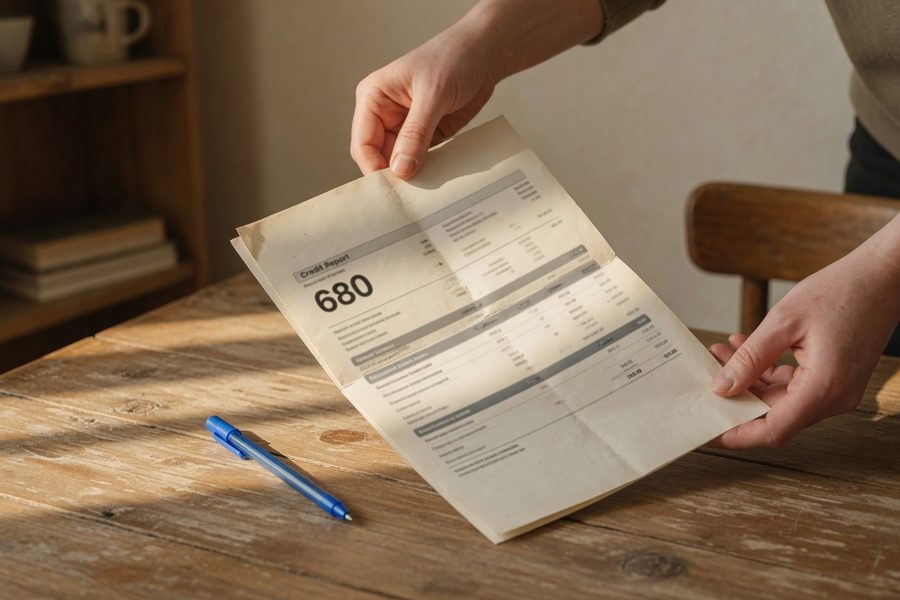
Start looking at platforms only after your FICO clears 680. That’s the pivot. Drop below and the approval math turns against you fast. Credible’s analysis of tens of thousands of loan inquiries from 2025 shows exactly how steep the slope is: for scores of 800 and above, fintech approval sits at 82.3%. In the 670–739 band, it’s 60.4%. Once you slip to 580–669, the figure plummets to 22.4%, and below 580 it’s practically a lockout at 0.5%.
What most “best fintech loans” roundups won’t tell you is that even when a 640-scoring applicant gets a green light, the offer rarely resembles the advertised rate. LendingTree’s marketplace data for Q4 2025 pegs the average APR for excellent-credit borrowers at 15.75%; for poor-credit applicants, that number leaps to 30.25%. That’s not a premium. It’s a different financial product entirely.
The Consumer Financial Protection Bureau’s 2025 BNPL report confirms the broader fintech direction: approval rates climbed from 67% in 2020 to 79% in 2022 across credit tiers. But where that growth came from was marginal extensions, not deep-subprime access. Most platforms still hard-decline anyone north of a 36% DTI or a recent delinquency.
If you aren’t sure where your score lands, soft-pull pre-qualification on a site like LendingTree or even directly through a lender’s portal costs nothing and won’t dent your credit. Jumping straight to a hard application, though, especially when you’re on the bubble, turns the algorithm against you. Multiple hard pulls in a short window signal desperation, and fintech models are trained to pick that up. For a clear breakdown of how even a 20-point score bump moves you into a lower pricing band, see the interest rate tiers lenders actually use.
Full Approval vs. Partial Funding: Why Getting a “Yes” Isn’t the Same as Getting What You Need
You get congratulated by the app, but the loan amount is only 40% of what you applied for, and the rate is two points higher than the teaser. That’s the most common outcome among fintech borrowers. According to the Federal Reserve’s Consumer & Community Context report (March 2025), online lenders gave at least some financing to 70% of small-business financing applicants in 2023, yet only 31% received the full amount they requested, per Credit Suite’s analysis of the Federal Reserve Small Business Credit Survey. The same pattern holds for personal loans, where partial approvals are used to manage risk on borderline files.
Compare that to small banks: 52% of applicants walked away with full funding in the same period, according to the same Federal Reserve survey data. Credit unions pushed full-approval rates even higher while still declining less often overall. When you see a fintech promise “coverage for unexpected expenses,” understand that it may deliver a fraction of the safety net you actually need. Many consumer reviews cite partial offers that create more stress, a $3,000 approval when the medical bill is $6,500 doesn’t solve the problem.
A partial approval often masks an opaque risk assessment. The lender uses the lower amount to cap its exposure but won’t necessarily tell you why the cut happened. If you’re carrying other debts, even small ones, the system’s affordability check might slice your offer without warning. And if you then supplement the shortfall from another platform, a behavior known as digital loan stacking, the second lender’s algorithm sees the new loan application as a red flag and either declines or jacks the rate. We cover the full mechanics in why stacking multiple platforms quietly backfires.
The takeaway: if your personal finance requires a guaranteed amount, fintech should not be your first stop. Credit unions, small banks, and even some online-focused community institutions deliver more certainty on full funding. If you still lean fintech, test your eligibility via a soft pull that shows both the approval probability and the likely funded amount, and assume 20% less than what’s displayed.
Your Employment Type and DTI Dictate Whether the Algorithm Cuts You a Break
Fintech underwriting engines adore W-2 income, steady job tenure, and a debt-to-income ratio that stays below 36%. Push your DTI past 40%, and approval odds collapse, even for applicants with a solid FICO. The algorithms weigh front-end DTI heavily because they’re optimized for repayment predictability, not relationship banking.
Self-employed borrowers and gig workers get a tougher script. Roughly 29% of small business financing applicants now turn to online lenders, according to the Federal Reserve’s 2025 Small Business Credit Survey, up from 17% in 2020. Yet for personal-use money, the approval channel narrows when income swings month to month. Most platforms will accept bank-transaction data as an alternative signal, consistent deposits, steady utility payments, but that help is limited. If your average monthly balance is low or overdrafts appear, the algorithm penalizes you harder than a human underwriter might. The documentation hurdles and what actually works are outlined in how self-employed borrowers can document income for better rates.
One efficient way to gauge your odds: use a digital lender’s soft-pull pre-offer tool without initiating a full application. Softer analytics let you see a preliminary rate range based on your cash flow, not just a snapshot of your credit file. But don’t confuse pre-approval with a hard offer; the final terms can shift once a hard pull is triggered and the full alternative-data analysis runs.

How does this translate into real dollars? Suppose you need $7,000 for a car repair and some lingering credit-card consolidation. With a 640 FICO and a DTI of 38%, a fintech platform might still approve you, but at a 30.25% APR over three years. Your monthly payment lands at about $295. That same loan from a credit union for “fair-credit” borrowers, carrying an 18% APR, drops the payment to $257. Over three years, the fintech route costs an extra $1,368. If the fintech also gives you only partial funding, you’re paying a premium for a half-solution. That’s the math that makes comparing offers across lender types non-negotiable.
The algorithm’s narrow view of DTI also means that carrying a mortgage or auto loan with on-time payments won’t rescue you. The machine sees the total obligation load, not the nuance that a mortgage signals stability. If you suspect your DTI is misrepresented, common when variable income or seasonal bonuses complicate the standard 28/36 rule, brush up on the DTI misconceptions that trip up personal loan applicants.
It’s also worth noting a structural limitation of fintech models: the prime rate at 6.75% means even well-qualified borrowers are starting from a higher floor than they were in 2021. A fintech APR that looks competitive in isolation may still represent a significant premium over what a local credit union or small bank charges someone with the same profile. Running those side-by-side numbers before applying takes less than 30 minutes and can easily save hundreds over the life of the loan.
Who Should and Who Should Not
Good candidates
These profiles align with what fintech algorithms reward, fast, mostly automated decisions at rates that beat traditional banks.
- W-2 earners with a FICO above 720 and a debt-to-income ratio below 36% who need a lump sum within a week.
- Borrowers with a thin file but strong rent- and utility-payment history who can demonstrate consistent cash inflows through bank-account access.
- People who have already pre-qualified through a soft pull and see an APR under 18%, and who need only the exact amount that appears in the initial offer.
- Applicants with no existing personal loans elsewhere, so the algorithm’s debt-stacking flag stays dormant.
- Those who have a single financial gap (a car repair, a medical bill) and can repay in 24 to 36 months without refinancing.
Who should skip it
Fintech platforms typically produce more cost and frustration than value for these borrowers.
- Anyone with a FICO below 620, the approval rate is vanishingly small, and the APR will be north of 30% if approved.
- Self-employed individuals with uneven income who cannot show 12 months of stable average deposits; even with alternative data, denial is likely.
- Borrowers whose DTI exceeds 45%, regardless of credit score, the automated underwriting almost always returns a hard “no.”
- People who already carry a personal loan or high credit-card utilization; partial approvals and rate penalties become much more common.
- Those who haven’t checked a credit union’s rate first. Small banks funded 52% of applicants fully in 2023, compared to just 31% for online lenders, and often at better APRs, per the Federal Reserve Small Business Credit Survey.
Frequently Asked Questions
What are the average fintech loan approval rates in 2025?
Approval rates vary sharply by credit tier. Borrowers with scores of 800+ see 82.3% approval, those in the 670–739 range get 60.4%, and the 580–669 band drops to 22.4%. For scores below 580, the figure is essentially 0.5%.
Do fintech lenders approve bad credit?
Rarely, and when they do, the cost is extreme. The 0.5% approval rate under a 580 FICO means nearly all bad-credit applicants are denied. The few who qualify face APRs above 30%, turning a $7,000 three-year loan into nearly $3,600 in interest.
Why do fintech lenders deny applications?
The top triggers are a DTI above 40%, recent delinquency, and multiple hard inquiries in a short window. Even strong credit can be declined if the algorithms detect loan-stacking or irregular income that fails to meet the platform’s stability threshold.
Is it easier to get approved by a fintech lender than a bank?
For partial funding, yes. The Federal Reserve’s March 2025 data shows 70% of fintech applicants got at least some financing. But for full-amount approval, small banks outperform fintechs by a wide margin. If you need the entire sum, a fintech often isn’t easier.
How do employment type and gig income affect fintech loan approval?
W-2 workers with consistent pay stubs clear automated checks easily. Gig earners and freelancers face heavier scrutiny, even when they supply bank-transaction data. Many platforms will still default to tighter DTI ceilings and lower offered amounts for variable-income applicants.
Sources
Sources
- Federal Reserve Board, Consumer & Community Context, March 2025
- Consumer Financial Protection Bureau, BNPL Report 2025
- Federal Reserve Banks, 2026 Report on Employer Firms (2025 SBCS)
- Credit Suite, Small Business Lending Statistics and Trends
- The Broker Shop, Business Loan Approval Rates by Lender Type
- Federal Reserve Bank of St. Louis, Bank Prime Loan Rate