
Reviewed by the CapitalLendingNews Editorial Team
Our Take
Self-employed borrowers who present two years of tax returns with all schedules, plus three to six months of bank statements showing consistent deposits, consistently access the lowest advertised personal loan APRs, often within the same tier as salaried applicants. The recommendation holds when your gross revenue trend is stable or rising, your DTI sits below 35%, and your accounts are cleanly separated. The case for waiting: if your most recent tax year shows a sharp income dip due to deductions or a slow quarter, applying after your next strong filing year will produce materially better rates.
Self-employed personal loan income is one of the most misunderstood factors in consumer lending. Lenders do not doubt that freelancers, contractors, and business owners earn money, they doubt they can verify it well enough to price risk accurately. According to the Bureau of Labor Statistics, self-employment accounts for roughly 10% of total U.S. employment, yet underwriting systems were built around W-2 income. That gap creates real friction at the application stage.
This article is for independent contractors, sole proprietors, and small business owners who want a personal loan at the best available rate, not just approval. What makes the difference is rarely the income itself; it is how thoroughly and strategically that income is documented before the application goes in.
Key Takeaways
- Major lenders including SoFi, Discover, and Citi require at least two years of federal tax returns from self-employed applicants as of their 2025–2026 application guidance.
- Borrowers with 24 months of documented, consistent deposits and a debt-to-income ratio under 35% routinely qualify for the lowest advertised APR tiers, according to CFPB consumer loan research.
- IRS 1099-K reporting thresholds shifted significantly for tax year 2024, the threshold dropped to $5,000 per IRS guidance, which means more gig-platform income now appears on formal tax records, helping document self-employed personal loan income.
- Automated underwriting flags variable income more aggressively than manual review; requesting a manual underwrite by a loan officer experienced with self-employed files is a concrete path to better terms, not just a fallback.
- In my experience reviewing self-employed loan files, applicants who submit a one-page income summary explaining deductions, before being asked, cut back-and-forth with lenders by a noticeable margin and reduce the risk of a lower rate offer at closing.
Why Self-Employed Borrowers Face Stricter Income Scrutiny
Lenders price risk based on repayment certainty, and variable income introduces uncertainty that a W-2 eliminates by design. A salaried employee’s gross income is a single, verifiable number. For a self-employed borrower, qualifying income depends on net profit after deductions, averaged across multiple years, and then cross-checked against actual cash flow, a three-step process that salaried applicants never face.
How DTI and Income Documentation Interact
Debt-to-income ratio is the central metric lenders use to set rates and approve amounts. For self-employed applicants, the DTI calculation starts with net profit from Schedule C, not gross revenue. Aggressive but legal deductions, home office, vehicle use, depreciation, can reduce that figure significantly below what actually hit your bank account. A borrower earning $120,000 in gross revenue but reporting $72,000 in net profit will have their DTI calculated on the lower number. That matters enormously when you are trying to hit the sub-35% DTI threshold that unlocks the best rate tiers.
This is also where credit score interacts with documentation. As covered in our breakdown of credit score interest rate tiers, each 20-point jump in score can shift your APR by a meaningful margin. But even a strong credit score cannot compensate for income documentation that raises underwriter concerns. Both factors have to be solid.
What I see in practice: Self-employed applicants often assume a high credit score alone will carry their application. It helps, but lenders use income documentation to set the loan amount ceiling. A 780 FICO score paired with a thin or inconsistent income file still gets a reduced offer or a higher rate than the applicant expected.
Core Documents Most Lenders Request From Self-Employed Applicants
Here’s the thing: the minimum document set is two years of federal tax returns with all schedules attached, plus two to three months of bank statements. Every major personal loan lender, SoFi, Discover, Citi, LightStream, lists this combination in their 2025–2026 self-employed applicant guidance. Submitting anything less almost guarantees a slower decision, a higher rate, or both.
Tax Returns and What to Include
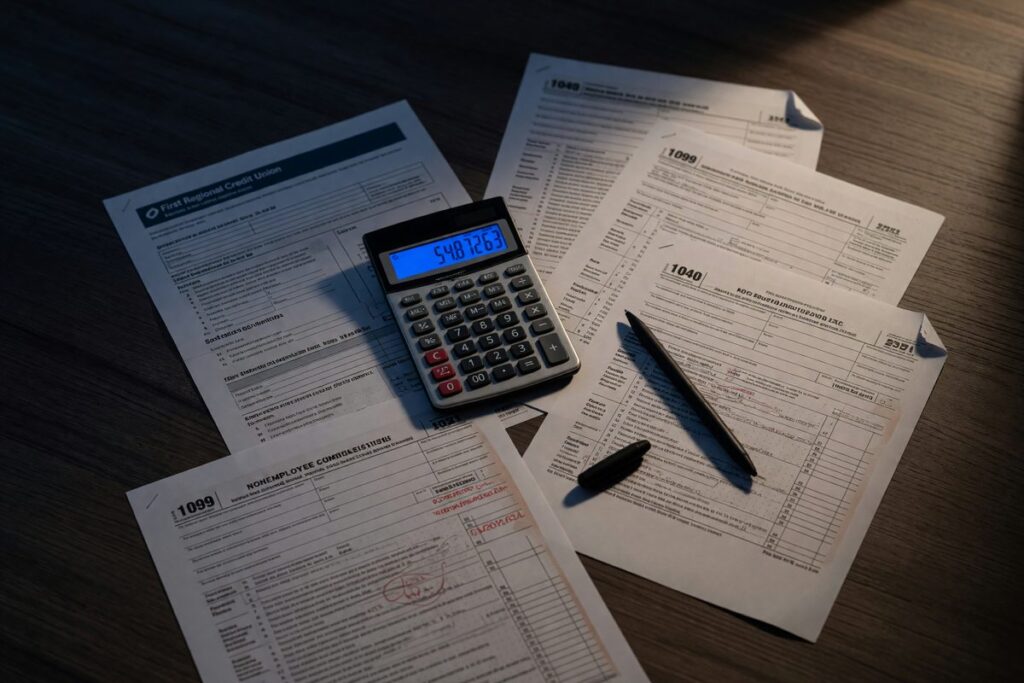
The full return means every schedule. For a sole proprietor, that includes Schedule C (profit or loss from business) and Schedule SE (self-employment tax). For S-corp or partnership owners, lenders want the business K-1 alongside the personal return. Submitting only the 1040 form without schedules is one of the most common delays I see, the underwriter will request them anyway, adding days to the process.
IRS Form 1099-NEC covers non-employee compensation from clients who paid you $600 or more. The 1099-K now covers gig-platform payments above $5,000 for tax year 2024, following the IRS’s phased reporting threshold change. If you receive income through platforms like PayPal, Stripe, or Venmo for business purposes, that income now appears on a formal tax record, which is genuinely useful for documenting self-employed personal loan income that previously fell below reporting thresholds.
Bank Statements as a Cross-Check
Lenders treat bank statements as a reality check against tax figures. Three months is a minimum; six months is better. What underwriters look for is deposits that align with or exceed the net profit reported. Consistent, recurring deposits, especially ACH transfers from clients or platform payouts, read as stable income. Sporadic large deposits with long gaps in between raise questions even if the annual total looks fine.
Separating business and personal accounts before you apply is not optional if you want a clean file. Commingled accounts force the underwriter to guess which deposits are business income, which introduces doubt. It also complicates DTI calculations. For self-employed borrowers who are also weighing whether a personal loan or another product is the right instrument, our comparison of personal loans versus cash-out refinancing for financial emergencies is worth reading before committing to either path.
How Lenders Calculate Qualifying Income From Your Tax Returns
Most lenders average your net profit across the two most recent tax years, then divide by 24 to get a monthly qualifying income. That number drives both your DTI and the maximum loan amount. The calculation is not always straightforward.
Certain non-cash deductions can be added back before the average is calculated. Depreciation is the most common, it reduces taxable income without representing an actual cash outflow. Some lenders, particularly those with manual underwriting processes, will also add back one-time or extraordinary business expenses that clearly will not recur. Getting credit for these add-backs requires documenting them explicitly. A two-page profit-and-loss statement that separates recurring operating costs from one-time capital expenses makes this easy for the underwriter. Without it, they default to the Schedule C net profit as written, which is often the more conservative number.
Where this gets tricky: If year one showed $95,000 in net profit and year two showed $68,000, perhaps due to a large equipment purchase, the 24-month average is $81,500. But if year two is your most recent, some lenders weight it more heavily. Knowing which method your target lender uses before you apply changes whether you apply now or after the next filing.

Leveraging Bank Statements and Cash-Flow Evidence Beyond Tax Returns
Bank statements do more than confirm what your tax return says, used well, they can offset a tax return that looks lean because of legitimate deductions. This is the angle most competing guides miss.
Deposit Matching and What Underwriters Flag
The goal is to show deposits that match or exceed your reported net income on a monthly basis. If your Schedule C reports $6,000 per month in net profit but your bank statements show $9,000 in monthly deposits, an attentive underwriter, specifically, a human one doing a manual review, will want to understand the difference. Often the gap reflects deductible business expenses paid from the same account. Annotating the three to six months of statements with a simple key (which deposits are revenue, which are transfers between accounts) removes that ambiguity before the underwriter has to ask.
Recurring ACH transfers from the same client or platform carry more weight than one-off deposits. They signal ongoing contractual relationships rather than sporadic work. This principle parallels how lenders treat overtime and bonus pay, as covered in our guide on how lenders treat overtime and bonus income, regularity of receipt is what converts variable income into qualifying income.
Accounting Software Exports as Real-Time Evidence
This is an underused option. Exports from QuickBooks Online or Xero, particularly a profit-and-loss report for the current year-to-date, provide documentation that tax returns cannot: recent performance. If your most recent tax return covers 2024 but you are applying in mid-2026, a current-year P&L showing consistent revenue through May 2026 addresses the time gap directly. Some fintech lenders now accept API-linked accounting data in lieu of static PDFs, which is faster and harder to dispute. As we note in our coverage of alternative signals digital lenders are weighing in 2026, real-time financial data connections are becoming a genuine underwriting input, not just a novelty.
| Document Type | What It Proves | Lender Weight | Time Period Covered |
|---|---|---|---|
| 2-Year Federal Tax Returns | Net profit, deductions, income history | Primary, required by most lenders | 24 months historical |
| Schedule C / Schedule SE | Business income breakdown, self-employment tax | Required with 1040, not optional | Per tax year filed |
| 1099-NEC / 1099-K Forms | Client payments, platform income | Supplementary, corroborates tax return | Per tax year issued |
| 3–6 Months Bank Statements | Cash flow, deposit consistency | Primary, cross-checks reported income | Recent 90–180 days |
| Current-Year P&L Statement | Recent revenue, operating costs | Strong supplementary, bridges the tax gap | Year-to-date 2026 |
| Client Contracts / Invoices | Ongoing income commitments | Supplementary, supports future stability | Active as of application date |
Additional Records That Strengthen Approval Odds and Access Lower Rates
Beyond the core document set, three additional items can meaningfully shift an underwriter’s confidence, and in some cases, move an application from a mid-tier to a top-tier rate.
Business Licenses and Contracts
A current business license from your state or municipality confirms that your business is a formal, registered entity. Client contracts showing retainer arrangements or recurring service agreements do something tax returns cannot: they suggest future income, not just past income. Lenders cannot underwrite on projections, but a contract with 12 months remaining effectively shows your income is not likely to drop sharply after closing.
Other Income Streams
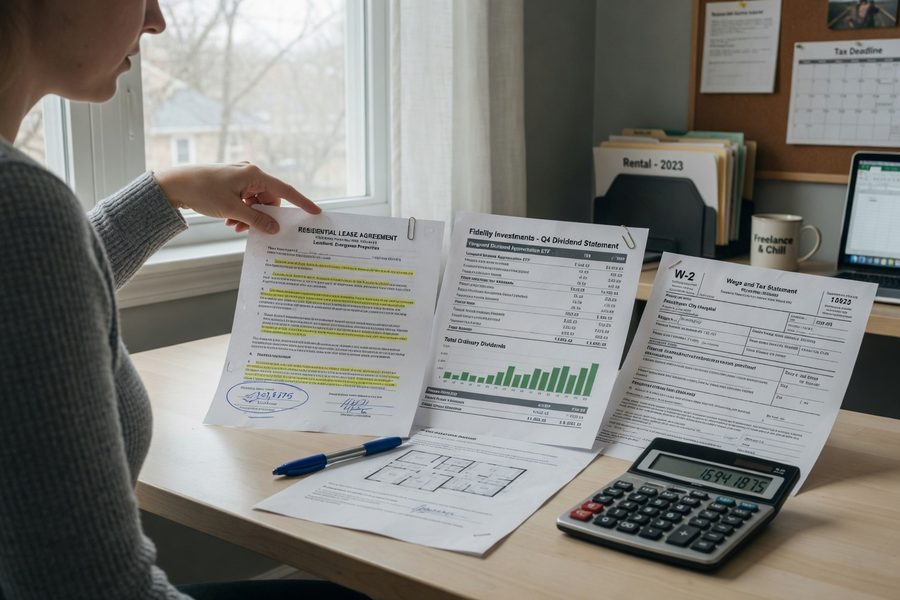
Rental income, investment dividends, or a spouse’s W-2 income (on a joint application) can offset the variability concern that self-employment creates. Document these the same way: tax records, statements, and a brief explanatory note if the income is recent. For borrowers managing multiple income streams while also carrying existing debt, the calculation of whether to prioritize debt payoff before applying is worth running, our analysis of paying off debt versus saving for a larger financial goal walks through that math in detail.
What clients often miss: Gig workers who file both a Schedule C and receive 1099-K forms often think they are double-reporting income. They are not, but the overlap confuses underwriters who are not familiar with platform-based income. A one-paragraph cover note explaining the filing structure saves real time in manual review.
Where This Recommendation Falls Short
Here’s the thing: the document-everything approach works well for established self-employed borrowers with clean records. The drawback is that it assumes your tax returns are working for you, not against you, and for many self-employed borrowers, they are not.
If your business is genuinely profitable but your net profit is kept low by aggressive deductions, depreciation, large Section 179 expensing, home office costs, the qualifying income lenders calculate may not support the loan amount you need. Manual underwriting with add-backs helps, but not every lender offers it, and the ones that do often require a relationship with a loan officer rather than a digital application. That means more time and, in some cases, a harder credit inquiry before you even get to a rate quote.
The tradeoff cuts another way for newer self-employed borrowers. Most lenders require two full years of self-employment tax history. If you left salaried work in late 2024 and are applying in 2026 with one strong filing year and one partial year, you may not qualify for the best rates regardless of how your documents are organized. Some lenders will work with 12 months of documented self-employment, but the rate differential is real, typically higher APR compared to borrowers showing full 24-month histories, because the risk model genuinely changes.
There is also a timing catch that the straightforward advice does not address. Applying after a year in which you legitimately had high expenses and low net profit, even if the underlying business is healthy, locks in a lower qualifying income for 24 months of averaging. Waiting one full tax year before applying, if your situation allows it, can shift that average meaningfully. The cost of waiting is the opportunity cost of not having the funds now. Only you can weigh that.
Finally, not all personal loan lenders handle self-employed files equally. Automated underwriting systems at banks and credit unions are designed around W-2 applicants. A file with a Schedule C, multiple 1099s, and a supplemental P&L can trip flag logic that was never designed to evaluate it fairly. In those cases, fintech lenders with manual underwriting capacity or explicit self-employed loan programs are often the better channel, even if the advertised APR range looks similar.
How We Sourced This
This article draws from IRS official guidance on 1099-K reporting thresholds and Schedule C filing requirements (irs.gov, current), CFPB consumer loan research and personal loan consumer tools (consumerfinance.gov), Bureau of Labor Statistics self-employment data from the May 2026 employment situation summary, and publicly available 2025–2026 personal loan application requirements from SoFi, Discover, and LightStream. Rate tier and DTI threshold references are based on underwriting standards published on lender websites and reviewed against Experian and FICO’s consumer credit guidance. All source URLs were verified as active in June 2026. No statistics were estimated or derived from unpublished sources.
Frequently Asked Questions
Can I qualify for a personal loan with only one year of self-employment history?
Some lenders will approve with 12 months of self-employment, but most require two full years. The catch is that single-year applicants typically face higher rates and lower approval amounts because the lender has less data to average. Your strongest path is a lender with a manual underwriting option rather than a fully automated system.
Does my gross revenue or net profit determine my qualifying income?
Net profit as reported on Schedule C is the baseline most lenders use. Gross revenue does not qualify you directly. However, if your net profit is reduced by large non-cash deductions like depreciation, a lender doing manual underwriting may add those back to produce a higher qualifying income figure, which is worth specifically asking about when you apply.
Will a profit-and-loss statement substitute for tax returns?
No, not with most traditional lenders. A P&L statement is a supplement, not a replacement. It fills the gap between your last tax filing and the current date, but lenders still require the underlying tax returns as the primary record. Some fintech lenders are beginning to accept real-time accounting data connections as primary evidence, but this remains the exception rather than the rule as of mid-2026.
How does my credit score interact with income documentation?
Both factors matter independently, and a weakness in either will cost you. A strong credit score above 720 does not offset thin income documentation, lenders use income to set the loan amount ceiling, and the rate is influenced by both. Conversely, solid income documentation cannot compensate for a score below 660, which most top-tier lenders treat as a rate-tier cutoff.
What is the best way to handle business and personal income on the same tax return?
File Schedule C to separate business income and expenses from personal income. Keep business and personal bank accounts completely separate before you apply, this makes the bank statement review faster and reduces underwriter questions. Commingled accounts are one of the most common reasons self-employed loan applications slow down or receive conditional approvals.
Does the 2024 IRS change to 1099-K reporting thresholds help self-employed borrowers?
Yes, in a practical way. The threshold dropped to $5,000 for tax year 2024, meaning more gig and platform income now appears on formal IRS records. If you earn through PayPal, Stripe, or similar platforms, more of that income is now documented on a 1099-K, which lenders can cross-reference against your Schedule C filing. It also reduces the risk of appearing to under-report income, which some automated underwriting flags.
Should I apply with a bank I already have a relationship with or try a fintech lender?
If your file is clean and straightforward, two years of consistent Schedule C income, separate accounts, a FICO above 720, an existing banking relationship can help because a loan officer there already knows your history. For more complex files with multiple income streams, large deductions, or shorter self-employment history, a fintech lender with explicit self-employed programs often produces better outcomes because their underwriting was built for that profile. Gig workers and contractors with unusual income structures may also find relevant guidance in our article on digital lending for gig workers between contracts.