

Fact-checked by the CapitalLendingNews editorial team
You have $500 sitting in your checking account at the end of the month, and two options staring you down: throw it at your personal loan, or park it in a savings account. It sounds simple. It isn’t. The question of whether to pay off loan early vs save is one of the most consequential, and most misunderstood, financial decisions everyday Americans face. Get it wrong, and you could be hemorrhaging hundreds or thousands of dollars in unnecessary interest, or leaving yourself dangerously exposed to a single unexpected expense.
The Federal Reserve’s 2023 Report on the Economic Well-Being of U.S. Households found that nearly 37% of Americans could not cover a $400 emergency expense without borrowing money or selling something. Meanwhile, the average personal loan interest rate in 2024 hovered between 11% and 21%, depending on creditworthiness, rates that can silently devour thousands of dollars over a 3-to-5-year loan term. At the same time, high-yield savings accounts were offering APYs of 4.5% to 5.0%, creating a genuinely competitive alternative for your extra cash.
This guide cuts through the noise. We’ll walk you through the precise math behind both strategies, explain when saving wins, when early repayment wins, and how to build a hybrid approach that gets you ahead on both fronts. You’ll walk away with a clear, personalized framework, not generic advice, but a decision tree grounded in actual numbers and real financial situations.
Key Takeaways
- Personal loan interest rates averaged 11.48% for 24-month loans as of early 2024, according to Federal Reserve data, far outpacing the best savings account APYs of 5.0%.
- Paying off a $10,000 personal loan at 15% APR one year early saves approximately $1,500 in interest charges over the remaining loan life.
- High-yield savings accounts now offer APYs up to 5.00%, meaning $10,000 saved earns roughly $500 in a single year, still less than what a 15% loan costs you monthly.
- Nearly 37% of Americans cannot cover a $400 emergency, making an emergency fund of 3-6 months’ expenses a financial prerequisite before aggressively paying down debt.
- Some personal loans carry prepayment penalties of 1-2% of the remaining loan balance, potentially $100-$200 on a $10,000 loan, which must be factored into your payoff math.
- A “hybrid” strategy, splitting extra cash between loan paydown and savings, can reduce total interest paid by up to 30% while simultaneously building a 3-month emergency buffer within 12 months.
In This Guide
- The Core Math: Interest Rates Are the Deciding Factor
- When Paying Off Your Loan Early Wins
- When Saving Your Extra Cash Wins
- Prepayment Penalties: The Hidden Cost of Paying Early
- Why the Emergency Fund Rule Changes Everything
- The Hybrid Approach: Pay Off Loan Early vs Save at the Same Time
- How Your Decision Affects Your Credit Score
- Tax Considerations Most People Ignore
- The Psychology of Debt: Why Emotion Matters in This Decision
- Making the Final Call: Pay Off Loan Early vs Save
The Core Math: Interest Rates Are the Deciding Factor
Strip away all the emotion and complexity, and the pay off loan early vs save decision boils down to a single mathematical principle: compare the cost of your debt against the return on your savings. When your loan’s interest rate exceeds what your savings account earns, every dollar you put toward the loan generates a better return than saving it.
Here’s a concrete example. Carry a $10,000 personal loan at 18% APR and you have $1,000 of extra cash. Putting that $1,000 toward the loan effectively earns you an 18% guaranteed return, because you’re eliminating debt that costs 18% annually. A high-yield savings account earning 4.75% APY on that same $1,000 earns you $47.50 over the year. The math is unambiguous.
The Guaranteed Return Principle
Unlike stock market returns, which are uncertain, debt elimination offers a guaranteed, risk-free return equal to your loan’s interest rate. This is the core insight most financial advisors rely on when advising clients. The stock market may average 7-10% historically, but it can also lose 30% in a bad year. Paying down a 15% loan returns exactly 15%, every time, with zero risk.
Understanding how compounding works is essential here. Two years into a loan, you’ve already paid the heaviest portion of front-loaded interest. In many amortized loans, the interest-to-principal ratio shifts over time, earlier payments are heavily weighted toward interest, while later payments go more toward principal. To understand how this compounding works against you, read our deep dive on how interest rate compounding works and why it costs more than you expect.
The average personal loan interest rate for a 24-month loan was 12.35% APR as of Q4 2023, according to Federal Reserve data. The average high-yield savings APY in the same period was 4.75%. That’s a 7.6 percentage point gap, money clearly better spent on debt elimination for most borrowers.
Breaking Down the Interest Rate Comparison
| Loan APR | Savings APY (HYSA) | Net Benefit of Early Payoff | Verdict |
|---|---|---|---|
| 6% or below | 4.75% | +1.25% | Slight edge to payoff |
| 8% | 4.75% | +3.25% | Lean toward payoff |
| 12% | 4.75% | +7.25% | Strong case for payoff |
| 18% | 4.75% | +13.25% | Prioritize payoff aggressively |
| 21%+ | 4.75% | +16.25%+ | Maximum urgency to pay off |
This table assumes a current high-yield savings APY of approximately 4.75%. As rates shift with Federal Reserve policy, these calculations change. Always plug in your current numbers before making a decision.
When Paying Off Your Loan Early Wins
In most scenarios where personal loan rates exceed 8-10%, aggressively paying down debt is the mathematically dominant strategy. But math alone doesn’t tell the whole story, your loan’s remaining term, your total outstanding balance, and your monthly cash flow all influence the outcome.
Consider a borrower with a $15,000 personal loan at 17% APR with 30 months remaining. The total remaining interest owed is approximately $3,900. Making one extra $500 payment per month reduces the payoff timeline by 8 months and saves roughly $1,200 in interest. That’s a guaranteed $1,200 return on $4,000 in extra payments, a 30% return in under 3 years, with zero risk.
High-APR Loans: The Non-Negotiable Case
Personal loans carrying an APR above 15% almost always warrant early payoff as the correct financial decision. Rates this high often accompany subprime lending conditions, meaning you’re already paying a premium, and every additional month of carrying that balance compounds the damage. For borrowers uncertain how lenders determine their rate, understanding the factors behind common mistakes borrowers make when comparing loan interest rates can help you evaluate your current terms more clearly.
The psychological weight of high-interest debt also has documented financial costs. A 2023 study published in the Journal of Consumer Research found that financial stress impairs decision-making quality, leading indebted individuals to make costlier choices in other spending categories, a cascading effect that amplifies the true cost of carrying debt.
On a $10,000 personal loan at 20% APR over 48 months, you’ll pay approximately $4,620 in total interest, nearly half the original loan amount. Making one extra payment of $200 per month cuts that interest cost to around $2,800 and eliminates the loan 14 months early.
Loans Nearing Their Final Year
With only 12 months or fewer remaining, the interest-saving potential of early payoff drops sharply. At this stage of an amortized loan, the majority of your payments are already going toward principal. Paying off the last $2,000 of a 12% loan 6 months early saves you approximately $65 in interest, the calculus shifts toward saving that cash instead.
In the final stretch of a loan, building your savings buffer often generates more long-term value than squeezing out a small interest reduction. This is one of the few cases where the save-first logic holds even with a moderate-rate loan.
One honest caveat: aggressive early payoff is not the right move for everyone. Borrowers who drain all discretionary income into loan paydown, leaving zero savings cushion, routinely end up back in debt within a year when an emergency hits. The strategy that looks best on a spreadsheet can backfire badly in practice if it leaves you with no liquidity. That risk is real, and worth naming plainly.
When Saving Your Extra Cash Wins
Saving wins when your loan’s interest rate is low enough that the opportunity cost of deploying cash toward debt, rather than keeping it liquid, outweighs the interest savings. This scenario became increasingly common as high-yield savings account rates surged past 4.5% in 2023 and 2024.
A personal loan at 5.5% against a HYSA earning 4.75% leaves an effective gap of only 0.75%. In that case, the liquidity value of keeping cash accessible may outweigh the marginal interest savings from early payoff. Cash in savings can respond to emergencies; cash sent to a lender cannot be retrieved without a new loan.
When Savings Rates Are Genuinely Competitive
Top-tier high-yield savings accounts and CDs offer returns that genuinely compete with low-APR loan savings in a high-rate environment. As of early 2024, Ally Bank, Marcus by Goldman Sachs, and SoFi were offering savings APYs between 4.50% and 5.00%. For borrowers with personal loans below 7%, the return differential is small enough to justify keeping cash in savings.
“When savings rates are within 2 percentage points of your loan rate, liquidity becomes the tiebreaker. A fully funded emergency fund is worth more than saving $80 in interest over six months.”
Low-Interest Loan Scenarios
| Scenario | Loan APR | Savings APY | Best Move |
|---|---|---|---|
| Credit union personal loan | 6.5% | 4.75% | Split 60/40 toward savings |
| Employer loan program | 4.0% | 5.00% | Maximize savings first |
| Promotional rate loan | 3.5% | 4.75% | Save, rate favors HYSA |
| Mid-range personal loan | 10.0% | 4.75% | Pay down loan first |
Note that employer loan programs and promotional rates are relatively rare. Most personal loans issued through banks and online lenders fall in the 10-20% range, where early payoff almost always wins on pure math.
Prepayment Penalties: The Hidden Cost of Paying Early
Prepayment penalties are fees lenders charge when you pay off a loan ahead of schedule. They exist because lenders profit from interest, and early payoff eliminates future interest income. Not all personal loans carry them, but many do, and failing to check before making extra payments is a costly mistake.
Prepayment penalties typically range from 1% to 5% of the remaining loan balance, or a flat fee equivalent to 2-3 months of interest. On a $10,000 loan balance, a 2% prepayment penalty equals $200, which could negate months of interest savings depending on your loan rate and timeline.
How to Check Your Loan Terms
Review your original loan agreement under sections labeled “prepayment,” “early payoff,” or “full payment.” Loans originated after 2013 are subject to consumer protection regulations that limit prepayment penalties on personal loans in many states, but restrictions vary by state and lender type. Always call your lender directly to confirm the exact terms before sending in a lump-sum payment.
Some lenders use “Rule of 78s” interest calculations on older loans, which front-loads interest so heavily that paying early saves almost nothing, and sometimes triggers a penalty. Loans originated before 2010 warrant a close look at the calculation method before assuming early payoff saves money.
Calculating the True Breakeven Point
To determine whether early payoff is still worthwhile after a penalty, calculate total interest remaining on the loan, subtract the penalty, and compare that to what you’d earn in a high-yield savings account over the same period. Net savings exceeding the HYSA return by at least $200-$300 generally make early payoff worthwhile.
| Remaining Balance | Loan APR | Prepayment Penalty | Interest Saved by Payoff | Net Savings |
|---|---|---|---|---|
| $10,000 | 15% | $200 (2%) | $1,500 | $1,300 |
| $5,000 | 12% | $100 (2%) | $450 | $350 |
| $2,000 | 10% | $60 (3%) | $110 | $50 |
Why the Emergency Fund Rule Changes Everything
Here is the foundational rule that overrides almost every other consideration: before aggressively paying off any debt, you need a minimum emergency fund. Financial planners broadly recommend 3-6 months of living expenses in a liquid, accessible savings account. Without this buffer, paying down debt is a high-risk strategy.
Why? Because life happens. Throw every extra dollar at your personal loan and then face a $2,000 car repair or a medical bill, and you’ll likely resort to high-interest credit cards or a new personal loan, potentially at a higher rate than the one you just paid off. You’ve gone backward financially.
The “Minimum Buffer” Threshold
Most personal finance experts draw the line at $1,000 as a bare-minimum emergency fund before directing extra cash toward debt. But $1,000 covers very little in 2024, a single emergency room visit can exceed this amount even with insurance. A more realistic minimum is 1 month of essential expenses, which for the average American household means approximately $3,000-$4,000.
Starting from zero savings? Our guide on how to build an emergency fund when you live paycheck to paycheck provides a practical roadmap for reaching that $1,000 first milestone, even on a tight budget. Once that floor is in place, you can shift the balance of your extra cash toward loan repayment.
According to Bankrate’s 2024 Emergency Savings Report, 56% of U.S. adults are uncomfortable with their level of emergency savings. Among those carrying personal loan debt, the rate of financial discomfort jumps to 71%, underscoring how interconnected debt and savings health truly are.
Emergency Fund vs Debt Payoff: The Priority Stack
Financial planners generally recommend a priority hierarchy for your extra cash. Build a minimum $1,000 buffer first. Then aggressively pay high-interest debt (above 10%). Then expand your emergency fund to 3-6 months. Then save or invest remaining surplus funds.
This sequence protects you from the most dangerous financial failure modes while still capturing the mathematical win of eliminating high-cost debt as quickly as possible.
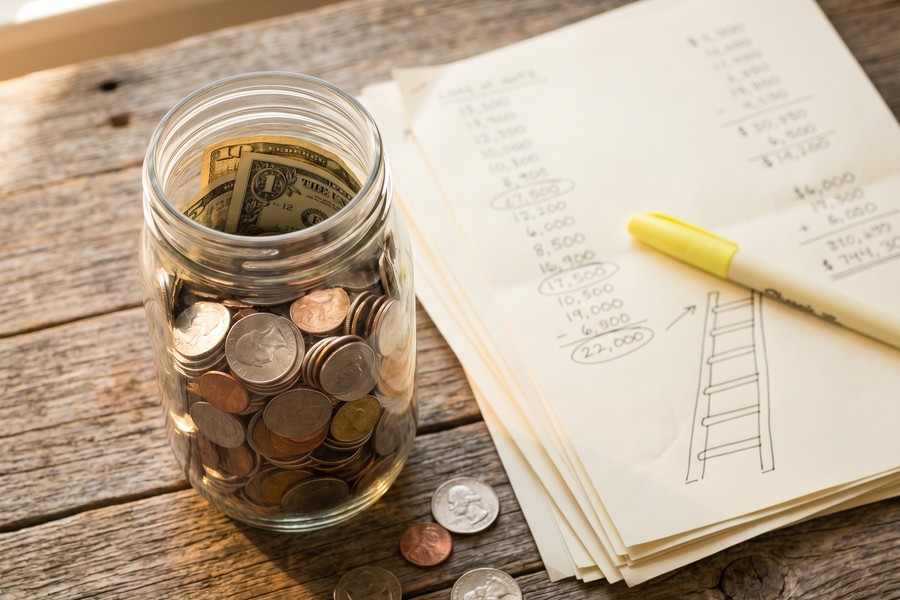
The Hybrid Approach: Pay Off Loan Early vs Save at the Same Time
The pay off loan early vs save debate doesn’t have to be binary. A hybrid strategy, allocating extra cash to both goals simultaneously, often produces the best outcome when your loan rate falls in the 8-12% range, or when you’re still building your emergency cushion.
Take a borrower with $600 per month in discretionary income. A 70/30 split directs $420 toward extra loan payments and $180 into a high-yield savings account. Over 18 months, this approach reduces total interest paid by approximately 22% while building a $3,240 savings buffer, nearly one month of average U.S. household expenses.
Sample Hybrid Allocation Models
| Monthly Extra Cash | Loan APR | Recommended Split | Loan Allocation | Savings Allocation |
|---|---|---|---|---|
| $300 | 18% | 90/10 | $270 | $30 |
| $500 | 12% | 70/30 | $350 | $150 |
| $800 | 8% | 50/50 | $400 | $400 |
| $1,000 | 6% | 30/70 | $300 | $700 |
The higher your loan’s APR, the more aggressively you should tilt toward debt elimination. As your loan rate drops toward or below the prevailing savings rate, the case for saving strengthens.
Debt Payoff Strategies That Work Alongside Saving
When deploying extra cash toward your loan, targeting principal directly, rather than simply making the next month’s payment early, produces the largest interest savings. Always specify with your lender that extra payments should be applied to principal. Many lenders default to applying overpayments to future interest first, which minimizes your savings.
Carrying multiple debts alongside your personal loan? The debt avalanche vs debt snowball comparison can help you sequence payoffs in a way that maximizes total interest savings while maintaining momentum. The avalanche method, in particular, pairs well with a hybrid save-and-pay strategy.
Set up automatic transfers on payday, one to your loan’s principal, one to your high-yield savings account. Automating the split removes decision fatigue and eliminates the temptation to spend the surplus before it’s allocated. Even a $50/month savings contribution compounds meaningfully over 36 months.
How Your Decision Affects Your Credit Score
Many borrowers overlook the credit score implications of paying off a personal loan early. The impact is more nuanced than most people expect, and sometimes counterintuitive.
Paying off a loan improves your debt-to-income ratio, which is favorable for future borrowing. However, closing an installment loan account can slightly reduce your credit score in the short term by shrinking your credit mix and reducing your average account age, two factors that collectively account for about 25% of your FICO score.
The Credit Mix Effect
FICO scoring models reward borrowers who demonstrate they can manage different types of credit, revolving credit (like credit cards) and installment loans (like personal loans or mortgages). Paying off your only installment loan removes this positive signal from your credit file. Planning a major loan application, a mortgage, for example, within the next 12 months? Consider the timing carefully before closing out the account.
“Paying off a loan is almost always good for your long-term financial health, but there can be a short-term score dip of 5 to 15 points when the account closes. For most people, that recovers within 3-6 months as their overall debt burden drops.”
Credit Utilization and Open Accounts
Unlike credit cards, installment loans don’t affect your credit utilization ratio, the percentage of revolving credit you’re using. Paying down your personal loan won’t directly lower utilization. However, eliminating the monthly payment frees up cash flow that can be used to pay down credit card balances, which does reduce utilization and can boost scores meaningfully.
For borrowers focused on improving their credit score, perhaps to qualify for a better mortgage rate, our breakdown of FHA loan rates vs conventional mortgage rates shows how even a 20-point score improvement can change your loan options and total cost over time.

Tax Considerations Most People Ignore
Personal loan interest is generally not tax-deductible for most borrowers. Unlike mortgage interest or student loan interest (which have deductibility rules under IRS guidelines), personal loan interest has no federal tax advantage. This means every dollar of interest you pay is a true after-tax cost, making high-rate personal loans even more expensive than they appear on paper.
By contrast, interest earned in a savings account is taxable as ordinary income. Earn $500 in HYSA interest in a year and, in the 22% federal tax bracket, your effective after-tax return is approximately $390. This slightly narrows the gap between saving and debt payoff, but in most cases, it still favors elimination of high-interest debt.
The After-Tax Return Comparison
To make an accurate comparison, always calculate the after-tax return on savings. A 5.00% HYSA return in the 22% bracket yields an effective after-tax return of 3.90%. A 12% personal loan, with no tax deduction, costs 12% in after-tax dollars. The gap: 8.1 percentage points in favor of paying off the loan.
In the 22% federal tax bracket, a savings account earning 5.00% APY yields an effective after-tax return of 3.90%. This means any personal loan above 4% APR is costing more, on an after-tax basis, than your savings account is earning. Most personal loans are well above 4%.
Tax-Advantaged Savings: A Special Case
One scenario where saving beats loan payoff on a tax-adjusted basis: employer-sponsored retirement accounts with matching contributions. A 100% employer match on contributions up to 4% of salary is an instant 100% return, far exceeding any personal loan’s interest rate. Always capture the full employer match before directing extra cash toward debt. This is one of the few exceptions where the math clearly favors saving over debt elimination.
Weighing where to put money beyond an emergency fund and loan payoff? Our comparison of Roth IRA vs Traditional IRA options explains how tax-advantaged accounts can interact with your overall debt repayment strategy.
The Psychology of Debt: Why Emotion Matters in This Decision
Financial decisions are never made in a purely rational vacuum. Research consistently shows that debt stress impairs cognitive function, sleep quality, and relationship health. A 2022 American Psychological Association Stress in America survey found that 65% of Americans cited money as a significant source of stress, with debt cited as the primary driver among those carrying consumer loans.
This matters for the pay off loan early vs save calculation because a strategy that’s mathematically optimal but psychologically unsustainable isn’t actually optimal. Carrying a loan that creates sufficient anxiety to degrade your productivity or lead to other costly financial decisions can cause real economic harm, and eliminating that loan, even at a marginal mathematical cost, may generate genuine value.
The “Debt-Free Dividend”
Behavioral economists have documented what they call the “debt-free dividend”, the measurable improvement in financial decision-making and savings behavior that follows the elimination of a significant debt. People who pay off loans tend to redirect their former monthly payments into savings at higher rates than those who use incremental debt reduction strategies.
This psychological momentum is part of why the debt snowball method, which prioritizes paying off smaller balances first, regardless of interest rate, has proven effective for many borrowers despite being mathematically suboptimal. The emotional win of eliminating an account generates follow-through behavior that pure math cannot predict.
Some borrowers fall into a pattern of “debt cycling”, aggressively paying off a loan, then running up new debt to cover gaps caused by depleted savings. This cycle often results in paying more total interest than a measured hybrid approach would have. Building savings alongside debt payoff protects against this trap.
Knowing Your Financial Personality
Are you a “debt avoider” who loses sleep over outstanding balances? Or an “optimizer” who can comfortably carry low-rate debt while maximizing returns elsewhere? Your honest self-assessment shapes which strategy you’ll actually stick to. A plan that earns 1.5% more in theoretical returns but causes you to abandon the strategy after three months is worse than the “suboptimal” plan you’ll actually follow for three years.
Making the Final Call: Pay Off Loan Early vs Save
Bringing together the math, the psychology, and the practical considerations, the pay off loan early vs save decision follows a clear decision framework. The rate spread between your loan and your savings account is the starting point, but it’s not the ending point.
Think through four key variables in sequence: your loan’s APR, your current emergency fund status, any prepayment penalties, and your psychological relationship with debt. Each variable can shift the optimal answer in one direction or the other.
The Decision Framework Summary
| Factor | Pay Off Loan Early | Save First |
|---|---|---|
| Loan APR | Above 10% | Below 6% |
| Emergency Fund | Already have 3+ months | Less than 1 month saved |
| Prepayment Penalty | None or minimal (<1%) | Significant (2%+) |
| Loan Remaining Term | More than 18 months left | Under 12 months left |
| Employer 401k Match | Already maximizing match | Match not yet captured |
| Psychological Stress | High debt anxiety | Comfortable managing debt |
When most of your answers fall in the “Pay Off Loan Early” column, accelerate payoff. When they cluster in the “Save First” column, protect your liquidity. When they’re mixed, the hybrid approach is your best path.
“There is no universal right answer. The best strategy is one that’s mathematically defensible, emotionally sustainable, and calibrated to your specific loan terms, savings rate environment, and life circumstances.”
A borrower who directs $400 per month in extra payments toward a $12,000 personal loan at 16% APR, rather than saving that amount at 4.75% APY, saves approximately $2,240 in total interest and pays off the loan 22 months earlier. Over the same period, saving $400/month at 4.75% would accumulate $8,800 plus $285 in interest, a much smaller financial gain.

According to a 2023 TransUnion analysis, borrowers who paid off personal loans early were 34% more likely to open a new credit product within 12 months at a lower interest rate, suggesting that early payoff improves both creditworthiness and future borrowing costs.
Real-World Example: How Maria Saved $3,100 With a Hybrid Strategy
Maria is a 34-year-old graphic designer in Austin, Texas, earning $58,000 per year. In January 2023, she carried a $14,000 personal loan at 17.5% APR with 42 months remaining, and had just $400 in savings. Her monthly required payment was $430. After covering essential expenses, she had approximately $650 per month in discretionary income.
Initially, Maria planned to put her entire $650 surplus toward the loan. But after reviewing her situation, she adopted a 70/30 hybrid strategy: $455 per month toward extra loan principal payments and $195 per month into a high-yield savings account earning 4.80% APY. Over 12 months, she built a $2,340 emergency buffer while simultaneously reducing her loan balance to $9,700, eliminating $1,940 in principal beyond her scheduled payments and saving approximately $1,200 in projected future interest.
In month 13, Maria’s car needed $1,800 in repairs. Because she had her savings buffer, she covered the repair without touching a credit card or taking a new loan. Without the savings component, she would have been forced to borrow $1,800 at a credit card rate of 24%, adding an estimated $850 in new interest costs over 24 months. Her hybrid approach effectively earned her $2,050 in total value: $1,200 in loan interest savings plus $850 in avoided credit card costs.
By December 2024, Maria had paid off the loan entirely, 11 months ahead of schedule, with $3,100 in total interest saved compared to the original amortization schedule. Her savings account had grown to $4,680, giving her a solid 1.5-month emergency fund. Her credit score, which had dipped 8 points when the loan account closed, rebounded 19 points within 4 months as her overall debt burden dropped and her payment history strengthened.
Your Action Plan
-
Find Your Loan’s Exact APR and Remaining Terms
Pull your original loan agreement or log into your lender’s portal. Note the exact APR, current outstanding balance, remaining term in months, and any prepayment penalty terms. You cannot make an informed decision without these four numbers in front of you.
-
Check Your Current Savings Rate Environment
Look up current high-yield savings account APYs from at least three institutions, Ally, Marcus by Goldman Sachs, and SoFi are reliable benchmarks. Note the highest available APY and compare it directly to your loan APR. The rate spread determines your mathematical bias toward payoff or saving.
-
Assess Your Emergency Fund Status
Calculate your essential monthly expenses, rent or mortgage, utilities, groceries, insurance, minimum debt payments. Multiply by 1 to get your minimum buffer threshold and by 3-6 for a full emergency fund. Savings below 1 month of expenses should be prioritized before aggressive debt paydown.
-
Verify Whether Your Loan Has Prepayment Penalties
Call your lender’s customer service line and ask directly: “Does my loan carry a prepayment penalty, and how is it calculated?” Get the answer in writing, via email confirmation or a note of the representative’s name and the date of the call. Factor the penalty into your net savings calculation before committing to early payoff.
-
Capture Any Available Employer 401k Match First
Before directing a single dollar toward extra loan payments, confirm whether your employer offers a 401k match and whether you are contributing enough to capture the full match. An unmatched 100% employer contribution is a return no personal loan payoff can beat. Leaving match money on the table means increasing your 401k contribution should come first.
-
Choose Your Strategy and Set Your Split
Based on your loan APR vs savings APY spread, emergency fund status, and prepayment penalty assessment, choose: aggressive payoff (80-100% of extra cash to loan principal), hybrid (60/40 or 70/30 split), or savings priority (80% or more to savings). Write the split down and set up automatic transfers to enforce it on payday.
-
Instruct Your Lender to Apply Extra Payments to Principal
When making extra loan payments, always specify, in writing or by checking the appropriate box in your online portal, that the overpayment should be applied to principal, not future interest. This single step can save you hundreds of dollars compared to letting the lender apply the funds on their default schedule.
-
Review and Adjust Every Six Months
The Federal Reserve adjusts rates periodically, savings APYs fluctuate, and your loan balance decreases over time, all of which change the optimal allocation. Schedule a 30-minute financial review every six months to recalculate your rate spread, reassess your emergency fund, and adjust your split ratio accordingly. What was optimal at month one may not be optimal at month 18.
Frequently Asked Questions
Is it always better to pay off a personal loan early than to save?
No. When your personal loan’s APR is lower than, or close to, what a high-yield savings account earns, the liquidity value of keeping cash accessible can outweigh the marginal interest savings from early payoff. For most borrowers carrying personal loans above 10% APR, however, early payoff generates a better guaranteed return than savings accounts currently offer.
What interest rate threshold should push me toward paying off the loan early?
The general rule: when your loan APR exceeds the prevailing high-yield savings APY by 2 or more percentage points, prioritize early payoff. With HYSAs offering 4.5-5.0%, that means loans above roughly 6.5-7.0% APR favor early payoff for most borrowers. Below that spread, splitting or saving becomes more defensible.
Will paying off my personal loan early hurt my credit score?
It can cause a small, temporary dip, typically 5 to 15 FICO points, when the account closes, due to reduced credit mix and shorter average account age. This dip usually recovers within 3-6 months, and the long-term benefits of lower debt burden and improved debt-to-income ratio generally outweigh the short-term score impact for most borrowers.
Should I pay off debt or build an emergency fund first?
Build a minimum emergency fund first, at least $1,000, ideally 1 month of essential expenses, before aggressively targeting loan payoff. A single unexpected expense without savings forces you back into high-interest debt, potentially undoing months of payoff progress. Once you have a basic emergency cushion, shift the majority of extra cash toward high-interest debt.
Can I pay off a personal loan early without a penalty?
Many personal loans, particularly those issued after 2013, carry no prepayment penalty. Some lenders do charge a prepayment fee of 1-5% of the remaining balance or 2-3 months of interest. Always review your loan agreement and confirm directly with your lender before making a lump-sum payoff to avoid unexpected charges.
What if I have multiple debts alongside my personal loan?
Prioritize by interest rate. Eliminate the highest-rate debt first (debt avalanche method) to minimize total interest paid. Personal loans at 15-20% should generally be paid before student loans at 5-7%, for example. If the psychological weight of multiple accounts is overwhelming, the debt snowball method, smallest balance first, can build the momentum needed to stay the course.
Is a high-yield savings account the best place to park extra cash while I pay off a loan?
For the savings portion of a hybrid strategy, a high-yield savings account is generally the best choice for funds you may need within 1-3 years. HYSAs offer FDIC insurance up to $250,000, daily liquidity, and competitive APYs. Certificates of deposit can offer slightly higher rates but lock your funds for a fixed term, making them less suitable for emergency funds but useful for specific savings goals.
Does making extra loan payments reduce my required monthly payment?
For most personal loans, making extra principal payments reduces your total loan balance and shortens the payoff timeline, but does not automatically reduce your required monthly payment. Your scheduled payment amount stays the same unless you formally refinance or modify the loan. The benefit of extra payments is a faster payoff date and lower total interest paid, not a lower monthly obligation.
What if savings account rates drop significantly, should I rethink my strategy?
Yes. If savings APYs fall sharply, back toward the 1.5% levels seen before the Fed’s 2022-2023 rate cycle, for instance, the case for aggressive loan payoff becomes even stronger. Conversely, refinancing your personal loan to a much lower rate while savings rates remain elevated can shift the math toward saving. Revisit your strategy whenever either rate moves by more than 1 percentage point.
Can I refinance my personal loan to a lower rate and then focus on saving?
Qualifying for a rate that’s 3 or more percentage points below your current APR can shift the optimal strategy toward saving. Refinancing often involves origination fees of 1-6% of the loan amount, though, which must be factored into the break-even calculation. Use our comparison of fixed vs variable interest rate loan types to understand which refinancing option preserves the most value over your loan’s remaining term.
Who is this strategy NOT a good fit for?
The hybrid pay-and-save approach works best for borrowers with stable income and predictable expenses. Freelancers, gig workers, or anyone with highly variable monthly income may find a rigid split ratio hard to maintain, and may be better served building a larger emergency fund first before adding aggressive loan paydown. Similarly, borrowers within 12 months of a major loan application (such as a mortgage) should think carefully before closing an installment loan account, since the short-term credit score dip can affect qualification or rate.
Sources
- Federal Reserve, Consumer Credit Statistical Release (G.19)
- American Psychological Association, Stress in America 2022: Concerned About the Future, Feeling the Financial Pain
- Bankrate, Best High-Yield Savings Account Rates
- Bankrate, 2024 Emergency Savings Report
- IRS, Tax Topic 505: Interest Expense
- FDIC, Deposit Insurance Coverage Overview
- myFICO, What’s In Your FICO Credit Score
- CFPB, Fixed vs Variable Rate Loans Explained