

Fact-checked by the CapitalLendingNews editorial team
The average American teacher carries $58,700 in student loan debt, yet earns a median salary of just $61,820 per year, leaving almost no financial breathing room. For many educators, the math is brutally simple: after taxes, rent, groceries, and minimum loan payments, there is virtually nothing left over. The dream of paying off loans faster feels like a cruel joke when your paycheck disappears before the month ends.
What makes this crisis especially acute is its scale. According to the National Center for Education Statistics, more than 76% of public school teachers hold at least a bachelor’s degree, and a growing share, nearly 57%, hold a master’s degree or higher, which dramatically inflates their loan balances. The Federal Student Aid data center shows that teachers collectively owe tens of billions in federal loans. Meanwhile, PSLF forgiveness, often cited as the solution, has a staggering 98% rejection rate on initial applications, leaving educators stranded with decades of debt.
This guide is built specifically for teachers who want a concrete, data-backed roadmap to pay off loans faster, without gutting their retirement accounts or burning out by working three jobs. You will find exact side income strategies, retirement-preservation tactics, and a step-by-step action plan that educators across the country are already using to shave years off their debt timelines.
Key Takeaways
- The average teacher with $58,700 in student debt can save over $14,000 in interest by adding just $300/month in extra payments.
- Side income of $500-$1,000/month applied exclusively to principal can cut a 10-year loan timeline down to 6-7 years.
- Contributing at least 3-6% to a 403(b) or pension while aggressively paying debt is mathematically superior to pausing retirement in most teacher scenarios.
- Teachers who use the PSLF program correctly and supplement with side income can eliminate remaining balances 2-3 years earlier than those relying on PSLF alone.
- Popular teacher side hustles, tutoring, curriculum design, and online course creation, generate an average of $8,400-$18,000 in additional annual income.
- Refinancing student loans to a rate 2% lower on a $50,000 balance saves approximately $5,800 over 5 years, but only makes sense outside of PSLF programs.
In This Guide
- The Teacher Debt Crisis in Numbers
- Top Side Income Strategies for Teachers
- The Retirement vs. Debt Payoff Dilemma
- Choosing the Right Loan Repayment Plan
- The Math of Extra Payments
- Making PSLF Work While Earning More
- Tax Strategies That Accelerate Debt Payoff
- When Refinancing Makes Sense for Teachers
- Automation and Systems to Stay on Track
The Teacher Debt Crisis in Numbers
Teachers occupy a unique financial position. They are highly educated professionals paid on compressed public salary scales, a combination that creates persistent, structural debt pressure. The problem has worsened over the past decade as tuition costs have outpaced salary increases by a wide margin.
Between 2010 and 2023, average public university tuition rose by approximately 31% after inflation, according to the National Center for Education Statistics tuition data. Teacher salaries, by contrast, have grown at roughly half that pace in real terms. The result is a debt-to-income ratio that squeezes every financial decision an educator makes.
Who Carries the Heaviest Debt Loads
Special education teachers, school counselors, and those who pursued graduate degrees to meet state licensure requirements often carry the largest balances, frequently $80,000 to $120,000 or more. This group faces the sharpest tension between debt payments and retirement savings.
Early-career teachers in their first five years carry an average monthly student loan payment of $503, per data from the Education Data Initiative. On a starting salary of $40,000-$45,000, that represents 13-15% of gross monthly income, before taxes, housing, or food.
Teachers hold an average of $58,700 in student loan debt. On a standard 10-year repayment plan at 6.5% interest, they pay $664/month, and $20,870 in total interest over the life of the loan.
The Retirement Gap Compounds the Problem
Many teachers contribute to defined-benefit pension plans, but vesting periods of 5-10 years mean early leavers receive nothing. For those who do stay, pension income in retirement rarely replaces more than 50-60% of pre-retirement earnings without supplemental savings. The pressure to simultaneously attack debt and build retirement security is very real.
Pausing retirement contributions to pay down debt faster risks losing employer-matching dollars and decades of compounding growth. An educator who skips just 3 years of a 4% employer match on a $50,000 salary forfeits $6,000 in free matching funds, plus the $18,000+ in compound growth those funds would generate over 30 years.
This strategy also does not work well for teachers who are uncertain about staying in public education long-term. If you leave before vesting in your pension, you may exit with neither retirement savings nor meaningful debt reduction, the worst of both outcomes. That possibility is worth factoring in before making any aggressive payoff plan.
Top Side Income Strategies for Teachers
The most effective way to pay off loans faster without raiding retirement accounts is to increase income, not just cut expenses. Teachers have significant, often underused assets: subject-matter expertise, communication skills, and credibility that commands premium rates in education markets.
The key is choosing side income streams that align with existing skills, have low startup costs, and do not require sacrificing mental health or personal time on a scale that leads to burnout. The strategies below are ranked by income potential and time investment.
Private Tutoring: High Hourly Rate, Flexible Hours
Private tutoring remains the most accessible side hustle for teachers. Rates range from $40 to $150 per hour depending on subject, grade level, and location, with SAT/ACT prep and AP subject tutoring at the top of that range. A teacher who tutors just 5 hours per week at $60/hour earns $15,600 annually before taxes.
Platforms like Wyzant, Tutor.com, and Varsity Tutors connect tutors with students online. In-person referrals through school networks often yield higher rates and more consistent clients. Many experienced teacher-tutors report reaching $1,200-$2,000/month within their first year without heavy marketing.
One real limitation: tutoring income is entirely time-dependent. You cannot tutor 10 students at once, and during high-stress stretches of the school year, state testing season, report card periods, the energy simply may not be there. Burning out mid-year and abandoning both the side income and the loan payoff plan is a common failure mode that rarely gets discussed.
The tutoring industry in the U.S. is valued at over $8 billion annually, and demand has surged post-pandemic. Teachers with STEM or test-prep expertise are among the most sought-after tutors in the market.
Curriculum Design and Digital Products
Selling lesson plans, unit guides, and classroom resources on platforms like Teachers Pay Teachers (TpT) has generated life-changing income for thousands of educators. The top sellers on TpT earn over $100,000 per year, but even median sellers report $3,000-$10,000 annually in largely passive income after the initial creation period.
The most successful digital products are unit bundles priced at $10-$30. A teacher who creates 20 high-quality bundles and earns $500/month from TpT has built a revenue stream that grows over time with minimal ongoing effort. That $500/month applied entirely to principal on a $55,000 loan saves more than $9,000 in interest and cuts repayment by approximately 2.5 years.
Online Course Creation and Live Workshops
Platforms like Udemy, Teachable, and Skillshare allow teachers to monetize specialized knowledge far beyond the classroom. Courses on academic subjects, professional development for other teachers, or education-adjacent skills (public speaking, study habits, college essay writing) routinely sell for $49-$299.
A mid-career teacher who launches two courses and earns $700/month has increased take-home income by $8,400/year, enough to make nearly 13 extra monthly loan payments on a $664 standard payment plan. The startup time investment is significant (40-80 hours per course), but the ongoing maintenance is low.
| Side Income Type | Avg. Monthly Earnings | Startup Time | Scalability |
|---|---|---|---|
| Private Tutoring | $800–$2,000 | Low (1-2 weeks) | Limited (time-based) |
| TpT Digital Products | $300–$1,500 | Medium (2-4 weeks) | High (passive) |
| Online Courses | $500–$2,500 | High (1-3 months) | Very High (passive) |
| Curriculum Consulting | $1,000–$3,500 | Low (existing skills) | Medium |
| Freelance Writing/Editing | $400–$1,200 | Low (1-2 weeks) | Medium |
The Retirement vs. Debt Payoff Dilemma
The most emotionally charged financial question teachers face is: should I pause retirement contributions to pay off loans faster? The short answer, backed by math, is almost always no, but the nuance matters enormously depending on your specific loan rates and employer match structure.
The critical variable is the comparison between your loan interest rate and your expected investment return rate. If your loans carry a 6.5% interest rate and your retirement account is projected to return 7-8% annually, the mathematical case for maintaining retirement contributions while making minimum loan payments is strong.
The Employer Match Equation
Many school districts offer a 403(b) match of 3-5% of salary. Forgoing that match to pay extra on loans is equivalent to refusing a 100% guaranteed return, something no investment can reliably offer. A teacher earning $55,000 with a 4% match who stops contributing loses $2,200/year in free money, plus future growth.
The only exception: if your loan interest rate exceeds 8-9% (common with older private loans), paying down that debt aggressively first can be mathematically justified, after capturing the full employer match. Under no circumstance should a teacher leave employer match dollars on the table.
“Teachers face a uniquely painful version of this dilemma because their pension vesting schedules create a ‘cliff’ — either you stay long enough to collect, or you receive almost nothing. That changes the calculus on whether a 403(b) supplement is critical. For teachers unlikely to vest, I prioritize debt payoff more aggressively.”
The 15% Rule for Teacher Finances
Financial planners often recommend that educators aim to direct at least 15% of gross income toward retirement (including pension contributions and 403(b) savings combined). If your pension contribution already represents 8% of your salary, adding 7% to a 403(b) hits that threshold, freeing all side income for debt payoff without guilt or sacrifice.
Educators who use this framework report feeling far less financial anxiety. The retirement box is checked. Every dollar of side hustle income becomes a weapon against debt, and tools like zero-based budgeting (covered in detail on our guide to zero-based budgeting vs. the envelope method for debt payoff) help ensure those extra dollars actually reach the loan servicer.

Choosing the Right Loan Repayment Plan
Your repayment plan is the foundation of your debt strategy. Choosing the wrong plan can cost teachers tens of thousands of dollars in unnecessary interest, or disqualify them from programs like PSLF that could eliminate large balances entirely.
The federal government offers eight primary repayment plans, but for teachers, three options dominate the conversation: the Standard 10-Year Plan, Income-Driven Repayment (IDR), and the SAVE Plan (the newest IDR option launched in 2023).
Comparing Repayment Plans for Teachers
| Repayment Plan | Monthly Payment (on $58,700 balance) | Total Interest Paid | PSLF Eligible |
|---|---|---|---|
| Standard 10-Year | ~$657 | ~$20,000 | Yes |
| SAVE Plan | ~$280–$380 | $40,000–$80,000+ | Yes |
| PAYE | ~$310–$420 | $35,000–$70,000+ | Yes |
| Graduated Plan | $370 rising to $1,100 | ~$28,000 | No |
| Extended 25-Year | ~$395 | ~$57,000 | No |
For teachers pursuing PSLF, the SAVE or PAYE plan lowers monthly payments, but the goal is forgiveness after 120 qualifying payments, not minimizing interest. For teachers NOT pursuing PSLF (or those with private loans), the Standard 10-Year plan with extra payments applied to principal is almost always the fastest and cheapest path to zero.
The Hidden Cost of Extended Plans
Choosing a 25-year extended repayment plan to lower monthly payments may feel like financial relief. In reality, it can cost an additional $37,000 in interest on a $58,700 balance. That is money that could fund a down payment, build retirement assets, or eliminate the loan entirely on a standard timeline.
Switching from a Standard Plan to an extended or graduated plan to reduce monthly pressure can permanently disqualify prior payments from PSLF credit. Consult your loan servicer before changing plans if you may pursue PSLF in the future.
The Math of Extra Payments
One of the most powerful ways to pay off loans faster is deceptively simple: pay more than the minimum. Every dollar applied to principal reduces the balance on which interest accrues, creating a compounding benefit that grows over time.
The math here is unambiguous. On a $58,700 loan at 6.5% interest with a standard $657 monthly payment, adding just $200/month in extra principal payments cuts the repayment timeline from 10 years to 7.5 years and saves $8,200 in interest. Adding $500/month cuts it to 6 years and saves $13,800.
Targeting the Right Loan First
Borrowers with multiple federal loans should understand the difference between the avalanche method and the snowball method. The avalanche method (targeting highest-interest loans first) saves the most money mathematically. The snowball method (targeting smallest balances first) provides psychological wins that keep people motivated.
Research published by the Harvard Business Review suggests the snowball method leads to higher actual payoff rates because motivation matters as much as math for most borrowers. Educators with very high-interest private loans and smaller federal loans may benefit from a hybrid approach, tackling private debt first while making minimum federal payments.
Adding $500/month to a $58,700 loan at 6.5% interest saves $13,800 in total interest and eliminates the loan 4 years ahead of schedule. Over a teaching career, that freed-up cash invested at 7% generates over $52,000 by retirement.
Biweekly Payment Strategy
Switching from monthly to biweekly loan payments is a no-effort strategy that makes one extra full payment per year. On a $657 monthly payment, biweekly payments of $328.50 result in 26 half-payments annually, the equivalent of 13 full monthly payments instead of 12. This alone cuts approximately 9 months off a standard 10-year loan.
Many loan servicers allow biweekly payment scheduling. If yours does not, simply divide your monthly payment by 12 and add that amount ($54.75 in this example) to each monthly payment. The effect is mathematically identical.

Making PSLF Work While Earning More
Public Service Loan Forgiveness (PSLF) remains the single largest debt relief opportunity available to teachers, potentially forgiving $40,000-$100,000+ in federal loans after 120 qualifying payments. Yet its complexity and historically high rejection rate have left many educators either avoiding it entirely or making costly mistakes.
The fundamental tension for teachers using side income is this: PSLF forgives your remaining balance after 120 payments, so paying extra reduces the forgiven amount, not the timeline. If you are on track for PSLF, extra principal payments do not accelerate forgiveness. They actually reduce the benefit you receive.
Who Benefits From PSLF vs. Aggressive Payoff
| Scenario | Best Strategy | Estimated Savings |
|---|---|---|
| Balance over $60K, staying in public school 10+ years | PSLF + minimum IDR payments | $30,000–$100,000+ |
| Balance under $30K, any employer | Aggressive payoff with side income | $6,000–$15,000 in interest |
| Balance $30K–$60K, likely to leave public sector | Hybrid: PSLF attempt + extra payments | Varies significantly |
| Private loans only | Refinance + aggressive payoff | $5,000–$20,000 |
| Mixed public/private loans | PSLF for federal, aggressive for private | Maximize both tracks |
Side Income and PSLF Eligibility
A common fear: does earning side income disqualify you from PSLF? The answer is no. PSLF eligibility is based on your primary employer being a qualifying public or nonprofit entity, your tutoring income, TpT sales, or online courses have no bearing on that status. However, side income does affect your IDR payment calculation.
If you earn $800/month in tutoring income and recertify your IDR plan, your adjusted gross income rises, which increases your required monthly payment. This is not necessarily bad. Higher payments mean more principal reduction and a smaller forgiven balance. For those near the 120-payment milestone, this is largely irrelevant. For those early in the PSLF track, it requires careful planning.
According to the Institute of Student Loan Advisors (TISLA), the PSLF program produces the greatest benefit when navigated correctly, and the most common reason borrowers are denied is paperwork error, not actual ineligibility. Submitting Employment Certification Forms annually, rather than waiting until the 120-payment mark, is the single most important protective step any PSLF-track teacher can take.
Tax Strategies That Accelerate Debt Payoff
Taxes are one of the most overlooked tools in a teacher’s debt elimination toolkit. Smart tax planning can generate hundreds or thousands of extra dollars per year, money that flows directly into loan payments when managed correctly.
The educator expense deduction allows K-12 teachers to deduct up to $300 in unreimbursed classroom expenses ($600 for married filing jointly with both spouses as educators). While modest, it is a guaranteed return available to nearly every teacher. Tracking expenses throughout the year ensures you capture the full deduction.
Self-Employment Tax on Side Income
When teachers earn tutoring or freelance income, they become self-employed for tax purposes. This triggers self-employment (SE) tax of 15.3% on net earnings, on top of ordinary income tax. A teacher earning $10,000 in tutoring income owes roughly $1,530 in SE tax plus income tax. Ignoring this can create a devastating tax bill in April.
The solution is quarterly estimated tax payments and meticulous expense tracking. Home office deductions, professional development costs, equipment purchases, and platform fees (TpT’s commission, for example) all reduce taxable self-employment income. A teacher who tracks $2,500 in legitimate deductions against $10,000 in tutoring income saves approximately $600 in combined SE and income taxes at a moderate tax rate.
Open a dedicated checking account for all side income and expenses. This single habit simplifies quarterly tax estimates, prevents accidental spending of tax-owed funds, and makes it dramatically easier to maximize deductions at tax time.
Using a SEP-IRA or Solo 401(k) for Dual Benefits
Self-employed educators with consistent side income can open a SEP-IRA or Solo 401(k). These accounts allow contributions of up to 25% of net self-employment income (up to $69,000 in 2024 for a Solo 401(k)). Every dollar contributed reduces taxable income, lowering the tax bill and building retirement savings at the same time.
This creates a two-pronged benefit. A teacher earning $15,000 in tutoring income who contributes $3,000 to a SEP-IRA reduces their taxable income by $3,000 while building retirement wealth. The tax savings generated, approximately $720 at a 24% marginal rate, can then be applied directly to loan principal. That is $720 in loan reduction that came entirely from smarter tax structure, not additional work.
When Refinancing Makes Sense for Teachers
Refinancing student loans means replacing existing federal or private loans with a new private loan at a lower interest rate. It can be a powerful tool to pay off loans faster, but it carries significant risks for teachers that are frequently underestimated.
The primary risk is permanent. Refinancing federal loans into a private loan eliminates PSLF eligibility, IDR plan access, and federal forbearance protections, forever. For any teacher who might pursue PSLF or who values the safety net of income-driven payments, refinancing federal loans is almost never advisable.
When Refinancing Is the Right Move
Refinancing makes clear sense in three scenarios: you have high-rate private loans (above 7-8%), you are certain you will not pursue PSLF, and your credit score qualifies you for meaningfully lower rates (a reduction of 1.5% or more). Refinancing a $50,000 private loan from 9% to 6% saves approximately $9,200 over 7 years.
Teachers interested in how debt-to-income ratios affect their loan application outcomes should review our analysis of how debt-to-income ratios quietly kill loan applications on digital lending platforms, the same principles apply to refinancing eligibility. Lenders want to see a DTI below 43%, and teachers with multiple loan balances often push this limit.
According to Credible’s 2023 refinancing data, the average interest rate reduction for borrowers who refinance student loans is 2.4 percentage points. On a $60,000 balance over 10 years, that saves approximately $8,400 in total interest.
Refinancing Private Loans Without Touching Federal Loans
Borrowers carrying both federal and private loans can refinance selectively, targeting only private loans while keeping federal loans intact. This approach preserves all federal protections and PSLF eligibility while capturing interest savings on private debt. Most major refinancing lenders including SoFi, Earnest, and Laurel Road allow this structure.
Before refinancing, teachers should also verify their credit profile is competitive. Strategies for building a stronger credit profile, even without traditional assets, are covered in our guide on how renters with no assets are building credit scores above 700. A score above 720 typically unlocks the best refinancing rates available.
Automation and Systems to Stay on Track
Behavioral economics research consistently shows that the biggest obstacle to debt payoff is not income, it is behavior. Automating extra payments produces dramatically higher success rates than manual monthly transfers. Automation removes the decision entirely, which removes the temptation to spend the money elsewhere.
The system that works best for most teachers is the paycheck intercept method: direct side income into a dedicated debt-payoff account, then schedule an automatic transfer to your loan servicer on the same day the deposit clears. The money never enters your spending account, so it is never at risk of being redirected.
Setting Up Your Debt Payoff Automation
Most loan servicers accept recurring additional principal payments. Log in to your servicer’s portal, set a recurring payment in the exact amount of your average monthly side income after taxes, and designate it as a principal-only payment. This ensures every extra dollar reduces balance, not interest first, as servicers default to doing.
For teachers using income-based side hustles with variable monthly income, a rolling 3-month average provides a reliable baseline for automation without overdrawing accounts in slow months. In high-earning months (December tutoring surge, summer course launches), the excess can be swept into a loan payment as a bonus.
A 2022 study by the Consumer Financial Protection Bureau found that borrowers who automated extra loan payments were 34% more likely to pay off loans early compared to those making manual additional payments each month.
Tracking Progress to Maintain Motivation
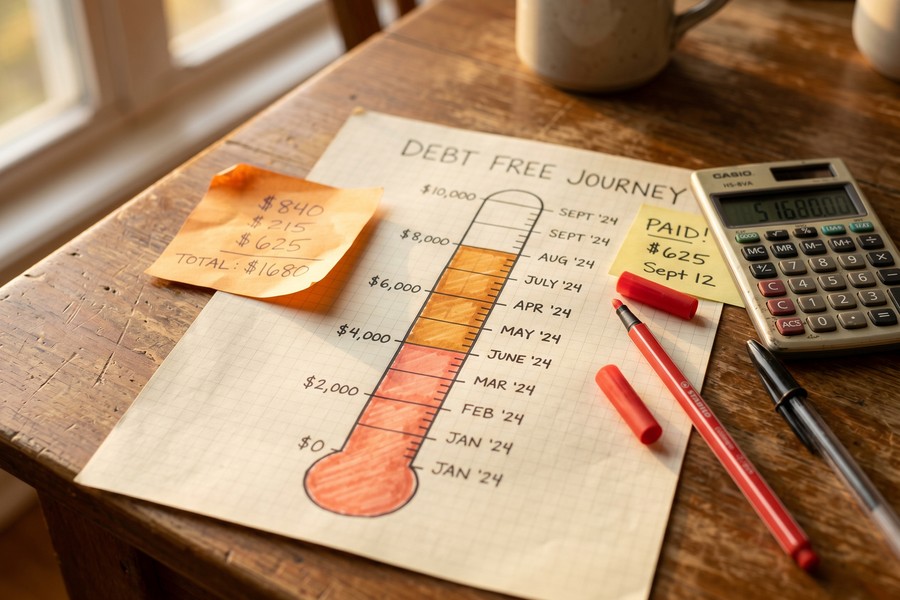
Debt payoff is a marathon. Tracking progress visually, using apps like Undebt.it, YNAB, or a simple spreadsheet, produces significantly higher motivation and follow-through. Seeing the balance drop each month reinforces the behavior loop.
Milestone celebrations matter too. An educator who reduces their balance by $10,000 should mark that moment, even with something small and inexpensive. The psychological reward of acknowledging progress sustains the multi-year commitment required for full debt elimination. Coupling this emotional structure with the financial discipline of single-income household budgeting strategies (explored in our piece on how couples with one income stretch a single salary to cover major expenses) creates a complete financial behavior system.
According to research from the Center for Retirement Research at Boston College, automated savings and payment behaviors are the most reliable predictor of long-term financial goal completion, not income level, not financial literacy scores. The people who pay off loans fastest are the ones whose systems make the right choice automatic, not the ones who rely on willpower each month.
Tools and Apps Worth Using
| Tool | Best For | Cost | Key Feature |
|---|---|---|---|
| Undebt.it | Debt avalanche/snowball tracking | Free / $12/year | Visual payoff timeline |
| YNAB | Zero-based budgeting + debt | $14.99/month | Every dollar assigned |
| Studentaid.gov | Federal loan tracking + PSLF | Free | Official federal portal |
| Mint / Credit Karma | Budget overview + net worth | Free | Aggregated financial view |
| QuickBooks Self-Employed | Side income tax tracking | $15/month | Mileage + expense logging |
Educators who run side hustles also benefit from understanding how lenders evaluate self-employed income, particularly if they plan to refinance or take on any new credit. Our breakdown of fixed vs. adjustable rate loans for self-employed borrowers covers key differences that become relevant as your side income grows and your financial options expand.
Fintech loan stacking, taking multiple personal loans from different lenders simultaneously, is a growing trap for borrowers seeking quick debt consolidation. Lenders flag this behavior and it can seriously damage your credit profile. Review the full risks in our guide on fintech loan stacking and how to avoid the trap.
Real-World Example: How One 5th-Grade Teacher Paid Off $71,000 in 6.5 Years
Sarah M. graduated in 2016 with a master’s in education and $71,000 in federal student loans, a mix of unsubsidized Stafford loans at 6.0% and PLUS loans at 7.08%. On her starting salary of $42,000 in a mid-sized Midwestern school district, her standard repayment payment was $788/month. After taxes, rent, and basic living expenses, she had approximately $150/month of discretionary income. The math was suffocating.
In her second year of teaching, Sarah began tutoring three students per week through a local referral network, charging $55/hour for reading comprehension and test prep. Within six months, she had built a client list of seven students, generating $1,540/month in tutoring income. After setting aside 28% for taxes ($431), she directed the remaining $1,109 entirely to her highest-interest PLUS loans as extra principal payments. She also enrolled in her district’s 403(b) plan at the minimum rate needed to capture the full 3% employer match, contributing $1,260/year in employee contributions to receive $1,260 in employer match.
By year three, Sarah had eliminated both PLUS loans ($24,200 combined) and refinanced her remaining federal Stafford loans, now $46,800, to a private lender at 4.9% after confirming she did not qualify for PSLF due to a gap in qualifying employment. She also launched a TpT shop selling reading comprehension unit bundles, which generated an additional $450/month in relatively passive income by year four. That combined side income of approximately $1,550/month post-tax was routed through an automatic monthly transfer to her loan servicer as principal-only payments.
Sarah made her final loan payment in March 2023, six years and four months after graduation, clearing $71,000 at an average effective rate of 6.2%. Over that period, she paid approximately $18,400 in total interest, compared to the $54,100 she would have paid on a standard 25-year extended plan. Her 403(b) balance stood at $19,800, boosted by employer matching and consistent contributions throughout her debt payoff journey. With her loan eliminated, she redirected the full $1,788/month (former loan payment plus side income) toward retirement, on track to retire at 57 with over $900,000 in combined retirement assets.
Your Action Plan
-
Audit Your Loans in Full
Log in to studentaid.gov and pull a complete picture of every federal loan: balance, interest rate, servicer, repayment plan, and payment count. For private loans, contact each lender directly. You cannot build a payoff strategy without knowing your exact starting point. Document everything in a spreadsheet.
-
Determine Your PSLF Eligibility, Immediately
If you work for a public school district, most teachers qualify for PSLF. Submit an Employment Certification Form today, even if you are just starting out, to confirm eligibility and begin counting qualifying payments. Waiting costs payments that count toward your 120-payment threshold. Use the PSLF Help Tool on studentaid.gov to verify your employer.
-
Lock In Your Retirement Floor Before Attacking Debt
Set your 403(b) contribution rate to capture 100% of your employer match before directing any money toward extra loan payments. This is your non-negotiable baseline. If your pension contribution is already substantial, verify you are on track for the 15% total retirement savings rate. Then, and only then, redirect extra income to loans.
-
Choose and Launch Your Primary Side Income Stream
Select one side income strategy that matches your subject expertise, available time, and income goals. If immediate income is the priority, start with private tutoring. If long-term passive income is the goal, invest 4-6 weeks building a TpT product library or an online course. Set a realistic first-year income target ($6,000-$12,000) and a weekly time commitment you can actually sustain.
-
Open Dedicated Side Income Infrastructure
Open a separate checking account for all side income. This account is for taxes, quarterly payments, and loan transfers only, never for daily spending. Set aside 28-30% of every side income deposit in a linked savings account for tax obligations. The remaining 70-72% transfers automatically to your loan servicer as a principal-only payment.
-
Automate Every Extra Payment
Set up a recurring additional principal payment with your loan servicer equal to your average monthly side income after taxes. Designate it explicitly as a principal-only payment. Schedule the transfer to occur within 48 hours of your side income deposit clearing. Remove the decision entirely, automation is the mechanism that separates teachers who pay off loans faster from those who intend to.
-
Run a Tax Optimization Review Annually
Each January, review your self-employment income and maximize deductions before filing. Consider contributing to a SEP-IRA or Solo 401(k) to reduce taxable income and build retirement assets at the same time. Work with a CPA who has self-employment experience, the cost ($200-$400 for a tax review) typically returns 3-5x in identified deductions. Apply any tax refund directly to your highest-rate loan.
-
Review and Recalibrate Every Six Months
Every June and December, pull your loan balances, check your PSLF payment count, and review your side income earnings. Adjust your automatic payment amounts upward as income grows. Celebrate milestones, every $10,000 eliminated is worth acknowledging. Recalculate your projected payoff date to keep the finish line visible and motivating.
Related reading: How California Graduates Are Using Income.
Frequently Asked Questions
Does earning side income affect my federal loan repayment plan?
Yes, if you are on an income-driven repayment plan, your monthly payment is calculated based on your adjusted gross income (AGI). Side income increases your AGI at recertification, which can raise your IDR payment. For PSLF-track teachers, this is generally fine because higher payments still count as qualifying payments. For teachers not on PSLF, a higher payment is actually beneficial, more money goes toward principal, reducing balance faster.
Can I tutor while working as a full-time teacher without violating my contract?
Most school districts do not prohibit private tutoring outside of school hours, but some have conflict-of-interest clauses that restrict tutoring your own current students. Review your contract’s outside employment provisions. A small number of districts require approval for outside income above a certain threshold. When in doubt, submit a written inquiry to HR, most districts approve tutoring requests quickly.
Will side income hurt my PSLF eligibility?
No. PSLF eligibility is based on your primary employer being a qualifying public service organization. Side income from tutoring, digital products, or freelance work does not affect that status. The only scenario where extra income could theoretically affect PSLF is if it indicates your primary employment has shifted, which is not the case for teachers earning supplemental income on weekends and evenings.
Is it better to pay off loans faster or invest in a taxable brokerage account?
After capturing your full employer match in retirement accounts, the comparison comes down to your loan interest rate vs. expected investment return. At current federal loan rates (6.5-8.0%), paying down loans first is roughly equivalent to a guaranteed after-tax return at that rate. If your loans are below 5%, investing in a diversified index fund with historical returns of 7-10% annually may mathematically outperform early payoff. Most financial planners recommend a split: pay extra on loans above 6% while investing conservatively in loans below 5%.
How much side income do I realistically need to pay off loans meaningfully faster?
Even $300/month in extra payments on a $58,700 loan at 6.5% saves $8,600 in interest and cuts repayment by 2.5 years. $500/month saves $13,800 and cuts 4 years. The threshold for meaningful acceleration is relatively low, consistent extra payments matter far more than the specific amount, and $300-$500/month is very achievable through tutoring just 5-8 hours per week.
Should I refinance my student loans if I am pursuing PSLF?
No. Refinancing federal loans into a private loan permanently eliminates PSLF eligibility, there is no reversing it. If you have any possibility of pursuing PSLF (meaning you work or might work in a qualifying public or nonprofit role), keep your federal loans intact. The only exception is if you are 100% certain you will leave public education and have confirmed PSLF is not in your future.
What if I cannot qualify for PSLF, what is my best strategy?
If PSLF is not an option (private school employment, for example, or private loans), the best approach is to choose the standard 10-year repayment plan, apply all side income as extra principal payments, and consider refinancing private loans to a lower rate if your credit score qualifies you. This combination can eliminate a $58,700 balance in 5-6 years for a teacher earning $700-$1,000/month in side income.
Is this approach realistic for teachers with very high debt, $100,000 or more?
It depends heavily on whether PSLF is available. For teachers carrying $100,000+ in federal loans who work at qualifying public schools, PSLF combined with minimum IDR payments is almost certainly the better path, side income strategy shifts from paying down principal to building retirement savings and an emergency fund during the 10-year qualifying window. For those with $100,000+ in private loans who cannot access PSLF, the side income approach still applies, but the timeline extends considerably. A realistic estimate for someone earning $1,000/month in extra income against a $100,000 private loan at 7% is 9-11 years to payoff, not 5-6. That is an important distinction before committing to the plan.
How do I handle taxes on my tutoring and digital product income?
Tutoring and TpT income are self-employment income, subject to both income tax and self-employment (SE) tax of 15.3% on net earnings. You are required to file a Schedule C with your federal tax return and pay quarterly estimated taxes if you expect to owe more than $1,000 in federal taxes. Track all business expenses (platform fees, materials, home office, internet) to reduce your net self-employment income. Consider working with a tax professional in your first year of meaningful side income, it almost always pays for itself.
Can I use a personal loan to pay off my student loans faster?
This is rarely advisable for federal student loans. Personal loan rates typically range from 8-25%, which is almost certainly higher than your federal loan rate. More importantly, consolidating federal loans into a personal loan eliminates all federal protections, PSLF eligibility, income-driven repayment access, deferment, and forbearance. For private student loans at very high rates (above 10-12%), a personal loan consolidation at a lower rate might make sense, but it requires careful rate comparison. Review how fintech lenders determine loan limits before applying at our guide on how fintech lenders decide your loan limit.
What happens to my side income strategy if I take parental leave or have a medical emergency?
Build a 3-month emergency fund before aggressively scaling your side income and extra loan payments. This buffer allows you to pause extra payments during hardship without derailing your overall plan. Federal loans offer deferment and income-driven repayment as safety nets. Private loans offer more limited protections, another reason to eliminate private debt first. Treat your emergency fund as non-negotiable infrastructure, not optional savings.
Sources
- National Center for Education Statistics, Teacher Educational Attainment Data
- National Center for Education Statistics, Tuition Cost Fast Facts
- IRS, Educator Expense Deduction (Topic 458)
- IRS, Self-Employment Tax Overview
- Bureau of Labor Statistics, Teacher Salary Data
- Center for Retirement Research at Boston College, Retirement Income Studies