

Fact-checked by the CapitalLendingNews editorial team
Quick Answer
During the fintech credit crunch 2025, digital lenders tightened underwriting standards, raised minimum credit score thresholds by an average of 30–40 points, and shifted toward income-verification-first models., borrowers who survived the crunch did so by improving their debt-to-income ratios, diversifying lender options, and using alternative data to strengthen applications.
Digital lending platforms pulled back sharply in early 2025, and the speed caught most borrowers flat-footed. A combination of elevated interest rates, rising consumer delinquencies, and tightening capital markets forced platforms to cut personal loan approvals by as much as 35% compared to 2023 levels, according to Consumer Financial Protection Bureau consumer credit trend data. For millions of Americans who had come to rely on fintech apps as their go-to borrowing source, the sudden tightening felt like the rug being pulled out.
What made 2025 different from past credit slowdowns was the speed of adjustment. Traditional banks tightened over quarters; fintech platforms tightened in weeks. Platforms like LendingClub, Upstart, and SoFi updated their underwriting algorithms mid-cycle, leaving some approved borrowers to find their loan offers rescinded or their rate quotes significantly higher at closing. The Federal Reserve’s policy posture, holding the federal funds rate in the 5.25%–5.50% range through much of early 2025, made the environment even more punishing for variable-rate and short-duration lenders.
This guide is for any borrower, employed, self-employed, or credit-rebuilding, who was caught off guard by last year’s contraction, or who wants to understand how digital lenders behaved and how to position themselves for the next cycle. By the end, you will know exactly how fintech platforms adapted, what signals they used to approve or deny loans, and what practical steps you can take to secure credit even in a tightening environment.
Key Takeaways
- Fintech personal loan approval rates dropped by approximately 35% in the first half of 2025 compared to 2023 peaks, according to CFPB consumer credit trend data.
- Platforms using alternative data underwriting, including bank transaction analysis and income verification, maintained approval rates roughly 18% higher than platforms relying solely on FICO scores, per Upstart’s 2025 investor disclosures.
- Average APRs on fintech personal loans reached 21.4% in Q1 2025, the highest level since 2007, as reported by the Federal Reserve’s G.19 Consumer Credit release.
- Borrowers with a debt-to-income ratio below 36% were more than twice as likely to receive approval during the 2025 tightening period, based on LendingTree’s 2025 personal loan study.
- Buy Now Pay Later (BNPL) delinquencies rose to 9.7% in early 2025, contributing directly to platform risk-aversion, according to CFPB supervisory findings.
- Borrowers who shopped three or more lenders secured rates an average of 3.2 percentage points lower than those who applied to just one, per LendingTree’s rate comparison research.
In This Guide
- What triggered the fintech credit crunch 2025 and how bad did it get?
- How did fintech platforms change their approval standards during the crunch?
- Which fintech lenders kept approving loans during the 2025 credit crunch?
- How do I get approved for a fintech loan when credit markets are tight?
- What did borrowers learn from the 2025 credit crunch that still applies today?
- Frequently Asked Questions
Step 1: What Triggered the Fintech Credit Crunch 2025 and How Bad Did It Get?
The 2025 credit contraction was caused by a convergence of three forces: sustained high interest rates, rising consumer loan defaults, and a pullback in institutional funding for digital lending platforms. Understanding the root causes helps borrowers predict when similar contractions may occur in the future.
The Three Triggers Explained
First, the Federal Reserve’s rate policy kept borrowing costs elevated well into 2025. Fintech lenders fund their loan books through institutional investors and securitization markets, when those markets became more expensive, platforms passed costs directly to borrowers or stopped lending altogether.
Second, consumer delinquency rates spiked. The New York Federal Reserve reported that credit card delinquency rates hit their highest level in over a decade in early 2025, signaling that the post-pandemic credit expansion had outpaced many borrowers’ ability to repay.
Third, the BNPL sector specifically faced a reckoning. Delinquencies on buy-now-pay-later products, offered aggressively by companies like Affirm, Klarna, and Afterpay, soared to 9.7% in early 2025. That alarmed the institutional investors backing broader fintech lending, triggering a sector-wide capital retreat.
What to Watch Out For
Many borrowers made the mistake of assuming fintech platforms would remain accessible regardless of macro conditions. Fintech is not a separate financial ecosystem, it is deeply connected to the same capital markets that drive traditional bank lending. When those markets tighten, digital lenders tighten faster because they lack the deposit base that cushions traditional banks.
That said, speed works in both directions. The same algorithmic infrastructure that let platforms tighten in weeks allowed some of them to ease standards again within a quarter once delinquency trends stabilized. Borrowers who waited out the worst months of 2025 often found conditions meaningfully better by mid-year. Timing is real, even if predicting it precisely is not realistic for most people.
Average APRs on fintech personal loans reached 21.4% in Q1 2025, the highest level since 2007, while origination volumes fell by roughly 35% from 2023 peak levels, according to Federal Reserve G.19 data and CFPB credit trend reports.
For borrowers who had relied on fintech for fast, convenient credit, the 2025 contraction was a wake-up call. As our guide on how rising interest rates affect your credit card balance explains, rate environments ripple through every form of consumer credit, and digital lending is no exception.
Step 2: How Did Fintech Platforms Change Their Approval Standards During the Crunch?
Platforms adapted to the 2025 credit crunch primarily by raising minimum credit score thresholds, tightening debt-to-income requirements, and placing greater emphasis on income stability over credit score alone. These changes happened rapidly, in some cases, within a single quarter.
How to Understand the New Standards
Minimum credit score requirements rose across the board. Platforms that previously approved borrowers with FICO scores in the 580–620 range began requiring scores of 620–660 as a floor. Some premium platforms like SoFi quietly moved their effective minimum closer to 680.
Debt-to-income (DTI) ratio limits tightened from a common ceiling of 45% down to 36%–40% at many platforms. Borrowers carrying significant credit card balances suddenly found themselves disqualified even with acceptable credit scores. Our breakdown of common mistakes borrowers make when comparing loan interest rates covers why DTI is often the overlooked factor in loan shopping.
Income verification also became more stringent. Where platforms like Upstart had previously relied on self-reported income combined with AI modeling, many shifted toward requiring two or more months of bank statements or third-party payroll verification through services like Plaid or Pinwheel.
Here is where borrowers with non-traditional income hit a particular wall. Gig workers and freelancers whose income streams look irregular on paper, even when earnings are solid, faced additional documentation hurdles that salaried applicants did not. Alternative data underwriting helped some of them, but not all platforms offered it, and the ones that did were not necessarily the ones with the best rates.
What to Watch Out For
A common borrower mistake during this period was applying to multiple platforms rapidly after one rejection. Each hard inquiry reduces your credit score by a small amount. Using pre-qualification tools, which use soft pulls only, is the correct approach before submitting any formal application.
Multiple hard credit inquiries within a short window can lower your FICO score by 5–10 points per inquiry. During a credit crunch, every point matters. Always use pre-qualification or soft-pull tools before committing to a full application.
The shift toward income-first underwriting is actually a trend that predates the crunch. As we detailed in our article on how fintech lenders use bank transaction data to approve loans, platforms have been moving toward cash flow analysis for years, 2025 simply accelerated the timeline.
Step 3: Which Fintech Lenders Kept Approving Loans During the 2025 Credit Crunch?
Not all fintech platforms retreated equally during the 2025 credit crunch. Lenders with diversified funding sources, strong balance sheets, or bank charters, giving them access to deposits, held up significantly better than marketplace lenders dependent on institutional capital.
How to Identify Resilient Platforms
SoFi Technologies, which received a bank charter in 2022, was able to fund loans from its own deposit base rather than relying solely on securitization markets. This insulated it from the capital market disruptions that hit pure-play marketplace lenders hardest.
LendingClub, which similarly transitioned to a bank model after acquiring Radius Bank, maintained more stable origination volumes than non-bank competitors. Avant and OneMain Financial, which serve near-prime borrowers and have deep experience in credit cycles, adjusted their models without shutting down originations entirely.
By contrast, several marketplace-only platforms significantly curtailed new lending. Prosper Marketplace and some newer entrants reduced originations sharply as their institutional investors, hedge funds and asset managers, reduced allocations to consumer credit amid rising defaults.

| Lender / Platform | Model Type | Est. 2025 Approval Rate Change | Minimum Credit Score (2025) | Max DTI Accepted |
|---|---|---|---|---|
| SoFi | Bank-chartered fintech | -12% from 2023 | 680 | 43% |
| LendingClub | Bank-chartered fintech | -18% from 2023 | 660 | 40% |
| Upstart | AI-driven marketplace | -29% from 2023 | 620 | 45% |
| Avant | Near-prime direct lender | -22% from 2023 | 600 | 42% |
| Prosper | Pure marketplace | -38% from 2023 | 640 | 36% |
| OneMain Financial | Secured/unsecured direct | -15% from 2023 | 580 | 40% |
The table above illustrates a clear pattern: platforms with bank charters or balance-sheet lending capacity proved far more resilient than marketplace intermediaries. This distinction is one borrowers should understand before selecting a platform, especially heading into uncertain rate environments. Our comparison of fintech loan apps vs. peer-to-peer lending platforms digs deeper into these structural differences.
Fintech lenders with bank charters can fund loans from customer deposits, which cost far less than institutional capital. During the 2025 crunch, the cost-of-funds advantage for bank-chartered fintechs was estimated at 1.5–2.5 percentage points, a gap large enough to keep them lending when marketplace peers could not.
Step 4: How Do I Get Approved for a Fintech Loan When Credit Markets Are Tight?
Getting approved for a fintech loan during a credit crunch requires targeting the right lenders, strengthening your application profile before applying, and using alternative data that some platforms now accept in place of or in addition to traditional credit scores.
How to Do This
Start with pre-qualification, not applications. Nearly every major fintech platform, SoFi, LendingClub, Upstart, Avant, offers soft-pull pre-qualification that shows you likely rates and terms without affecting your credit score. Treat pre-qualification as your filtering step.
Reduce your DTI before applying. Paying down even one or two credit card balances before submitting an application can move your DTI from disqualifying territory into the accepted range. Borrowers who reduced their DTI below 36% were more than twice as likely to receive approval during the 2025 tightening period, according to LendingTree’s 2025 personal loan study.
Use alternative data where platforms accept it. Platforms like Upstart and Petal accept bank transaction history as supplemental evidence of financial health. If your credit score is borderline, ask whether the platform accepts cash flow data or income documentation that falls outside standard W-2 reporting. This is especially important for self-employed borrowers, a group we cover in detail in our guide on how self-employed borrowers can overcome the interest rate penalty lenders apply.
Apply to a credit union as a backup. Many federally chartered credit unions, including those operating digital-first platforms like Alliant Credit Union and PenFed Credit Union, maintained more stable personal loan programs through 2025 because their mission-driven, member-owned structure insulates them from investor-driven pullbacks.
What to Watch Out For
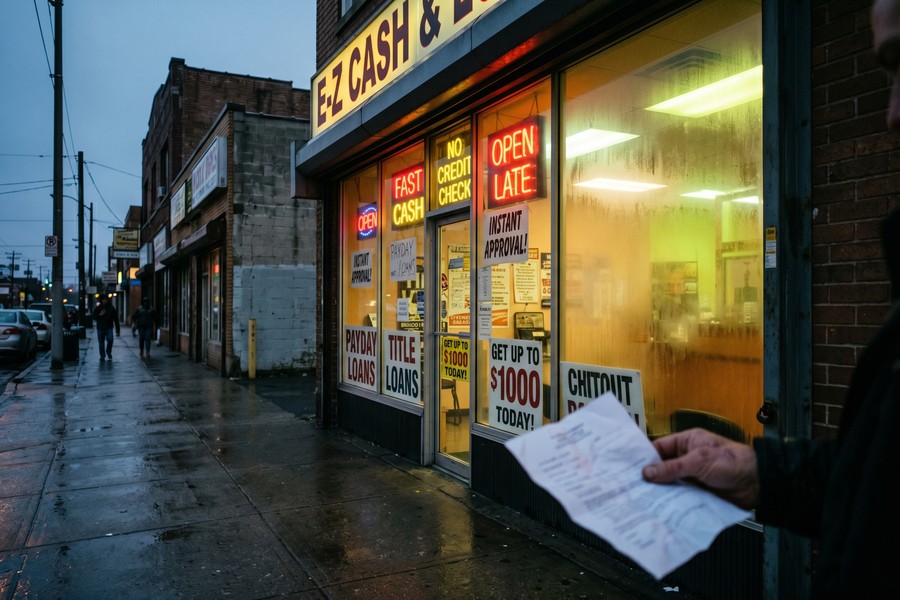
Avoid predatory lenders who fill the void during credit crunches. When mainstream fintechs tighten, high-cost installment lenders and tribal lenders often increase marketing. APRs from these sources can exceed 100%, turning a short-term cash need into a long-term debt spiral.
One honest limitation worth naming: the alternative-data approach only helps borrowers whose financial behavior looks good in the underlying transaction data. If your bank account shows frequent overdrafts, irregular income, or late recurring payments, providing that data may actually hurt your application rather than help it. Transparency cuts both ways. Ask yourself whether your last 90 days of account activity tells a story a lender would find reassuring before consenting to share it.
If you need to borrow during a credit crunch, consider requesting a smaller loan amount than you initially planned. Platforms facing risk-off environments are significantly more likely to approve loans under $10,000 than larger requests, even for the same borrower profile. A smaller approval now can be followed by a refinance or top-up once conditions ease.
Step 5: What Did Borrowers Learn From the 2025 Credit Crunch That Still Applies Today?
The most durable lesson from last year’s contraction is that credit access is cyclical, and the borrowers who treated their financial profile as a living asset to be actively managed fared far better than those who assumed easy credit would remain permanently available.
The Five Lasting Lessons
Lesson 1: Build emergency savings before you need to borrow. Borrowers with three to six months of expenses saved were less likely to need emergency credit at the worst possible time, when rates and denial rates were highest. Our guide on how to build an emergency fund when you live paycheck to paycheck offers a practical framework for getting there.
Lesson 2: Your credit profile is a product, manage it actively. Borrowers who had been monitoring their credit utilization, disputing errors, and keeping older accounts open entered the crunch with stronger FICO scores and better outcomes. Credit building is not a one-time task.
Lesson 3: Diversify your lender relationships. Having a relationship with both a traditional bank or credit union and one or two fintech platforms gave borrowers real optionality. Those who had deposited savings with SoFi or LendingClub, for example, were often prioritized as existing customers during approval decisions.
Lesson 4: Understand what data your lender uses. The platforms that continued to lend through 2025 were largely those using alternative data underwriting, income trends, spending patterns, rent payment history. Borrowers who understood this proactively prepared documentation that those platforms would value. Our article on how open banking is reshaping digital lender credit assessment explains how this data ecosystem works.
Lesson 5: Debt management is risk management. Borrowers who entered 2025 with high revolving balances, particularly those with BNPL obligations stacked on top of credit card debt, found themselves squeezed from multiple directions simultaneously. Systematic debt reduction is not just a savings strategy; it is credit access insurance.
What to Watch Out For
One mistake borrowers made was waiting for conditions to improve before taking action. Credit profile improvements take months to register on FICO scores. Starting today means being in a materially stronger position within six months, well before the next credit cycle turns.
Request your free credit reports from AnnualCreditReport.com, the only federally authorized free report source, and check all three bureaus (Equifax, Experian, TransUnion) for errors. Dispute errors directly with each bureau using certified mail to create a paper trail. Even one removed negative item can shift your score by 20–40 points.

Related reading: How to Choose the Best Credit Card for Travel Rewards in 2025.
Frequently Asked Questions
Did fintech platforms actually stop lending during the 2025 credit crunch, or did they just raise rates?
Most platforms did both, they raised rates and reduced approval volumes, but very few stopped lending entirely. Bank-chartered platforms like SoFi and LendingClub continued originating loans, while some pure marketplace lenders paused new products or significantly restricted eligibility. The borrower experience varied dramatically by platform type and credit profile.
What credit score do I need to get a fintech personal loan in a tight credit market?
During the 2025 credit crunch, most mainstream fintech platforms raised their effective minimums to 620–660, with premium platforms like SoFi targeting 680+. Near-prime lenders like Avant and OneMain Financial continued to consider scores as low as 580–600, though at significantly higher APRs. A credit score of 660 or above gives you access to the broadest range of competitive options.
Should I use a fintech lender or a credit union when banks are tightening?
In a tightening environment, credit unions often offer more stable terms and lower rates because they are not dependent on institutional capital markets. Federally chartered credit unions cap their APR at 18% on most personal loans, a ceiling that meant real savings when fintech APRs averaged 21.4% in Q1 2025. Apply to both and compare pre-qualification offers before committing.
How did BNPL debt affect my ability to get a fintech loan in 2025?
BNPL obligations increasingly appeared in lender underwriting assessments in 2025, particularly after the CFPB issued guidance requiring BNPL providers to report to credit bureaus. Borrowers carrying multiple active BNPL installments saw their effective DTI rise, sometimes pushing them past lender thresholds even when their FICO score appeared healthy. Paying off BNPL balances before applying is now a critical pre-application step. For more context, see our comparison of BNPL vs. digital personal loans for large purchases.
Can I still get approved for a fintech loan with a 600 credit score after the 2025 crunch?
Yes, but your options are narrower and your rate will be higher. Near-prime lenders like Avant, OneMain Financial, and OppFi remained active through the crunch for borrowers with scores in the 580–620 range. Expect APRs in the 24%–36% range at this score level. Pairing a below-average credit score with a strong, stable income and low DTI significantly improves your odds.
What alternative data can I use to strengthen my fintech loan application?
Platforms using alternative data underwriting, including Upstart, Petal, and Tomo, accept bank transaction history, rent payment records, and payroll data via integrations with services like Plaid, Pinwheel, and Argyle. Providing 90–180 days of consistent direct deposits and on-time recurring payments can offset a borderline credit score. Ask each platform directly whether they accept supplemental income documentation before applying. Our deep dive on how fintech lenders use bank transaction data explains exactly how this works.
How long does it take to get approved for a fintech personal loan in 2025?
Most fintech platforms still offer same-day or next-business-day approvals for straightforward applications, typically 1–3 business days from application to funding. However, during the 2025 crunch, platforms requiring manual income verification added 2–5 business days to the process. Having bank statements, pay stubs, or payroll verification ready before you apply speeds up the process significantly.
What is the difference between the fintech credit crunch 2025 and a traditional bank credit tightening?
The 2025 contraction moved significantly faster than traditional bank tightening cycles. Traditional banks tighten loan standards over quarters as they adjust internal credit policies through governance processes. Fintech platforms adjust underwriting algorithms in days or weeks, meaning borrowers can find conditions changed between pre-qualification and final application. This speed advantage cuts both ways, fintech can also ease standards rapidly when conditions improve.
Is alternative data underwriting a good option for every borrower?
No, and this is worth being direct about. Alternative data underwriting works best for borrowers whose recent financial behavior is genuinely strong but whose credit file is thin or older. If your transaction history shows overdrafts, irregular income, or missed recurring bills, consenting to share that data can actively hurt your application. Before opting into bank data sharing, review your last 90 days of account activity and be honest about what a lender would see. Borrowers with messy cash flow histories are better served by addressing those patterns first, then applying.
Should I wait for credit conditions to ease before applying for a personal loan, or apply now?
Apply now if you have an urgent financial need and qualify under current standards, waiting for rates to fall is not a reliable strategy when the need is pressing. If your need is not urgent, spending three to six months improving your DTI and credit score will likely yield better offers than waiting for macro conditions to shift. The strategy for locking in a low rate before the Fed moves can help you time your application more strategically.
What mistakes did borrowers make during the fintech credit crunch 2025 that I should avoid?
Three patterns stood out. First, applying to multiple lenders simultaneously with hard pulls damaged scores at exactly the moment each point mattered most. Second, borrowers ignored BNPL balances that quietly inflated their effective DTI. Third, many turned to high-cost lenders out of desperation when better alternatives, credit unions, near-prime direct lenders, smaller platforms, still existed. A measured, pre-qualified approach with prepared documentation would have served most borrowers far better. Our resource on 5 mistakes people make when paying off credit card debt covers closely related pitfalls worth reviewing before any borrowing decision.
Sources
- Consumer Financial Protection Bureau, Consumer Credit Trends
- Federal Reserve, G.19 Consumer Credit Statistical Release
- Federal Reserve Bank of New York, Household Debt and Credit Report
- Consumer Financial Protection Bureau, BNPL Supervisory Findings Newsroom
- Federal Reserve, Federal Open Market Committee Policy Decisions