
Updated July 2026
Market Pulse
- 1. The 30-year fixed mortgage rate averaged 6.49% as of July 9, 2026, according to FRED (MORTGAGE30US), up from 6.43% the prior week.
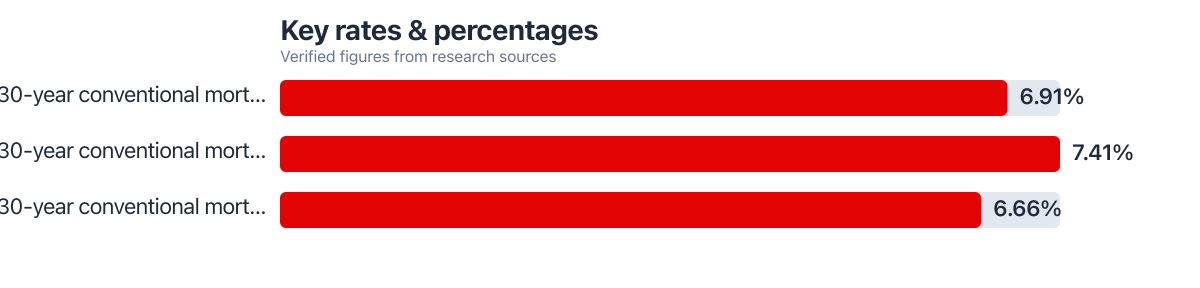
- 2. The average 30-year conventional mortgage rate for a FICO score of 620 was 7.41%, per Experian.
- 3. A FICO score of 700 corresponds to an average rate of 6.91% on a 30-year conventional loan, according to Experian (2026).
- 4. The average rate for borrowers with a FICO score of 760 or higher is 6.66%, as reported by Experian.
- 5. Unemployment fell to 4.20% in June 2026 (BLS, LNS14000000), down from 4.30% in May, marking a 2.3% month-over-month decline.
- 6. Market sentiment reflects concern: foxbusiness.com reported a +0.24 sentiment score for mortgage rate increases, citing rates at their highest in nearly a year.
Credit scores are doing more work than ever in determining what homebuyers actually pay for a mortgage in 2026. Move your FICO score up by just 40 points and you could save more than $60,000 in interest across a 30-year loan. The average 30-year fixed rate currently sits at 6.49%, but that headline number hides a wide split by credit tier. Borrowers at 620 are paying 7.41% on average, while those at 760 or above get 6.66%. That’s not a rounding error, it’s a structural line dividing who gets cheap capital and who doesn’t. Fannie Mae and Freddie Mac’s move to accept FICO Score 10T and VantageScore 4.0 adds a new wrinkle to underwriting, but the underlying math hasn’t changed: better scores still mean better rates.
Rates climbing to 6.49% this week, the highest point in nearly a year, makes credit positioning matter even more right now. Investors are clearly nervous: DHI dropped 3.08%, IYR slipped 0.51%. Geopolitical tension is pushing yields upward, and that’s putting refinancing decisions under a tighter microscope tied to credit quality. Lenders are pulling in their risk tolerance, so the credit score impact cuts deeper now than it did during the low-rate years.
Data as of
Official figures from FRED (MORTGAGE30US, MORTGAGE15US, FEDFUNDS, UNRATE, TOTALSL, REVOLSL), BLS (LNS14000000), and Experian (average mortgage rates by FICO score) were accessed on 2026-07-15. State-level complaint data comes from Texas DOI filings (2024-2025). Market news and sentiment are drawn from Finnhub and Marketaux; these are secondary context and should not be treated as official statistics. Official figures from FRED, BLS, and DOI; market color from news feeds.
What the Data Says
The gap between credit tiers isn’t an abstract concept anymore., the spread between a 620 and a 760 FICO score comes out to 75 basis points on the average 30-year fixed rate, per Experian. That’s a real cost difference built into the system. Against the market-wide 6.49% rate, a 620-score borrower paying 7.41% ends up handing over tens of thousands of dollars more in interest across the life of the loan.
| Indicator | Latest | Prior / YoY |
|---|---|---|
| 30-Year Fixed Rate (MORTGAGE30US) | 6.49% | 6.43% (prior week) |
| 30-Year Rate: FICO 620 | 7.41% | 7.41% (same) |
| 30-Year Rate: FICO 700 | 6.91% | 6.91% (same) |
| 30-Year Rate: FICO 760+ | 6.66% | 6.66% (same) |
| Unemployment Rate (BLS) | 4.20% | 4.30% (MoM -2.3%) |
A borrower with a 620 FICO score pays $1,941 according to Experian monthly on a $350,000 loan, $95 more than the $1,846 average for a 700 score.
Key Takeaway: A FICO score of 620 results in a mortgage rate 75 basis points higher than a score of 760, costing a typical borrower over $60,000 in total interest over 30 years, based on Experian’s 2026 data.
What Markets Are Reacting To
Mortgage rates pushed higher again, touching their highest point in nearly a year, as tensions with Iran sent investors scrambling toward fixed-income safety. The average 30-year fixed rate reached 6.49% in late July 2026, per FRED. Housing stocks felt it right away: DHI fell 3.08%, IYR dropped 0.51%. Sentiment tracked by foxbusiness.com came in at +0.24, capturing the unease around climbing borrowing costs. AD Mortgage rolled out a new affordability initiative around the same time, another sign that the industry is bracing for what’s coming.
Key Takeaway: With rates at their highest in nearly a year and housing equities under pressure, the credit score impact is amplified. Borrowers with scores below 700 now face a steeper cost of capital, making credit improvement a critical step before rate locking, according to Fox Business, July 16, 2026.
What This Means for You
Your credit score isn’t a side detail anymore, it’s one of the biggest levers in what you’ll pay for a house. Below 700? You’re paying directly for that risk. On a $350,000 loan, a 620 score puts your monthly payment at $1,941, while a 700 score brings it down to $1,846, a $95 gap every month. Stretch that over 30 years and you’re looking at more than $34,000 in extra interest. Even moving from 700 to 740 can knock another $150 or so off your monthly payment in some cases.
For anyone sitting between 620 and 699, today’s rate environment makes the gap hurt more. A 620 score locks you into 7.41%; a 700 score drops you to 6.91%. Fifty basis points doesn’t sound like much until you run the numbers: on that same $350,000 loan, the 6.91% rate saves $3,430 in total interest compared to 7.41%. That’s not theoretical, it’s calculated straight from Experian’s 2026 data.
Refinancers need to think about this too. Someone with a 680 score might get quoted 7.0% today, while a 720 score could land closer to 6.75%. Those savings add up fast. A Green Mortgages vs Conventional Mortgages: Which Saves More Money and Carbon? comparison makes clear that even green loan incentives can’t make up for a weak credit score. And borrowers in states like Texas, where insurers such as CIGNA and Health Care Service Corporation show up with high complaint indices, should keep a close eye on their credit health too. Low scores tend to compound other risks during underwriting.
One real limitation: all of this assumes your income, down payment, and debt-to-income ratio are steady. If you’re self-employed, dealing with irregular income, or carrying heavy debt, even a 760 score might not get you the best rate on offer. Lenders apply overlays, extra risk checks that can push your rate up regardless of what your credit report says. A California borrower with a 740 score and a 45% DTI, for instance, might see a rate 15 to 20 basis points higher than someone with the same score but a 38% DTI. Credit score carries a lot of weight, but it isn’t the whole story.
Key Takeaway: If your credit score is below 700, consider it a financial liability. Improving your score to 700 or above can save over $34,000 in interest on a $350,000 loan, based on Experian’s 2026 data.
Should You Act Now?
If your score is under 700, don’t sit on it. With 30-year rates hovering near 6.5%, the cost of a weaker score bites harder than it has in past cycles. Going from 680 to 720 can shave 25 to 30 basis points off your rate. On a $378,000 loan, that could mean $168 less every month and roughly $60,000 saved in interest over 30 years, per a May 2026 Mortgage Reports analysis.
The only real reason to hold off is if your score is already 740 or better, or you know a rate lock is coming within 30 days. Anyone under 650 should focus on repair work first: dispute errors, pay down balances, skip new hard inquiries. Even in a quiet period, a single inquiry can knock 5 to 10 points off your score. A Five Things Borrowers Get Wrong About Debt guide is a good reminder that utilization and payment history usually matter more than people assume.
Another limitation: credit improvements don’t help everyone equally. Someone with a thin file, few accounts, short history, might not see much of a rate change even after real effort. In New York, some lenders now run alternative data models for applicants with under two years of credit history, meaning a 680 could get treated like a 700 at one lender and not at another. Credit quality matters, but so does whichever risk model your lender happens to use.
Key Takeaway: If your credit score is below 700, improve it before locking in a rate. A jump to 700 or above can save over $34,000 on a $350,000 loan, based on Experian’s 2026 data.
Fannie Mae requires a minimum representative credit score of 620 for certain loans insured or guaranteed by federal agencies. This threshold remains stable, but the rate impact of scores above 700 is more pronounced than ever. The use of FICO Score 10T and VantageScore 4.0 is now permitted for loan deliveries to Fannie Mae, reflecting a shift toward more dynamic credit evaluation models.
Related reading: build sustainable portfolio outperforms real.
Frequently Asked Questions
What does a 7.41% mortgage rate mean for a 620 FICO score?
A 7.41% rate on a $350,000 loan means a monthly payment of $1,941. That’s $95 more than the $1,846 paid at a 700 score. Over 30 years, the gap adds up to more than $34,000 in total interest, based on Experian’s 2026 data.
Does a 760 FICO score guarantee the best rate?
Not guaranteed, but your odds improve a lot. At 760 and above, you’re in range for the lowest conventional rates, typically around 6.66%. Lenders can still apply overlays based on income, down payment, or debt-to-income ratio, so it pays to compare quotes rather than assume.
How does a recent hard inquiry affect my mortgage rate?
A single hard inquiry can pull your score down 5 to 10 points. If you’re sitting at 710, a new inquiry could push you to 700 and into a higher rate tier. Most lenders give you a 45-day window for rate shopping without penalty, but it’s smart to avoid new inquiries once you’re in final underwriting.
Can I still qualify with a 620 FICO score?
Yes, but with tradeoffs. A 620 clears the minimum bar for conventional loans, though you’ll pay more for it. FHA loans go as low as 500 with a 10% down payment, but even FHA borrowers under 620 end up paying higher insurance premiums.
How do FICO Score 10T and VantageScore 4.0 affect my rate?
These newer models weigh recent payment history and utilization more heavily. Borrowers with thin files or older delinquencies may see their scores improve under this system. Fannie Mae and Freddie Mac now accept both, though rollout is still ongoing and some lenders continue pricing off older models.
Should I wait for rates to drop before applying?
Only if you’re fairly confident your credit will improve meaningfully in the next 30 to 60 days. Right now, rates are trending upward because of geopolitical risk. Sitting on your hands without improving your score just means you risk paying more later. Your credit standing is a lot more predictable than trying to time the rate market.
How do credit mix and utilization affect mortgage approval?
Lenders look at your credit mix (revolving versus installment debt) and your utilization (how much credit you’re using versus what’s available). High revolving balances can drag your score down even with a spotless payment record. Keeping utilization near 30% is far safer than running it up to 70%. Sinking funds explained: budgeting strategy covers one way to lean less on credit and keep utilization in check.
Sources
- Fannie Mae: General Requirements for Credit Scores
- Freddie Mac: Selling Policy Bulletin 2026-D
- Federal Housing Finance Agency: New Credit Score Models
- Experian: Average Mortgage Rates by Credit Score (2026)
- Fox Business: Mortgage Rates Jump to Highest Level in Almost a Year
- Manila Times: AD Mortgage Launches Affordability Initiative