

Verdict at a Glance
Waiting for lower 2026 mortgage rates beats buying now for first-time buyers in high-tax states only if forecasts hold near 5.9% by year-end; buying now wins if you need housing today and can qualify comfortably, because property taxes above 1.88% in states like New Jersey and Illinois erase most of the savings from a small rate drop anyway.
Updated January 2026
If your target home sits in a county where the effective property tax rate tops 1.88%, as it does in parts of New Jersey and Illinois, waiting for a rate dip below 6% often saves less than people expect. The tax bill can add more to your monthly payment than a quarter-point rate move saves you.
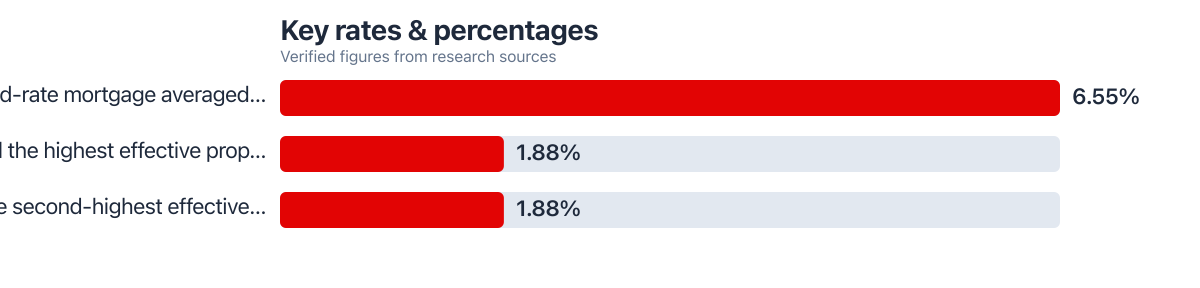
Two things determine what a first-time buyer in a high-tax state actually pays each month: the mortgage rate and the property tax bill sitting next to it. That second number gets ignored in most national rate forecasts, which is a problem when you’re comparing 2026 mortgage rates against a housing budget in New Jersey, Illinois, California, or New York. The 30-year fixed rate averaged 6.55% as of mid-July 2026, according to Freddie Mac’s weekly survey, and separate Federal Reserve data pegged it at 6.49% just a week earlier, per the FRED MORTGAGE30US series.
The gap between “national rate forecast” and “what you’ll actually pay in Newark or Naperville” is the real story here. Rates matter, but property taxes in the highest-cost states often add the equivalent of a full percentage point to your effective borrowing cost. Below, we break down where the two numbers collide and at what threshold the math flips in favor of waiting versus buying now.
Key Takeaways
- The 30-year fixed rate hit 6.55% in mid-July 2026, a near one-year high, according to Freddie Mac’s weekly survey.
- Fannie Mae projects rates falling to 5.9% by the end of 2026, but that forecast hasn’t shown up in the actual data yet.
- New Jersey and Illinois both carry an effective property tax rate of 1.88%, more than triple the national median, per the Tax Foundation.
- On a $350,000 home, that tax gap adds roughly $388 a month, more than double the projected savings from waiting for rates to fall to 5.9%.
- Unemployment eased to 4.20% in June 2026 from 4.30% in May, even as mortgage rates ticked up, per FRED’s UNRATE series.
- FHA loans, with a 3.5% minimum down payment, remain one of the more practical ways for first-time buyers to offset heavy property tax bills in high-tax states.
| Attribute | National Average (Low-Tax States) | High-Tax States (NJ, IL, CA, NY) |
|---|---|---|
| Current 30-yr fixed rate | 6.55% | 6.55% (same nationally) |
| Effective property tax rate | ~0.55% (national median) | 1.88% in NJ and IL |
| Annual tax on $350,000 home | $1,925 | $6,580 |
| SALT deduction cap impact | Minimal (tax bill under cap) | Significant (bill often exceeds $10,000 cap with mortgage interest) |
| 2026 rate forecast (Fannie Mae) | 5.9% by year-end | 5.9% by year-end (same forecast) |
| Typical first-time buyer down payment | 6-10% | 3-5% (higher home prices strain savings) |
| FHA loan popularity among first-timers | Moderate | High (lower down payment offsets tax burden) |
| Total monthly PITI vs. national average | Baseline | 20-30% higher |
Where Do Mortgage Rates Actually Stand Right Now?
The 30-year fixed rate sat at 6.55% as of July 16, 2026, according to Freddie Mac’s Primary Mortgage Market Survey. That’s the highest reading in close to a year, and it came alongside renewed geopolitical tension tied to Iran, which Yahoo Finance reported pushed Treasury yields higher that week. Separate coverage from Fox Business confirmed the jump, framing it as a near one-year high rather than the gradual decline many buyers expected entering the year.
Federal Reserve data tells a slightly different but related story. The FRED series on the 30-year fixed rate showed 6.49% for the week of July 9, 2026, up from 6.43% the prior week, a 0.9% increase in a single week. The 15-year fixed rate moved similarly, from 5.79% to 5.82%. Meanwhile, the Federal Funds Effective Rate held flat at 3.63% in June 2026, unchanged from May, which tells us the recent mortgage rate uptick isn’t coming from Fed policy directly. It’s coming from bond market reaction to global events and inflation expectations.
Unemployment actually improved slightly, dropping to 4.20% in June 2026 from 4.30% in May, a 2.3% decline according to both FRED’s UNRATE series and the Bureau of Labor Statistics household survey. A cooling labor market combined with sticky rates is an odd mix, and it’s part of why forecasters remain split on where 2026 mortgage rates land by December.
Forecasts Say 5.9%. Reality Says Not Yet.
Fannie Mae’s official forecast calls for the 30-year fixed rate to average 5.9% by the end of 2026, down from 6.4% at the close of 2025. Morgan Stanley’s outlook is even more optimistic, projecting rates near 5.75% alongside modest home price growth. A consensus of 21 separate forecasts lands around 6.18% for the year as a whole.
None of that has happened yet. As of mid-July 2026, actual rates sit at 6.49% to 6.55% depending on the survey, well above every one of those year-end targets. That gap matters for a first-time buyer trying to decide whether to lock in now at close to 6.5% or wait for a dip that forecasters keep promising but that hasn’t materialized through the first half of the year.
On this factor: Forecasters project 2026 mortgage rates falling to roughly 5.9% by year-end, but actual mid-year rates sit near 6.55%, a gap of over half a point according to Freddie Mac and Fannie Mae’s own projections.
Why First-Time Buyers Feel Every Rate Move Harder
A repeat buyer with 20% equity from a prior sale can absorb a rate bump. A first-time buyer putting down 3-5% cannot. Every quarter-point increase in the 2026 mortgage rates environment tightens the debt-to-income ratio a lender uses to qualify someone with no existing home equity to lean on.
This is the core reason first-timers get squeezed disproportionately when rates rise even modestly. Their income has to stretch across a full monthly payment with almost no cushion, unlike a repeat buyer who locked in a lower rate years ago and is sitting on what economists call the “lock-in effect,” a reluctance to sell and re-enter the market at today’s higher rates. That dynamic has kept inventory tight and prices firm, even as affordability worsens for the exact buyers trying to get in the door for the first time. Anyone weighing this decision against other debt obligations should look at the math for 2026 on paying off debt or saving for a bigger down payment, since the tradeoff shifts depending on where rates land.
First-time buyers relying on variable income, like overtime or bonus pay, face an added wrinkle: lenders often discount that income when calculating qualification ratios, which matters more when every basis point of rate pushes the payment higher. Understanding how lenders treat overtime and bonus income when setting your mortgage rate is worth doing before you even start shopping lenders.
On this factor: First-time buyers absorb rate increases far harder than repeat buyers, with tighter DTI margins and no home equity cushion; the lock-in effect keeps 2026 mortgage rates volatility hitting new entrants hardest.
Why Property Taxes Matter More Than the Rate Here
New Jersey carries the highest effective property tax rate on owner-occupied housing in the country at 1.88%, according to the Tax Foundation’s state-by-state analysis. Illinois ties for second place at the same 1.88% rate. Compare that to a national median effective rate closer to 0.55%, and you can see why a national mortgage rate forecast tells only half the story for buyers in these markets.
On a $350,000 first home, a 1.88% effective rate means $6,580 in annual property taxes. The same home in a low-tax state might carry an annual tax bill under $2,000. That’s a difference of roughly $382 per month, added directly to principal, interest, and insurance, before you’ve spent a dollar on the mortgage rate itself.
The SALT deduction cap makes this worse for new buyers specifically. Since federal tax law capped state and local tax deductions at $10,000, homeowners in high-tax states with large mortgage interest bills plus high property taxes routinely exceed that cap and lose the ability to deduct the excess. A first-time buyer in New Jersey or Illinois financing a starter home with a 6.5% rate and a $6,500+ tax bill will often blow past the $10,000 SALT ceiling almost entirely through property tax alone, leaving little room to deduct mortgage interest on top of it. Established homeowners with older, smaller mortgages (and correspondingly lower interest expense) feel this cap much less acutely than someone taking out a fresh loan at today’s rates.
New Jersey and Illinois both post an effective property tax rate of 1.88% on owner-occupied housing, the two highest in the nation, according to the Tax Foundation’s 2024 data. That’s more than triple the national median rate.
What a Rate Drop Is Really Worth Once Taxes Are Added
Here’s a worked example using verified figures. Take a $350,000 starter home financed with a 30-year fixed loan at the current 6.55% rate from Freddie Mac’s survey, with 5% down, leaving a loan balance of $332,500.
Principal and interest alone on that loan runs about $2,120 per month. Add property taxes. In a low-tax state at roughly 0.55%, the buyer pays about $160 monthly in taxes, for a total PITI (before insurance) near $2,280. In New Jersey or Illinois at 1.88%, the same home generates $548 monthly in property taxes, pushing total PITI to roughly $2,668. That’s a difference of $388 per month, or $4,656 per year, purely from location, with the identical loan amount and identical rate.
Now layer in the rate forecast. If 2026 mortgage rates do fall to Fannie Mae’s projected 5.9% by year-end, that same $332,500 loan drops to roughly $1,978 in principal and interest, a savings of about $142 per month compared to today’s 6.55% rate. That’s real money, but it’s less than half the monthly gap created by moving from a low-tax state to a high-tax one. A first-time buyer fixated on waiting for a rate dip while ignoring the tax environment is optimizing for the smaller number.
On this factor: A rate drop from 6.55% to a forecasted 5.9% saves roughly $142 monthly on a typical starter loan, while moving from a low-tax to a high-tax state adds about $388 monthly in property taxes alone, per Tax Foundation data.
What Actually Helps Buyers in These Markets
FHA loans remain the most practical entry point for first-time buyers in high-tax states, since the 3.5% minimum down payment frees up cash that would otherwise go toward a larger down payment, leaving more room in the monthly budget to absorb a heavier tax bill. VA loans, where eligible, avoid down payment requirements entirely and deserve serious consideration given how much high property taxes already strain monthly affordability calculations. Buyers should also look at state-specific first-time buyer assistance programs; New Jersey, New York, and Illinois all run down payment assistance and closing cost grant programs that can offset some of the tax burden, though eligibility usually phases out above certain income thresholds.
Rate lock timing matters more in these markets, too, because tax escrow accounts get recalculated based on the county’s most recent assessment. Buyers closing near a reassessment date can see their monthly payment shift even if the mortgage rate itself never moves. It’s worth reviewing why repeat buyers lock rates too late on new construction homes, since the same timing mistakes apply just as easily to first-timers buying in high-tax counties.
Public sector employees, including teachers and other government workers, sometimes qualify for below-market rate programs that aren’t widely advertised by mainstream lenders, and these can meaningfully offset the tax disadvantage in states like Illinois and New Jersey where public employment is common. It’s also worth comparing fixed versus adjustable structures directly, since a starter home comparison of fixed versus adjustable costs over five years can reveal whether locking in today’s 6.55% fixed rate actually beats a shorter-term ARM given how compressed the rate forecast gap really is.
On this factor: FHA and VA loans, combined with state-specific down payment assistance, do more to offset high-tax-state costs than waiting on a rate dip; a 3.5% FHA down payment frees cash that a rate wait does not replace.
When Is Waiting for a Lower Rate the Right Call?
- Your closing timeline has real flexibility, meaning six months or more before you need to move, giving forecasted declines toward 5.9% time to actually materialize.
- You’re currently below the qualification threshold at 6.55% but would clear it comfortably at a rate closer to 6%, based on your lender’s DTI calculation.
- You’re renting in a stable, non-escalating lease and have no urgent housing need forcing a purchase in the next two quarters.
- You expect a income increase or bonus payout in the next 6-12 months that would improve your qualifying position regardless of rate movement.
When Does Buying Now Make More Sense?
- You need housing within the next 60-90 days due to a lease expiration, job relocation, or growing household, and can’t gamble on a forecast that hasn’t materialized through mid-2026.
- You qualify comfortably at today’s 6.55% rate with a debt-to-income ratio under 43%, meaning a future rate drop is a bonus, not a requirement.
- You’ve found a home in a high-tax state where the property tax bill, not the rate, is your primary affordability constraint, since waiting for a lower rate does little to offset a 1.88% tax rate.
- Local inventory is thin and competitive, and delaying risks losing the specific property to another buyer while rates stay roughly flat.
- You qualify for a state-specific first-time buyer assistance program with a limited enrollment window that could close before rates move meaningfully.
| Criteria | Buy Now at 6.55% | Wait for Forecasted 5.9% |
|---|---|---|
| Cost certainty | High: locks in known payment today | Low: forecasts have missed targets before |
| Monthly payment (rate only) | Higher by ~$142/month | Lower, if forecast holds |
| Property tax exposure | Unaffected by rate timing | Unaffected by rate timing |
| Inventory risk | Lower: secures home now | Higher: competing buyers may act first |
| Flexibility for timeline | Best for buyers needing housing within 90 days | Best for buyers with 6+ months runway |
| Overall winner | Depends on timeline: buy now if you qualify and need housing soon; wait only with genuine flexibility and a qualification gap that a lower rate would close | |

Frequently Asked Questions
What are 2026 mortgage rates expected to be by the end of the year?
Fannie Mae projects an average of 5.9% for the 30-year fixed rate by the end of 2026, down from 6.4% at the close of 2025. As of mid-July 2026, actual rates remained higher, at 6.55% according to Freddie Mac, so the projected decline hasn’t fully materialized yet.
Why do high-tax states hurt first-time buyers more than the mortgage rate does?
Property taxes in states like New Jersey and Illinois run as high as 1.88% effective rate, more than triple the national median, according to the Tax Foundation. On a $350,000 home, that adds roughly $388 more per month than a low-tax state, which typically exceeds the savings from waiting for a modest rate drop.
Does the SALT deduction cap affect first-time buyers more than repeat buyers?
Yes, generally. First-time buyers financing new loans at today’s rates carry higher mortgage interest expense combined with high property taxes, pushing them past the $10,000 SALT cap more easily than established owners with smaller, older mortgages and lower interest costs.
Should first-time buyers wait for mortgage rates to drop in 2026?
Only if their timeline allows real flexibility, generally six months or more, and if a lower rate would meaningfully improve their qualification. Buyers who already qualify at 6.55% and need housing soon typically shouldn’t gamble on forecasts that have missed targets through mid-2026.
Are FHA loans still a good option for first-time buyers in high-tax states in 2026?
Yes. FHA loans require as little as 3.5% down, which frees up cash to help offset heavier monthly property tax bills common in states like New Jersey, New York, and Illinois. That tradeoff often matters more than chasing a lower conventional rate.
How much does a 1.88% property tax rate add to a monthly mortgage payment?
On a $350,000 home, a 1.88% effective property tax rate adds about $548 per month, compared to roughly $160 monthly at the national median rate near 0.55%. That’s a difference of about $388 per month based on Tax Foundation figures.
Buyers thinking about how variable income affects approval odds under any of these rate scenarios should also review five things borrowers get wrong about debt-to-income ratio, since the same DTI mechanics that govern personal loans apply directly to mortgage qualification in tight, high-tax markets.
Sources
- Freddie Mac, Primary Mortgage Market Survey
- FRED, MORTGAGE30US: 30-Year Fixed Rate Mortgage Average
- Tax Foundation, Property Taxes by State and County, 2024
- Fox Business, Mortgage Rates Rise Again in July 2026
- Bureau of Labor Statistics, CPS Household Survey, June 2026
- FRED, UNRATE: Civilian Unemployment Rate
- Capital Lending News, Paying Off Debt vs. Saving for a Down Payment in 2026
- Capital Lending News, How Lenders Treat Overtime and Bonus Income for Mortgage Qualification
- Capital Lending News, Why Repeat Buyers Lock Rates Too Late on New Construction Homes
- Capital Lending News, Fixed vs. Adjustable Rate Mortgages for Starter Homes: Five-Year Costs