

Verdict at a Glance
Home equity loans and HELOCs win for homeowners with equity to spare, since rates run near 7.43%-8.08% versus personal loan floors well above 10%. Choose a 0% intro APR credit card instead if you can repay the full balance within 18 months and need less than $10,000.
Updated July 2026
If your repayment timeline runs longer than the promotional window on a 0% card, typically 12 to 21 months, the deferred interest or the standard purchase APR that kicks in afterward can erase every dollar you saved. Home equity products avoid that cliff but add foreclosure risk if payments lapse, according to the Consumer Financial Protection Bureau.
Personal loans used to be the default answer for debt consolidation or a big unplanned expense. That default is getting harder to justify. The average personal loan rate hit 17.36% in the second quarter of 2026, according to WalletHub’s quarterly rate report, and even borrowers with strong credit are seeing three-year rates near 13.91% as of mid-July, per Credible’s rate tracker. That has pushed more borrowers to look at loan alternatives that don’t carry the same pricing.
This piece compares the two alternatives that matter most for most borrowers weighing loan alternatives right now: home equity products against 0% intro APR credit cards. One wins on rate. The other wins on speed and simplicity. The number that flips the decision is your repayment timeline, and we’ll walk through exactly where that line sits.
| Attribute | Home Equity Loan/HELOC | 0% Intro APR Credit Card |
|---|---|---|
| Typical rate | 7.43% (HELOC) to 8.08% (loan) | 0% for promo period, then 18-29.99% |
| Loan amount | $10,000 to $500,000+ (equity-dependent) | $1,000 to $25,000 (credit-line dependent) |
| Collateral | Your home | None (unsecured) |
| Credit score needed | 620-680 minimum, best rates at 740+ | 670+ for most 0% offers |
| Time to fund | 2-6 weeks (appraisal, closing) | Same day to 7-10 days |
| Fees | Closing costs 2-5% of loan, appraisal fees | Balance transfer fee 3-5%, annual fee sometimes |
| Repayment window | 5-30 years, fixed schedule | 12-21 months at 0%, then revolving |
| Risk if you default | Foreclosure | Credit damage, collections, no home risk |
How Do 2026 Rates on Loan Alternatives Actually Compare
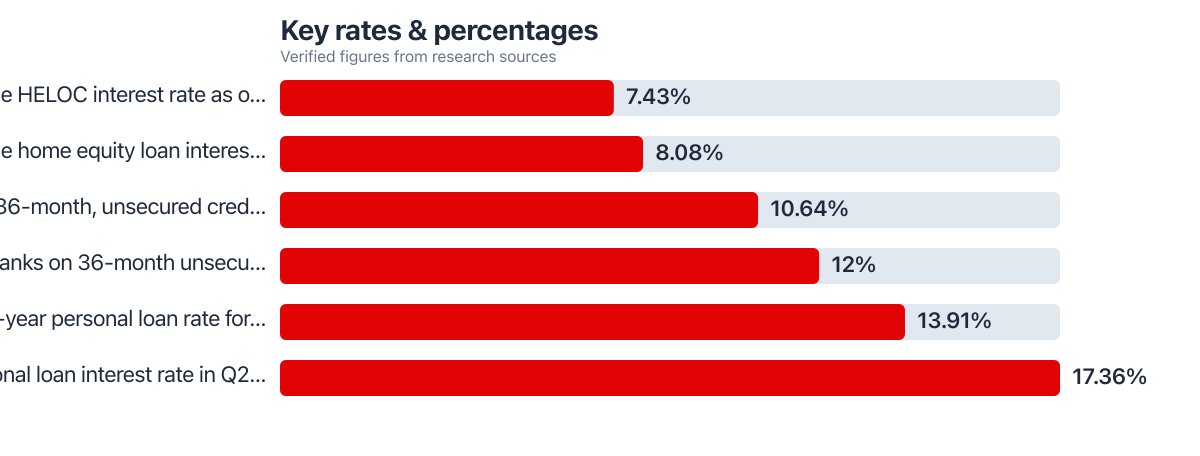
Home equity products are cheaper than personal loans right now, by a wide margin. The national average HELOC rate sits at 7.43% and home equity loans average 8.08% as of July 15, 2026, according to Bankrate’s rate survey. Compare that to credit union personal loans averaging 10.64% for a 36-month term, and bank personal loans averaging 12.00%, both per the National Credit Union Administration’s Q4 2025 data.
The gap widens for borrowers without top-tier credit. WalletHub’s 17.36% average for Q2 2026 blends borrowers across the spectrum, and subprime applicants often see quotes north of 30%. A 0% intro card sidesteps rate risk entirely for the promotional window, but only if the balance gets paid off before that window closes. Run the math on a $10,000 balance: at 17.36% amortized over 36 months, you’d pay roughly $3,140 in total interest. At 8.08% over the same term, that drops to roughly $1,340. That’s a difference of about $1,800, which is real money for most households.
Federal Reserve data adds context. The federal funds rate has held at 3.63% through June 2026, unchanged from May, per FRED’s monthly series. That stability means personal loan rates aren’t likely to drop much further this year, which makes the pricing gap versus home equity products more durable, not less. If you’re weighing a personal loan vs. cash-out refinance for speed reasons, know that the rate premium you’re paying for that speed has grown, not shrunk.
On this factor: Home equity products beat personal loans and most unsecured alternatives by 2-9 percentage points depending on the lender tier, per Bankrate’s July 2026 data. 0% cards can match that for short-term needs, but only within the promo window.
Collateral Risk: What You’re Actually Putting on the Line
Home equity borrowing wins on rate but loses on downside risk, and that tradeoff deserves a straight answer. A HELOC or home equity loan uses your house as collateral. Miss enough payments and the lender can foreclose, a risk that simply doesn’t exist with an unsecured personal loan or a credit card, according to the CFPB’s consumer guidance on HELOCs.
Credit cards carry no collateral risk, but the consequence of default still hurts: collections, credit score damage, and potential lawsuits over unpaid balances. Neither path is risk-free. The difference is what’s at stake. Losing a home is a categorically worse outcome than a damaged credit file, even though the credit file problem is more likely to actually happen given how few home equity borrowers default.
There’s a tax wrinkle worth knowing. Home equity loan interest is only deductible in 2026 if the funds go toward buying, building, or substantially improving the home that secures the loan, under current IRS rules that haven’t changed since the 2017 tax reform. Using a HELOC to pay off credit card debt doesn’t qualify for that deduction. If you’re financing home improvements specifically, a green mortgages conventional mortgages: which saves more comparison is worth reading alongside this one, since energy-efficient upgrades sometimes unlock additional rate discounts.
On this factor: Unsecured options win on downside protection since there’s no home at risk; home equity products win on rate but require accepting foreclosure exposure, per the CFPB.
Qualifying for Loan Alternatives With Gig or Self-Employed Income
Gig workers and self-employed borrowers face a specific problem: most lenders want two years of W-2s or tax returns showing stable income, and irregular 1099 earnings don’t fit that mold cleanly. This is a gap most rate-comparison articles skip entirely, and it matters because self-employment has grown steadily since 2020.
Credit unions tend to be more flexible here than banks, partly because underwriters can manually review bank statements and 1099 patterns rather than relying purely on automated scoring. If you’re building a documentation file, How Self-employed borrowers document income matters as much as the credit score itself. Peer-to-peer platforms are often even more flexible, since investor-funded loans can weigh bank account cash flow over tax return smoothness.
Home equity lenders are the strictest on this front. Because the loan is secured by real property and sold on secondary markets in many cases, documentation standards mirror mortgage underwriting: two years of tax returns, often with income averaged and haircut for volatility. A self-employed borrower with strong cash flow but messy paperwork will typically have an easier time with a credit union personal loan or a P2P platform than with a HELOC.
On this factor: Credit unions and P2P platforms outperform home equity lenders for self-employed borrowers by offering manual underwriting instead of rigid two-year tax return requirements.
The unemployment rate fell to 4.20% in June 2026, down from 4.30% in May, a 2.3% month-over-month improvement according to the Federal Reserve’s FRED database. A tighter labor market generally supports approval odds across every loan alternative, since lenders weigh employment stability heavily in underwriting.
Credit Union and P2P Rates: The Middle Ground
Credit unions occupy the space between home equity products and bank personal loans on price. The average 36-month credit union personal loan rate was 10.64% in Q4 2025, compared to 12.00% for banks on the same term, per NCUA data. That 1.36-point gap is consistent enough that it’s worth checking a local credit union before signing with a national online lender, especially if you’re weighing a personal loan peer-to-peer comparison for fair credit scores in the 640-680 range.
P2P platforms add another variable: investor-set pricing. Rates can undercut both banks and credit unions for well-qualified borrowers, but fee structures vary by platform, with origination fees commonly running 1-8% of the loan amount depending on risk tier. That fee gets deducted from the loan proceeds, so a $10,000 P2P loan with a 5% origination fee only nets you $9,500, an detail that often gets buried in marketing materials and inflates the effective APR above the advertised rate.
On this factor: Credit unions beat banks by roughly 1.36 percentage points on average personal loan pricing, per NCUA Q4 2025 data, while P2P rates vary more by borrower risk tier and origination fees.
401(k) Loans: Borrowing From Yourself Instead of a Lender
A 401(k) loan lets you borrow against your own retirement balance, typically at prime plus 1-2 points, which lands somewhere around 8.5-10.5% in the current rate environment. The interest you pay goes back into your own account rather than to a bank, which is the single biggest structural difference from every other option on this list.
The catch is job-change risk. Leave your employer, whether by choice or layoff, and most plans require the outstanding balance repaid within a short window, often 60-90 days, or the remainder gets treated as a taxable distribution plus a possible 10% early withdrawal penalty if you’re under 59½. With unemployment at 4.20% per the Bureau of Labor Statistics, that risk is lower than it was a year ago, but it’s not zero, and it’s a risk unique to this option among all the loan alternatives discussed here.
On this factor: 401(k) loans win on interest going back to yourself but lose on job-change exposure; they suit stable employees more than borrowers facing layoff risk or planning a career change soon.
When Home Equity Products Are the Better Choice
- You need more than $15,000 and want the lowest realistic rate, currently averaging 7.43%-8.08% per Bankrate
- You have at least 15-20% equity in your home and a credit score above 680
- The funds are going toward home improvements, which preserves interest deductibility
- Your repayment timeline extends beyond three years, making a fixed rate more valuable than a temporary 0% promo
- You can absorb 2-6 weeks of underwriting and closing time without urgency
When 0% Intro APR Credit Cards Are the Better Choice
- You need less than $10,000 and can realistically repay it within 12-21 months
- You don’t own a home or don’t have enough equity to qualify for a HELOC
- You need funds within days, not weeks
- You want to avoid any collateral risk, even at a higher long-run rate if the promo period isn’t enough time
- Your credit score is 670 or higher, qualifying you for the best promotional offers
| Criteria | Home Equity Loan/HELOC | 0% Intro APR Card |
|---|---|---|
| Cost | 5/5 (lowest sustained rate) | 4/5 (0% short-term, risky long-term) |
| Flexibility | 3/5 (fixed use, tied to home) | 4/5 (revolving, any purchase) |
| Speed | 2/5 (2-6 weeks) | 5/5 (days) |
| Eligibility | 3/5 (needs equity, 620+ score) | 4/5 (needs 670+ score, no equity) |
| Risk if things go wrong | 2/5 (foreclosure exposure) | 3/5 (credit damage only) |
| Overall winner | Home equity for large, long-term borrowing; 0% cards for small, short-term needs | |
Market conditions add some near-term texture. Mortgage rates jumped to their highest level in nearly a year in mid-July 2026, according to Fox Business, with the 30-year average at 6.49% and the 15-year at 5.82% as of July 9, per FRED’s mortgage rate series. HELOC rates track short-term benchmarks more than long mortgage rates, so this uptick affects new mortgages more than existing home equity lines. Still, some analysts see a real chance of a Fed rate hike by September, per a recent Yahoo Finance analysis, which would push variable HELOC rates higher and make locking in a fixed home equity loan more attractive for borrowers who want payment certainty now.

Before choosing any option, it’s worth understanding how lenders calculate your debt-to-income ratio, since that number affects approval odds across every alternative discussed here, not just traditional personal loans. It’s also worth checking whether common misconceptions about debt-to-income are holding your application back before you assume you don’t qualify for the cheaper option.
Related reading: hidden mistakes trigger higher interest.
Frequently Asked Questions
Is a HELOC or a personal loan cheaper in 2026?
A HELOC is cheaper for most qualified borrowers. The national average HELOC rate is 7.43% versus personal loan averages ranging from 10.64% at credit unions to 17.36% overall, per Bankrate and WalletHub.
Can I use a 0% APR credit card instead of a personal loan for debt consolidation?
Yes, if you can repay the transferred balance within the promotional window, typically 12-21 months. Beyond that window, the standard purchase APR applies, which often exceeds personal loan rates.
Do 401(k) loans hurt my credit score?
No. 401(k) loans don’t involve a credit check or credit bureau reporting, since you’re borrowing your own money. The main risk is repayment acceleration if you change jobs.
What credit score do I need for a home equity loan?
Most lenders want at least 620-680, with the best rates reserved for scores above 740. This is comparable to what’s needed for the best personal loan rates.
Are peer-to-peer loans safer than home equity loans?
They’re safer in terms of collateral, since P2P loans are unsecured and carry no foreclosure risk. They’re not necessarily cheaper, since origination fees of 1-8% can raise the effective rate above the advertised APR.
Can self-employed borrowers qualify for lower-rate loan alternatives?
Yes, though it requires more documentation. Credit unions and P2P platforms tend to underwrite self-employed income more flexibly than home equity lenders, which typically require two years of tax returns.
Is home equity loan interest tax-deductible in 2026?
Only if the funds are used to buy, build, or substantially improve the home securing the loan, under current IRS rules unchanged since 2017. Using the funds for debt consolidation or other purposes doesn’t qualify.
Sources
- Bankrate, Current HELOC Rates
- Bankrate, Current Home Equity Loan Rates
- WSJ Buy Side, Best Credit Union Personal Loans
- WSJ Buy Side, Best Personal Loans
- WalletHub, Average Personal Loan Interest Rate
- Federal Reserve Economic Data, Federal Funds Effective Rate
- Bureau of Labor Statistics, Employment Situation Summary