

The Verdict
Skipping mortgage insurance in California is usually worth it if you can put down a genuine 20% without draining your reserves. It is not worth it if doing so means borrowing through a piggyback loan or accepting a permanently higher rate, since both often cost more than standard PMI over 30 years.
Updated December 2025
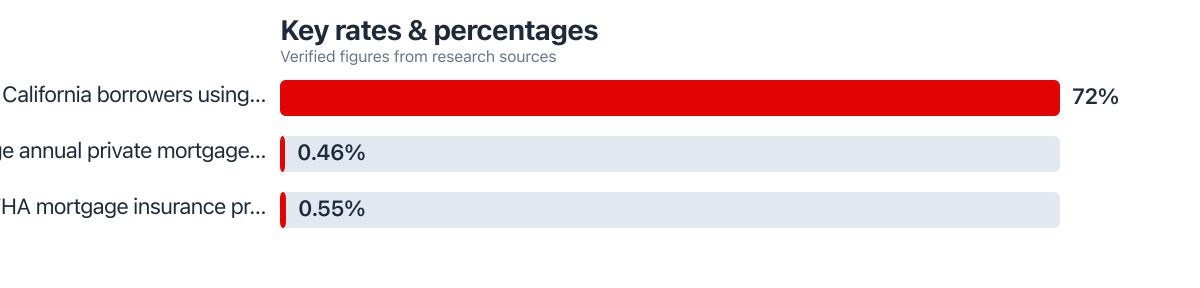
California’s mortgage insurance cost problem starts with the state’s home prices. The average loan amount for buyers who used private mortgage insurance in California in 2024 was $569,817, according to U.S. Mortgage Insurers, which means even a modest annual premium rate translates into a real monthly bill. Roughly 43,000 California households relied on PMI to buy homes with low down payments that same year, per the same USMI data, and most of them, 72%, were first-time buyers stretching to compete in an expensive market.
Rates have not made the decision easier. The average 30-year fixed mortgage sat at 6.55% as of mid-July 2026, up from 6.49% the week before, according to Federal Reserve Economic Data. When financing costs climb, the temptation to dodge PMI through a second loan or a higher permanent rate grows too, and that’s exactly when the math needs the closest look.
| Reasons to Skip PMI | Detail | Detail |
|---|---|---|
| You have a true 20% down payment | No monthly PMI charge at all | Lower total interest paid over the loan’s life |
| You qualify for a no-PMI credit union program | Some offer 5% down with no mortgage insurance | Often limited by income caps or membership area |
| You plan to stay 10+ years | More time to build equity before selling | Reduces exposure to a market downturn at sale |
| You can invest the difference | Cash not tied up in a bigger down payment | Only wins if returns beat the loan’s effective rate |
| Reasons Not to Skip PMI | ||
| You’d need a piggyback loan | Second mortgage rates run 1-3% higher than the first | Often erases PMI savings within 5-7 years |
| The lender offers “no PMI” for a higher rate | Lender-paid PMI locks in the higher rate for the full term | Cannot be canceled even after reaching 20% equity |
| Standard PMI would cost less monthly | Annual PMI premiums range from 0.46% to 1.50% of the loan | Cancels automatically once you hit 78% loan-to-value |
| You need cash reserves more than equity | Draining savings for 20% down leaves no cushion | California’s cost of living leaves little room for shocks |
Key Takeaways
- You can put 20% down without touching your emergency fund or retirement contributions
- Your credit score qualifies you for standard PMI under 0.75% annually, not the higher 1.50% tier
- You won’t need a second mortgage carrying a rate 1-3 points above your first loan’s rate
- You plan to stay in the home at least 5-7 years, long enough to outlast piggyback loan math
- Your lender’s “no PMI” offer doesn’t lock you into a permanently higher rate you can’t refinance away from
- You’ve compared the 30-year total cost of PMI against the total cost of a higher rate or second loan
- You’re not relying on home appreciation alone to reach 20% equity faster than the loan terms assume
What Does Mortgage Insurance Cover, and Why Is It Required in California?
Mortgage insurance protects the lender, not the homebuyer. Private mortgage insurance, or PMI, is typically required on conventional loans when the down payment is under 20%, according to the Consumer Financial Protection Bureau. If the borrower defaults, PMI compensates the lender for part of the loss; it does nothing to protect the homeowner’s equity or credit.
California’s Department of Financial Protection and Innovation confirms that paying less than 20% down on a conventional loan means you’ll need PMI, and that it increases your monthly expenses. On a loan near the state’s typical PMI-backed average of $569,817, even a modest 0.6% annual rate adds roughly $285 a month, before property tax or homeowners insurance.
Cancellation isn’t automatic goodwill from the lender; it’s a federal right. Under the Homeowners Protection Act, borrowers can request PMI cancellation once the loan balance hits 80% of the original home value, and servicers must terminate it automatically at 78%. FHA loans work differently: the mortgage insurance premium, or MIP, often runs for the life of the loan unless the borrower refinances into a conventional mortgage.
Why “No PMI” Loans Often Cost More Than PMI Itself
A loan advertised as “no PMI” almost always shifts the same cost into a permanently higher interest rate, and that trade rarely favors the borrower over 30 years. Lender-paid PMI, or LPMI, folds the insurance cost into the rate itself; the catch is that you can’t cancel it later, even after your equity crosses 20%, unlike standard borrower-paid PMI which drops off at 78% loan-to-value.
Run the numbers on a $600,000 California loan. Standard PMI at the lower end of the Urban Institute’s tracked range, around 0.46% annually according to their data cited by NerdWallet, costs about $230 a month and disappears once you reach 78% LTV, typically within 8-11 years on a standard amortization schedule. An LPMI loan might trade that for a rate 0.25 to 0.375 points higher, which on the same $600,000 balance adds roughly $95 to $145 a month for the entire 30-year term, since it never cancels. Over three decades, that gap can total tens of thousands of dollars more than paying PMI and watching it drop off.
Piggyback structures carry a similar trap. An 80-10-10 loan splits financing into a first mortgage, a second mortgage, and a 10% down payment, avoiding PMI on paper. But second mortgage rates typically run 1 to 3 percentage points above the first loan’s rate, and that gap often erases any PMI savings within 5 to 7 years. Borrowers comparing this option should also look at how fixed variable rate personal loans: when locking in actually costs you more plays out, since a similar locked-rate penalty applies to piggyback seconds that can’t easily refinance away.
What’s the Risk of Skipping 20% Down in California?
Yes, and the risk is sharper in California than in most states because closing costs here eat into thin equity fast. Selling a home typically costs 6% to 8% of the sale price in agent commissions, transfer taxes, and closing fees; a buyer who put down only 5% or 10% can find that a modest price dip wipes out their equity entirely once those costs are subtracted.
This isn’t uniform across the state. Coastal metros like the Bay Area have historically shown faster appreciation but sharper corrections, while inland markets in the Central Valley tend to move more slowly in both directions. A buyer with 5% down in a coastal market riding a downturn could face negative equity at sale even after two or three years of payments, while a similar buyer inland might have more cushion simply because prices moved less to begin with.
Who Should and Who Should Not Skip PMI
Good candidates
Skipping mortgage insurance makes sense for buyers who can hit 20% down without gutting their financial cushion.
- A buyer with substantial liquid savings, say $150,000 or more, who can put 20% down on a $750,000 home and still keep 6 months of expenses in reserve
- A borrower who qualifies for a genuine no-PMI credit union program with 5% down and no income cap conflicts
- A household planning to stay in the home 10 years or longer, giving equity time to build regardless of short-term price swings
- Someone who has already compared the 30-year cost of standard PMI against any lender-paid alternative and confirmed PMI cancels sooner
Who should avoid it
Avoiding PMI at any cost is the wrong instinct for several types of California buyers.
- A first-time buyer who would need to drain retirement savings or an emergency fund to reach 20% down
- Anyone offered a piggyback second mortgage with a rate more than 2 points above the first loan, especially if they plan to sell within 5 years
- A buyer considering lender-paid PMI who expects rates to fall and wants the flexibility to refinance later
- Someone buying in a coastal market with thin savings, where a 5-10% down payment leaves little room against transaction costs at resale
FHA MIP vs. Conventional PMI: Which Costs More Over Time
Conventional PMI usually wins over the long run because it can be canceled; FHA’s mortgage insurance premium often cannot. The standard FHA MIP rate sits at 0.55% annually for most 30-year loans with a loan-to-value above 95%, according to HUD guidelines, and for loans originated with less than 10% down, that premium typically runs for the entire loan term rather than dropping off at a set equity threshold.
Compare that to conventional PMI, which ranges from 0.46% to 1.50% depending on credit score, per the Urban Institute’s Housing Finance Policy Center, but cancels automatically at 78% LTV under federal law. A borrower with strong credit (a 760+ score) will often land near the low end of that PMI range and see it disappear within a decade, while an FHA borrower with the same financial profile could pay MIP for the life of the loan unless they refinance. For buyers weighing this trade-off against saving longer for a bigger down payment, the math resembles the comparison laid out in Pay Off Debt or Save for a Bigger Down Payment? Here’s the Math for 2026, where patience often beats the higher permanent cost of skipping conventional PMI altogether.

Rate context matters here too. With the 30-year average at 6.55% and the 15-year average at 5.93% as of mid-July 2026 per FRED data, insurers themselves are navigating a mixed environment; Chubb reported an 18.8% rise in Q2 underwriting income according to reinsurance industry reporting, while Travelers posted strong underwriting and investment results in the same quarter per separate coverage. None of that changes what PMI costs a homebuyer directly, but it’s a reminder that insurance pricing sits inside a broader, actively priced market, not a fixed government fee.
Buyers weighing whether to delay a purchase to save the full 20% should also account for inflation eating into that savings timeline. The Bureau of Labor Statistics tracked overall consumer prices up 3.5% year over year, according to the Bureau of Labor Statistics CPI data, which means cash sitting in a savings account for a future down payment is losing ground even as it grows toward the 20% target.
Anyone building a savings plan toward that 20% threshold might also benefit from reviewing sinking funds explained: budgeting strategy to avoid piggyback financing altogether, or comparing how a green mortgages conventional mortgages: which saves more, since some green mortgage programs offer reduced PMI rates for energy-efficient homes in California. Borrowers stacking multiple financing products to bridge a down payment gap should also be cautious of digital loan stacking: borrowing multiple platforms at once, which can complicate underwriting on the primary mortgage.
Frequently Asked Questions
Is PMI tax deductible in California?
Federal deductibility of PMI has expired and been reinstated multiple times in recent years, and California does not currently offer a separate state-level PMI deduction independent of federal rules. Check current IRS guidance each tax year, since this provision has a history of lapsing.
How much does mortgage insurance cost in California per month?
On a typical California loan near $569,817, the average PMI-backed loan amount reported by U.S. Mortgage Insurers, monthly PMI typically runs between $220 and $700 depending on credit score and down payment size. Borrowers with scores above 760 usually land near the lower end of that range.
Can I remove PMI before reaching 20% equity?
Not under standard rules; the Homeowners Protection Act sets 80% loan-to-value as the point where you can request cancellation, and 78% as the automatic cutoff. Some lenders allow early removal if a new appraisal shows enough value appreciation, but that’s a lender-specific option, not a guaranteed right.
Is an 80-10-10 piggyback loan better than paying PMI in California?
Usually not, because the second mortgage in a piggyback structure carries a rate 1 to 3 points higher than the first loan, often erasing any PMI savings within 5 to 7 years. It can make sense for a buyer with strong income who plans to pay off the second mortgage aggressively within 2 to 3 years, but for most buyers, standard PMI that cancels at 78% LTV works out cheaper.
Sources
- Consumer Financial Protection Bureau, What Is Private Mortgage Insurance
- Consumer Financial Protection Bureau, When Can I Remove PMI From My Loan
- California Department of Financial Protection and Innovation, Consumer Financial Education: Housing
- U.S. Mortgage Insurers, California Ranks 3rd in Low Down Payment Homebuyers Using PMI in 2024
- NerdWallet, PMI Calculator and Urban Institute Rate Data
- Neighbors Bank, FHA Mortgage Insurance Premium Guidelines